第1章科学と宇宙――ひとめぐりScience and the Universe: A Brief Tour
1.7 The Universe on the Large Scale1.7 大きな規模で見る宇宙
In a very rough sense, you could think of the solar system as your house or apartment and the Galaxy as your town, made up of many houses and buildings. In the twentieth century, astronomers were able to show that, just as our world is made up of many, many towns, so the universe is made up of enormous numbers of galaxies. (We define the universe to be everything that exists that is accessible to our observations.) Galaxies stretch as far into space as our telescopes can see, many billions of them within the reach of modern instruments. When they were first discovered, some astronomers called galaxies island universes, and the term is aptly descriptive; galaxies do look like islands of stars in the vast, dark seas of intergalactic space.
英語のヒント
ごく大まかな意味では、太陽系をあなたの家やアパート、銀河をたくさんの家や建物からなる町と考えてよい。20世紀、天文学者は、私たちの世界が数えきれないほど多くの町からできているように、宇宙も膨大な数の銀河からできていることを示した。ここでは宇宙を、存在し、私たちの観測で調べることのできるすべてのものと定義する。銀河は、望遠鏡で見える限りの宇宙の遠方まで広がっている。現代の装置が届く範囲には、数十億もの銀河がある。銀河が初めて発見されたころ、島宇宙と呼ぶ天文学者もいた。この呼び名は姿をよく表している。実際、銀河は、銀河間空間の広大で暗い海に浮かぶ、星の島のように見えるのだ。
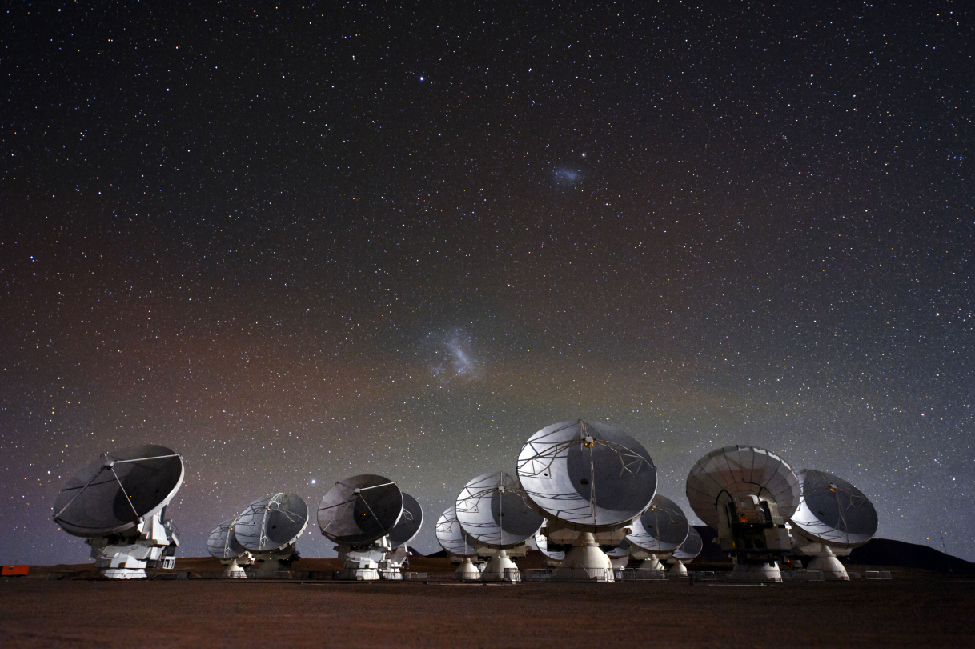
The nearest galaxy, discovered in 1993, is a small one that lies 70,000 light-years from the Sun in the direction of the constellation Sagittarius, where the smog in our own Galaxy makes it especially difficult to discern. (A constellation, we should note, is one of the 88 sections into which astronomers divide the sky, each named after a prominent star pattern within it.) Beyond this Sagittarius dwarf galaxy lie two other small galaxies, about 160,000 light-years away. First recorded by Magellan’s crew as he sailed around the world, these are called the Magellanic Clouds (Figure 1.12). All three of these small galaxies are satellites of the Milky Way Galaxy, interacting with it through the force of gravity. Ultimately, all three may even be swallowed by our much larger Galaxy, as other small galaxies have been over the course of cosmic time.
英語のヒント
1993年に発見された最も近い銀河は、太陽から70,000光年離れた、いて座の方向にある小さな銀河である。その方向には私たちの銀河のスモッグがあるため、特に見分けにくい。ここで注意しておくと、星座とは、天文学者が空を分割した88の領域の一つで、それぞれ、その中にある目立つ星の並びにちなんで名付けられている。このいて座矮小銀河のさらに向こう、約160,000光年の距離には、別の二つの小さな銀河がある。マゼランの世界周航の際、船員たちが初めて記録したこの二つは、マゼラン雲と呼ばれる(図1.12)。これら三つの小さな銀河はすべて天の川銀河の伴銀河で、重力を通じて相互作用している。宇宙の長い歴史のなかでほかの小さな銀河がそうなったように、この三つも最終的には、はるかに大きな私たちの銀河に飲み込まれるかもしれない。
Neighbor Galaxies.近隣の銀河。
credit: ESO, C. Malin · CC BY 4.0
Figure 1.12 This image shows both the Large Magellanic Cloud and the Small Magellanic Cloud above the telescopes of the Atacama Large Millimeter/Submillimeter Array (ALMA) in the Atacama Desert of northern Chile. (credit: ESO, C. Malin)
図1.12 チリ北部のアタカマ砂漠にあるアタカマ大型ミリ波サブミリ波干渉計(ALMA)の望遠鏡群の上に、大マゼラン雲と小マゼラン雲の両方が見える。(クレジット:ESO、C. Malin)
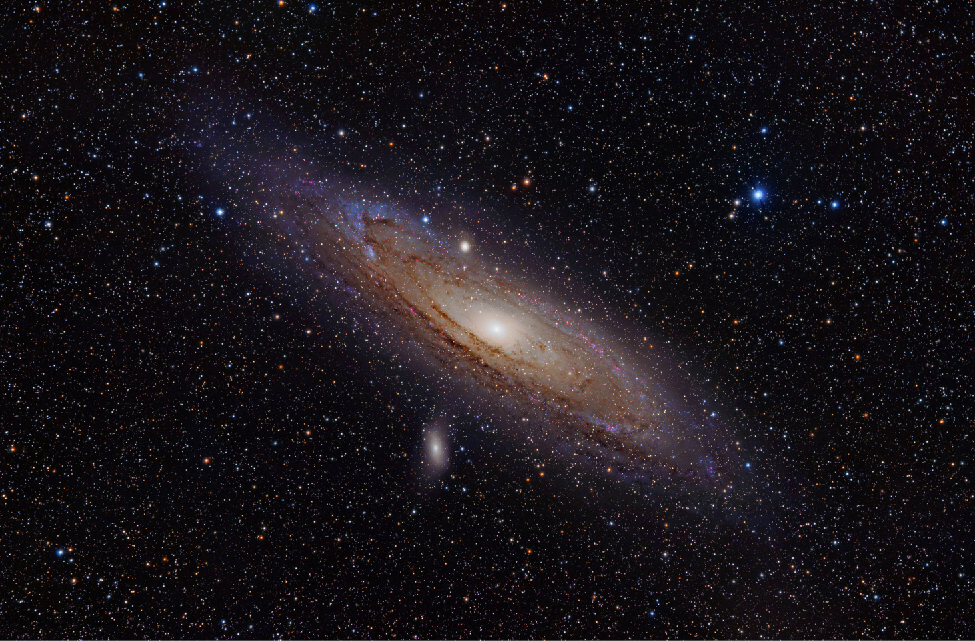
The nearest large galaxy is a spiral quite similar to our own, located in the constellation of Andromeda, and is thus called the Andromeda galaxy; it is also known by one of its catalog numbers, M31 (Figure 1.13). M31 is a little more than 2 million light-years away and, along with the Milky Way, is part of a small cluster of more than 50 galaxies referred to as the Local Group.
英語のヒント
最も近い大きな銀河は、私たちの銀河によく似た渦巻銀河で、アンドロメダ座にあることから、アンドロメダ銀河と呼ばれる。カタログ番号の一つであるM31という名前でも知られている(図1.13)。M31は200万光年余りの距離にあり、天の川銀河とともに、50個を超える銀河からなる小さな集まり、局所銀河群の一員である。
Closest Spiral Galaxy.最も近い渦巻銀河。
credit: Adam Evans · CC BY 2.0
Figure 1.13 The Andromeda galaxy (M31) is a spiral-shaped collection of stars similar to our own Milky Way. (credit: Adam Evans)
図1.13 アンドロメダ銀河(M31)は、私たちの天の川銀河に似た、渦巻状の星の集まりである。(クレジット:Adam Evans)
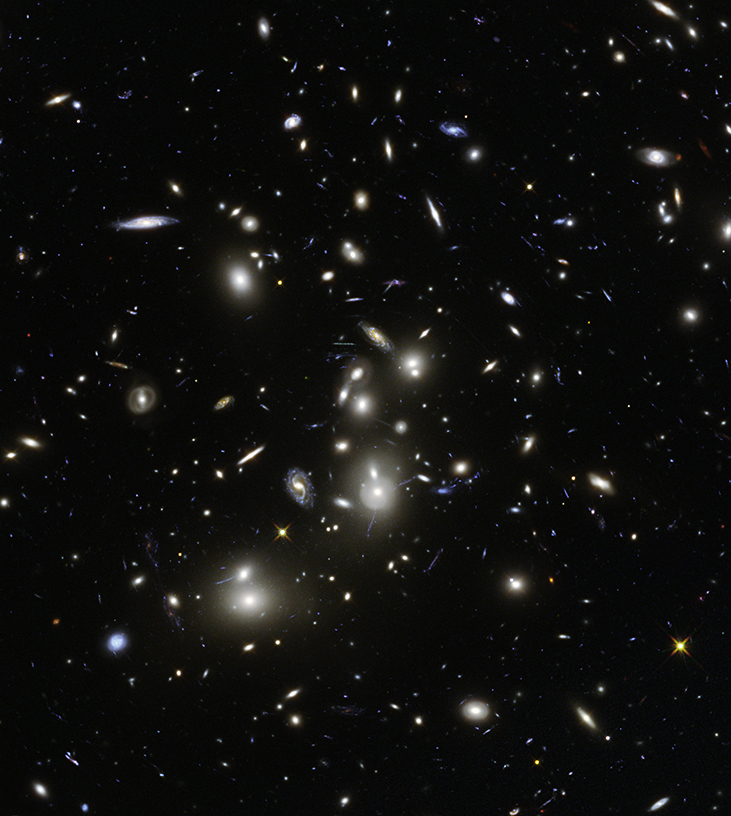
At distances of 10 to 15 million light-years, we find other small galaxy groups, and then at about 50 million light-years there are more impressive systems with thousands of member galaxies. We have discovered that galaxies occur mostly in clusters, both large and small (Figure 1.14).
英語のヒント
1000万から1500万光年の距離には、ほかの小さな銀河群がある。さらに約5000万光年まで進むと、数千個の銀河を含む、いっそう壮大な系がある。銀河は主に、大小さまざまな集団をつくって存在することがわかっている(図1.14)。
Cluster of Galaxies.銀河団。
credit: NASA, ESA, and J. Lotz, M. Mountain, A. Koekemoer, and the HFF Team (STScI) · CC BY 4.0
Figure 1.14 This image shows part of a rich cluster of galaxies some 4 billion light-years away. Nicknamed Pandora's Cluster, the grouping consists of many galaxies, each with billions of stars in them. (credit: NASA, ESA, and J. Lotz, M. Mountain, A. Koekemoer, and the HFF Team (STScI))
図1.14 約40億光年離れた、銀河の豊富な銀河団の一部を示す画像。「パンドラ銀河団」の愛称をもつこの集まりは、多くの銀河からなり、各銀河には数十億個の恒星が含まれている。(クレジット:NASA、ESA、J. Lotz、M. Mountain、A. Koekemoer、HFF Team〔STScI〕)
Some of the clusters themselves form into larger groups called superclusters. The Local Group is part of a supercluster of galaxies, called the Virgo Supercluster, which stretches over a diameter of 110 million light-years. We are just beginning to explore the structure of the universe at these enormous scales and are already encountering some unexpected findings.
英語のヒント
銀河団のなかには、それ自体が集まって、超銀河団と呼ばれるさらに大きな集団をつくるものがある。局所銀河群は、おとめ座超銀河団という銀河の集団の一部で、その直径は1億1000万光年にわたる。私たちは、このような巨大な規模での宇宙の構造を探り始めたばかりだが、すでに予想外の発見にも出会っている。
At even greater distances, where many ordinary galaxies are too dim to see, we find quasars. These are brilliant centers of galaxies, glowing with the light of an extraordinarily energetic process. The enormous energy of the quasars is produced by gas that is heated to a temperature of millions of degrees as it falls toward a massive black hole and swirls around it. The brilliance of quasars makes them the most distant beacons we can see in the dark oceans of space. They allow us to probe the universe 10 billion light-years away or more, and thus 10 billion years or more in the past.
英語のヒント
さらに遠く、多くの普通の銀河が暗すぎて見えなくなる距離には、クエーサーがある。これは、途方もなく大きなエネルギーを生む過程の光で輝く、銀河の明るい中心部である。クエーサーの膨大なエネルギーは、大質量のブラックホールへ落ち込み、そのまわりを渦巻くなかで、数百万度まで熱せられたガスから生じる。クエーサーはきわめて明るいため、宇宙の暗い海で私たちに見える、最も遠い灯台となっている。これにより、100億光年かそれ以上遠くの宇宙、つまり100億年かそれ以上の過去を調べることができる。
With quasars we can see way back close to the Big Bang explosion that marks the beginning of time. Beyond the quasars and the most distant visible galaxies, we have detected the feeble glow of the explosion itself, filling the universe and thus coming to us from all directions in space. The discovery of this “afterglow of creation” is considered to be one of the most significant events in twentieth-century science, and we are still exploring the many things it has to tell us about the earliest times of the universe.
英語のヒント
クエーサーを使うと、時間の始まりを刻むビッグバンの爆発の近くまで、はるか昔を見渡せる。クエーサーや、目に見える最も遠い銀河のさらに向こうから、爆発そのもののかすかな光も検出されている。その光は宇宙を満たし、宇宙空間のあらゆる方向から私たちに届く。この「創造の残光」の発見は、20世紀の科学で最も重要な出来事の一つとされている。この光が宇宙の最初期について教えてくれる多くのことを、私たちは今も調べ続けている。
Measurements of the properties of galaxies and quasars in remote locations require large telescopes, sophisticated light-amplifying devices, and painstaking labor. Every clear night, at observatories around the world, astronomers and students are at work on such mysteries as the birth of new stars and the large-scale structure of the universe, fitting their results into the tapestry of our understanding.
英語のヒント
遠くにある銀河やクエーサーの性質を測定するには、大型望遠鏡、精巧な光増幅装置、そして丹念な作業が必要となる。晴れた夜には毎晩、世界中の天文台で、天文学者や学生が、新しい恒星の誕生や宇宙の大規模構造といった謎に取り組んでいる。そして、その結果を、私たちの理解という大きな織物へと織り込んでいる。