第2章空を観測する――天文学の誕生Observing the Sky: The Birth of Astronomy
Thinking Aheadまず考えてみよう
Night Sky.夜空。
credit: modification of work by ESO/Y. Beletsky · CC BY 4.0
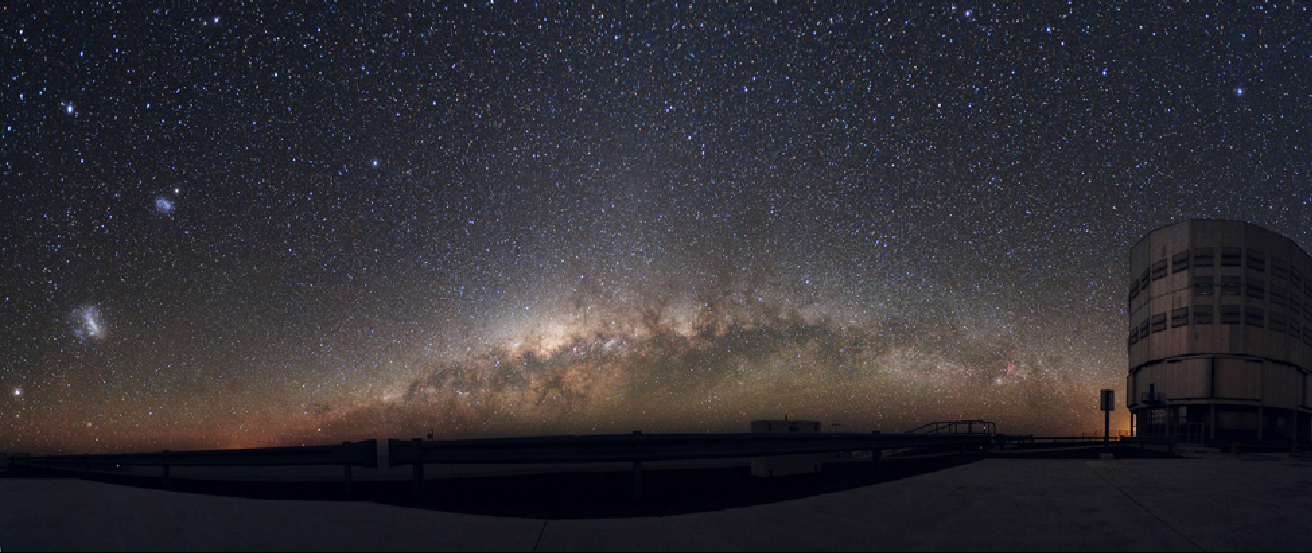
Figure 2.1 In this panoramic photograph of the night sky from the Atacama Desert in Chile, we can see the central portion of the Milky Way Galaxy arcing upward in the center of the frame. On the left, the Large Magellanic Cloud and the Small Magellanic Cloud (smaller galaxies that orbit the Milky Way Galaxy) are easily visible from the Southern Hemisphere. (credit: modification of work by ESO/Y. Beletsky)
図2.1 チリのアタカマ砂漠から夜空を撮ったこのパノラマ写真では、画像の中央で、天の川銀河の中心部が上向きの弧を描いている。左には、天の川銀河を周回する小さな銀河である大マゼラン雲と小マゼラン雲が見える。これらは南半球から見つけやすい。(クレジット:ESO/Y. Beletskyによる作品を改変)
Much to your surprise, a member of the Flat Earth Society moves in next door. He believes that Earth is flat and all the NASA images of a spherical Earth are either faked or simply show the round (but flat) disk of Earth from above. How could you prove to your new neighbor that Earth really is a sphere? (When you’ve thought about this on your own, you can check later in the chapter for some suggested answers.)
英語のヒント
驚いたことに、地球平面協会の会員が隣に引っ越してきた。その人は、地球は平らであり、NASAが示す球形の地球の画像はすべて、偽物か、丸いが平らな地球の円盤を上から写しただけだと信じている。地球が本当に球であると、この新しい隣人にどう証明できるだろうか。まず自分で考えてから、この章の後の部分で、考えられる答えを確かめてみよう。
Today, few people really spend much time looking at the night sky. In ancient days, before electric lights robbed so many people of the beauty of the sky, the stars and planets were an important aspect of everyone’s daily life. All the records that we have—on paper and in stone—show that ancient civilizations around the world noticed, worshipped, and tried to understand the lights in the sky and fit them into their own view of the world. These ancient observers found both majestic regularity and never-ending surprise in the motions of the heavens. Through their careful study of the planets, the Greeks and later the Romans laid the foundation of the science of astronomy.
英語のヒント
今日では、夜空を見るために本当に長い時間を使う人は少ない。電灯が多くの人々から空の美しさを奪う以前の古代には、恒星や惑星は誰にとっても日々の暮らしの重要な一部だった。紙に残されたものも石に刻まれたものも、私たちのもつあらゆる記録は、世界各地の古代文明が空の光に気づき、それを崇拝し、理解しようとし、自分たちの世界観のなかに位置づけようとしたことを示している。古代の観測者は天の動きのなかに、壮大な規則性と、尽きることのない驚きの両方を見いだした。ギリシャ人、そして後のローマ人は、惑星を注意深く研究することで、天文学という科学の基礎を築いた。