第2章空を観測する――天文学の誕生Observing the Sky: The Birth of Astronomy
Ptolemy’s Model of the Solar Systemプトレマイオスの太陽系モデル
The last great astronomer of the Roman era was Claudius Ptolemy (or Ptolemaeus), who flourished in Alexandria in about the year 140. He wrote a mammoth compilation of astronomical knowledge, which today is called by its Arabic name, Almagest (meaning “The Greatest”). Almagest does not deal exclusively with Ptolemy’s own work; it includes a discussion of the astronomical achievements of the past, principally those of Hipparchus. Today, it is our main source of information about the work of Hipparchus and other Greek astronomers.
英語のヒント
ローマ時代の最後の偉大な天文学者は、西暦140年ごろにアレクサンドリアで活躍したクラウディオス・プトレマイオスである。英語ではClaudius Ptolemy、またはPtolemaeusとも呼ばれる。彼は天文学の知識を集大成した大著を記した。この本は今日、「最も偉大なもの」を意味するアラビア語名『アルマゲスト』で知られている。『アルマゲスト』は、プトレマイオス自身の研究だけを扱うのではない。過去の天文学上の成果、特にヒッパルコスの業績も論じている。現在、この本は、ヒッパルコスやほかのギリシャの天文学者の仕事を知るための主要な情報源となっている。
Ptolemy’s most important contribution was a geometric representation of the solar system that predicted the positions of the planets for any desired date and time. Hipparchus, not having enough data on hand to solve the problem himself, had instead amassed observational material for posterity to use. Ptolemy supplemented this material with new observations of his own and produced a cosmological model that endured more than a thousand years, until the time of Copernicus.
英語のヒント
プトレマイオスの最も重要な貢献は、任意の日付・時刻の惑星の位置を予測できる、太陽系の幾何学的な表現だった。ヒッパルコスは、この問題を自分で解くには手元のデータが足りず、代わりに、後世の人々が使うための観測資料を蓄えていた。プトレマイオスは、その資料に自分の新しい観測を加え、コペルニクスの時代まで1000年以上続く宇宙モデルをつくりあげた。
The complicating factor in explaining the motions of the planets is that their apparent wandering in the sky results from the combination of their own motions with Earth’s orbital revolution. As we watch the planets from our vantage point on the moving Earth, it is a little like watching a car race while you are competing in it. Sometimes opponents’ cars pass you, but at other times you pass them, making them appear to move backward for a while with respect to you.
英語のヒント
惑星の運動の説明を複雑にするのは、空での見かけのさまよいが、惑星自身の運動と地球の公転を組み合わせた結果だということだ。動いている地球という位置から惑星を見るのは、自分も参加している自動車レースを眺めることに少し似ている。ときには相手の車が自分を追い越し、別のときには自分が相手を追い越す。後者の場合、相手の車は、しばらく自分に対して後ろへ動いて見える。
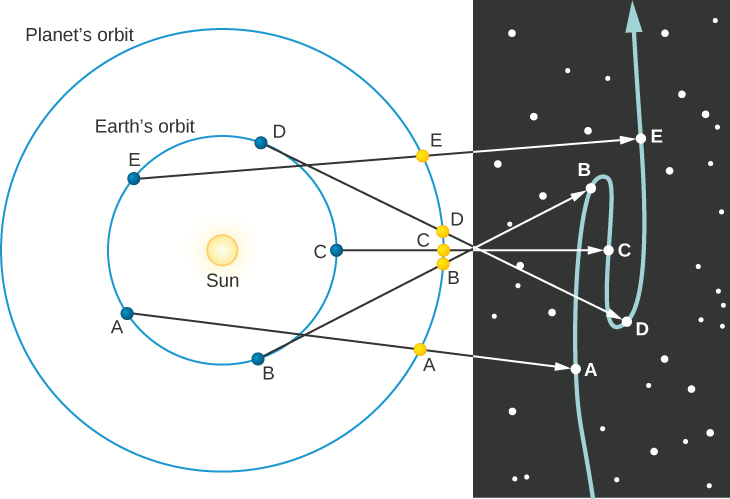
Figure 2.13 shows the motion of Earth and a planet farther from the Sun—in this case, Mars. Earth travels around the Sun in the same direction as the other planet and in nearly the same plane, but its orbital speed is faster. As a result, it overtakes the planet periodically, like a faster race car on the inside track. The figure shows where we see the planet in the sky at different times. The path of the planet among the stars is illustrated in the star field on the right side of the figure.
英語のヒント
図2.13は、地球と、それより太陽から遠い惑星、この場合は火星の運動を示している。地球はその惑星と同じ向きに、ほぼ同じ平面内で太陽を回るが、公転の速さは地球のほうが大きい。そのため、内側のコースを走る速いレーシングカーのように、地球は周期的にその惑星を追い越す。図には、異なる時刻に惑星が空のどこに見えるかが示されている。恒星の間で惑星がたどる道筋は、図の右側の星空の部分に描かれている。
Retrograde Motion of a Planet beyond Earth’s Orbit.地球の軌道の外側にある惑星の逆行。
OpenStax / Rice University · CC BY 4.0
Figure 2.13 The letters on the diagram show where Earth and Mars are at different times. By following the lines from each Earth position through each corresponding Mars position, you can see how the retrograde path of Mars looks against the background stars.
図2.13 図の文字は、異なる時刻の地球と火星の位置を示す。それぞれの地球の位置から、対応する火星の位置を通る線をたどると、背景の恒星に対して、火星の逆行の道筋がどう見えるかわかる。
Normally, planets move eastward in the sky over the weeks and months as they orbit the Sun, but from positions B to D in Figure 2.13, as Earth passes the planets in our example, it appears to drift backward, moving west in the sky. Even though it is actually moving to the east, the faster-moving Earth has overtaken it and seems, from our perspective, to be leaving it behind. As Earth rounds its orbit toward position E, the planet again takes up its apparent eastward motion in the sky. The temporary apparent westward motion of a planet as Earth swings between it and the Sun is called retrograde motion. Such backward motion is much easier for us to understand today, now that we know Earth is one of the moving planets and not the unmoving center of all creation. But Ptolemy was faced with the far more complex problem of explaining such motion while assuming a stationary Earth.
英語のヒント
ふつう惑星は、太陽を公転しながら、数週間から数か月かけて空を東へ動く。しかし図2.13のBからDの位置では、この例のように地球が惑星を追い越すと、惑星は逆向きに流れ、空を西へ動くように見える。実際には東へ動いているのに、もっと速い地球が追い越すため、私たちの視点では、惑星が後ろに取り残されるように見えるのである。地球が軌道を回ってEの位置へ向かうと、惑星は再び、空を東へ動くように見える。地球が惑星と太陽の間を回り込むときに起きる、この一時的な見かけの西向きの運動を、逆行という。地球が万物の動かない中心ではなく、動く惑星の一つだとわかっている現在、この逆向きの運動はずっと理解しやすい。しかしプトレマイオスは、地球が静止していると仮定しながら、この運動を説明するという、はるかに複雑な問題に直面した。
Furthermore, because the Greeks believed that celestial motions had to be circles, Ptolemy had to construct his model using circles alone. To do it, he needed dozens of circles, some moving around other circles, in a complex structure that makes a modern viewer dizzy. But we must not let our modern judgment cloud our admiration for Ptolemy’s achievement. In his day, a complex universe centered on Earth was perfectly reasonable and, in its own way, quite beautiful. However, as Alfonso X, the King of Castile, was reported to have said after having the Ptolemaic system of planet motions explained to him, [Quotation omitted for rights reasons.]
英語のヒント
さらにギリシャ人は、天体の運動は円でなければならないと信じていたため、プトレマイオスも、円だけでモデルを組み立てなければならなかった。そのために、別の円のまわりを動く円を含む、何十もの円が必要となり、現代の人が見れば目の回るような構造になった。しかし、現代の判断によって、プトレマイオスの業績への敬意を曇らせてはならない。当時、地球を中心とした複雑な宇宙は、完全に理にかなっており、それなりに実に美しくもあった。とはいえ、カスティーリャ王アルフォンソ10世は、プトレマイオスの惑星運動の体系の説明を受けた後、こう言ったと伝えられる。〔権利の関係で割愛〕
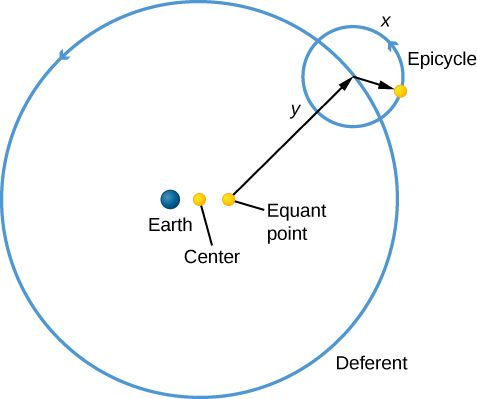
Ptolemy solved the problem of explaining the observed motions of planets by having each planet revolve in a small orbit called an epicycle. The center of the epicycle then revolved about Earth on a circle called a deferent (Figure 2.14). When the planet is at position x in Figure 2.14 on the epicycle orbit, it is moving in the same direction as the center of the epicycle; from Earth, the planet appears to be moving eastward. When the planet is at y, however, its motion is in the direction opposite to the motion of the epicycle’s center around Earth. By choosing the right combination of speeds and distances, Ptolemy succeeded in having the planet moving westward at the correct speed and for the correct interval of time, thus replicating retrograde motion with his model.
英語のヒント
プトレマイオスは、各惑星を周転円という小さな軌道で回らせることで、観測される惑星の運動を説明する問題を解いた。その周転円の中心は、導円と呼ばれる円に沿って、地球のまわりを回る(図2.14)。惑星が図2.14の周転円上のxの位置にあるとき、その動く向きは周転円の中心と同じである。地球からは、惑星は東へ進むように見える。一方、yにあるときは、惑星の動く向きは、地球のまわりを回る周転円の中心の動きとは反対になる。速さと距離を適切に組み合わせることで、プトレマイオスは、惑星が正しい速さで、正しい長さの時間だけ西へ動くようにすることに成功し、モデルで逆行を再現した。
Ptolemy’s Complicated Cosmological System.プトレマイオスの複雑な宇宙体系。
OpenStax / Rice University · CC BY 4.0
Figure 2.14 Each planet orbits around a small circle called an epicycle. Each epicycle orbits on a larger circle called the deferent. This system is not centered exactly on Earth but on an offset point called the equant. The Greeks needed all this complexity to explain the actual motions in the sky because they believed that Earth was stationary and that all sky motions had to be circular.
図2.14 各惑星は、周転円と呼ばれる小さな円のまわりを回る。各周転円は、導円というさらに大きな円に沿って回る。この体系の中心は厳密には地球上ではなく、エカントと呼ばれる、ずれた点にある。ギリシャ人は、地球が静止し、空のすべての運動が円でなければならないと信じていた。そのため、実際の天体の動きを説明するのに、これだけの複雑さが必要だった。
However, we shall see in Orbits and Gravity that the planets, like Earth, travel about the Sun in orbits that are ellipses, not circles. Their actual behavior cannot be represented accurately by a scheme of uniform circular motions. In order to match the observed motions of the planets, Ptolemy had to center the deferent circles, not on Earth, but at points some distance from Earth. In addition, he introduced uniform circular motion around yet another axis, called the equant point. All of these considerably complicated his scheme.
英語のヒント
しかし「軌道と重力」で見るように、惑星は地球と同じく、円ではなく楕円の軌道に沿って太陽のまわりを動く。その実際の振る舞いを、等速円運動の仕組みだけで正確に表すことはできない。観測される惑星の運動と一致させるため、プトレマイオスは、導円の中心を地球ではなく、そこからいくらか離れた点に置かなければならなかった。さらに、エカント点と呼ばれる別の軸のまわりの等速円運動も取り入れた。これらすべてが、彼の体系を大幅に複雑にした。
It is a tribute to the genius of Ptolemy as a mathematician that he was able to develop such a complex system to account successfully for the observations of planets. It may be that Ptolemy did not intend for his cosmological model to describe reality, but merely to serve as a mathematical representation that allowed him to predict the positions of the planets at any time. Whatever his thinking, his model, with some modifications, was eventually accepted as authoritative in the Muslim world and (later) in Christian Europe.
英語のヒント
このように複雑な体系をつくり、惑星の観測をうまく説明できたことは、数学者としてのプトレマイオスの天才性を物語る。彼は、自分の宇宙モデルが現実を描写することを意図したのではなく、単に、いつでも惑星の位置を予測できる数学的な表現として役立てようとしただけなのかもしれない。彼が何を考えていたにせよ、そのモデルは、いくつかの修正を経て、やがてイスラム世界で、そして後にはキリスト教ヨーロッパでも、権威あるものとして受け入れられた。
Ancient Greeks such as Aristotle recognized that Earth and the Moon are spheres, and understood the phases of the Moon, but because of their inability to detect stellar parallax, they rejected the idea that Earth moves. Eratosthenes measured the size of Earth with surprising precision. Hipparchus carried out many astronomical observations, making a star catalog, defining the system of stellar magnitudes, and discovering precession from the apparent shift in the position of the north celestial pole. Ptolemy of Alexandria summarized classic astronomy in his Almagest; he explained planetary motions, including retrograde motion, with remarkably good accuracy using a model centered on Earth. This geocentric model, based on combinations of uniform circular motion using epicycles, was accepted as authority for more than a thousand years.
アリストテレスなどの古代ギリシャ人は、地球と月が球であることを認識し、月の満ち欠けを理解していた。しかし、恒星の視差を検出できなかったため、地球が動くという考えは退けた。エラトステネスは、驚くべき精度で地球の大きさを測った。ヒッパルコスは数多くの天文観測を行い、星表をつくり、恒星の等級の体系を定め、天の北極の位置の見かけのずれから歳差を発見した。アレクサンドリアのプトレマイオスは、『アルマゲスト』に古典天文学をまとめ、地球を中心とするモデルで、逆行を含む惑星の運動を非常によい精度で説明した。周転円を用いて等速円運動を組み合わせるこの地球中心のモデルは、1000年以上にわたって、権威あるものとして受け入れられた。
apparent magnitude
見かけの等級
a measure of how bright a star looks in the sky; the larger the number, the dimmer the star appears to us
空で恒星がどれほど明るく見えるかを表す尺度。数値が大きいほど、星は私たちに暗く見える。
cosmology
宇宙論
the study of the organization and evolution of the universe
宇宙の構造と進化を研究する学問。
epicycle
周転円
the circular orbit of a body in the Ptolemaic system, the center of which revolves about another circle (the deferent)
プトレマイオス体系で天体が回る円軌道。その中心は、別の円である導円に沿って回転する。
parallax
視差
the apparent displacement of a nearby star that results from the motion of Earth around the Sun
地球が太陽のまわりを動くことによって起こる、近くの恒星の見かけの位置のずれ。
precession (of Earth)
歳差(地球の)
the slow, conical motion of Earth’s axis of rotation caused principally by the gravitational pull of the Moon and Sun on Earth’s equatorial bulge
地球の自転軸が円すいを描くようにゆっくり動くこと。主に、地球の赤道の膨らみを月と太陽の重力が引くことで生じる。
retrograde motion
逆行
the apparent westward motion of a planet on the celestial sphere or with respect to the stars
天球上、または恒星を基準にした、惑星の見かけの西向きの運動。