第2章空を観測する――天文学の誕生Observing the Sky: The Birth of Astronomy
Celestial Poles and Celestial Equator天の極と天の赤道
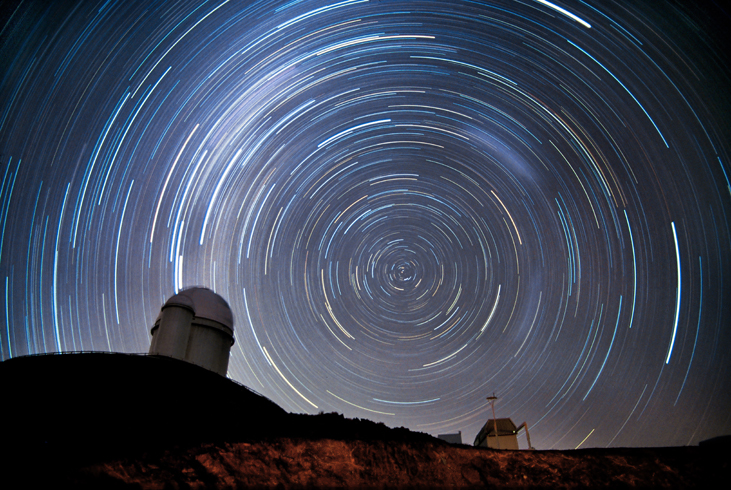
To help orient us in the turning sky, astronomers use a system that extends Earth’s axis points into the sky. Imagine a line going through Earth, connecting the North and South Poles. This is Earth’s axis, and Earth rotates about this line. If we extend this imaginary line outward from Earth, the points where this line intersects the celestial sphere are called the north celestial pole and the south celestial pole. As Earth rotates about its axis, the sky appears to turn in the opposite direction around those celestial poles (Figure 2.4). We also (in our imagination) throw Earth’s equator onto the sky and call this the celestial equator. It lies halfway between the celestial poles, just as Earth’s equator lies halfway between our planet’s poles.
英語のヒント
回る空のなかで方向をつかみやすくするため、天文学者は、地球の軸の両端を空へ延ばす仕組みを使う。地球を貫き、北極と南極を結ぶ線を想像してほしい。これが地球の自転軸で、地球はこの線のまわりを回る。この想像上の線を地球の外へ延ばしたとき、天球と交わる点を、天の北極と天の南極という。地球が軸のまわりを回ると、空は天の極のまわりを反対向きに回るように見える(図2.4)。また、想像のなかで地球の赤道を空へ投影し、これを天の赤道と呼ぶ。地球の赤道が南北の極の中間にあるのと同じように、天の赤道も天の両極の中間に位置する。
Circling the South Celestial Pole.天の南極をめぐる星々。
Credit: ESO/Iztok Bončina · CC BY 4.0
Figure 2.4 This long-exposure photo shows trails left by stars as a result of the apparent rotation of the celestial sphere around the south celestial pole. (In reality, it is Earth that rotates.) (Credit: ESO/Iztok Bončina)
図2.4 この長時間露光の写真には、天の南極のまわりを天球が回転するように見えることで、星が残した光跡が写っている。実際に回転しているのは地球である。(クレジット:ESO/Iztok Bončina)
Now let’s imagine how riding on different parts of our spinning Earth affects our view of the sky. The apparent motion of the celestial sphere depends on your latitude (position north or south of the equator). First of all, notice that Earth’s axis is pointing at the celestial poles, so these two points in the sky do not appear to turn.
英語のヒント
回転する地球のどこに乗っているかによって、空の見え方がどう変わるかを考えてみよう。天球の見かけの動きは、観測者の緯度、つまり赤道からどれだけ北または南にいるかによって決まる。まず、地球の軸が天の極を指しているため、空のこの二つの点は回転して見えないことに注目しよう。
If you stood at the North Pole of Earth, for example, you would see the north celestial pole overhead, at your zenith (Figure 2.5). The celestial equator, 90° from the celestial poles, would lie along your horizon. As you watched the stars during the course of the night, they would all circle around the celestial pole, with none rising or setting. Only that half of the sky north of the celestial equator is ever visible to an observer at the North Pole. Similarly, an observer at the South Pole would see only the southern half of the sky.
英語のヒント
たとえば地球の北極に立てば、天の北極は頭上の天頂に見えるだろう(図2.5)。天の両極から90度離れた天の赤道は、地平線に沿って位置する。一晩を通して星を眺めると、すべての星が天の極のまわりを回り、昇る星も沈む星もない。北極にいる観測者に見えるのは、いつでも天の赤道より北側の半分の空だけである。同じように、南極の観測者には南側半分の空しか見えない。
If you were at Earth’s equator, on the other hand, you see the celestial equator (which, after all, is just an “extension” of Earth’s equator) pass overhead through your zenith. The celestial poles, being 90° from the celestial equator, must then be at the north and south points on your horizon. As the sky turns, all stars rise and set; they move straight up from the east side of the horizon and set straight down on the west side. During a 24-hour period, all stars are above the horizon exactly half the time. (Of course, during some of those hours, the Sun is too bright for us to see them.)
英語のヒント
一方、地球の赤道にいれば、結局は地球の赤道を「延長」したものにすぎない天の赤道が、頭上の天頂を通るのが見える。天の両極は天の赤道から90度離れているため、地平線の真北と真南に来るはずである。空が回るにつれて、すべての星が昇って沈む。星は東の地平線からまっすぐ上へ昇り、西の地平線へまっすぐ下に沈む。24時間のうち、すべての星がちょうど半分の時間、地平線の上にある。もちろん、その時間の一部は、太陽が明るすぎるため星を見ることはできない。
What would an observer in the latitudes of the United States or Europe see? Remember, we are neither at Earth’s pole nor at the equator, but in between them. For those in the continental United States and Europe, the north celestial pole is neither overhead nor on the horizon, but in between. It appears above the northern horizon at an angular height, or altitude, equal to the observer’s latitude. In San Francisco, for example, where the latitude is 38° N, the north celestial pole is 38° above the northern horizon.
英語のヒント
アメリカ合衆国やヨーロッパの緯度にいる観測者には、何が見えるだろうか。そこは地球の極でも赤道でもなく、その中間だということを思い出そう。アメリカ本土やヨーロッパにいる人にとって、天の北極は頭の真上でも地平線上でもなく、その間にある。それは北の地平線の上に、観測者の緯度と等しい角度の高さ、すなわち高度に見える。たとえば北緯38度のサンフランシスコでは、天の北極は北の地平線から38度上にある。
For an observer at 38° N latitude, the south celestial pole is 38° below the southern horizon and, thus, never visible. As Earth turns, the whole sky seems to pivot about the north celestial pole. For this observer, stars within 38° of the North Pole can never set. They are always above the horizon, day and night. This part of the sky is called the north circumpolar zone. For observers in the continental United States, the Big Dipper, Little Dipper, and Cassiopeia are examples of star groups in the north circumpolar zone. On the other hand, stars within 38° of the south celestial pole never rise. That part of the sky is the south circumpolar zone. To most U.S. observers, the Southern Cross is in that zone. (Don’t worry if you are not familiar with the star groups just mentioned; we will introduce them more formally later on.)
英語のヒント
北緯38度の観測者にとって、天の南極は南の地平線より38度下にあり、決して見えない。地球が回転すると、空全体が天の北極を中心に回るように見える。この観測者から見ると、天の北極から38度以内にある星は沈むことがなく、昼も夜も常に地平線の上にある。この空の部分を、北の周極域という。アメリカ本土の観測者にとって、北斗七星、小北斗七星、カシオペヤ座は、北の周極域にある星の集まりの例である。逆に、天の南極から38度以内の星は、決して昇らない。その部分は南の周極域である。アメリカの大部分の観測者にとって、南十字はこの領域にある。今挙げた星の集まりになじみがなくても心配はいらない。後であらためて紹介する。
At this particular time in Earth’s history, there happens to be a star very close to the north celestial pole. It is called Polaris, the pole star, and has the distinction of being the star that moves the least amount as the northern sky turns each day. Because it moved so little while the other stars moved much more, it played a special role in the mythology of several Native American tribes, for example (some called it the “fastener of the sky”).
英語のヒント
地球の歴史のなかのこの時代には、たまたま天の北極のすぐ近くに星がある。ポラリス、すなわち北極星と呼ばれる星で、北の空が毎日回るとき、動く量が最も小さい星という特徴をもつ。ほかの星がずっと大きく動くのに、この星はほとんど動かないため、たとえばアメリカ先住民のいくつかの部族では、神話のなかで特別な役割を果たした。「空を留めるもの」と呼ぶ人々もいた。