第2章空を観測する――天文学の誕生Observing the Sky: The Birth of Astronomy
2.1 The Sky Above2.1 頭上の空
Learning Objectives学習の目標
By the end of this section, you will be able to:
この節を学び終えると、次のことができるようになる。
Define the main features of the celestial sphere
天球の主な特徴を定義する。
Explain the system astronomers use to describe the sky
天文学者が空を記述するために使う仕組みを説明する。
Describe how motions of the stars appear to us on Earth
地球上の私たちに、恒星の動きがどのように見えるかを説明する。
Describe how motions of the Sun, Moon, and planets appear to us on Earth
地球上の私たちに、太陽・月・惑星の動きがどのように見えるかを説明する。
Understand the modern meaning of the term constellation
星座という語の現代的な意味を理解する。
Our senses suggest to us that Earth is the center of the universe—the hub around which the heavens turn. This geocentric (Earth-centered) view was what almost everyone believed until the European Renaissance. After all, it is simple, logical, and seemingly self-evident. Furthermore, the geocentric perspective reinforced those philosophical and religious systems that taught the unique role of human beings as the central focus of the cosmos. However, the geocentric view happens to be wrong. One of the great themes of our intellectual history is the overthrow of the geocentric perspective. Let us, therefore, take a look at the steps by which we reevaluated the place of our world in the cosmic order.
英語のヒント
私たちの感覚は、地球が宇宙の中心、すなわち天がそのまわりを回る中心点であるかのように伝えてくる。この地球中心の宇宙観、地球中心説は、ヨーロッパのルネサンスまで、ほとんどすべての人が信じていたものだった。何しろ単純で、筋が通り、一見して自明に思える。さらに、地球中心の見方は、人間が宇宙の中心として特別な役割を担うと教える哲学や宗教の体系を補強した。しかし、実際には地球中心説は間違っている。私たちの知の歴史を貫く大きな主題の一つが、この地球中心の見方を覆すことである。そこで、宇宙の秩序のなかで地球が占める位置を、私たちがどのような段階を経て見直してきたのかを見てみよう。
The Celestial Sphere天球
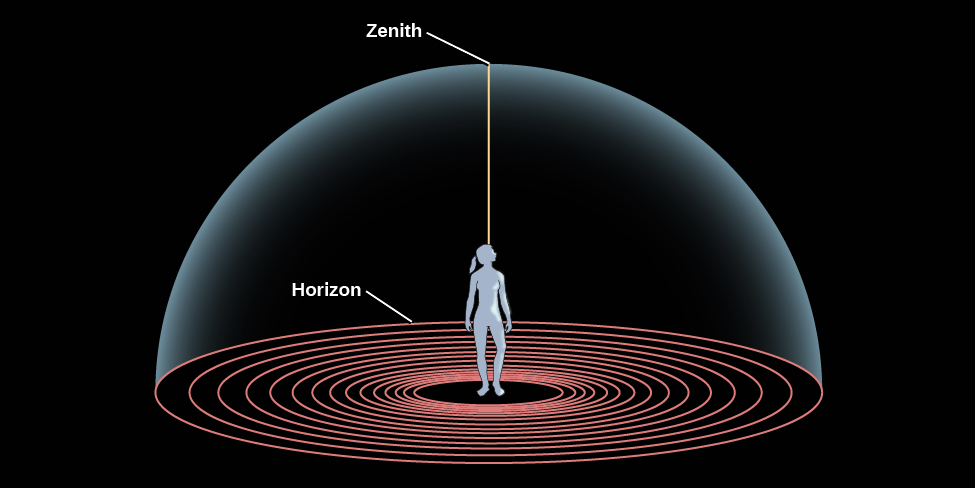
If you go on a camping trip or live far from city lights, your view of the sky on a clear night is pretty much identical to that seen by people all over the world before the invention of the telescope. Gazing up, you get the impression that the sky is a great hollow dome with you at the center (Figure 2.2), and all the stars are an equal distance from you on the surface of the dome. The top of that dome, the point directly above your head, is called the zenith, and where the dome meets Earth is called the horizon. From the sea or a flat prairie, it is easy to see the horizon as a circle around you, but from most places where people live today, the horizon is at least partially hidden by mountains, trees, buildings, or smog.
英語のヒント
キャンプに出かけたり、街の明かりから遠く離れた場所で暮らしたりすると、晴れた夜に見る空は、望遠鏡が発明される前に世界中の人々が見ていたものと、ほとんど変わらない。見上げると、空は自分を中心にした巨大な中空のドームで、すべての星がドームの表面にあり、自分から等しい距離にあるように感じられる(図2.2)。そのドームの頂上、つまり頭の真上の点を天頂といい、ドームが地球と接するところを地平線という。海や平らな草原からなら、地平線が自分のまわりの円としてよく見える。しかし、今日人々が暮らす場所の大部分では、地平線は少なくとも一部が、山や木、建物、スモッグに隠されている。
The Sky around Us.私たちを取り囲む空。
OpenStax / Rice University · CC BY 4.0
Figure 2.2 The horizon is where the sky meets the ground; an observer’s zenith is the point directly overhead.
図2.2 地平線は空と地面が接するところであり、観測者の天頂は頭の真上の点である。
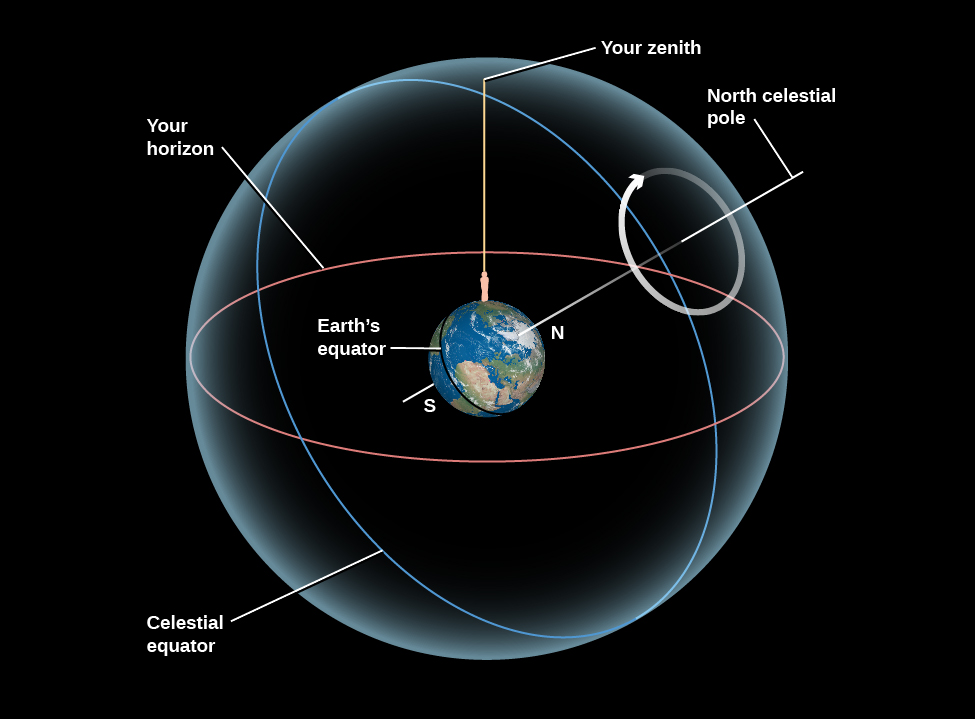
If you lie back in an open field and observe the night sky for hours, as ancient shepherds and travelers regularly did, you will see stars rising on the eastern horizon (just as the Sun and Moon do), moving across the dome of the sky in the course of the night, and setting on the western horizon. Watching the sky turn like this night after night, you might eventually get the idea that the dome of the sky is really part of a great sphere that is turning around you, bringing different stars into view as it turns. The early Greeks regarded the sky as just such a celestial sphere (Figure 2.3). Some thought of it as an actual sphere of transparent crystalline material, with the stars embedded in it like tiny jewels.
英語のヒント
古代の羊飼いや旅人がよくしていたように、開けた野原に仰向けになり、何時間も夜空を観察すると、恒星が太陽や月と同じように東の地平線から昇り、一晩かけて空のドームを横切り、西の地平線へ沈んでいくのが見える。毎晩このように空が回るのを見ていると、空のドームは、実は自分のまわりを回る大きな球の一部で、回転するにつれて別の星々が視界に現れるのだ、と思いつくかもしれない。初期のギリシャ人は、空をまさにそのような天球と考えていた(図2.3)。なかには、透明な結晶質の物質でできた実体のある球に、小さな宝石のように星が埋め込まれていると考える人もいた。
Circles on the Celestial Sphere.天球上の円。
OpenStax / Rice University · CC BY 4.0
Figure 2.3 Here we show the (imaginary) celestial sphere around Earth, on which objects are fixed, and which rotates around Earth on an axis. In reality, it is Earth that turns around this axis, creating the illusion that the sky revolves around us. Note that Earth in this picture has been tilted so that your location is at the top and the North Pole is where the N is. The apparent motion of celestial objects in the sky around the pole is shown by the circular arrow.
図2.3 地球を取り囲む、想像上の天球を示している。天体はその上に固定され、天球が軸のまわりに地球を取り囲んで回転する。実際にこの軸のまわりを回っているのは地球であり、そのため空が私たちのまわりを回るように見える。この図では、観測者の位置が一番上、北極がNの位置になるように、地球を傾けていることに注意しよう。極のまわりを回る天体の見かけの動きは、円形の矢印で示してある。
Today, we know that it is not the celestial sphere that turns as night and day proceed, but rather the planet on which we live. We can put an imaginary stick through Earth’s North and South Poles, representing our planet’s axis. It is because Earth turns on this axis every 24 hours that we see the Sun, Moon, and stars rise and set with clockwork regularity. Today, we know that these celestial objects are not really on a dome, but at greatly varying distances from us in space. Nevertheless, it is sometimes still convenient to talk about the celestial dome or sphere to help us keep track of objects in the sky. There is even a special theater, called a planetarium, in which we project a simulation of the stars and planets onto a white dome.
英語のヒント
今日では、昼と夜が移り変わるにつれて回っているのは天球ではなく、私たちの住む惑星であるとわかっている。地球の北極と南極を貫く想像上の棒を置けば、この惑星の自転軸を表せる。太陽・月・恒星が、時計のように正確に昇っては沈むのが見えるのは、地球がこの軸のまわりを24時間ごとに回転するからである。また、これらの天体が実際にドームの上にあるのではなく、宇宙空間の、それぞれ大きく異なる距離にあることもわかっている。それでも、空の天体の位置を追うには、天のドームや天球という言い方が便利なことがある。白いドームに恒星や惑星の姿を再現して投影する、プラネタリウムという専用の劇場まである。
As the celestial sphere rotates, the objects on it maintain their positions with respect to one another. A grouping of stars such as the Big Dipper has the same shape during the course of the night, although it turns with the sky. During a single night, even objects we know to have significant motions of their own, such as the nearby planets, seem fixed relative to the stars. Only meteors—brief “shooting stars” that flash into view for just a few seconds—move appreciably with respect to other objects on the celestial sphere. (This is because they are not stars at all. Rather, they are small pieces of cosmic dust, burning up as they hit Earth’s atmosphere.) We can use the fact that the entire celestial sphere seems to turn together to help us set up systems for keeping track of what things are visible in the sky and where they happen to be at a given time.
英語のヒント
天球が回転しても、その上の天体同士の位置関係は保たれる。北斗七星のような星の並びは、空とともに回転するものの、一晩を通して同じ形をしている。一晩という時間では、近くの惑星のように、それ自体がかなり動くとわかっている天体でさえ、恒星に対しては固定されているように見える。天球上のほかの天体に対して、はっきりとわかるほど動くのは、ほんの数秒だけ視界に閃く、短い「流れ星」、すなわち流星だけである。それは、流星がそもそも恒星ではないからだ。流星の正体は、地球の大気に突入して燃え尽きる、小さな宇宙の塵である。天球全体が一緒に回るように見えるという事実を使えば、その時々に空のどこで何が見えるかを追跡する仕組みをつくることができる。