第2章空を観測する――天文学の誕生Observing the Sky: The Birth of Astronomy
Rising and Setting of the Sun太陽が昇り、沈むこと
We described the movement of stars in the night sky, but what about during the daytime? The stars continue to circle during the day, but the brilliance of the Sun makes them difficult to see. (The Moon can often be seen in the daylight, however.) On any given day, we can think of the Sun as being located at some position on the hypothetical celestial sphere. When the Sun rises—that is, when the rotation of Earth carries the Sun above the horizon—sunlight is scattered by the molecules of our atmosphere, filling our sky with light and hiding the stars above the horizon.
英語のヒント
夜空の星の動きを説明してきたが、昼間はどうだろうか。星は昼間も回り続けているが、太陽の明るさのために見えにくい。もっとも、月は昼間にもよく見える。ある一日を考えれば、太陽は想像上の天球のどこかの位置にあるとみなせる。太陽が昇るとき、つまり地球の自転によって太陽が地平線の上に運ばれるように見えるとき、大気の分子が太陽の光を散乱させる。その光が空を満たし、地平線の上にある星を隠す。
For thousands of years, astronomers have been aware that the Sun does more than just rise and set. It changes position gradually on the celestial sphere, moving each day about 1° to the east relative to the stars. Very reasonably, the ancients thought this meant the Sun was slowly moving around Earth, taking a period of time we call 1 year to make a full circle. Today, of course, we know it is Earth that is going around the Sun, but the effect is the same: the Sun’s position in our sky changes day to day. We have a similar experience when we walk around a campfire at night; we see the flames appear in front of each person seated about the fire in turn.
英語のヒント
何千年もの間、天文学者は、太陽がただ昇って沈むだけではないことに気づいていた。太陽は天球上の位置をしだいに変え、恒星に対して毎日約1度ずつ東へ動く。古代の人々が、太陽は地球のまわりをゆっくり回り、1年と呼ぶ時間をかけて一周するのだと考えたのは、もっともなことだった。もちろん現在では、太陽のまわりを回るのは地球だとわかっているが、その結果は同じである。私たちの空での太陽の位置が、日ごとに変わるのだ。夜、たき火のまわりを歩くときにも、同じような経験をする。火のまわりに座る人々の前に、炎が順番に重なって見えるのである。
The path the Sun appears to take around the celestial sphere each year is called the ecliptic (Figure 2.6). Because of its motion on the ecliptic, the Sun rises about 4 minutes later each day with respect to the stars. Earth must make just a bit more than one complete rotation (with respect to the stars) to bring the Sun up again.
英語のヒント
太陽が毎年、天球を一周するように見える道筋を、黄道という(図2.6)。黄道上を動くため、太陽は恒星に比べて、毎日およそ4分ずつ遅れて昇る。太陽が再び昇るまでに、地球は恒星を基準にして、ちょうど一回転より少し多く回らなければならない。
Star Circles at Different Latitudes.緯度によって異なる星の円運動。
OpenStax / Rice University · CC BY 4.0
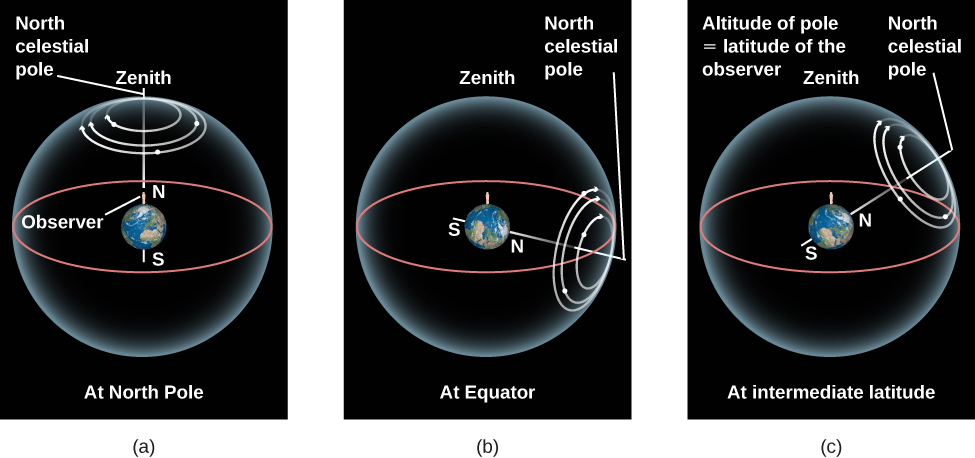
Figure 2.5 The turning of the sky looks different depending on your latitude on Earth. The red circle in each case is your horizon. Your zenith is the point above your head. (a) At the North Pole, the stars circle the zenith and do not rise and set. (b) At the equator, the celestial poles are on the horizon, and the stars rise straight up and set straight down. (c) At intermediate latitudes, the north celestial pole is at some position between overhead and the horizon. Its angle above the horizon turns out to be equal to the observer’s latitude. Stars rise and set at an angle to the horizon.
図2.5 空の回転の見え方は、地球上の緯度によって異なる。どの場合も、赤い円は観測者の地平線で、天頂は頭の真上の点である。(a)北極では、星は天頂のまわりを回り、昇ったり沈んだりしない。(b)赤道では、天の両極が地平線上にあり、星はまっすぐ上に昇り、まっすぐ下へ沈む。(c)その中間の緯度では、天の北極は頭上と地平線の間のどこかにある。地平線からの角度は、観測者の緯度と等しい。星は地平線に対して斜めに昇り、沈む。
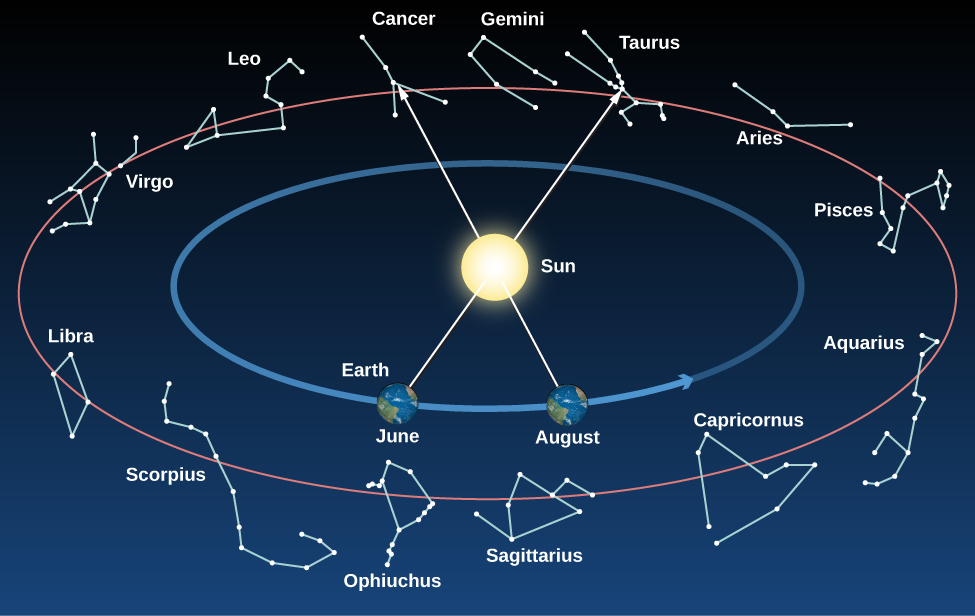
As the months go by and we look at the Sun from different places in our orbit, we see it projected against different places in the sky, and thus against different stars in the background (Figure 2.6 and Table 2.1)—or we would, at least, if we could see the stars in the daytime. In practice, we must deduce which stars lie behind and beyond the Sun by observing the stars visible in the opposite direction at night. After a year, when Earth has completed one trip around the Sun, the Sun will appear to have completed one circuit of the sky along the ecliptic.
英語のヒント
月日がたち、公転軌道上の異なる位置から太陽を見ると、太陽は空の異なる場所に投影されて見え、そのため、背景の異なる恒星に重なって見える(図2.6、表2.1)。少なくとも、もし昼間に恒星が見えれば、そう見えるはずである。実際には、夜に反対の方向で見える恒星を観測し、太陽の背後のさらに向こうにはどの星があるかを推論しなければならない。1年がたち、地球が太陽を一周し終えると、太陽も黄道に沿って空を一周し終えたように見える。
Constellations on the Ecliptic.黄道上の星座。
OpenStax / Rice University · CC BY 4.0
Figure 2.6 As Earth revolves around the Sun, we sit on “platform Earth” and see the Sun moving around the sky. The circle in the sky that the Sun appears to make around us in the course of a year is called the ecliptic. This circle (like all circles in the sky) goes through a set of constellations. The ancients thought these constellations, which the Sun (and the Moon and planets) visited, must be special and incorporated them into their system of astrology. Note that at any given time of the year, some of the constellations crossed by the ecliptic are visible in the night sky; others are in the day sky and are thus hidden by the brilliance of the Sun. (The term constellation will be defined more precisely in the next subsection.)
図2.6 地球が太陽のまわりを公転する間、私たちは「地球という台」に座って、太陽が空を動くのを見る。太陽が一年の間に私たちのまわりに描くように見える空の円を、黄道という。この円は、空に描くほかのすべての円と同じように、いくつもの星座を通り抜ける。古代の人々は、太陽、そして月や惑星が訪れるこれらの星座は特別なものに違いないと考え、占星術の体系に取り入れた。一年のどの時点でも、黄道が横切る星座の一部は夜空に見え、残りは昼の空にあるため、太陽の明るさに隠されていることに注意しよう。星座という語は、次の小節でさらに正確に定義する。
Constellations on the Ecliptic 黄道上の星座 |
|
|---|---|
Constellation on the Ecliptic 黄道上の星座 |
Dates When the Sun Crosses It 太陽が通過する日付 |
Capricornus やぎ座 |
January 21–February 16 1月21日〜2月16日 |
Aquarius みずがめ座 |
February 16–March 11 2月16日〜3月11日 |
Pisces うお座 |
March 11–April 18 3月11日〜4月18日 |
Aries おひつじ座 |
April 18–May 13 4月18日〜5月13日 |
Taurus おうし座 |
May 13–June 22 5月13日〜6月22日 |
Gemini ふたご座 |
June 22–July 21 6月22日〜7月21日 |
Cancer かに座 |
July 21–August 10 7月21日〜8月10日 |
Leo しし座 |
August 10–September 16 8月10日〜9月16日 |
Virgo おとめ座 |
September 16–October 31 9月16日〜10月31日 |
Libra てんびん座 |
October 31–November 23 10月31日〜11月23日 |
Scorpius さそり座 |
November 23–November 29 11月23日〜11月29日 |
Ophiuchus へびつかい座 |
November 29–December 18 11月29日〜12月18日 |
Sagittarius いて座 |
December 18–January 21 12月18日〜1月21日 |
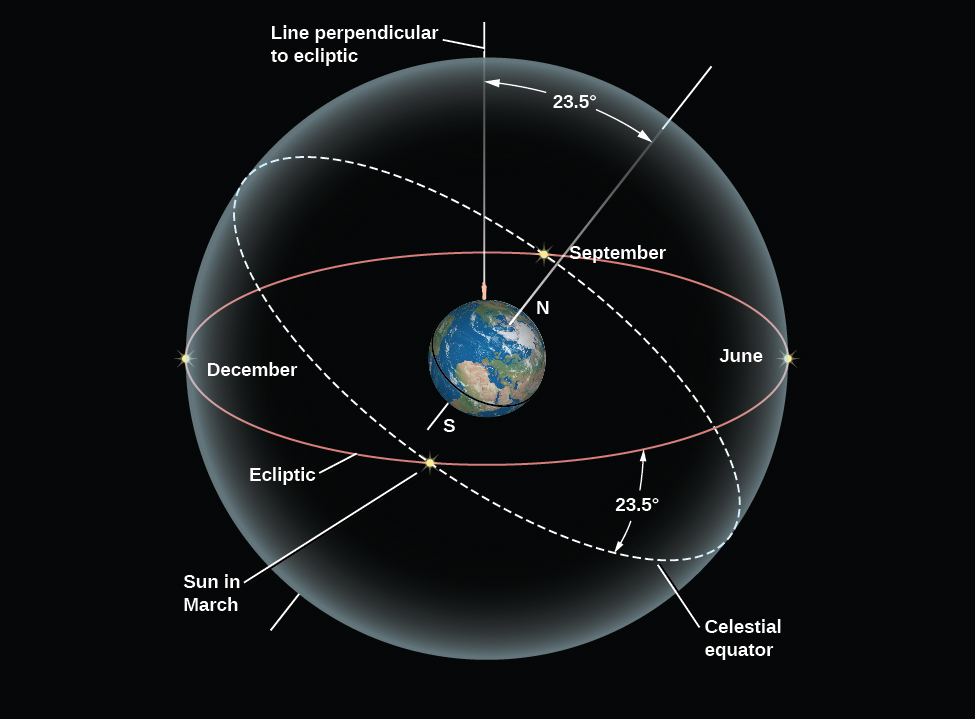
The ecliptic does not lie along the celestial equator but is inclined to it at an angle of about 23.5°. In other words, the Sun’s annual path in the sky is not linked with Earth’s equator. This is because our planet’s axis of rotation is tilted by about 23.5° from a vertical line sticking out of the plane of the ecliptic (Figure 2.7). Being tilted from “straight up” is not at all unusual among celestial bodies; Uranus and Pluto are actually tilted so much that they orbit the Sun “on their side.”
英語のヒント
黄道は天の赤道に沿っているのではなく、それに対して約23.5度傾いている。言い換えると、太陽が一年かけて空を進む道筋は、地球の赤道とは一致しない。これは、地球の自転軸が、黄道面から垂直に立てた線に対して約23.5度傾いているためである(図2.7)。天体の軸が「まっすぐ上」から傾いていることは、まったく珍しくない。天王星と冥王星は実際、それほど大きく傾いており、「横倒し」の状態で太陽のまわりを公転している。
The Celestial Tilt.天球の傾き。
OpenStax / Rice University · CC BY 4.0
Figure 2.7 The celestial equator is tilted by 23.5° to the ecliptic. As a result, North Americans and Europeans see the Sun north of the celestial equator and high in our sky in June, and south of the celestial equator and low in the sky in December.
図2.7 天の赤道は黄道に対して23.5度傾いている。そのため、北アメリカやヨーロッパでは、6月の太陽は天の赤道より北側の、空の高いところに見え、12月には天の赤道より南側の、低いところに見える。
The inclination of the ecliptic is the reason the Sun moves north and south in the sky as the seasons change. In Earth, Moon, and Sky, we discuss the progression of the seasons in more detail.
英語のヒント
季節の移り変わりとともに太陽が空を南北に動くのは、黄道が傾いているためである。「地球・月・空」の章では、季節の進み方をさらに詳しく説明する。