第4章地球・月・空Earth, Moon, and Sky
Thinking Aheadこの章を読む前に
Southern Summer.南半球の夏。
credit: modification of work by NASA · NASA media use guidelines
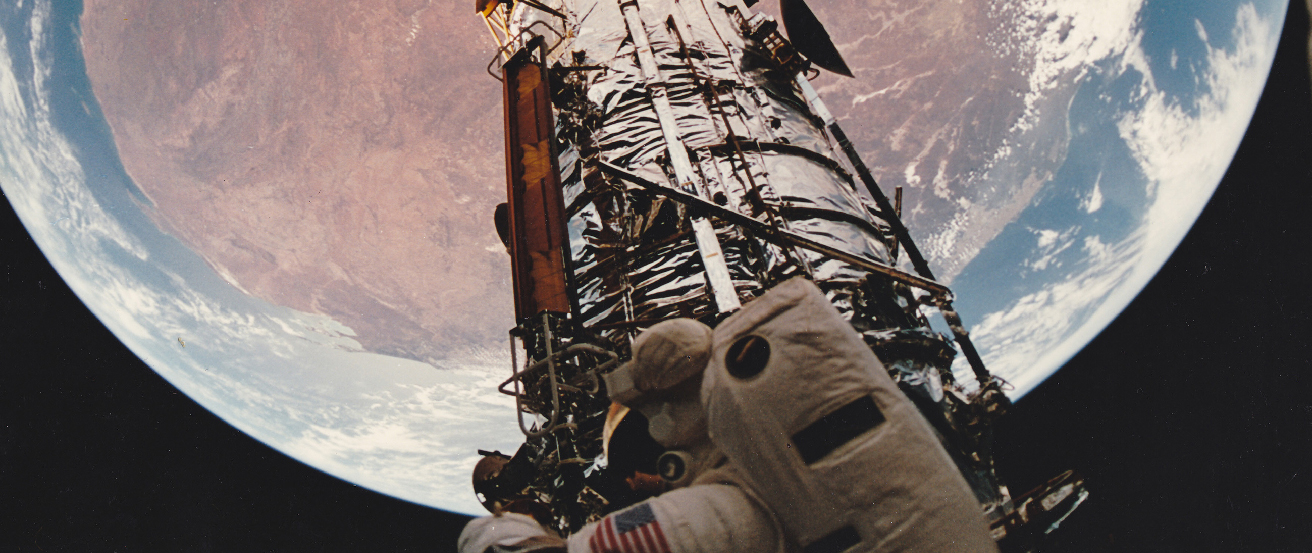
Figure 4.1 As captured with a fish-eye lens aboard the Atlantis Space Shuttle on December 9, 1993, Earth hangs above the Hubble Space Telescope as it is repaired. The reddish continent is Australia, its size and shape distorted by the special lens. Because the seasons in the Southern Hemisphere are opposite those in the Northern Hemisphere, it is summer in Australia on this December day. (credit: modification of work by NASA)
図4.1 1993年12月9日、スペースシャトル・アトランティスの船上から魚眼レンズで撮影。修理中のハッブル宇宙望遠鏡の上方に地球が浮かぶ。赤みがかった大陸はオーストラリアで、特殊なレンズのため大きさと形がゆがんでいる。南半球と北半球では季節が逆なので、この12月の日、オーストラリアは夏である。(出典:NASAの作品を改変)
If Earth’s orbit is nearly a perfect circle (as we saw in earlier chapters), why is it hotter in summer and colder in winter in many places around the globe? And why are the seasons in Australia or Peru the opposite of those in the United States or Europe?
英語のヒント
前の章で見たように、地球の軌道がほぼ完全な円なら、なぜ地球上の多くの場所では夏に暑く、冬に寒くなるのだろうか。また、オーストラリアやペルーの季節が、アメリカやヨーロッパと逆なのはなぜだろうか。
The story is told that Galileo, as he left the Hall of the Inquisition following his retraction of the doctrine that Earth rotates and revolves about the Sun, said under his breath, “But nevertheless it moves.” Historians are not sure whether the story is true, but certainly Galileo knew that Earth was in motion, whatever church authorities said.
英語のヒント
ガリレオは、地球が自転し、太陽の周りを公転するという説を撤回したあと、異端審問の法廷を去り際に「それでも地球は動く」と小声でつぶやいたと伝えられる。この話が事実かどうか、歴史家にも確証はない。しかし、教会の権威者が何と言おうと、地球が動いていることをガリレオが知っていたのは確かである。
It is the motions of Earth that produce the seasons and give us our measures of time and date. The Moon’s motions around us provide the concept of the month and the cycle of lunar phases. In this chapter we examine some of the basic phenomena of our everyday world in their astronomical context.
英語のヒント
季節を生み、時刻や日付の基準を与えるのは、地球の運動である。地球の周りを回る月の運動からは、1か月という考え方と月の満ち欠けの周期が生まれる。この章では、日常に見られる基本的な現象のいくつかを、天文学の視点から調べる。