第4章地球・月・空Earth, Moon, and Sky
4.7 Eclipses of the Sun and Moon4.7 日食と月食
Learning Objectives学習の目標
By the end of this section, you will be able to:
この節を学ぶと、次のことができるようになる。
Describe what causes lunar and solar eclipses
月食と日食が起きる原因を説明する。
Differentiate between a total and partial solar eclipse
皆既日食と部分日食を区別する。
Explain why lunar eclipses are much more common than solar eclipses
月食が日食よりはるかに頻繁に見られる理由を説明する。
One of the coincidences of living on Earth at the present time is that the two most prominent astronomical objects, the Sun and the Moon, have nearly the same apparent size in the sky. Although the Sun is about 400 times larger in diameter than the Moon, it is also about 400 times farther away, so both the Sun and the Moon have the same angular size—about 1/2°. As a result, the Moon, as seen from Earth, can appear to cover the Sun, producing one of the most impressive events in nature.
英語のヒント
現在の地球に暮らすうえでの偶然の一つは、空で最も目立つ二つの天体、太陽と月の見かけの大きさが、ほぼ同じことにある。太陽の直径は月の約400倍だが、距離も約400倍遠いため、どちらの角直径も約0.5°になる。その結果、地球から見ると、月が太陽を覆い隠すことがあり、自然界で最も印象的な現象の一つを生む。
Any solid object in the solar system casts a shadow by blocking the light of the Sun from a region behind it. This shadow in space becomes apparent whenever another object moves into it. In general, an eclipse occurs whenever any part of either Earth or the Moon enters the shadow of the other. When the Moon’s shadow strikes Earth, people within that shadow see the Sun at least partially covered by the Moon; that is, they witness a solar eclipse. When the Moon passes into the shadow of Earth, people on the night side of Earth see the Moon darken in what is called a lunar eclipse. Let’s look at how these happen in more detail.
英語のヒント
太陽系の固体の物体は、太陽光を遮ることで、その後ろの領域に影を作る。宇宙空間のこの影は、別の物体がその中へ入ると見えるようになる。一般に、地球か月のどこか一部が、もう一方の影へ入ると食が起きる。月の影が地球に当たると、影の中にいる人には太陽の少なくとも一部が月に覆われて見える。つまり日食を目撃する。月が地球の影に入ると、地球の夜側にいる人には、月が暗くなる月食という現象が見える。この仕組みを、さらに詳しく見てみよう。
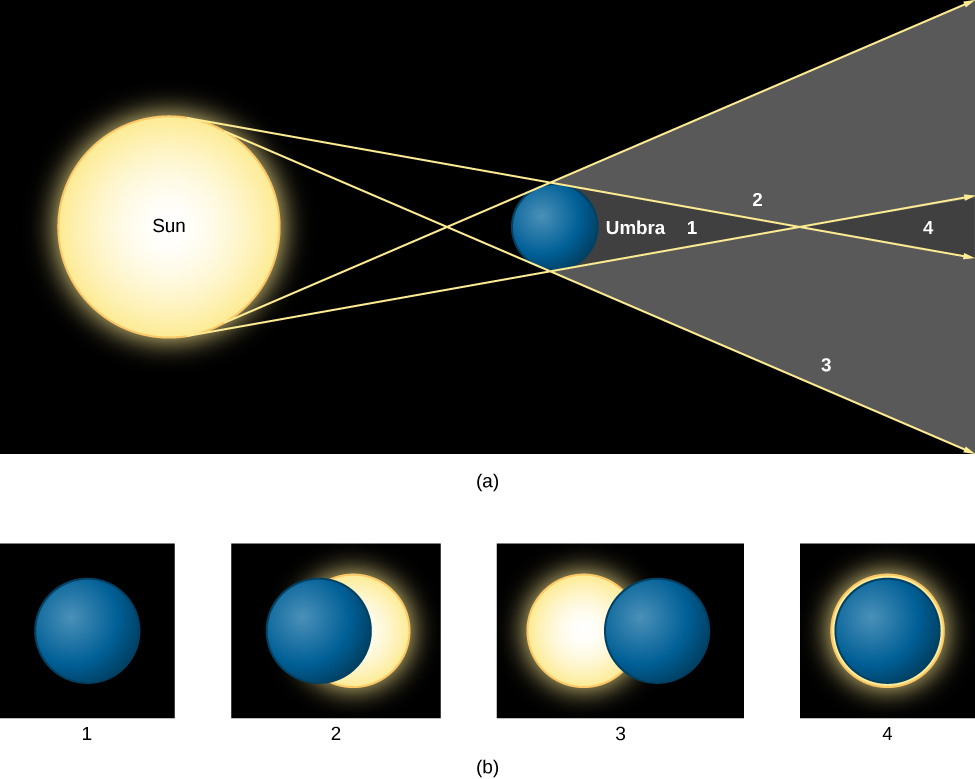
The shadows of Earth and the Moon consist of two parts: a cone where the shadow is darkest, called the umbra, and a lighter, more diffuse region of darkness called the penumbra. As you can imagine, the most spectacular eclipses occur when an object enters the umbra. Figure 4.21 illustrates the appearance of the Moon’s shadow and what the Sun and Moon would look like from different points within the shadow.
英語のヒント
地球や月の影は、二つの部分からなる。影が最も暗い円すい状の領域が本影で、その外側の、より明るくぼんやりした暗がりが半影である。想像できるように、最も壮観な食は、天体が本影に入るときに起きる。図4.21は月の影の形と、その影の中の異なる地点から、太陽と月がどう見えるかを示す。
Solar Eclipse.日食。
OpenStax / Rice University · CC BY 4.0
Figure 4.21 (a) The shadow cast by a spherical body (the Moon, for example) is shown. Notice the dark umbra and the lighter penumbra. Four points in the shadow are labeled with numbers. In (b) you see what the Sun and Moon would look like in the sky at the four labeled points. At position 1, you see a total eclipse. At positions 2 and 3, the eclipse is partial. At position 4, the Moon is farther away and thus cannot cover the Sun completely; a ring of light thus shows around the Sun, creating what is called an “annular” eclipse.
図4.21 (a) 月などの球形の天体が作る影。暗い本影と、より明るい半影に注目しよう。影の中の4地点に番号を付けてある。(b)は、その4地点の空で太陽と月がどう見えるかを示す。位置1では皆既食、位置2と3では部分食が見える。位置4では月が遠いため、太陽を完全には覆えない。そのため太陽の光が輪状に残り、「金環食」と呼ばれる現象になる。
If the path of the Moon in the sky were identical to the path of the Sun (the ecliptic), we might expect to see an eclipse of the Sun and the Moon each month—whenever the Moon got in front of the Sun or into the shadow of Earth. However, as we mentioned, the Moon’s orbit is tilted relative to the plane of Earth’s orbit about the Sun by about 5° (imagine two hula hoops with a common center, but tilted a bit). As a result, during most months, the Moon is sufficiently above or below the ecliptic plane to avoid an eclipse. But when the two paths cross (twice a year), it is then “eclipse season” and eclipses are possible.
英語のヒント
空での月の通り道が太陽の通り道、つまり黄道と一致していれば、月が太陽の前や地球の影に入るたびに、毎月、日食と月食が見られるはずだと考えられる。しかし、すでに述べたように、月の軌道面は、地球が太陽を回る軌道面に対して約5°傾いている。中心を共通にし、互いに少し傾けた二つのフラフープを想像しよう。その結果、大半の月には、月は黄道面の十分上または下を通り、食は起きない。二つの通り道が交わるとき、年に2回、「食の季節」となり、食が起こり得る。
Eclipses of the Sun日食
The apparent or angular sizes of both the Sun and Moon vary slightly from time to time as their distances from Earth vary. (Figure 4.21 shows the distance of the observer varying at points 1–4, but the idea is the same.) Much of the time, the Moon looks slightly smaller than the Sun and cannot cover it completely, even if the two are perfectly aligned. In this type of “annular eclipse,” there is a ring of light around the dark sphere of the Moon.
英語のヒント
太陽と月の見かけの大きさ、つまり角直径は、地球からの距離が変わるにつれて、時々少しずつ変化する。図4.21では位置1~4で観測者との距離を変えてあるが、考え方は同じである。月は太陽より少し小さく見えることが多く、その場合は両者が完全に重なっても、太陽全体を覆えない。この「金環食」では、月の暗い球の周りに光の輪が残る。
However, if an eclipse of the Sun occurs when the Moon is somewhat nearer than its average distance, the Moon can completely hide the Sun, producing a total solar eclipse. Another way to say it is that a total eclipse of the Sun occurs at those times when the umbra of the Moon’s shadow reaches the surface of Earth.
英語のヒント
しかし、月が平均距離よりいくらか近いときに日食が起きれば、月は太陽全体を隠し、皆既日食を生む。別の言い方をすれば、月の影の本影が地表まで届くときに、皆既日食が起きる。
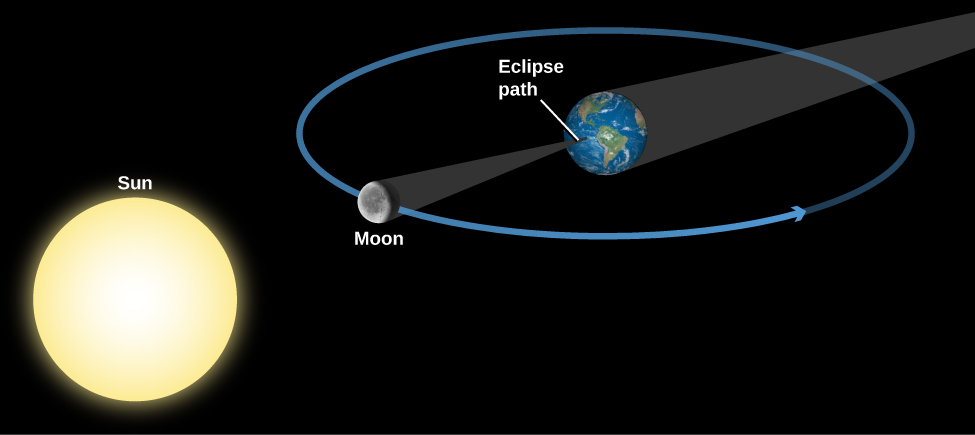
The geometry of a total solar eclipse is illustrated in Figure 4.22. If the Sun and Moon are properly aligned, then the Moon’s darkest shadow intersects the ground at a small point on Earth’s surface. Anyone on Earth within the small area covered by the tip of the Moon’s shadow will, for a few minutes, be unable to see the Sun and will witness a total eclipse. At the same time, observers on a larger area of Earth’s surface who are in the penumbra will see only a part of the Sun eclipsed by the Moon: we call this a partial solar eclipse.
英語のヒント
皆既日食の位置関係を図4.22に示す。太陽と月が適切に一直線に並ぶと、月の最も暗い影が、地表の小さな地点に当たる。月の影の先端に覆われる小さな範囲の中では、誰もが数分間、太陽を見られなくなり、皆既日食を目撃する。同時に、地表のより広い範囲で半影の中にいる観測者には、太陽の一部だけが月に隠れて見える。これを部分日食という。
Between Earth’s rotation and the motion of the Moon in its orbit, the tip of the Moon’s shadow sweeps eastward at about 1500 kilometers per hour along a thin band across the surface of Earth. The thin zone across Earth within which a total solar eclipse is visible (weather permitting) is called the eclipse path. Within a region about 3000 kilometers on either side of the eclipse path, a partial solar eclipse is visible. It does not take long for the Moon’s shadow to sweep past a given point on Earth. The duration of totality may be only a brief instant; it can never exceed about 7 minutes.
英語のヒント
地球の自転と月の公転運動が組み合わさり、月の影の先端は、地表の細い帯に沿って時速約1500キロメートルで東へ走る。天気さえ許せば皆既日食が見えるこの細い帯を、皆既日食帯と呼ぶ。その両側のおよそ3000キロメートル以内の地域では、部分日食が見える。月の影が地上のある地点を通り過ぎるのに、長い時間はかからない。皆既の継続時間はほんの一瞬の場合もあり、最大でも約7分を超えない。
Geometry of a Total Solar Eclipse.皆既日食の位置関係。
OpenStax / Rice University · CC BY 4.0
Figure 4.22 Note that our diagram is not to scale. The Moon blocks the Sun during new moon phase as seen from some parts of Earth and casts a shadow on our planet.
図4.22 この図は縮尺どおりではない。新月の位相のとき、地球の一部からは月が太陽を隠して見え、地表に影が落ちる。
Because a total eclipse of the Sun is so spectacular, it is well worth trying to see one if you can. There are some people whose hobby is “eclipse chasing” and who brag about how many they have seen in their lifetimes. Because much of Earth’s surface is water, eclipse chasing can involve lengthy boat trips (and often requires air travel as well). As a result, eclipse chasing is rarely within the budget of a typical college student. Nevertheless, a list of future eclipses is given for your reference in Appendix H, just in case you strike it rich early.
英語のヒント
皆既日食は非常に壮観なので、可能なら一度は見ようとする価値がある。「日食追いかけ」を趣味にして、生涯に何回見たかを自慢する人々もいる。地表の大半は海なので、追いかけるには長い船旅が必要になることがあり、飛行機での移動もよく必要になる。そのため、普通の大学生の予算で日食を追いかけられることは少ない。それでも、早いうちに大金を手にするかもしれないので、参考として付録Hに、これからの日食の一覧を載せてある。