第4章地球・月・空Earth, Moon, and Sky
4.5 Phases and Motions of the Moon4.5 月の満ち欠けと運動
Learning Objectives学習の目標
By the end of this section, you will be able to:
この節を学ぶと、次のことができるようになる。
Explain the cause of the lunar phases
月が満ち欠けする原因を説明する。
Understand how the Moon rotates and revolves around Earth
月がどのように自転し、地球の周りを公転するかを理解する。
After the Sun, the Moon is the brightest and most obvious object in the sky. Unlike the Sun, it does not shine under its own power, but merely glows with reflected sunlight. If you were to follow its progress in the sky for a month, you would observe a cycle of phases (different appearances), with the Moon starting dark and getting more and more illuminated by sunlight over the course of about two weeks. After the Moon’s disk becomes fully bright, it begins to fade, returning to dark about two weeks later.
英語のヒント
月は太陽に次いで、空で最も明るく目立つ天体である。太陽とは違って自分の力で光るのではなく、太陽光を反射して輝いているにすぎない。1か月にわたって空での月の動きを追えば、見え方がひと巡りする、満ち欠けの周期を観察できる。月は暗い状態から始まり、約2週間の間に、太陽光で照らされた部分が次第に大きく見えるようになる。円盤全体が明るくなったあとには欠け始め、さらに約2週間後に暗い状態へ戻る。
These changes fascinated and mystified many early cultures, which came up with marvelous stories and legends to explain the cycle of the Moon. Even in the modern world, many people don’t understand what causes the phases, thinking that they are somehow related to the shadow of Earth. Let us see how the phases can be explained by the motion of the Moon relative to the bright light source in the solar system, the Sun.
英語のヒント
この変化は昔の多くの文化で人々を魅了し、不思議がらせた。人々は月の周期を説明するため、すばらしい物語や伝説を生み出した。現代でも、満ち欠けの原因を理解せず、何らかの形で地球の影と関係していると思う人は多い。太陽系の明るい光源である太陽に対して月が動くことで、満ち欠けがどう説明できるかを見てみよう。
Lunar Phases月の満ち欠け
Although we know that the Sun moves 1/12 of its path around the sky each month, for purposes of explaining the phases, we can assume that the Sun’s light comes from roughly the same direction during the course of a four-week lunar cycle. The Moon, on the other hand, moves completely around Earth in that time. As we watch the Moon from our vantage point on Earth, how much of its face we see illuminated by sunlight depends on the angle the Sun makes with the Moon.
英語のヒント
太陽が1か月に空の道筋の12分の1を進むことは分かっているが、満ち欠けを説明するためには、約4週間の月の周期の間、太陽光はほぼ同じ方向から来ると仮定してよい。その間に、月は地球の周りをひと回りする。地上から月を見ると、月の見える面のうち太陽光で照らされた部分がどれだけを占めるかは、月と太陽がなす角度によって決まる。
Here is a simple experiment to show you what we mean: stand about 6 feet in front of a bright electric light in a completely dark room (or outdoors at night) and hold in your hand a small round object such as a tennis ball or an orange. Your head can then represent Earth, the light represents the Sun, and the ball the Moon. Move the ball around your head (making sure you don’t cause an eclipse by blocking the light with your head). You will see phases just like those of the Moon on the ball. (Another good way to get acquainted with the phases and motions of the Moon is to follow our satellite in the sky for a month or two, recording its shape, its direction from the Sun, and when it rises and sets.)
英語のヒント
意味を確かめる簡単な実験をしてみよう。完全に暗い部屋、または夜の屋外で、明るい電灯の約6フィート前に立ち、テニスボールやオレンジなど、小さく丸いものを手に持つ。頭が地球、電灯が太陽、ボールが月を表す。頭で光を遮って食を起こさないように注意しながら、ボールを頭の周りで動かそう。ボールに、月と同じような満ち欠けが見えるはずである。月の満ち欠けと運動に親しむもう一つのよい方法は、1~2か月、空にある月を追い、その形、太陽から見てどちらの方向にあるか、昇る時刻と沈む時刻を記録することである。
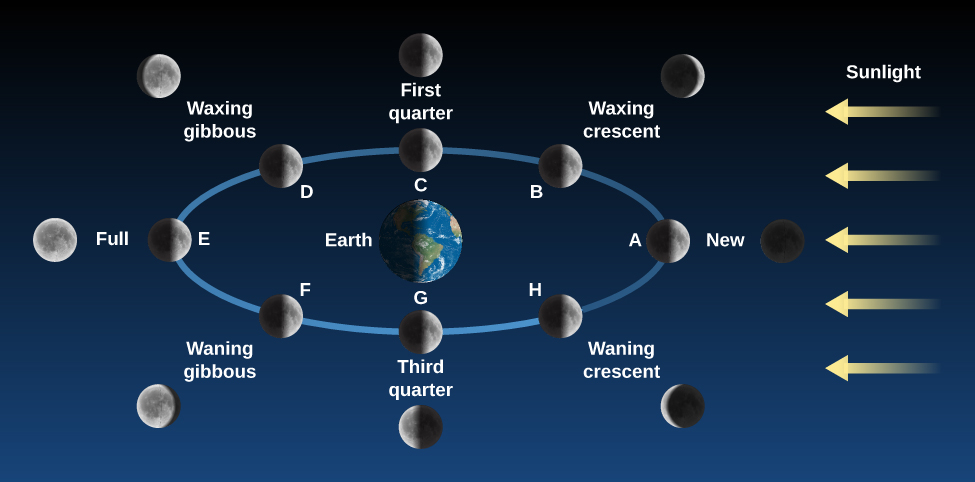
Let’s examine the Moon’s cycle of phases using Figure 4.14, which depicts the Moon’s behavior for the entire month. The trick to this figure is that you must imagine yourself standing on Earth, facing the Moon in each of its phases. So, for the position labeled “New,” you are on the right side of Earth and it’s the middle of the day; for the position “Full,” you are on the left side of Earth in the middle of the night. Note that in every position on Figure 4.14, the Moon is half illuminated and half dark (as a ball in sunlight should be). The difference at each position has to do with what part of the Moon faces Earth.
英語のヒント
1か月全体の月の様子を描いた図4.14で、満ち欠けの周期を調べよう。この図を読むこつは、自分が地球に立ち、それぞれの位相の月に向かっていると想像することにある。「New」(新月)の位置なら、自分は地球の右側にいて、時刻は昼の真ん中である。「Full」(満月)の位置なら、地球の左側にいて、真夜中である。図4.14のどの位置でも、月は半分が照らされ、半分は暗いことに注意しよう。日光を受ける球なら、当然そうなる。位置ごとの違いは、月のどの部分が地球に向いているかにある。
Phases of the Moon.月の満ち欠け。
credit: modification of work by NASA · NASA media use guidelines
Figure 4.14 The appearance of the Moon changes over the course of a complete monthly cycle. The pictures of the Moon on the blue circle show the perspective from space, with the Sun off to the right in a fixed position. The outer images show how the Moon appears to you in the sky from each point in the orbit. Imagine yourself standing on Earth, facing the Moon at each stage. In the position “New,” for example, you are facing the Moon from the right side of Earth in the middle of the day. (Note that the distance of the Moon from Earth is not to scale in this diagram: the Moon is roughly 30 Earth-diameters away from us.) (credit: modification of work by NASA)
図4.14 1か月の周期を通じて月の見え方は変わる。青い円の上の月は、宇宙から見た姿であり、太陽は図の右の外側の一定の位置にある。外周の画像は、軌道上のそれぞれの位置で、地上の空に月がどう見えるかを示す。自分が地球に立ち、各段階の月を向いていると想像しよう。たとえば「New」(新月)の位置では、昼の真ん中に、地球の右側から月に向かっている。この図の地球と月の距離は、縮尺どおりではない。月は地球の直径のおよそ30倍の距離にある。(出典:NASAの作品を改変)
The Moon is said to be new when it is in the same general direction in the sky as the Sun (position A). Here, its illuminated (bright) side is turned away from us and its dark side is turned toward us. You might say that the Sun is shining on the “wrong ” side of the Moon from our perspective. In this phase the Moon is invisible to us; its dark, rocky surface does not give off any light of its own. Because the new moon is in the same part of the sky as the Sun, it rises at sunrise and sets at sunset.
英語のヒント
月が空で太陽とおおむね同じ方向にあるとき、月は新月であるという(位置A)。このとき、照らされた明るい側は地球とは反対を向き、暗い側が地球を向く。私たちから見ると、太陽は月の「反対側」を照らしている、と言ってもよい。この位相では、私たちに月は見えない。暗い岩石の表面は、自分では光を出さないからである。新月は空で太陽と同じ場所にあるため、日の出とともに昇り、日の入りとともに沈む。
But the Moon does not remain in this phase long because it moves eastward each day in its monthly path around us. Since it takes about 30 days to orbit Earth and there are 360° in a circle, the Moon will move about 12° in the sky each day (or about 24 times its own diameter). A day or two after the new phase, the thin crescent first appears, as we begin to see a small part of the Moon’s illuminated hemisphere. It has moved into a position where it now reflects a little sunlight toward us along one side. The bright crescent increases in size on successive days as the Moon moves farther and farther around the sky away from the direction of the Sun (position B). Because the Moon is moving eastward away from the Sun, it rises later and later each day (like a student during summer vacation).
英語のヒント
しかし、月は毎月、地球の周りを回りながら日々東へ進むため、この位相に長くとどまることはない。地球を1周するのに約30日かかり、円は360°なので、月は空で1日に約12°、すなわち月自身の直径の約24倍だけ動く。新月の1~2日後、照らされた半球の一部が見え始め、初めて細い月が現れる。月は、一方の縁に沿って、太陽光の少しを私たちのほうへ反射する位置に移ったのである。月が空を進んで太陽の方向から遠ざかるにつれ、明るい三日月形の部分は日ごとに大きくなる(位置B)。月は太陽から東へ離れていくため、昇る時刻も毎日遅くなる。夏休み中の学生のようなものである。
After about one week, the Moon is one-quarter of the way around its orbit (position C) and so we say it is at the first quarter phase. Half of the Moon’s illuminated side is visible to Earth observers. Because of its eastward motion, the Moon now lags about one-quarter of the day behind the Sun, rising around noon and setting around midnight.
英語のヒント
約1週間後、月は軌道の4分の1まで進む(位置C)。このため、この位相をfirst quarter、すなわち上弦という。月の照らされた側の半分が、地上の観測者から見える。月は東へ進んだため、太陽より約4分の1日遅れるようになり、正午ごろに昇り、真夜中ごろに沈む。
During the week after the first quarter phase, we see more and more of the Moon’s illuminated hemisphere (position D), a phase that is called waxing (or growing) gibbous (from the Latin gibbus, meaning hump). Eventually, the Moon arrives at position E in our figure, where it and the Sun are opposite each other in the sky. The side of the Moon turned toward the Sun is also turned toward Earth, and we have the full phase.
英語のヒント
上弦のあとの1週間では、月の照らされた半球がますます多く見えるようになる(位置D)。この位相はwaxing、すなわち満ちていくgibbous、凸月と呼ばれる。gibbousは「こぶ」を意味するラテン語gibbusに由来する。やがて月は図の位置Eに達し、空で太陽と正反対になる。太陽を向く月の面が同時に地球も向くため、満月となる。
When the Moon is full, it is opposite the Sun in the sky. The Moon does the opposite of what the Sun does, rising at sunset and setting at sunrise. Note what that means in practice: the completely illuminated (and thus very noticeable) Moon rises just as it gets dark, remains in the sky all night long, and sets as the Sun’s first rays are seen at dawn. Its illumination throughout the night helps lovers on a romantic stroll and students finding their way back to their dorms after a long night in the library or an off-campus party.
英語のヒント
満月は、空で太陽と正反対にある。太陽とは逆に、日の入りとともに昇り、日の出とともに沈む。これが実際に何を意味するかに注目しよう。全面が明るく、したがって非常に目立つ月が、暗くなるとちょうど昇り、一晩中空にとどまり、夜明けに太陽の最初の光が見えるころに沈む。夜通しの月明かりは、ロマンチックな散歩をする恋人たちや、図書館や学外のパーティーで長い夜を過ごしたあと、寮へ帰る学生たちの助けになる。
And when is the full moon highest in the sky and most noticeable? At midnight, a time made famous in generations of horror novels and films. (Note how the behavior of a vampire like Dracula parallels the behavior of the full Moon: Dracula rises at sunset, does his worst mischief at midnight, and must be back down in his coffin by sunrise. The old legends were a way of personifying the behavior of the Moon, which was a much more dramatic part of people’s lives in the days before electric lights and television.)
英語のヒント
では、満月が最も高く、最も目立つのはいつだろうか。答えは真夜中である。何世代もの怪奇小説や映画で、おなじみになった時刻だ。ドラキュラのような吸血鬼の行動が、満月の動きと対応することに注目しよう。ドラキュラは日没に起き、真夜中に最も悪いことをし、日の出までには棺に戻って横たわらねばならない。昔の伝説は、月の振る舞いを擬人化する方法だった。電灯やテレビがなかった時代、月は人々の生活の中で、今よりずっと強い存在感を持っていた。
Folklore has it that more crazy behavior is seen during the time of the full moon (the Moon even gives a name to crazy behavior—“lunacy”). But, in fact, statistical tests of this “hypothesis” involving thousands of records from hospital emergency rooms and police files do not reveal any correlation of human behavior with the phases of the Moon. For example, homicides occur at the same rate during the new moon or the crescent moon as during the full moon. Most investigators believe that the real story is not that more crazy behavior happens on nights with a full moon, but rather that we are more likely to notice or remember such behavior with the aid of a bright celestial light that is up all night long.
英語のヒント
言い伝えでは、満月のころには異常な行動が多く見られるとされる。「狂気」を表すlunacyという語そのものも、月に由来する。しかし実際には、病院の救急外来や警察の数千件の記録を使ってこの「仮説」を統計的に調べても、人の行動と月の満ち欠けとの相関は見つからない。たとえば殺人は、新月や細い月のころにも、満月のころと同じ割合で起きる。多くの研究者は、実情は満月の夜に異常な行動が増えることではなく、一晩中出ている明るい天体の光のおかげで、そうした行動に気付いたり、覚えていたりしやすくなることだ、と考えている。
During the two weeks following the full moon, the Moon goes through the same phases again in reverse order (points F, G, and H in Figure 4.14), returning to new phase after about 29.5 days. About a week after the full moon, for example, the Moon is at third quarter, meaning that it is three-quarters of the way around (not that it is three-quarters illuminated—in fact, half of the visible side of the Moon is again dark). At this phase, the Moon is now rising around midnight and setting around noon.
英語のヒント
満月のあとの2週間、月は同じ位相を逆の順序で再びたどり、約29.5日で新月に戻る(図4.14のF、G、H)。たとえば満月から約1週間後には、third quarter、すなわち下弦になる。これは軌道の4分の3まで進んだという意味で、4分の3が照らされているという意味ではない。実際には、見えている月の面の半分が、再び暗くなっている。この位相では、月は真夜中ごろに昇り、正午ごろに沈む。
Note that there is one thing quite misleading about Figure 4.14. If you look at the Moon in position E, although it is full in theory, it appears as if its illumination would in fact be blocked by a big fat Earth, and hence we would not see anything on the Moon except Earth’s shadow. In reality, the Moon is nowhere near as close to Earth (nor is its path so identical with the Sun’s in the sky) as this diagram (and the diagrams in most textbooks) might lead you to believe.
英語のヒント
図4.14には、一つ、かなり誤解を招くところがある。位置Eの月を見ると、理屈の上では満月のはずなのに、大きな地球が実際には日光を遮ってしまい、月には地球の影しか見えないように思える。実際の月は、この図や多くの教科書の図から想像するほど、地球に近くはない。また、空での月の通り道も、太陽の通り道とそれほど重なってはいない。
The Moon is actually 30 Earth-diameters away from us; Science and the Universe: A Brief Tour contains a diagram that shows the two objects to scale. And, since the Moon’s orbit is tilted relative to the path of the Sun in the sky, Earth’s shadow misses the Moon most months. That’s why we regularly get treated to a full moon. The times when Earth’s shadow does fall on the Moon are called lunar eclipses and are discussed in Eclipses of the Sun and Moon.
英語のヒント
月は実際には、地球の直径の30倍の距離にある。「科学と宇宙――ひとめぐり」には、地球と月を同じ縮尺で描いた図がある。また、月の軌道は空での太陽の通り道に対して傾いているため、大半の月には地球の影は月を外れる。だからこそ、私たちは満月を定期的に楽しめるのである。地球の影が実際に月に落ちるときが月食であり、「日食と月食」で取り上げる。