第4章地球・月・空Earth, Moon, and Sky
4.2 The Seasons4.2 季節
Learning Objectives学習の目標
By the end of this section, you will be able to:
この節を学ぶと、次のことができるようになる。
Describe how the tilt of Earth’s axis causes the seasons
地軸の傾きがどのように季節を生むかを説明する。
Explain how seasonal differences on Earth vary with latitude
地球上の季節の違いが、緯度によってどう変わるかを説明する。
One of the fundamental facts of life at Earth’s midlatitudes, where most of this book’s readers live, is that there are significant variations in the heat we receive from the Sun during the course of the year. We thus divide the year into seasons, each with its different amount of sunlight. The difference between seasons gets more pronounced the farther north or south from the equator we travel, and the seasons in the Southern Hemisphere are the opposite of what we find on the northern half of Earth. With these observed facts in mind, let us ask what causes the seasons.
英語のヒント
本書の読者の多くが暮らす地球の中緯度地域では、太陽から受ける熱の量が1年の間に大きく変わることが、生活の基本的な事実の一つになっている。そのため、私たちは1年を、日光の量がそれぞれ異なる季節に分けている。赤道から北へ、または南へ遠ざかるほど季節の違いははっきりし、南半球の季節は北半球と逆になる。この観察事実を頭に置いて、季節が生じる原因を考えよう。
Many people have believed that the seasons were the result of the changing distance between Earth and the Sun. This sounds reasonable at first: it should be colder when Earth is farther from the Sun. But the facts don’t bear out this hypothesis. Although Earth’s orbit around the Sun is an ellipse, its distance from the Sun varies by only about 3%. That’s not enough to cause significant variations in the Sun’s heating. To make matters worse for people in North America who hold this hypothesis, Earth is actually closest to the Sun in January, when the Northern Hemisphere is in the middle of winter. And if distance were the governing factor, why would the two hemispheres have opposite seasons? As we shall show, the seasons are actually caused by the 23.5° tilt of Earth’s axis.
英語のヒント
地球と太陽の距離が変わるために季節が生じる、と考えてきた人は多い。一見もっともらしく聞こえる。地球が太陽から遠いときには、寒くなるはずだというわけである。しかし、事実はこの仮説を裏付けない。地球が太陽を回る軌道は楕円だが、太陽からの距離の変動は約3%にすぎない。それだけでは、太陽による加熱量の大きな変化は説明できない。この仮説を信じる北アメリカの人々にとって、さらに都合が悪いことに、地球が太陽に最も近づくのは1月、北半球の真冬である。しかも、距離が決定的な要因なら、なぜ南北の半球で季節が逆になるのだろうか。これから示すように、季節を実際に生むのは、地軸の23.5°の傾きである。
The Seasons and Sunshine季節と日光
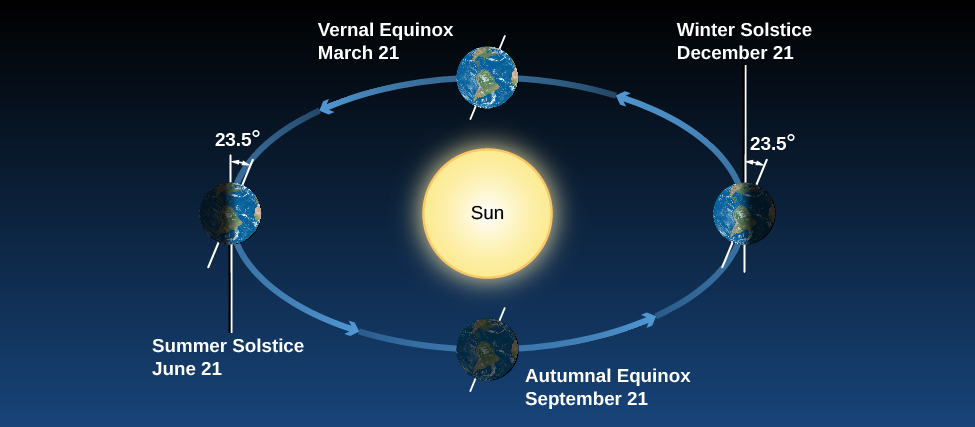
Figure 4.5 shows Earth’s annual path around the Sun, with Earth’s axis tilted by 23.5°. Note that our axis continues to point the same direction in the sky throughout the year. As Earth travels around the Sun, in June the Northern Hemisphere “leans into” the Sun and is more directly illuminated. In December, the situation is reversed: the Southern Hemisphere leans into the Sun, and the Northern Hemisphere leans away. In September and March, Earth leans “sideways”—neither into the Sun nor away from it—so the two hemispheres are equally favored with sunshine.
英語のヒント
図4.5は、地軸が23.5°傾いた地球が、1年かけて太陽の周りを回る道筋を示す。地軸が1年を通じて空の同じ方向を向き続けることに注目しよう。地球が太陽の周りを進むにつれ、6月には北半球が太陽のほうに「身を乗り出す」向きになり、日光をより正面から受ける。12月には逆に、南半球が太陽のほうに傾き、北半球は太陽から遠ざかる向きに傾く。9月と3月には、地球は太陽に向かうのでも遠ざかるのでもなく「横向き」に傾いているため、両半球は同じように日光を受ける。
Seasons.季節。
OpenStax / Rice University · CC BY 4.0
Figure 4.5 We see Earth at different seasons as it circles the Sun. In June, the Northern Hemisphere “leans into” the Sun, and those in the North experience summer and have longer days. In December, during winter in the Northern Hemisphere, the Southern Hemisphere “leans into” the Sun and is illuminated more directly. In spring and autumn, the two hemispheres receive more equal shares of sunlight.Note that the dates indicated for the solstices and equinoxes are approximate; depending on the year, they may occur a day or two earlier or later.
図4.5 太陽を回る地球を、季節ごとに示した図。6月には北半球が太陽のほうに「身を乗り出す」向きになり、北半球は夏を迎え、昼が長くなる。北半球の冬に当たる12月には、南半球が太陽のほうに傾き、日光をより正面から受ける。春と秋には、両半球が受ける日光の量はより均等になる。図に示した夏至・冬至・春分・秋分の日付はおよそであり、年によって1~2日前後することがある。
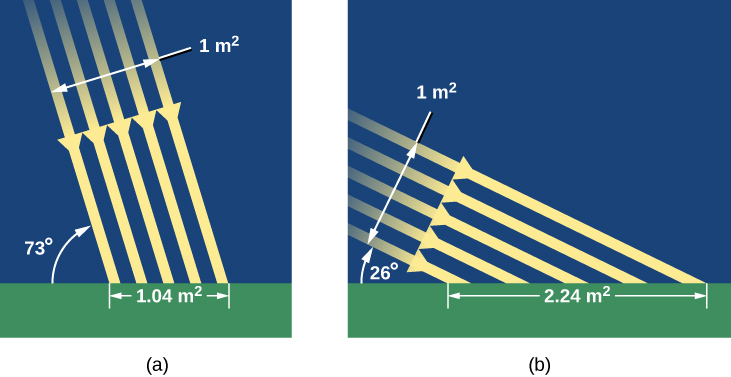
How does the Sun’s favoring one hemisphere translate into making it warmer for us down on the surface of Earth? There are two effects we need to consider. When we lean into the Sun, sunlight hits us at a more direct angle and is more effective at heating Earth’s surface (Figure 4.6). You can get a similar effect by shining a flashlight onto a wall. If you shine the flashlight straight on, you get an intense spot of light on the wall. But if you hold the flashlight at an angle (if the wall “leans out” of the beam), then the spot of light is more spread out. Like the straight-on light, the sunlight in June is more direct and intense in the Northern Hemisphere, and hence more effective at heating.
英語のヒント
片方の半球に日光が多く当たることは、地表にいる私たちの暖かさに、どのようにつながるのだろうか。考えるべき効果は二つある。太陽のほうに傾くと、日光はより正面から当たり、地表を効率よく温める(図4.6)。懐中電灯で壁を照らすと、同じような効果を確かめられる。壁に正面から光を当てると、強く照らされた部分ができる。ところが斜めに当てると、つまり壁が光の束から「のけぞる」向きになると、照らされる部分は広がる。正面から当てた懐中電灯の光と同じように、6月の北半球では日光がより正面から強く当たるので、地表をいっそう効率よく温める。
The Sun’s Rays in Summer and Winter.夏と冬の太陽光線。
OpenStax / Rice University · CC BY 4.0
Figure 4.6 (a) In summer, the Sun appears high in the sky and its rays hit Earth more directly, spreading out less. (b) In winter, the Sun is low in the sky and its rays spread out over a much wider area, becoming less effective at heating the ground.
図4.6 (a) 夏は太陽が空の高い位置にあり、光線が地表により正面から当たるため、広がりが小さい。(b) 冬は太陽が低く、光線がはるかに広い面積に広がるため、地面を温める効果が弱くなる。
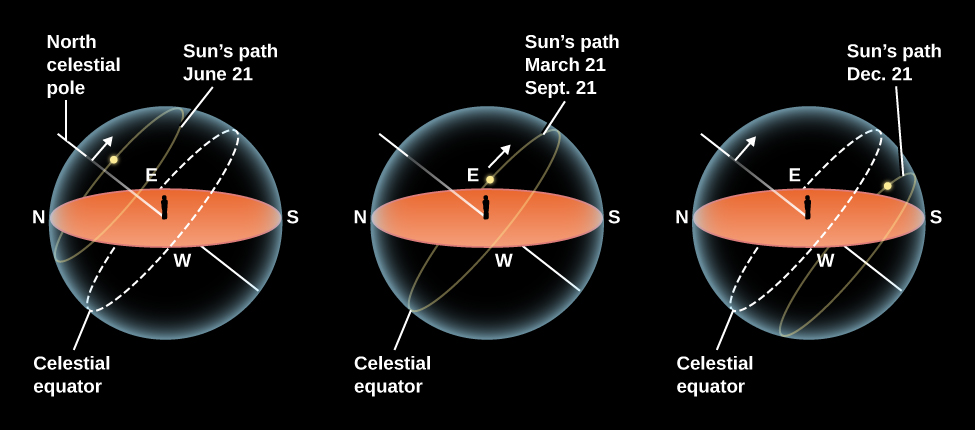
The second effect has to do with the length of time the Sun spends above the horizon (Figure 4.7). Even if you’ve never thought about astronomy before, we’re sure you have observed that the hours of daylight increase in summer and decrease in winter. Let’s see why this happens.
英語のヒント
二つ目の効果は、太陽が地平線より上にある時間の長さに関係する(図4.7)。これまで天文学について考えたことがなくても、夏には昼が長くなり、冬には短くなることには気付いているはずである。なぜそうなるのかを見てみよう。
The Sun’s Path in the Sky for Different Seasons.季節によって異なる、空での太陽の通り道。
OpenStax / Rice University · CC BY 4.0
Figure 4.7 On June 21, the Sun rises north of east and sets north of west. For observers in the Northern Hemisphere of Earth, the Sun spends about 15 hours above the horizon in the United States, meaning more hours of daylight. On December 21, the Sun rises south of east and sets south of west. It spends 9 hours above the horizon in the United States, which means fewer hours of daylight and more hours of night in northern lands (and a strong need for people to hold celebrations to cheer themselves up). On March 21 and September 21, the Sun spends equal amounts of time above and below the horizon in both hemispheres.
図4.7 6月21日、太陽は真東より北寄りから昇り、真西より北寄りに沈む。北半球のアメリカでは、太陽が地平線より上に約15時間あり、昼が長くなる。12月21日には、真東より南寄りから昇り、真西より南寄りに沈む。アメリカで太陽が地平線より上にある時間は9時間となり、北の地域では昼が短く、夜が長くなる。人々が元気を出すために祝祭を開きたくなるわけである。3月21日と9月21日には、どちらの半球でも、太陽が地平線より上にある時間と下にある時間は等しくなる。
As we saw in Observing the Sky: The Birth of Astronomy, an equivalent way to look at our path around the Sun each year is to pretend that the Sun moves around Earth (on a circle called the ecliptic). Because Earth’s axis is tilted, the ecliptic is tilted by about 23.5° relative to the celestial equator (review Figure 2.7). As a result, where we see the Sun in the sky changes as the year wears on.
英語のヒント
「空を観測する――天文学の誕生」で見たように、地球が毎年太陽を回る道筋は、太陽が地球の周りを黄道と呼ばれる円に沿って動くと考えても、同じように捉えられる。地軸が傾いているため、黄道も天の赤道に対して約23.5°傾いている(図2.7を振り返ろう)。その結果、1年が進むにつれて、空で太陽の見える位置が変化する。
In June, the Sun is north of the celestial equator and spends more time with those who live in the Northern Hemisphere. It rises high in the sky and is above the horizon in the United States for as long as 15 hours. Thus, the Sun not only heats us with more direct rays, but it also has more time to do it each day. (Notice in Figure 4.7 that the Northern Hemisphere’s gain is the Southern Hemisphere’s loss. There the June Sun is low in the sky, meaning fewer daylight hours. In Chile, for example, June is a colder, darker time of year.) In December, when the Sun is south of the celestial equator, the situation is reversed.
英語のヒント
6月の太陽は天の赤道より北にあり、北半球に住む人々と、より長い時間を過ごす。空高く昇り、アメリカでは地平線より上に15時間もとどまる。したがって、太陽は私たちをより正面からの光で温めるだけでなく、毎日、より長い時間をかけて温める。図4.7で、北半球が得た分を南半球が失うことに注目しよう。南半球では6月の太陽は低く、昼の時間が短い。たとえばチリでは、6月は寒く、日照時間の短い季節である。太陽が天の赤道より南にある12月には、状況が逆転する。
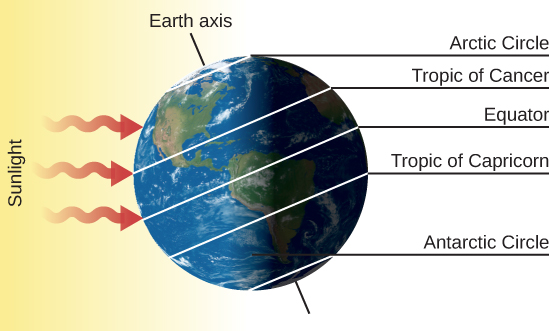
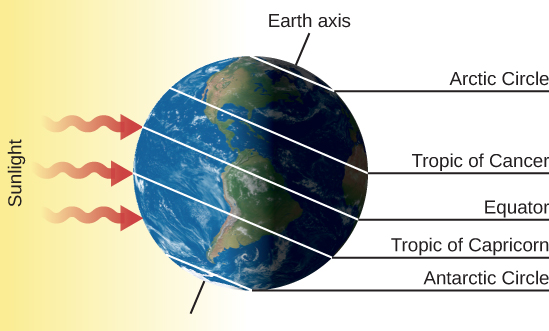
Let’s look at what the Sun’s illumination on Earth looks like at some specific dates of the year, when these effects are at their maximum. On or about June 21 (the date we who live in the Northern Hemisphere call the summer solstice or sometimes the first day of summer), the Sun shines down most directly upon the Northern Hemisphere of Earth. It appears about 23° north of the equator, and thus, on that date, it passes through the zenith of places on Earth that are at 23° N latitude. The situation is shown in detail in Figure 4.8. To a person at 23° N (near Hawaii, for example), the Sun is directly overhead at noon. This latitude, where the Sun can appear at the zenith at noon on the first day of summer, is called the Tropic of Cancer.
英語のヒント
この効果が最大になる、1年の特定の日付に、地球が太陽からどのように照らされるかを見てみよう。6月21日ごろ、北半球で夏至、あるいは夏の初日と呼ぶ日には、太陽は北半球を最も正面から照らす。太陽は赤道より約23°北にあるように見えるので、その日には北緯23°の地点の天頂を通る。図4.8に詳しく示した。北緯23°、たとえばハワイ近くにいる人には、正午の太陽が真上に見える。このように、夏の初日の正午に太陽が天頂に来る緯線を、北回帰線と呼ぶ。
We also see in Figure 4.8 that the Sun’s rays shine down all around the North Pole at the solstice. As Earth turns on its axis, the North Pole is continuously illuminated by the Sun; all places within 23° of the pole have sunshine for 24 hours. The Sun is as far north on this date as it can get; thus, 90° – 23° (or 67° N) is the southernmost latitude where the Sun can be seen for a full 24-hour period (sometimes called the “land of the midnight Sun”). That circle of latitude is called the Arctic Circle.
英語のヒント
図4.8を見ると、夏至には北極の周囲全体に太陽光が当たることも分かる。地球が地軸の周りを回転しても、北極は常に太陽に照らされ、北極から23°以内のすべての場所で24時間、日光が当たる。この日の太陽は、1年のうちで最も北にある。そのため、90°−23°、すなわち北緯67°が、太陽を24時間ずっと見られる最南端の緯度になる。「真夜中の太陽の国」と呼ばれることもある地域である。この緯線を北極圏の境界という。
Earth on June 21.6月21日の地球。
OpenStax / Rice University · CC BY 4.0
Figure 4.8 This is the date of the summer solstice in the Northern Hemisphere. Note that as Earth turns on its axis (the line connecting the North and South Poles), the North Pole is in constant sunlight while the South Pole is veiled in 24 hours of darkness. The Sun is at the zenith for observers on the Tropic of Cancer.
図4.8 北半球の夏至の日。地球が地軸、つまり北極と南極を結ぶ線の周りを回転しても、北極は常に日光を受け、南極は24時間、暗闇に覆われる。北回帰線上の観測者には、太陽が天頂に見える。
Many early cultures scheduled special events around the summer solstice to celebrate the longest days and thank their gods for making the weather warm. This required people to keep track of the lengths of the days and the northward trek of the Sun in order to know the right day for the “party.” (You can do the same thing by watching for several weeks, from the same observation point, where the Sun rises or sets relative to a fixed landmark. In spring, the Sun will rise farther and farther north of east, and set farther and farther north of west, reaching the maximum around the summer solstice.)
英語のヒント
昔の多くの文化では、昼が最も長くなることを祝い、暖かい気候をもたらした神々に感謝するため、夏至のころに特別な行事を行った。その「祝宴」の日を正しく知るには、昼の長さと、太陽が北へ移っていく様子を追う必要があった。同じ観測は自分でもできる。数週間、同じ観測場所から、固定した目印に対して太陽がどこから昇り、どこへ沈むかを見続ければよい。春には日の出の位置が真東から次第に北へ、日の入りの位置が真西から次第に北へ移り、夏至ごろに最も北へ達する。
Now look at the South Pole in Figure 4.8. On June 21, all places within 23° of the South Pole—that is, south of what we call the Antarctic Circle—do not see the Sun at all for 24 hours.
英語のヒント
次に、図4.8の南極を見よう。6月21日には、南極から23°以内のすべての場所、つまり南極圏の境界より南の地域では、24時間まったく太陽が見えない。
The situation is reversed 6 months later, about December 21 (the date of the winter solstice, or the first day of winter in the Northern Hemisphere), as shown in Figure 4.9. Now it is the Arctic Circle that has the 24-hour night and the Antarctic Circle that has the midnight Sun. At latitude 23° S, called the Tropic of Capricorn, the Sun passes through the zenith at noon. Days are longer in the Southern Hemisphere and shorter in the north. In the United States and Southern Europe, there may be only 9 or 10 hours of sunshine during the day. It is winter in the Northern Hemisphere and summer in the Southern Hemisphere.
英語のヒント
6か月後の12月21日ごろ、北半球の冬至、すなわち冬の初日には、図4.9のように状況が逆転する。今度は北極圏が24時間の夜となり、南極圏で真夜中の太陽が見られる。南回帰線と呼ばれる南緯23°の緯線では、正午に太陽が天頂を通る。南半球では昼が長く、北半球では短くなる。アメリカや南ヨーロッパでは、昼の日照時間が9~10時間しかないこともある。北半球は冬、南半球は夏である。
Earth on December 21.12月21日の地球。
OpenStax / Rice University · CC BY 4.0
Figure 4.9 This is the date of the winter solstice in the Northern Hemisphere. Now the North Pole is in darkness for 24 hours and the South Pole is illuminated. The Sun is at the zenith for observers on the Tropic of Capricorn and thus is low in the sky for the residents of the Northern Hemisphere.
図4.9 北半球の冬至の日。今度は北極が24時間暗く、南極が照らされる。南回帰線上の観測者には太陽が天頂に見え、そのため北半球の住民には太陽が空の低い位置に見える。
Seasonal Variations季節の変化
As you can see in Figure 4.8, the Tropic of Cancer is the latitude for which the Sun is directly overhead on the summer solstice. At this time, the Sun is at a declination of 23° N of the celestial equator, and the corresponding latitude on Earth is 23° N of the equator. If Earth were tilted a bit less, then the Tropic of Cancer would be at a lower latitude, closer to the equator.
英語のヒント
図4.8から分かるように、北回帰線は夏至に太陽が真上に来る緯線である。このとき太陽は天の赤道より北へ23°、つまり赤緯+23°の位置にあり、対応する地球上の緯度は北緯23°となる。地軸の傾きがもう少し小さければ、北回帰線はより低い緯度、つまり赤道に近いところに来る。
The Arctic Circle marks the southernmost latitude for which the day length is 24 hours on the day of the summer solstice. This is located at 90° – 23° = 67° N of Earth’s equator. If Earth were tilted a bit less, then the Arctic Circle would move farther North. In the limit at which Earth is not tilted at all (its axis is perpendicular to the ecliptic), the Tropic of Cancer would be right on Earth’s equator, and the Arctic Circle would simply be the North Pole. Suppose the tilt of Earth’s axis were tilted only 5°. What would be the effect on the seasons and the locations of the Tropic of Cancer and Arctic Circle?
英語のヒント
北極圏の境界は、夏至に昼の長さが24時間となる最南端の緯線であり、90°−23°=北緯67°に位置する。地軸の傾きがもう少し小さければ、この境界はさらに北へ移る。地軸がまったく傾かない極限、つまり地軸が黄道面に垂直な場合には、北回帰線は地球の赤道に一致し、北極圏の境界は北極点そのものになる。地軸の傾きがわずか5°だったとしよう。季節、北回帰線の位置、北極圏の境界の位置は、どのような影響を受けるだろうか。
Solution解き方
If Earth were tilted less, the seasons would be less extreme. The variation in day length and direct sunlight would be very small over the course of a year, and the Sun’s daily path in the sky would not vary much. If Earth were tilted by 5°, the Sun’s position on the day of the summer solstice would be 5° N of the celestial equator, so the Tropic of Cancer would be at the corresponding latitude on Earth of 5° N of the Equator. The Arctic Circle would be located at 90° – 5° = 85° N of the equator.
英語のヒント
地軸の傾きが小さければ、季節の違いは穏やかになる。1年を通じた昼の長さと日光の入射角の変化はごく小さくなり、空での太陽の1日の通り道も、あまり変わらない。地軸が5°傾いていれば、夏至の太陽は天の赤道の北5°に来るので、北回帰線も、それに対応する北緯5°に位置する。北極圏の境界は、90°−5°=北緯85°に位置する。
Check Your Learning理解を確かめよう
Suppose the tilt of Earth’s axis were 16°. What, then, would be the difference in latitude between the Arctic Circle and the Tropic of Cancer? What would be the effect on the seasons compared with that produced by the actual tilt of 23°?
英語のヒント
地軸の傾きが16°だったとしよう。その場合、北極圏の境界と北回帰線の緯度差は何度になるだろうか。また、実際の傾き23°がもたらす季節と比べて、どのような違いが生じるだろうか。
Many cultures that developed some distance north of the equator have a celebration around December 21 to help people deal with the depressing lack of sunlight and the often dangerously cold temperatures. Originally, this was often a time for huddling with family and friends, for sharing the reserves of food and drink, and for rituals asking the gods to return the light and heat and turn the cycle of the seasons around. Many cultures constructed elaborate devices for anticipating when the shortest day of the year was coming. Stonehenge in England, built long before the invention of writing, is probably one such device. In our own time, we continue the winter solstice tradition with various holiday celebrations around that December date.
英語のヒント
赤道からある程度北に離れた地域で発達した多くの文化には、12月21日ごろに祝祭がある。気分を沈ませる日光の不足や、しばしば危険なほどの寒さを、人々が乗り切る助けになる。もともとこの時期には、家族や友人と身を寄せ合い、蓄えた食べ物や飲み物を分け合い、光と暖かさを取り戻して季節の周期を再び進めてくれるよう、神々に願う儀式がよく行われた。1年で昼が最も短い日を予測するため、多くの文化が手の込んだ装置を築いた。文字の発明よりはるか以前に建てられたイギリスのストーンヘンジも、おそらくその一つである。現代の私たちも、この12月の日付の前後にさまざまな祝祭を開き、冬至の伝統を受け継いでいる。