第4章地球・月・空Earth, Moon, and Sky
4.3 Keeping Time4.3 時を測る
Learning Objectives学習の目標
By the end of this section, you will be able to:
この節を学ぶと、次のことができるようになる。
Explain the difference between the solar day and the sidereal day
太陽日と恒星日の違いを説明する。
Explain mean solar time and the reason for time zones
平均太陽時と、時間帯を設ける理由を説明する。
The measurement of time is based on the rotation of Earth. Throughout most of human history, time has been reckoned by positions of the Sun and stars in the sky. Only recently have mechanical and electronic clocks taken over this function in regulating our lives.
英語のヒント
時間の測定は、地球の自転を基礎としている。人類の歴史の大半において、時刻は空での太陽や星の位置によって数えられてきた。生活の時を整えるこの役割を機械式時計や電子時計が引き継いだのは、ごく最近のことである。
The Length of the Day1日の長さ
The most fundamental astronomical unit of time is the day, measured in terms of the rotation of Earth. There is, however, more than one way to define the day. Usually, we think of it as the rotation period of Earth with respect to the Sun, called the solar day. After all, for most people sunrise is more important than the rising time of Arcturus or some other star, so we set our clocks to some version of Sun-time. However, astronomers also use a sidereal day, which is defined in terms of the rotation period of Earth with respect to the stars.
英語のヒント
天文学で最も基本的な時間の単位は「日」であり、地球の自転を基準に測る。ただし、日の定義の仕方は一つだけではない。普通は、太陽に対する地球の自転周期、すなわち太陽日を考える。大半の人にとっては、アルクトゥールスなどの星が昇る時刻より、日の出のほうが大切なのだから、時計を何らかの形の「太陽を基準とする時刻」に合わせるのは自然なことである。しかし天文学者は、恒星に対する地球の自転周期で定義する恒星日も使う。
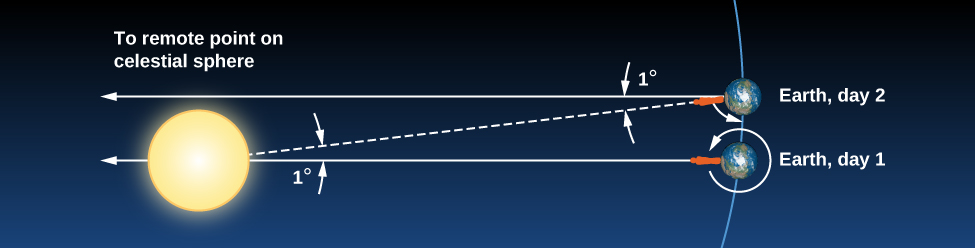
A solar day is slightly longer than a sidereal day because (as you can see from Figure 4.10) Earth not only turns but also moves along its path around the Sun in a day. Suppose we start when Earth’s orbital position is at day 1, with both the Sun and some distant star (located in the direction indicated by the long white arrow pointing left), directly in line with the zenith for the observer on Earth. When Earth has completed one rotation with respect to the distant star and is at day 2, the long arrow again points to the same distant star. However, notice that because of the movement of Earth along its orbit from day 1 to 2, the Sun has not yet reached a position above the observer. To complete a solar day, Earth must rotate an additional amount, equal to 1/365 of a full turn. The time required for this extra rotation is 1/365 of a day, or about 4 minutes. So the solar day is about 4 minutes longer than the sidereal day.
英語のヒント
太陽日は恒星日より少し長い。図4.10のように、地球は1日の間に自転するだけでなく、太陽の周りの軌道に沿っても進むからである。まず、地球が軌道上の「1日目」の位置にあり、太陽と遠くの恒星が、ともに地上の観測者の天頂の方向に並んでいるところから始めよう。恒星の方向は、左を向く長い白い矢印で示されている。地球がこの遠くの恒星に対して1回自転し、「2日目」の位置に来ると、長い矢印は再び同じ恒星を指す。しかし、地球が軌道に沿って1日目から2日目へ移動したため、太陽はまだ観測者の真上に来ていないことに注意しよう。1太陽日が完了するには、地球はさらに1回転の365分の1だけ回転しなければならない。この追加の回転に要する時間は1日の365分の1、すなわち約4分である。したがって、太陽日は恒星日より約4分長い。
Difference Between a Sidereal Day and a Solar Day.恒星日と太陽日の違い。
OpenStax / Rice University · CC BY 4.0
Figure 4.10 This is a top view, looking down as Earth orbits the Sun. Because Earth moves around the Sun (roughly 1° per day), after one complete rotation of Earth relative to the stars, we do not see the Sun in the same position.
図4.10 太陽の周りを公転する地球を上から見下ろした図。地球は太陽の周りを1日におよそ1°進む。そのため、恒星に対して地球がちょうど1回転しても、太陽は同じ位置には見えない。
Because our ordinary clocks are set to solar time, stars rise 4 minutes earlier each day. Astronomers prefer sidereal time for planning their observations because in that system, a star rises at the same time every day.
英語のヒント
普段の時計は太陽時に合わせてあるため、星が昇る時刻は毎日4分ずつ早くなる。天文学者は観測を計画するとき、恒星時を好んで使う。恒星時なら、ある星は毎日同じ時刻に昇るからである。
Sidereal Time and Solar Time恒星時と太陽時
The Sun makes a complete circle in the sky approximately every 24 hours, while the stars make a complete circle in the sky in 4 minutes less time, or 23 hours and 56 minutes. This causes the positions of the stars at a given time of day or night to change slightly each day. Since stars rise 4 minutes earlier each day, that works out to about 2 hours per month . So, if a particular constellation rises at sunset during the winter, you can be sure that by the summer, it will rise about 12 hours earlier, with the sunrise, and it will not be so easily visible in the night sky. Let’s say that tonight the bright star Sirius rises at 7:00 p.m. from a given location so that by midnight, it is very high in the sky. At what time will Sirius rise in three months?
英語のヒント
太陽はおよそ24時間ごとに空をひと回りするが、星はそれより4分短い23時間56分でひと回りする。そのため、昼夜のある決まった時刻に見た星の位置は、毎日少しずつ変わる。星が毎日4分早く昇ることは、1か月では約2時間に相当する。したがって、冬にある星座が日没とともに昇るなら、夏には約12時間早い日の出とともに昇り、夜空では見にくくなることが分かる。ある場所で今夜、明るい星シリウスが午後7時に昇り、真夜中には空高くにあるとしよう。3か月後、シリウスは何時に昇るだろうか。
Solution解き方
In three months’ time, Sirius will be rising earlier by:
3か月後、シリウスが昇る時刻は、次の時間だけ早くなる。
It will rise at about 1:00 p.m. and be high in the sky at around sunset instead of midnight. Sirius is the brightest star in the constellation of Canis Major (the big dog). So, some other constellation will be prominently visible high in the sky at this later date.
英語のヒント
シリウスは午後1時ごろに昇り、真夜中ではなく日没ごろに空高くに来る。シリウスは、おおいぬ座で最も明るい恒星である。そのころには、別の星座が夜空の高いところで目立って見えることになる。
Check Your Learning理解を確かめよう
If a star rises at 8:30 p.m. tonight, approximately what time will it rise two months from now?
ある星が今夜、午後8時30分に昇るとすると、2か月後にはおよそ何時に昇るだろうか。
Apparent Solar Time視太陽時
We can define apparent solar time as time reckoned by the actual position of the Sun in the sky (or, during the night, its position below the horizon). This is the kind of time indicated by sundials, and it probably represents the earliest measure of time used by ancient civilizations. Today, we adopt the middle of the night as the starting point of the day and measure time in hours elapsed since midnight.
英語のヒント
視太陽時とは、空での太陽の実際の位置、夜間であれば地平線より下の位置によって数える時刻、と定義できる。これは日時計が示す時刻であり、おそらく古代文明で使われた最も初期の時刻の測り方を表している。現在では真夜中を1日の始まりとし、真夜中から何時間たったかで時刻を測る。
During the first half of the day, the Sun has not yet reached the local meridian (the great circle in the sky that passes through our zenith). We designate those hours as before midday (ante meridiem, or a.m.), before the Sun reaches the local meridian. We customarily start numbering the hours after noon over again and designate them by p.m. (post meridiem), after the Sun reaches the local meridian.
英語のヒント
1日の前半では、太陽はまだその場所の子午線、すなわち天頂を通る空の大円に達していない。太陽が子午線に達する前のこの時間を、「正午より前」を意味するante meridiem、略してa.m.と呼ぶ。慣習として、正午のあとには時刻の数字を初めから数え直し、post meridiem、略してp.m.で表す。これは太陽がその場所の子午線を通過したあとの時間である。
Although apparent solar time seems simple, it is not really very convenient to use. The exact length of an apparent solar day varies slightly during the year. The eastward progress of the Sun in its annual journey around the sky is not uniform because the speed of Earth varies slightly in its elliptical orbit. Another complication is that Earth’s axis of rotation is not perpendicular to the plane of its revolution. Thus, apparent solar time does not advance at a uniform rate. After the invention of mechanical clocks that run at a uniform rate, it became necessary to abandon the apparent solar day as the fundamental unit of time.
英語のヒント
視太陽時は単純に見えるが、実際にはあまり使いやすくない。視太陽日の正確な長さは、1年の間にわずかに変わる。太陽が1年かけて空を巡る際の東向きの進み方は、一様ではない。地球が楕円軌道上を進む速さが、少し変わるためである。さらに、地球の自転軸が公転面に垂直でないことも、話を複雑にする。したがって、視太陽時は一定の速さでは進まない。一定の速さで動く機械式時計が発明されると、視太陽日を時間の基本単位として使うことは、やめる必要が生じた。