第4章地球・月・空Earth, Moon, and Sky
Appearance of a Total Eclipse皆既日食の見え方
What can you see if you are lucky enough to catch a total eclipse? A solar eclipse starts when the Moon just begins to silhouette itself against the edge of the Sun’s disk. A partial phase follows, during which more and more of the Sun is covered by the Moon. About an hour after the eclipse begins, the Sun becomes completely hidden behind the Moon. In the few minutes immediately before this period of totality begins, the sky noticeably darkens, some flowers close up, and chickens may go to roost. As an eerie twilight suddenly descends during the day, other animals (and people) may get disoriented. During totality, the sky is dark enough that planets become visible in the sky, and usually the brighter stars do as well.
英語のヒント
運よく皆既日食に出会えたら、何が見えるだろうか。日食は、月が太陽の円盤の縁に暗い輪郭を見せ始めるときに始まる。続く部分食の段階では、太陽が次第に月に覆われていく。食が始まって約1時間後、太陽は月の後ろに完全に隠れる。皆既が始まる直前の数分間には、空が目に見えて暗くなり、花が閉じたり、ニワトリがねぐらに入ったりすることがある。昼間なのに不気味な薄明が突然訪れ、ほかの動物や人間も、調子が狂うかもしれない。皆既中は、惑星が見えるほど空が暗くなり、普通は明るい恒星も見える。
As the bright disk of the Sun becomes entirely hidden behind the Moon, the Sun’s remarkable corona flashes into view (Figure 4.23). The corona is the Sun’s outer atmosphere, consisting of sparse gases that extend for millions of miles in all directions from the apparent surface of the Sun. It is ordinarily not visible because the light of the corona is feeble compared with the light from the underlying layers of the Sun. Only when the brilliant glare from the Sun’s visible disk is blotted out by the Moon during a total eclipse is the pearly white corona visible. (We’ll talk more about the corona in the chapter on The Sun: A Garden-Variety Star.)
英語のヒント
太陽の明るい円盤が月の後ろに完全に隠れると、見事なコロナがぱっと姿を現す(図4.23)。コロナは太陽の外層大気であり、見かけの表面から全方向に数百万マイルも延びる、希薄なガスからなる。通常は、下の太陽の層から来る光に比べてコロナの光が弱いため、見えない。皆既日食で、目に見える太陽の円盤のまぶしい光が月に覆い隠されたときにだけ、真珠のように白いコロナが見える。コロナについては「太陽――ありふれた恒星」の章で、さらに詳しく扱う。
The Sun’s Corona.太陽のコロナ。
Figure 4.23 The corona (thin outer atmosphere) of the Sun is visible during a total solar eclipse. (It looks more extensive in photographs than it would to the unaided eye.) (credit: modification of work by Lutfar Rahman Nirjhar)
図4.23 皆既日食中に見える、太陽のコロナ、すなわち薄い外層大気。肉眼で見るより、写真では広く広がって見える。(出典:Lutfar Rahman Nirjharの作品を改変)
The total phase of the eclipse ends, as abruptly as it began, when the Moon begins to uncover the Sun. Gradually, the partial phases of the eclipse repeat themselves, in reverse order, until the Moon has completely uncovered the Sun. We should make one important safety point here: while the few minutes of the total eclipse are safe to look at, if any part of the Sun is uncovered, you must protect your eyes with safe eclipse glassesEclipse glasses are available in many planetarium and observatory gift stores, and also from the two main U.S. manufacturers: American Paper Optics and Rainbow Symphony. or by projecting an image of the Sun (instead of looking at it directly). For more, read the How to Observe Solar Eclipses box in this chapter.
英語のヒント
月が太陽を再び露出させ始めると、皆既の段階は、始まったときと同じくらい突然終わる。その後、部分食の段階を逆の順序で少しずつたどり、やがて太陽は月にまったく隠されなくなる。ここで、観察の安全について重要な点を述べておく。太陽が完全に隠れている皆既の数分間は直接見られるが、太陽が少しでも露出しているときは、安全な日食観察用眼鏡で目を守るか、太陽の像を投影して、直接は見ないようにする必要がある。日食観察用眼鏡は、多くのプラネタリウムや天文台の売店のほか、アメリカの主要なメーカーであるAmerican Paper OpticsとRainbow Symphonyでも入手できる。詳しくは、この章の囲み記事「日食を観察する方法」を参照しよう。
Eclipses of the Moon月食
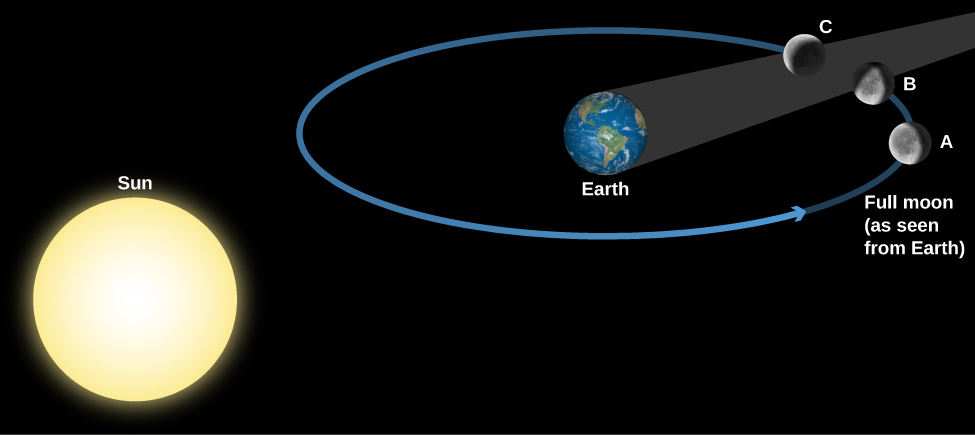
A lunar eclipse occurs when the Moon enters the shadow of Earth. The geometry of a lunar eclipse is shown in Figure 4.24. Earth’s dark shadow is about 1.4 million kilometers long, so at the Moon’s distance (an average of 384,000 kilometers), it could cover about four full moons. Unlike a solar eclipse, which is visible only in certain local areas on Earth, a lunar eclipse is visible to everyone who can see the Moon. Because a lunar eclipse can be seen (weather permitting) from the entire night side of Earth, lunar eclipses are observed far more frequently from a given place on Earth than are solar eclipses.
英語のヒント
月食は、月が地球の影に入るときに起きる。その位置関係を図4.24に示す。地球の暗い影の長さは約140万キロメートルで、平均38万4000キロメートルという月の距離では、満月を約4個覆えるほどの大きさがある。地球の限られた地域でしか見えない日食と異なり、月食は月を見られるすべての人に見える。天気さえ許せば、地球の夜側の全域から見えるため、地上のある一地点では、日食よりはるかに頻繁に月食を観測できる。
Geometry of a Lunar Eclipse.月食の位置関係。
OpenStax / Rice University · CC BY 4.0
Figure 4.24 The Moon is shown moving through the different parts of Earth’s shadow during a total lunar eclipse. Note that the distance the Moon moves in its orbit during the eclipse has been exaggerated here for clarity.
図4.24 皆既月食の間、月が地球の影の各部分を通り抜ける様子を示す。分かりやすくするため、食の間に月が軌道上を進む距離は誇張してある。
An eclipse of the Moon is total only if the Moon’s path carries it though Earth’s umbra. If the Moon does not enter the umbra completely, we have a partial eclipse of the Moon. But because Earth is larger than the Moon, its umbra is larger, so that lunar eclipses last longer than solar eclipses, as we will discuss below.
月食が皆既になるのは、月が地球の本影の中を通るときだけである。本影に完全には入らなければ、部分月食となる。地球は月より大きく、その本影も大きいため、後で説明するように、月食は日食より長く続く。
A lunar eclipse can take place only when the Sun, Earth, and Moon are in a line. The Moon is opposite the Sun, which means the Moon will be in full phase before the eclipse, making the darkening even more dramatic. About 20 minutes before the Moon reaches the dark shadow, it dims somewhat as Earth partly blocks the sunlight. As the Moon begins to dip into the shadow, the curved shape of Earth’s shadow upon it soon becomes apparent.
英語のヒント
月食は、太陽・地球・月が一直線に並ぶときにだけ起こる。月は太陽の反対側にあるので、食の前は満月であり、そのため暗くなる変化がいっそう際立つ。月が暗い影に達する約20分前には、地球が太陽光を部分的に遮るため、月はやや暗くなる。月が影に入り始めると、月面に落ちる地球の影が曲線状であることが、すぐに分かるようになる。
Even when totally eclipsed, the Moon is still faintly visible, usually appearing a dull coppery red. The illumination on the eclipsed Moon is sunlight that has been bent into Earth’s shadow by passing through Earth’s atmosphere.
英語のヒント
完全に食になっても月はかすかに見え、普通は鈍い銅色がかった赤に見える。食の月を照らすのは、地球の大気を通ることで曲げられ、地球の影へ入り込んだ太陽光である。
After totality, the Moon moves out of the shadow and the sequence of events is reversed. The total duration of the eclipse depends on how closely the Moon’s path approaches the axis of the shadow. For an eclipse where the Moon goes through the center of Earth’s shadow, each partial phase consumes at least 1 hour, and totality can last as long as 1 hour and 40 minutes. Eclipses of the Moon are much more “democratic” than solar eclipses. Since the full moon is visible on the entire night side of Earth, the lunar eclipse is visible for all those who live in that hemisphere. (Recall that a total eclipse of the Sun is visible only in a narrow path where the shadow of the umbra falls.) Total eclipses of the Moon occur, on average, about once every two or three years. A list of future total eclipses of the Moon is in Appendix H. In addition, since the lunar eclipse happens to a full moon, and a full moon is not dangerous to look at, everyone can look at the Moon during all the parts of the eclipse without worrying about safety.
英語のヒント
皆既のあと、月は影から出ていき、出来事が逆の順序で進む。食全体の長さは、月の通り道が影の中心軸にどれだけ近づくかによって決まる。月が地球の影の中心を通る食では、前後の部分食の段階がそれぞれ少なくとも1時間かかり、皆既は1時間40分もの長さになり得る。月食は日食より、はるかに「民主的」である。満月は地球の夜側全域で見えるので、その半球に暮らすすべての人に月食が見える。皆既日食が見えるのは、本影が落ちる細い帯だけだったことを思い出そう。皆既月食は平均して2~3年に1回起きるとされ、その今後の一覧を付録Hに載せてある。さらに、月食は満月に起こり、満月を見ても危険はないので、食のどの段階でも、誰でも安全を心配せずに月を見られる。
Thanks to our understanding of gravity and motion (see Orbits and Gravity), eclipses can now be predicted centuries in advance. We’ve come a long way since humanity stood frightened by the darkening of the Sun or the Moon, fearing the displeasure of the gods. Today, we enjoy the sky show with a healthy appreciation of the majestic forces that keep our solar system running.
英語のヒント
重力と運動について理解が進んだおかげで、今では何世紀も先の食を予測できる(「軌道と重力」を参照)。太陽や月が暗くなると神々の怒りを恐れておびえていたころから、人類は大きく進歩した。今日では、太陽系の運動を保つ壮大な力をきちんと理解しながら、空のショーを楽しんでいる。