第4章地球・月・空Earth, Moon, and Sky
4.6 Ocean Tides and the Moon4.6 海の潮汐と月
Learning Objectives学習の目標
By the end of this section, you will be able to:
この節を学ぶと、次のことができるようになる。
Describe what causes tides on Earth
地球で潮汐が起きる原因を説明する。
Explain why the amplitude of tides changes during the course of a month
潮汐の振幅が1か月の間に変わる理由を説明する。
Anyone living near the sea is familiar with the twice-daily rising and falling of the tides. Early in history, it was clear that tides must be related to the Moon because the daily delay in high tide is the same as the daily delay in the Moon’s rising. A satisfactory explanation of the tides, however, awaited the theory of gravity, supplied by Newton.
英語のヒント
海の近くに住む人なら、1日に2回、潮が満ち引きすることをよく知っている。満潮になる時刻が毎日遅れていく量が、月の出の遅れと同じなので、潮汐が月に関係することは歴史の早い時期から明らかだった。しかし、潮汐を十分に説明できるようになるには、ニュートンが示した重力の理論を待たねばならなかった。
The Pull of the Moon on Earth地球に働く月の引力
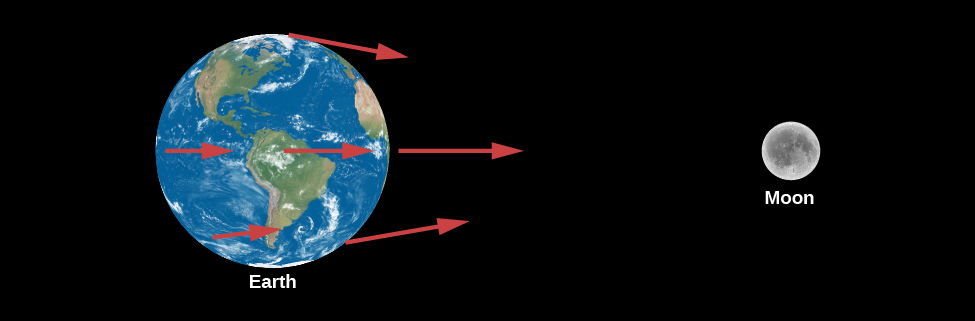
The gravitational forces exerted by the Moon at several points on Earth are illustrated in Figure 4.16. These forces differ slightly from one another because Earth is not a point, but has a certain size: all parts are not equally distant from the Moon, nor are they all in exactly the same direction from the Moon. Moreover, Earth is not perfectly rigid. As a result, the differences among the forces of the Moon’s attraction on different parts of Earth (called differential forces) cause Earth to distort slightly. The side of Earth nearest the Moon is attracted toward the Moon more strongly than is the center of Earth, which in turn is attracted more strongly than is the side opposite the Moon. Thus, the differential forces tend to stretch Earth slightly into an oblate spheroid (which is something like an American football shape), with its long diameter pointed toward the Moon.
英語のヒント
地球上のいくつかの地点で、月から受ける重力を図4.16に示す。これらの力は少しずつ異なる。地球は点ではなく、一定の大きさを持つためである。地球の各部分が月から等距離にあるわけではなく、月から見てまったく同じ方向にあるわけでもない。さらに地球は、完全な剛体ではない。その結果、地球の各部分に働く月の引力の差、いわゆる差分の力によって、地球はわずかに変形する。月に最も近い側は地球の中心より強く月へ引かれ、中心は月と反対側より強く引かれる。このように、力の差は地球をわずかに引き伸ばし、長い直径が月を向く、アメリカンフットボールのボールのような回転楕円体にしようとする。原文では、この形を「扁平回転楕円体」と呼んでいる。
Pull of the Moon.月の引力。
OpenStax / Rice University · CC BY 4.0
Figure 4.16 The Moon’s differential attraction is shown on different parts of Earth. (Note that the differences have been exaggerated for educational purposes.)
図4.16 地球の各部分で異なる、月の引力を示す。違いを分かりやすくするため、力の差は誇張してある。
If Earth were made of water, it would distort until the Moon’s differential forces over different parts of its surface came into balance with Earth’s own gravitational forces pulling it together. Calculations show that in this case, Earth would distort from a sphere by amounts ranging up to nearly 1 meter. Measurements of the actual deformation of Earth show that the solid Earth does distort, but only about one-third as much as water would, because of the greater rigidity of Earth’s interior.
英語のヒント
地球が水でできていれば、表面の各部分に働く月の引力の差が、地球自身を一つにまとめようとする重力と釣り合うまで変形するだろう。計算によると、この場合、球からのずれは大きいところでほぼ1メートルに達する。実際の地球の変形を測ると、固体の地球も確かに変形するが、その量は水の場合の約3分の1にすぎない。地球内部の剛性が、水より大きいためである。
Because the tidal distortion of the solid Earth amounts—at its greatest—to only about 20 centimeters, Earth does not distort enough to balance the Moon’s differential forces with its own gravity. Hence, objects at Earth’s surface experience tiny horizontal tugs, tending to make them slide about. These tide-raising forces are too insignificant to affect solid objects like astronomy students or rocks in Earth’s crust, but they do affect the waters in the oceans.
英語のヒント
固体の地球が潮汐で変形する量は、最大でも約20センチメートルにとどまる。そのため、地球自身の重力で月の引力の差を打ち消せるほどには変形しない。したがって地表の物体には、水平方向のごく小さな引っ張りが働き、物体を滑らせようとする。この起潮力は、天文学の学生や地殻の岩石など、固体の物体に影響するには小さすぎる。しかし、海の水には影響する。
The Formation of Tides潮汐ができる仕組み
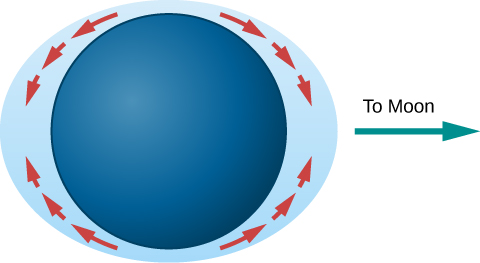
The tide-raising forces, acting over a number of hours, produce motions of the water that result in measurable tidal bulges in the oceans. Water on the side of Earth facing the Moon flows toward it, with the greatest depths roughly at the point below the Moon. On the side of Earth opposite the Moon, water also flows to produce a tidal bulge (Figure 4.17).
英語のヒント
起潮力が数時間にわたって働くと、水に流れが生じ、海に測定可能な潮汐の盛り上がりができる。地球の月を向いた側では、水が月の方向へ流れ、ほぼ月の真下で最も深くなる。月と反対側でも水が流れ、潮汐の盛り上がりを作る(図4.17)。
Tidal Bulges in an “Ideal” Ocean.「理想的な」海での潮汐の盛り上がり。
OpenStax / Rice University · CC BY 4.0
Figure 4.17 Differences in gravity cause tidal forces that push water in the direction of tidal bulges on Earth.
図4.17 重力の差によって潮汐力が生じ、地球上で潮が盛り上がる方向へ水を押し動かす。
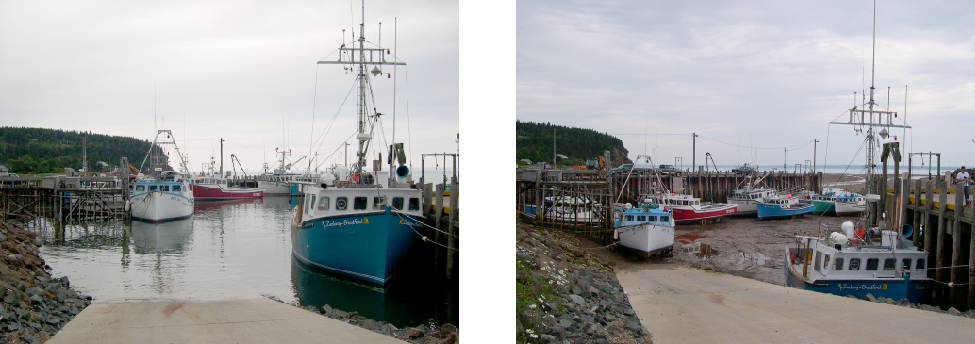
Note that the tidal bulges in the oceans do not result from the Moon’s compressing or expanding the water, nor from the Moon’s lifting the water “away from Earth.” Rather, they result from an actual flow of water over Earth’s surface toward the two regions below and opposite the Moon, causing the water to pile up to greater depths at those places (Figure 4.18).
英語のヒント
海の潮汐の盛り上がりは、月が水を圧縮したり膨張させたりするためでも、月が水を「地球から引き離して」持ち上げるためでもないことに注意しよう。実際には水が地表に沿って、月の真下とその反対側の二つの地域へ流れるために生じる。その場所に水が集まり、水深が大きくなるのである(図4.18)。
High and Low Tides.満潮と干潮。
credit a, b: modification of work by Dylan Kereluk · CC BY 2.0
Figure 4.18 This is a side-by-side comparison of the Bay of Fundy in Canada at high and low tides. (credit a, b: modification of work by Dylan Kereluk)
図4.18 カナダのファンディ湾を、満潮時と干潮時で並べて比較したもの。(a、bの出典:Dylan Kerelukの作品を改変)
In the idealized (and, as we shall see, oversimplified) model just described, the height of the tides would be only a few feet. The rotation of Earth would carry an observer at any given place alternately into regions of deeper and shallower water. An observer being carried toward the regions under or opposite the Moon, where the water was deepest, would say, “The tide is coming in”; when carried away from those regions, the observer would say, “The tide is going out.” During a day, the observer would be carried through two tidal bulges (one on each side of Earth) and so would experience two high tides and two low tides.
英語のヒント
ここまでの理想化したモデルでは、潮の高さはわずか数フィートにとどまる。後で見るように、このモデルは単純化しすぎている。地球の自転によって、ある場所の観測者は、水深の大きい地域と小さい地域へ交互に運ばれる。月の真下、またはその反対側の水が最も深い地域へ向かう観測者は、「潮が満ちてきた」と言い、そこから離れるときには「潮が引いてきた」と言うだろう。1日の間に観測者は、地球の両側に一つずつある二つの盛り上がりを通るので、満潮と干潮をそれぞれ2回経験する。
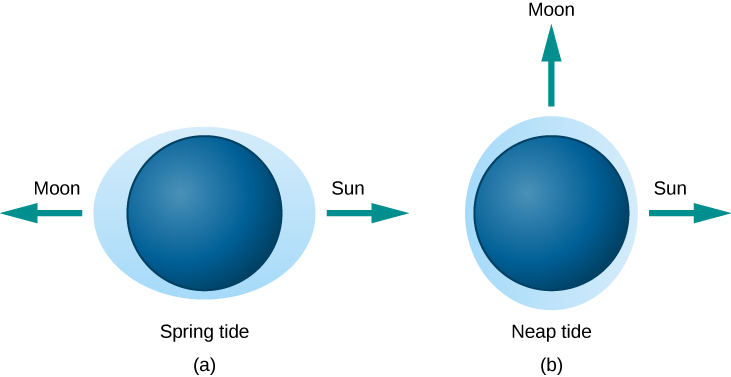
The Sun also produces tides on Earth, although it is less than half as effective as the Moon at tide raising. The actual tides we experience are a combination of the larger effect of the Moon and the smaller effect of the Sun. When the Sun and Moon are lined up (at new moon or full moon), the tides produced reinforce each other and so are greater than normal (Figure 4.19). These are called spring tides (the name is connected not to the season but to the idea that higher tides “spring up”). Spring tides are approximately the same, whether the Sun and Moon are on the same or opposite sides of Earth, because tidal bulges occur on both sides. When the Moon is at first quarter or last quarter (at right angles to the Sun’s direction), the tides produced by the Sun partially cancel the tides of the Moon, making them lower than usual. These are called neap tides.
英語のヒント
太陽も地球に潮汐を起こすが、その起潮作用は月の半分に満たない。私たちが実際に経験する潮汐は、月の大きな効果と太陽の小さな効果が合わさったものである。新月や満月のときのように太陽と月が一直線に並ぶと、両者の潮汐が強め合い、普段より大きくなる(図4.19)。これを大潮、英語ではspring tidesという。springは季節の春ではなく、潮が高く「跳ね上がる」という意味に関係する。潮の盛り上がりは地球の両側にできるため、太陽と月が地球の同じ側にあっても、反対側にあっても、大潮はおよそ同じになる。月が上弦や下弦にあるとき、つまり太陽の方向と直角にあるときには、太陽の潮汐が月の潮汐を部分的に打ち消し、普段より小さくなる。これを小潮という。
Tides Caused by Different Alignments of the Sun and Moon.太陽と月の位置関係による潮汐の違い。
OpenStax / Rice University · CC BY 4.0
Figure 4.19 (a) In spring tides, the Sun’s and Moon’s pulls reinforce each other. (b) In neap tides, the Sun and the Moon pull at right angles to each other and the resulting tides are lower than usual.
図4.19 (a) 大潮では、太陽と月の引力の効果が強め合う。(b) 小潮では、太陽と月が互いに直角の方向に引き、その結果生じる潮汐は普段より小さくなる。
The “simple” theory of tides, described in the preceding paragraphs, would be sufficient if Earth rotated very slowly and were completely surrounded by very deep oceans. However, the presence of land masses stopping the flow of water, the friction in the oceans and between oceans and the ocean floors, the rotation of Earth, the wind, the variable depth of the ocean, and other factors all complicate the picture. This is why, in the real world, some places have very small tides while in other places huge tides become tourist attractions. If you have been in such places, you may know that “tide tables” need to be computed and published for each location; one set of tide predictions doesn’t work for the whole planet. In this introductory chapter, we won’t delve further into these complexities.
英語のヒント
前の段落で説明した「単純な」潮汐の理論は、地球の自転が非常に遅く、全体が非常に深い海で覆われていれば、十分だろう。しかし実際には、水の流れをせき止める陸地、海の内部や海底との間の摩擦、地球の自転、風、水深の違いなど、多くの要因が状況を複雑にする。そのため現実には、潮汐がごく小さい場所もあれば、巨大な潮汐が観光名所になる場所もある。そのような場所へ行ったことがあれば、「潮汐表」が場所ごとに計算・公表される必要があると知っているかもしれない。一組の潮汐予報を、地球全体に使うことはできない。この入門の章では、こうした複雑さには、これ以上立ち入らない。