第13章彗星と小惑星――太陽系に残されたかけらComets and Asteroids: Debris of the Solar System
Thinking Aheadまず考えてみよう
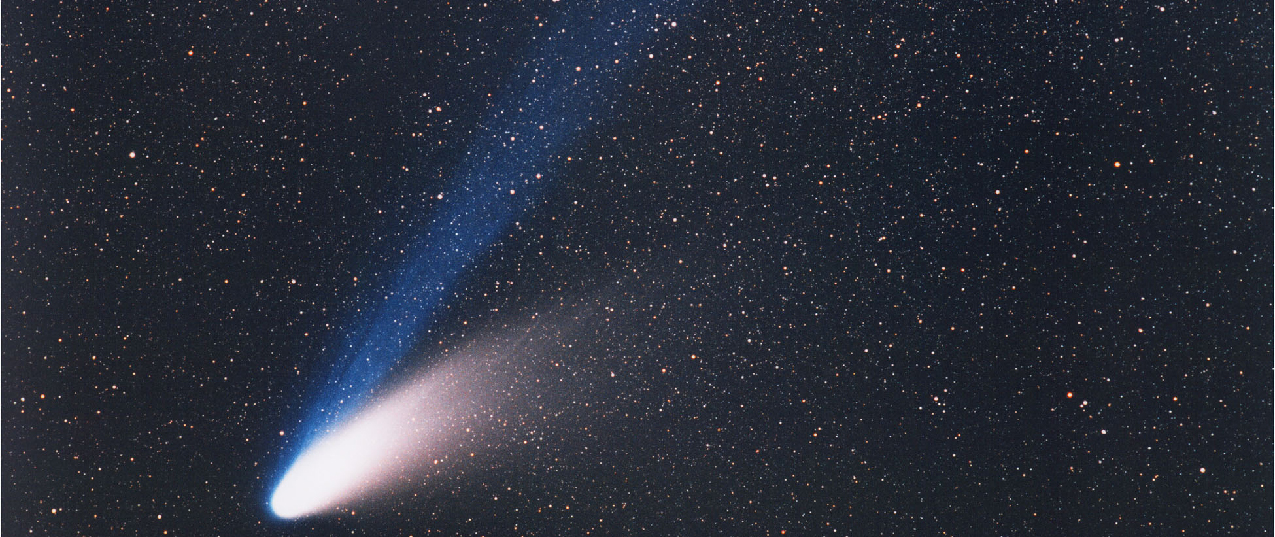
Hale-Bopp.ヘール・ボップ彗星。
credit: modification of work by ESO/E. Slawik · CC BY 4.0
Figure 13.1 Comet Hale-Bopp was one of the most attractive and easily visible comets of the twentieth century. It is shown here as it appeared in the sky in March 1997. You can see the comet’s long blue ion tail and the shorter white dust tail. You will learn about these two types of comet tails, and how they form, in this chapter. (credit: modification of work by ESO/E. Slawik)
図13.1 ヘール・ボップ彗星は、20世紀で最も美しく、見つけやすい彗星の一つだった。ここには1997年3月の空での姿を示す。長く青いイオンの尾と、それより短い白い塵の尾が見える。この章では、この二種類の彗星の尾と、そのでき方を学ぶ。(クレジット:ESO/E. Slawikの作品を改変)
Hundreds of smaller members of the solar system—asteroids and comets—are known to have crossed Earth’s orbit in the past, and many others will do so in centuries ahead. What could we do if we knew a few years in advance that one of these bodies would hit Earth?
英語のヒント
太陽系の小さな仲間である小惑星や彗星のうち、数百個は過去に地球の軌道を横切ったことがわかっており、これから数世紀の間には、さらに多くが横切るだろう。もしその一つが地球に衝突すると数年前にわかったら、私たちには何ができるだろうか。
To understand the early history of life on Earth, scientists study ancient fossils. To reconstruct the early history of the solar system, we need cosmic fossils—materials that formed when our system was very young. However, reconstructing the early history of the solar system by looking just at the planets is almost as difficult as determining the circumstances of human birth by merely looking at an adult.
英語のヒント
地球上の生命の初期の歴史を理解するため、科学者は古代の化石を調べる。太陽系の初期の歴史を復元するには、宇宙の化石、つまり太陽系がまだ非常に若かったころにできた物質が必要だ。しかし、惑星だけを見て太陽系の初期の歴史を復元するのは、大人を眺めるだけで、その人が生まれたときの状況を突き止めるのと、ほとんど同じくらい難しい。
Instead, we turn to the surviving remnants of the creation process—ancient but smaller objects in our cosmic neighborhood. Asteroids are rocky or metallic and contain little volatile (easily evaporated) material. Comets are small icy objects that contain frozen water and other volatile materials but with solid grains mixed in. In the deep freeze beyond Neptune, we also have a large reservoir of material unchanged since the formation of the solar system, as well as a number of dwarf planets.
英語のヒント
そこで、私たちは形成過程の生き残り、つまり宇宙の近隣にある、古くて小さな天体に目を向ける。小惑星は岩石質または金属質で、揮発性、すなわち蒸発しやすい物質をほとんど含まない。彗星は、水などの揮発性物質が凍ったものを含み、固体の粒も混じる小さな氷の天体だ。海王星の向こうの極寒の領域には、多数の準惑星とともに、太陽系の形成以来変わらずに残る物質の大きな貯蔵庫もある。