第13章彗星と小惑星――太陽系に残されたかけらComets and Asteroids: Debris of the Solar System
13.4 The Origin and Fate of Comets and Related Objects13.4 彗星と関連天体の起源と運命
Learning Objectives学習の目標
By the end of this section, you will be able to:
この節を終えると、次のことができるようになる。
Describe the traits of the centaur objects
ケンタウルス族天体の特徴を説明する。
Chronicle the discovery and describe the composition of the Oort cloud
オールトの雲の発見に至る経緯をたどり、その構成を説明する。
Describe trans-Neptunian and Kuiper-belt objects
太陽系外縁天体とカイパーベルト天体を説明する。
Explain the proposed fate of comets that enter the inner solar system
太陽系の内側へ入った彗星について、考えられている運命を説明する。
The comets we notice when they come near Earth (especially the ones coming for the first time) are probably the most primitive objects we can study, preserved unchanged for billions of years in the deep freeze of the outer solar system. However, astronomers have discovered many other objects that orbit the Sun beyond the planets.
英語のヒント
地球の近くへ来て私たちが気づく彗星、特に初めてやって来るものは、おそらく私たちが調べられる中で最も始原的な天体だ。外側の太陽系の極寒の中で、何十億年も変わらず保存されてきた。しかし天文学者は、惑星の向こうで太陽を回る、ほかの多くの天体も発見している。
Centaurs and TNOsケンタウルス族と太陽系外縁天体
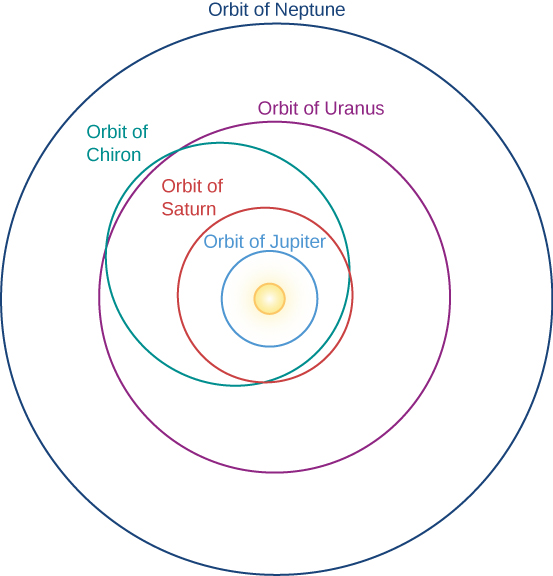
In the outer solar system, where most objects contain large amounts of water ice, the distinction between asteroids and comets breaks down. Astronomers initially still used the name “asteroids” for new objects discovered going around the Sun with orbits that carry them far beyond Jupiter. The first of these objects is Chiron, found in 1977 on a path that carries it from just inside the orbit of Saturn at its closest approach to the Sun out to almost the distance of Uranus (Figure 13.26). The diameter of Chiron is estimated to be about 200 kilometers, much larger than any known comet.
英語のヒント
大部分の天体が大量の水の氷を含む外側の太陽系では、小惑星と彗星の区別が成り立たなくなる。当初、天文学者は、太陽を回り、木星のはるか外まで達する軌道で新たに見つかる天体にも、「小惑星」という名を使い続けた。最初のものは、1977年に見つかったキロンだ。太陽に最も近いときには土星軌道のすぐ内側にあり、遠ざかると天王星の距離近くまで達する軌道を持つ(図13.26)。直径は約200kmと推定され、既知のどの彗星よりもはるかに大きい。
Chiron’s Orbit.キロンの軌道。
OpenStax / Rice University · CC BY 4.0
Figure 13.26 Chiron orbits the Sun every 50 years, with its closest approach being inside the orbit of Saturn and its farthest approach out to the orbit of Uranus.
図13.26 キロンは50年ごとに太陽を回り、最も近づくところは土星軌道の内側、最も遠ざかるところは天王星の軌道まで達する。
In 1992, a still-more-distant object named Pholus was discovered with an orbit that takes it 33 AU from the Sun, beyond the orbit of Neptune. Pholus has the reddest surface of any object in the solar system, indicating a strange (and still unknown) surface composition. As more objects are discovered in these distant reaches, astronomers decided that they will be given the names of centaurs from classical mythology; this is because the centaurs were half human, half horse, and these new objects display some of the properties of both asteroids and comets.
英語のヒント
1992年には、さらに遠いフォルスという天体が見つかった。その軌道は太陽から33天文単位、海王星軌道の向こうまで達する。フォルスの表面は太陽系のどの天体よりも赤く、奇妙で、まだわかっていない表面組成を示している。この遠方領域でさらに天体が見つかるにつれて、天文学者は、それらに古典神話のケンタウルスの名前を付けることにした。ケンタウルスが半人半馬であり、新しい天体が小惑星と彗星の両方の性質をいくらか示すためだ。
Beyond the orbit of Neptune lies a cold, dark realm populated by objects called simply trans-Neptunian objects (TNOs). The first discovered, and best known, of these TNOs is the dwarf planet Pluto. We discussed Pluto and the New Horizons spacecraft encounter with it in Rings, Moons, and Pluto. The second TNO was discovered in 1992, and now more than a thousand are known, most of them smaller than Pluto. In late 2018, a team of astronomers announced the discovery of the most distant TNO found so far, orbiting at 120 Astronomical Units, or 3 ½ times the distance of Pluto; they nicknamed it “farout.”
英語のヒント
海王星の軌道の向こうには、単に太陽系外縁天体、英語ではtrans-Neptunian objects、略してTNOと呼ばれる天体が存在する、冷たく暗い領域がある。最初に発見され、最もよく知られたTNOは、準惑星の冥王星だ。冥王星とニュー・ホライズンズの接近探査は、「環・衛星・冥王星」で取り上げた。二つ目のTNOは1992年に発見され、いまでは1000個以上が知られている。大部分は冥王星より小さい。2018年末、天文学者のチームは、これまでで最も遠いTNOの発見を発表した。120天文単位、冥王星までの距離の3.5倍のところを回り、「ファーアウト」という愛称を付けられた。
The largest ones after Pluto—named Eris, Makemake, and Haumea—are also classed as dwarf planets. Except for their small size, dwarf planets have many properties in common with the larger planets. Pluto has five moons, and two moons have been discovered orbiting Haumea and one each circling Eris and Makemake. Modern instruments have also allowed astronomers to discover moons around many of the smaller TNOs, just as they have around many asteroids. As of mid-2025, over 450 moons are now known in total around these smaller members of our solar system.
英語のヒント
冥王星に次いで大きい、エリス・マケマケ・ハウメアも、準惑星に分類される。小さいことを除けば、準惑星は大きな惑星と多くの性質を共有する。冥王星には五つの衛星があり、ハウメアを回る衛星は二つ、エリスとマケマケを回るものはそれぞれ一つ見つかっている。現代の観測装置によって、天文学者は、多くの小惑星の周りと同じように、小さなTNOの多くの周りにも衛星を見つけられるようになった。2025年半ばの時点では、こうした太陽系の小さな仲間の周りで、合計450個を超える衛星が知られている。
The Kuiper Belt and the Oort Cloudカイパーベルトとオールトの雲
TNOs are a part of what is called the Kuiper belt, a large area of space beyond Neptune that is also the source of many comets. Astronomers study the Kuiper belt in two ways. New, more powerful telescopes allow us to discover many of the larger members of the Kuiper belt directly. We can also measure the composition of short-period comets that are thought to originate in the Kuiper belt, where small gravitational perturbations from Neptune can gradually shift their orbits until they can penetrate the inner solar system. More than a thousand Kuiper belt objects have been discovered, and astronomers estimate that there are more than 100,000 with diameters larger than 100 kilometers, in a disk extending out to about 50 AU from the Sun.
英語のヒント
TNOは、カイパーベルトと呼ばれるものの一部だ。これは海王星の向こうに広がる大きな空間領域で、多くの彗星の供給源でもある。天文学者は二つの方法でカイパーベルトを調べる。より高性能な新しい望遠鏡によって、大きな構成天体を数多く直接発見できる。カイパーベルトから来たと考えられる短周期彗星の組成を測ることもできる。カイパーベルトでは、海王星による小さな重力摂動が徐々に軌道を変え、彗星が太陽系の内側へ入り込めるようになる。カイパーベルト天体は1000個以上見つかっており、天文学者は、太陽から約50天文単位まで伸びる円盤内に、直径100kmを超えるものが10万個以上あると推定している。
Following its successful flyby of Pluto, the New Horizons spacecraft explored the Kuiper Belt. The team eventually identified a member of the belt, 2014 MU16 (subsequently named Arrokoth), that could be reached by a slight change in the spacecraft trajectory. New Horizons flew past Arrokoth on January 1, 2019, at a distance of only 3,500 km, obtaining images and other data. The target turned out to be a contact binary, something new and unexpected (see photo).
英語のヒント
冥王星のフライバイに成功した後、ニュー・ホライズンズはカイパーベルトを探査した。チームは最終的に、探査機の経路をわずかに変えれば到達できる、カイパーベルトの一員2014 MU16、後にアロコスと名付けられた天体を選び出した。ニュー・ホライズンズは2019年1月1日、わずか3500kmの距離でアロコスのそばを通過し、画像などのデータを得た。対象は接触連星、すなわち二つの部分が接触した天体であり、これは新しく、予想外のものだった(写真参照)。
By following their orbits backward, we can calculate that the aphelia (points farthest from the Sun) of newly discovered comets typically have values near 50,000 AU (more than a thousand times farther than Pluto). This clustering of aphelion distances was first noted by Dutch astronomer Jan Oort, who, in 1950, proposed an idea for the origin of those comets that is still accepted today (Figure 13.27).
英語のヒント
新たに発見された彗星の軌道をさかのぼることで、その遠日点、つまり太陽から最も遠い点が、典型的には約5万天文単位、冥王星の1000倍以上遠くにあると計算できる。遠日点距離がこのあたりに集中することに最初に気づいたのは、オランダの天文学者ヤン・オールトだ。1950年、彼はそれらの彗星の起源について、今日でも受け入れられている考えを提案した(図13.27)。
Jan Oort (1900–1992).ヤン・オールト(1900〜1992年)。
Figure 13.27 (a) Jan Oort first suggested that there might be a reservoir of frozen chunks, potential comet nuclei, at the edge of the region of the Sun’s gravitational influence. (b) The first color image of the Kuiper Belt Object named Arrokoth, taken at a distance of 137,000 kilometers from the New Horizons spacecraft on January 1, 2019. (credit (a): This image is copyright by the Leiden Observatory; credit (b): NASA/JHU/SWRI)
図13.27 (a)ヤン・オールトは、太陽の重力が支配する領域の縁に、彗星核となりうる凍った塊の貯蔵庫があるかもしれないと、初めて提案した。(b)2019年1月1日、ニュー・ホライズンズが13万7000kmの距離から撮った、アロコスというカイパーベルト天体の最初のカラー画像。(aのクレジット:画像の著作権はライデン天文台にある。bのクレジット:NASA/JHU/SWRI)
It is possible to calculate that a star’s gravitational sphere of influence—the distance within which it can exert sufficient gravitation to hold onto orbiting objects—is about one third of its distance to the nearest other stars. Stars in the vicinity of the Sun are spaced in such a way that the Sun’s sphere of influence extends a little beyond 50,000 AU, or about 1 light-year. At such great distances, however, objects in orbit about the Sun can be perturbed by the gravity of passing stars. Some of the perturbed objects can then take on orbits that bring them much closer to the Sun (while others might be lost to the solar system forever).
英語のヒント
恒星の重力的な勢力圏、つまり周回する天体を保持するのに十分な重力を及ぼせる距離は、最も近いほかの恒星までの距離の約3分の1だと計算できる。太陽近くの星の間隔は、太陽の勢力圏が5万天文単位を少し超える、約1光年まで広がるようになっている。しかし、これほど遠いところでは、太陽を回る天体も、通り過ぎる恒星の重力で乱されうる。乱された天体の一部は、太陽にずっと近づく軌道へ移ることがある。一方、太陽系から永遠に失われるものもあるかもしれない。
Oort suggested, therefore, that the new comets we were seeing were examples of objects orbiting the Sun near the edge of its sphere of influence, whose orbits had been disturbed by nearby stars, eventually bringing them close to the Sun where we can see them. The reservoir of ancient icy objects from which such comets are derived is now called the Oort cloud.
英語のヒント
そこでオールトは、私たちが見ていた新しい彗星は、太陽の勢力圏の縁近くを周回していた天体が、近くの恒星に軌道を乱され、やがて私たちに見えるほど太陽へ近づいた例だと提案した。このような彗星の出所となる、古い氷の天体の貯蔵庫は、いまではオールトの雲と呼ばれる。
Astronomers estimate that there are about a trillion comets in the Oort cloud. In addition, we estimate that about 10 times this number of icy objects could be orbiting the Sun in the volume of space between the Kuiper belt (which is gravitationally linked to Neptune) and the Oort cloud. These objects remain undiscovered because they are too faint to be seen directly and their orbits are too stable to permit any of them to be deflected inward close to the Sun. The total number of icy or cometary objects in the outer reaches of our solar system could thus be on the order of 10 trillion , a very large number indeed.
英語のヒント
天文学者は、オールトの雲に約1兆個の彗星があると推定している。さらに、その約10倍の数の氷の天体が、海王星と重力的に結び付いたカイパーベルトと、オールトの雲との間の空間で、太陽を回っている可能性があると推定される。これらの天体は暗すぎて直接見えず、軌道も安定しすぎて太陽の近くへ向かうようにそらされないため、未発見のままだ。したがって、太陽系の外縁にある氷の天体や彗星状天体の総数は、10兆個の桁になる可能性がある。実に大きな数である。
What is the mass represented by comets? We can make an estimate if we assume something about comet sizes and masses. Let us suppose that the nucleus of Comet Halley is typical. Its observed volume is about 600 km3. If the primary constituent is water ice with a density of about 1 g/cm3, then the total mass of Halley’s nucleus must be about kilograms. This is about one ten billionth of the mass of Earth.
英語のヒント
個の彗星を合わせると、どれほどの質量になるだろうか。彗星の大きさや質量について仮定すれば、推定できる。ハレー彗星の核が典型的だとしよう。観測された体積は約600km³である。主な成分が密度約1g/cm³の水の氷なら、ハレー彗星の核の総質量は約kgのはずだ。これは地球の質量の約100億分の1に当たる。
If our estimate is reasonable and there are comets with this mass out there, their total mass would be equal to about 1000 Earths—comparable to the mass of all the planets put together. Therefore, icy, cometary material could be the most important constituent of the solar system after the Sun itself.
英語のヒント
推定が妥当で、この質量を持つ彗星が個あるなら、総質量は地球約1000個分になり、すべての惑星を合わせた質量と同程度になる。したがって氷からなる彗星状の物質は、太陽自体に次いで、太陽系の最も重要な構成物かもしれない。
Mass of the Oort Cloud Cometsオールトの雲の彗星の質量
Suppose the Oort cloud contains 1012 comets with an average diameter of 10 km each. Let’s estimate the mass of the total Oort cloud.
オールトの雲に、平均直径10kmの彗星が10¹²個あるとする。オールトの雲全体の質量を推定してみよう。
Solution解き方
We can start by assuming that typical comets are about the size of Comets Halley and Borrelly, with a diameter of 10 km and a density appropriate to water ice, which is about 1 g/cm3 or 1000 kg/m3. We know that , the volume of a sphere, and the radius, Therefore, for each comet,
英語のヒント
典型的な彗星はハレー彗星やボレリー彗星と同程度と仮定しよう。直径は10km、密度は水の氷にふさわしい約1g/cm³、すなわち1000kg/m³とする。、球の体積、半径という関係がわかっている。したがって、彗星一つについて、
Given that , each comet’s mass is
なので、彗星一つの質量は次のようになる。
To calculate the total mass of the cloud, we multiply this typical mass for one comet by the number of comets:
雲全体の質量を計算するには、彗星一つのこの典型的な質量に、彗星の個数を掛ける。
Check Your Learning理解を確かめよう
How does the total mass we calculated above compare to the mass of Jupiter? To the mass of the Sun? (Give a numerical answer.)
上で計算した総質量は、木星の質量と比べてどうだろうか。太陽の質量との比較ではどうか。数値で答えよう。