第13章彗星と小惑星――太陽系に残されたかけらComets and Asteroids: Debris of the Solar System
Vesta and Ceres.ベスタとケレス。
credit a, b: modification of work by NASA/JPL-Caltech/UCLA/MPS/DLR/IDA · JPL image use policy
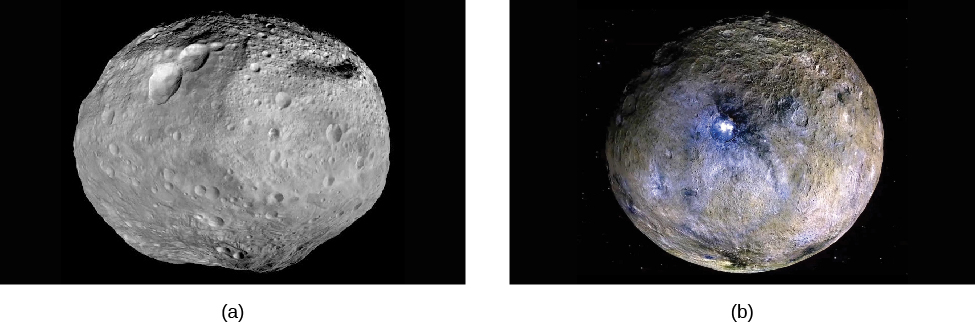
Figure 13.11 The NASA Dawn spacecraft took these images of the large asteroids (a) Vesta and (b) Ceres. (a) Note that Vesta is not round, as Ceres (which is considered a dwarf planet) is. A mountain twice the height of Mt. Everest on Earth is visible at the very bottom of the Vesta image. (b) The image of Ceres has its colors exaggerated to bring out differences in composition. You can see a white feature in Occator crater near the center of the image. (credit a, b: modification of work by NASA/JPL-Caltech/UCLA/MPS/DLR/IDA)
図13.11 NASAのドーン探査機が撮影した、大型小惑星(a)ベスタと(b)ケレス。(a)準惑星とされるケレスとは異なり、ベスタが丸くないことに注目しよう。ベスタの画像の最下部には、地球のエベレストの2倍の高さの山が見える。(b)ケレスの画像は、組成の違いを際立たせるため、色を強調してある。中央付近のオッカトル・クレーターに、白い模様が見える。(a・bのクレジット:NASA/JPL-Caltech/UCLA/MPS/DLR/IDAの作品を改変)
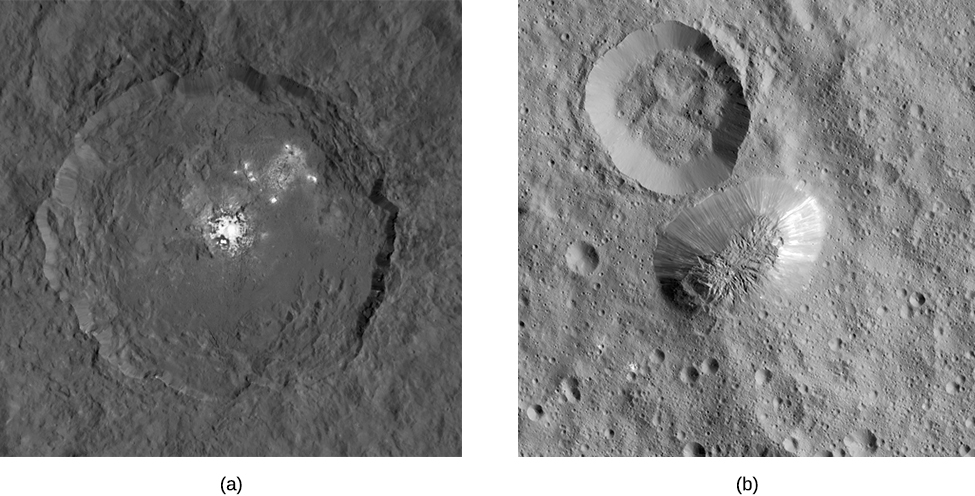
Ceres has not had a comparable history of giant impacts, so its surface is covered with craters that look more like those from the lunar highlands. One big surprise at Ceres is the presence of very bright white spots, associated primarily with the central peaks of large craters (Figure 13.12). The light-colored mineral is primarily salt, released from the interior. After repeated close flybys, data from the NASA Dawn spacecraft indicated that Ceres has (or has had) a subsurface ocean of water, with occasional eruptions on the surface. The most dramatic is the 4 kilometer tall ice volcano called Ahuna Mons (see Figure 13.12).
英語のヒント
ケレスには、同程度の巨大衝突の歴史がないため、表面を覆うクレーターは月の高地のものによく似ている。ケレスでの大きな驚きの一つは、主に大きなクレーターの中央丘に関係して、非常に明るい白い斑点があることだ(図13.12)。明るい色の鉱物は、主に内部から放出された塩である。繰り返し近接通過した後、NASAのドーン探査機のデータは、ケレスに地下の水の海があり、あるいはかつてあり、ときどき表面へ噴出することを示した。最も印象的なのが、アフナ山と呼ばれる高さ4kmの氷火山だ(図13.12参照)。
White Spots in a Larger Crater on Ceres.ケレスの大きなクレーターにある白い斑点。
credit a: modification of work by NASA/JPL-Caltech/UCLA/MPS/DLR/IDA; credit b: modification of work by NASA/JPL-Caltech/UCLA/MPS/DLR/IDA/PSI · JPL image use policy
Figure 13.12 White Spots in a Larger Crater on Ceres. (a) These bright features appear to be salt deposits in a Ceres crater called Occator, which is 92 kilometers across. (b) Ahuna Mons is an isolated mountain on Ceres, 4 kilometers high. It is thought to be an intrusion of ice from the interior. (credit a: modification of work by NASA/JPL-Caltech/UCLA/MPS/DLR/IDA; credit b: modification of work by NASA/JPL-Caltech/UCLA/MPS/DLR/IDA/PSI)
図13.12 ケレスの大きなクレーターにある白い斑点。(a)この明るい模様は、直径92kmのオッカトルというケレスのクレーターにある、塩の堆積物らしい。(b)アフナ山は、ケレスに孤立して立つ高さ4kmの山だ。内部から氷が貫入してできたものと考えられている。(aのクレジット:NASA/JPL-Caltech/UCLA/MPS/DLR/IDAの作品を改変。bのクレジット:NASA/JPL-Caltech/UCLA/MPS/DLR/IDA/PSIの作品を改変)
Lucy is a NASA mission to explore a category of solar system objects, the Trojan asteroids, that have not been explored before. The Trojans are found in two large clouds that precede and follow Jupiter in its orbit around the Sun (Figure 13.2). Because they are so far from both Earth and Jupiter, they have never been visited by spacecraft, and some scientists speculate that they were formed separately from other asteroids.
英語のヒント
ルーシーは、これまで探査されていない太陽系の天体の一群、トロヤ群小惑星を調べるNASAの計画だ。トロヤ群は、太陽の周りを回る木星の軌道で、木星に先行するものと後を追うものの二つの大きな雲状の集団に見つかる(図13.2)。地球からも木星からも非常に遠いため、これまで探査機が訪れたことはない。一部の科学者は、ほかの小惑星とは別個に形成されたのではないかと推測している。
Lucy was launched in 2021 on a 12-year journey that will take it out to one group of Trojans, then return to near Earth for a gravity boost to the other group, visiting eight asteroids in all. It has a powerful set of remote instruments such as imagers and spectrometers, to characterize the composition and geology of each target. No one knows what it may teach us about the evolution of the solar system.
英語のヒント
ルーシーは2021年に、12年間の旅に向けて打ち上げられた。一方のトロヤ群の集団まで飛び、その後、地球近くへ戻って重力で加速し、もう一方の集団へ向かう。訪れる小惑星は合計八個である。撮像装置や分光計などの高性能な遠隔観測装置を備え、各対象の組成と地質の特徴を調べる。この探査が太陽系の進化について何を教えてくれるか、まだ誰にもわからない。
A note about the quirky names assigned by astronomers: Both families of Trojan Asteroids are named for participants in the Trojan Wars of Greek mythology, in which the Greeks fought the Trojans. The ones in the group that precede Jupiter are assigned the names of Greek heroes, while the ones that follow Jupiter are assigned heroes from Troy. The Lucy mission is named for a noted fossilized skeleton of a human ancestor found in 1974, which, in turn, derived its name from the Beatles song "Lucy in the Sky with Diamonds."
英語のヒント
天文学者が付ける風変わりな名前について、一言添えておこう。トロヤ群小惑星の二つの集団は、ギリシャ人とトロヤ人が戦った、ギリシャ神話のトロイア戦争の登場人物にちなんでいる。木星に先行する集団にはギリシャ側の英雄、木星の後を追う集団にはトロイア側の英雄の名が付けられる。ルーシー探査機の名は、1974年に見つかった人類の祖先の有名な化石骨格に由来する。そして、その化石の名前は、ビートルズの曲「Lucy in the Sky with Diamonds」から取られた。
Interstellar Visitors恒星間空間からの訪問者
In late 2017, something entirely new was discovered: an interstellar asteroid. This visitor was found at a distance of 33 million kilometers with a survey telescope on Haleakala, Hawaii. As astronomers followed up on the discovery, it quickly became apparent that this asteroid was travelling far too fast to be part of the Sun’s family. Its orbit is a hyperbola, and when discovered it was already rapidly leaving the inner solar system. Although it was too distant for imaging by even large telescopes, its size and shape could be estimated from its brightness and rapid light fluctuations. It is highly elongated, with an approximately cylindrical shape. The nominal dimensions are about 200 meters in length and only 35 meters across, the most extreme of any natural object. Large objects, like planets and moons, are pulled by their own gravity into roughly spherical shapes, and even small asteroids and comets (often described as “potato-shaped”) rarely have irregularities of more than a factor of two.
英語のヒント
2017年末、まったく新しいもの、恒星間小惑星が発見された。この訪問者は、ハワイのハレアカラにあるサーベイ望遠鏡によって、3300万kmの距離で見つかった。天文学者が追跡観測すると、この小惑星はあまりにも速く動いており、太陽の仲間ではありえないことがすぐに明らかになった。軌道は双曲線で、発見時にはすでに太陽系の内側から急速に遠ざかっていた。大型望遠鏡でも姿を撮影するには遠すぎたが、明るさとその急速な変動から、大きさと形を推定できた。非常に細長く、ほぼ円柱状である。代表的な推定寸法は長さ約200m、幅わずか35mで、自然の天体としては最も極端だ。惑星や衛星のような大きな天体は、自身の重力でほぼ球形に引き寄せられる。しばしば「ジャガイモ形」といわれる小さな小惑星や彗星でさえ、寸法の違いが2倍を超えるほど不規則なことはめったにない。
This asteroid was named ‘Oumuamua, a Hawaiian word meaning “scout” or “first to reach out.” In a way, the discovery of an interstellar asteroid or comet was not unexpected. Early in solar system history, before the planet orbits sorted themselves into stable, non-intersecting paths all in the same plane, we estimate that quite a lot of mass was ejected, either whole planets or more numerous smaller fragments. Even today, an occasional comet coming in from the outer edges of the solar system can have its orbit changed by gravitational interaction with Jupiter and the Sun, and some of these escape on hyperbolic trajectories. In 2019, astronomers discovered an interstellar comet entering our solar system—more on this in the section on comets. As we have recently learned that planetary systems are common, the question became: where are similar debris objects ejected from other planetary systems? Now we have found two, and improved surveys will soon add others to this category.
英語のヒント
この小惑星は、ハワイ語で「偵察者」または「最初にやって来る者」を意味する、オウムアムアと名付けられた。ある意味では、恒星間小惑星や恒星間彗星の発見は予想外ではなかった。太陽系の歴史の初期、惑星の軌道が同じ平面内の安定した交差しない経路に落ち着く前には、かなりの量の物質が放り出されたと推定される。惑星が丸ごとの場合も、さらに多数の小さな破片の場合もあった。現在でも、太陽系の外縁から入ってくる彗星が、ときに木星や太陽との重力相互作用で軌道を変えられ、その一部が双曲線の経路で脱出することがある。2019年には、太陽系へ入ってくる恒星間彗星が発見された。これについては彗星の節でさらに述べる。惑星系はありふれていると最近わかってきたため、疑問は、ほかの惑星系から放り出された同じような破片はどこにあるのか、というものになった。いまでは二つが見つかり、改良されたサーベイによって、まもなくさらにこの分類の天体が加わるだろう。