第13章彗星と小惑星――太陽系に残されたかけらComets and Asteroids: Debris of the Solar System
13.3 The “Long-Haired” Comets13.3 「長い髪」を持つ彗星
Learning Objectives学習の目標
By the end of this section, you will be able to:
この節を終えると、次のことができるようになる。
Characterize the general physical appearance of comets
彗星の一般的な外見の特徴を説明する。
Explain the range of cometary orbits
彗星の軌道の多様性を説明する。
Describe the size and composition of a typical comet’s nucleus
典型的な彗星の核の大きさと組成を説明する。
Discuss the atmospheres of comets
彗星の大気を論じる。
Summarize the discoveries of the Rosetta mission
ロゼッタ探査の発見をまとめる。
Comets differ from asteroids primarily in their icy composition, a difference that causes them to brighten dramatically as they approach the Sun, forming a temporary atmosphere. In some early cultures, these so-called “hairy stars” were considered omens of disaster. Today, we no longer fear comets, but eagerly anticipate those that come close enough to us to put on a good sky show.
英語のヒント
彗星が小惑星と違うのは、主として氷からできている点だ。この違いのために、太陽へ近づくと一時的な大気を作り、大幅に明るくなる。古い文化の一部では、このいわゆる「毛の生えた星」は災厄の前兆と考えられていた。現在、私たちはもはや彗星を恐れず、すばらしい空の見せ物となるほど近づいてくるものを、心待ちにしている。
Appearance of Comets彗星の姿
A comet is a relatively small chunk of icy material (typically a few kilometers across) that develops an atmosphere as it approaches the Sun. Later, there may be a very faint, nebulous tail, extending several million kilometers away from the main body of the comet. Comets have been observed from the earliest times: accounts of comets are found in the histories of virtually all ancient civilizations. The typical comet, however, is not spectacular in our skies, instead having the appearance of a rather faint, diffuse spot of light somewhat smaller than the Moon and many times less brilliant. (Comets seemed more spectacular to people before the invention of artificial lighting, which compromises our view of the night sky.)
英語のヒント
彗星は比較的小さな氷の塊で、典型的には直径が数kmあり、太陽に近づくと大気を発達させる。その後、非常に淡い、雲のような尾が現れ、彗星の本体から数百万kmも伸びることがある。彗星はきわめて古い時代から観測されており、ほぼすべての古代文明の歴史に記録が見つかる。しかし典型的な彗星は、空で壮観な姿を見せるわけではない。むしろ、月よりやや小さく、明るさは何分の一も弱い、ぼんやりしたかなり暗い光の斑点に見える。(夜空の見え方を損なう人工照明が発明される前の人々には、彗星はもっと壮観に見えた。)
Like the Moon and planets, comets appear to wander among the stars, slowly shifting their positions in the sky from night to night. Unlike the planets, however, most comets appear at unpredictable times, which perhaps explain why they frequently inspired fear and superstition in earlier times. Comets typically remain visible for periods that vary from a couple of weeks to several months. We’ll say more about what they are made of and how they become visible after we discuss their motions.
英語のヒント
月や惑星と同じように、彗星は星々の間をさまよい、毎晩少しずつ空での位置を変えるように見える。しかし惑星と違って、大部分の彗星は予測できない時に現れる。このことが、かつてしばしば恐怖や迷信を呼び起こした理由かもしれない。彗星が見えている期間は、典型的には2週間ほどから数か月までさまざまだ。彗星が何からできていて、どうして見えるようになるかについては、まず運動を取り上げた後で、さらに述べる。
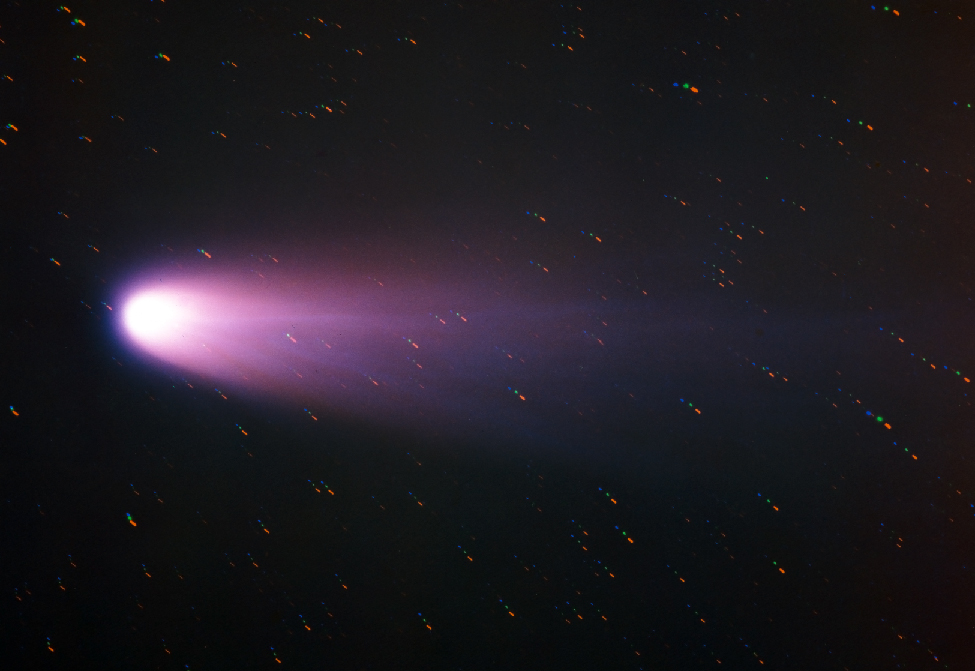
Note that still images of comets give the impression that they are moving rapidly across the sky, like a bright meteor or shooting star. Looking only at such images, it is easy to confuse comets and meteors. But seen in the real sky, they are very different: the meteor burns up in our atmosphere and is gone in a few seconds, whereas the comet may be visible for weeks in nearly the same part of the sky.
英語のヒント
彗星の静止画像を見ると、明るい流星や流れ星のように、空を急速に横切っている印象を受けることに注意しよう。そうした画像だけを見れば、彗星と流星は混同しやすい。しかし実際の空では、両者は大きく異なる。流星は大気中で燃え尽き、数秒で消えるのに対し、彗星は空のほぼ同じ場所に何週間も見えていることがある。
Comet Orbits彗星の軌道
The study of comets as members of the solar system dates from the time of Isaac Newton, who first suggested that they orbited the Sun on extremely elongated ellipses. Newton’s colleague Edmund Halley (see the Edmund Halley: Astronomy’s Renaissance Man feature box) developed these ideas, and in 1705, he published calculations of 24 comet orbits. In particular, he noted that the orbits of the bright comets that had appeared in the years 1531, 1607, and 1682 were so similar that the three could well be the same comet, returning to perihelion (closest approach to the Sun) at average intervals of 76 years. If so, he predicted that the object should next return about 1758. Although Halley had died by the time the comet appeared as he predicted, it was given the name Comet Halley (rhymes with “valley”) in honor of the astronomer who first recognized it as a permanent member of our solar system, orbiting around the Sun. Its aphelion (furthest point from the Sun) is beyond the orbit of Neptune.
英語のヒント
彗星を太陽系の仲間として研究する歴史は、アイザック・ニュートンの時代にさかのぼる。彼は初めて、彗星が極端に細長い楕円軌道で太陽を回ると提案した。ニュートンの同僚エドモンド・ハレー(コラム「エドモンド・ハレー――天文学の万能人」参照)は、その考えを発展させ、1705年に24個の彗星軌道の計算を発表した。特に彼は、1531年・1607年・1682年に現れた明るい彗星の軌道が非常によく似ており、三つは同じ彗星で、平均76年おきに近日点、つまり太陽への最接近点へ戻っているのかもしれないと気づいた。そうなら、次の帰還は1758年ごろになるはずだと予測した。彗星が予測どおりに現れたとき、ハレーはすでに亡くなっていた。しかし、太陽の周りを回り続ける太陽系の一員だと初めて認めた天文学者に敬意を表し、ハレー彗星と名付けられた。英語のHalleyはvalleyと韻を踏む。遠日点、すなわち太陽から最も遠い点は、海王星の軌道より外側にある。
We now know from historical records that Comet Halley has actually been observed and recorded on every passage near the Sun since 239 BCE at intervals ranging from 74 to 79 years. The period of its return varies somewhat because of orbital changes produced by the pull of the giant planets. In 1910, Earth was brushed by the comet’s tail, causing much needless public concern. Comet Halley last appeared in our skies in 1986 (Figure 13.16), when it was met by several spacecraft that gave us a wealth of information about its makeup; it will return in 2061.
英語のヒント
歴史記録から、ハレー彗星は実際に紀元前239年以来、74〜79年ごとに太陽の近くを通るたびに観測・記録されているとわかっている。戻ってくる周期が多少変わるのは、巨大惑星の引力が軌道を変えるためだ。1910年には、地球が彗星の尾をかすめ、世間に大きな、しかし不必要な不安が広がった。ハレー彗星が最後に私たちの空へ現れたのは1986年で(図13.16)、その際には複数の探査機が接近し、その構成について豊富な情報をもたらした。次は2061年に戻ってくる。
Comet Halley.ハレー彗星。
credit: modification of work by ESO · CC BY 4.0
Figure 13.16 This composite of three images (one in red, one in green, one in blue) shows Comet Halley as seen with a large telescope in Chile in 1986. During the time the three images were taken in sequence, the comet moved among the stars. The telescope was moved to keep the image of the comet steady, causing the stars to appear in triplicate (once in each color) in the background. (credit: modification of work by ESO)
図13.16 赤・緑・青の三枚を合成したこの画像は、1986年にチリの大型望遠鏡で見たハレー彗星を示す。三枚を順に撮る間に、彗星は星々の間を動いた。彗星の像を固定するために望遠鏡を動かした結果、背景の恒星は色ごとに一つずつ、三重に写っている。(クレジット:ESOの作品を改変)
Only a few comets return in a time measureable in human terms (shorter than a century or two), like Comet Halley does; these are called short-period comets. Many short-period comets have had their orbits changed by coming too close to one of the giant planets—most often Jupiter (and they are thus sometimes called Jupiter-family comets). Most comets have long periods and will take thousands of years to return, if they return at all. As we will see later in this chapter, most Jupiter-family comets come from a different source than the long-period comets (those with orbital periods longer than about a century).
英語のヒント
ハレー彗星のように、人間の尺度で測れる時間、つまり1〜2世紀より短い期間で戻ってくる彗星は少数で、短周期彗星と呼ばれる。多くの短周期彗星は、巨大惑星の一つ、とりわけ木星に近づきすぎて軌道を変えられている。そのため、ときに木星族彗星とも呼ばれる。大部分の彗星は長周期で、仮に戻るとしても何千年もかかる。この章の後で見るように、木星族彗星の大部分は、長周期彗星、すなわち公転周期がおよそ1世紀より長いものとは異なる供給源から来る。
Observational records exist for thousands of comets. We were visited by two bright comets in recent decades. First, in March 1996, came Comet Hyakutake, with a very long tail. A year later, Comet Hale-Bopp appeared; it was as bright as the brightest stars and remained visible for several weeks, even in urban areas (see the image that opens this chapter, Figure 13.1) Since then, there have been few comets visible to the naked eye, and astronomers (both professional and amateur) eagerly await such a visitor.
英語のヒント
数千個の彗星について観測記録がある。ここ数十年には、二つの明るい彗星が訪れた。まず1996年3月、非常に長い尾を持つ百武彗星が現れた。1年後にはヘール・ボップ彗星が現れ、最も明るい恒星と同じくらい明るく、都市でも数週間見え続けた(この章の冒頭の図13.1参照)。それ以降、肉眼で見える彗星はわずかしかなく、プロもアマチュアも、そのような訪問者を心待ちにしている。
Table 13.2 lists some well-known comets whose history or appearance is of special interest.
表13.2は、歴史や見た目に特に興味深い点のある、よく知られた彗星をいくつか挙げている。
Some Interesting Comets 興味深い彗星の例 |
||
|---|---|---|
Name 名前 |
Period 周期 |
Significance 注目すべき点 |
Great Comet of 1577 1577年の大彗星 |
Long 長周期 |
Tycho Brahe showed it was beyond the Moon (a big step in our understanding) ティコ・ブラーエが月より遠くにあると示した。彗星の理解にとって大きな一歩。 |
Great Comet of 1843 1843年の大彗星 |
Long 長周期 |
Brightest recorded comet; visible in daytime 記録にある最も明るい彗星。昼間でも見えた。 |
Daylight Comet of 1910 1910年の昼間の彗星 |
Long 長周期 |
Brightest comet of the twentieth century 20世紀で最も明るい彗星。 |
West ウェスト彗星 |
Long 長周期 |
Nucleus broke into pieces (1976) 核がばらばらに分裂した(1976年)。 |
Hyakutake 百武彗星 |
Long 長周期 |
Passed within 15 million km of Earth (1996) 地球から1500万km以内を通過した(1996年)。 |
Hale–Bopp ヘール・ボップ彗星 |
Long 長周期 |
Brightest recent comet (1997) 近年で最も明るい彗星(1997年)。 |
Swift-Tuttle スイフト・タットル彗星 |
133 years 133年 |
Parent comet of Perseid meteor shower ペルセウス座流星群の母彗星。 |
Halley ハレー彗星 |
76 years 76年 |
First comet found to be periodic; explored by spacecraft in 1986 周期的に戻ると初めてわかった彗星。1986年に探査機が調べた。 |
Borrelly ボレリー彗星 |
6.8 years 6.8年 |
Flyby by Deep Space 1 spacecraft (2000) ディープ・スペース1探査機がフライバイした(2000年)。 |
Biela ビエラ彗星 |
6.7 years 6.7年 |
Broke up in 1846 and not seen again 1846年に分裂し、その後は見られていない。 |
Churyumov-Gerasimenko チュリュモフ・ゲラシメンコ彗星 |
6.5 years 6.5年 |
Target of Rosetta mission (2014–16) ロゼッタ探査の対象(2014〜2016年)。 |
Wild 2 ヴィルト第2彗星 |
6.4 years 6.4年 |
Target of Stardust sample return mission (2004) スターダストのサンプルリターン探査の対象(2004年)。 |
Tempel 1 テンペル第1彗星 |
5.7 years 5.7年 |
Target of Deep Impact mission (2005) ディープ・インパクト探査の対象(2005年)。 |
Encke エンケ彗星 |
3.3 years 3.3年 |
Shortest known period 知られている中で最も短い周期。 |