第13章彗星と小惑星――太陽系に残されたかけらComets and Asteroids: Debris of the Solar System
The Comet’s Nucleus彗星の核
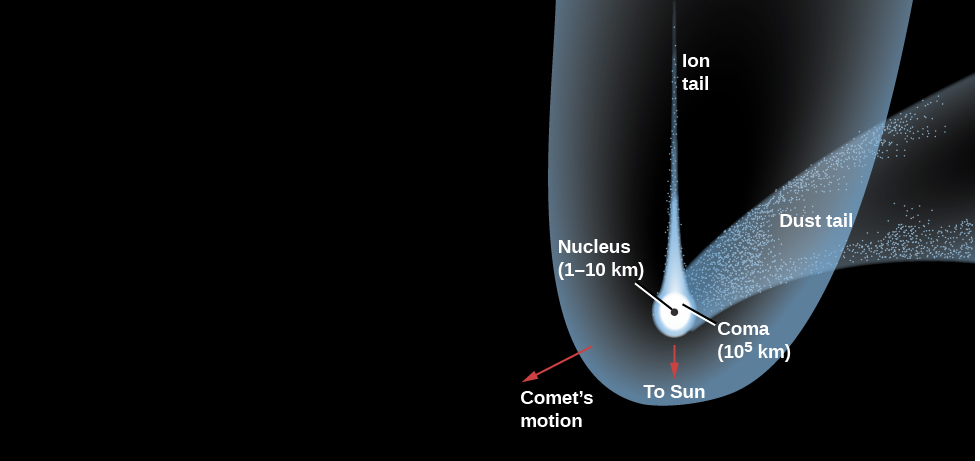
When we look at an active comet, all we normally see is its temporary atmosphere of gas and dust illuminated by sunlight. This atmosphere is called the comet’s head or coma. Since the gravity of such small bodies is very weak, the atmosphere is rapidly escaping all the time; it must be replenished by new material, which has to come from somewhere. The source is the small, solid nucleus inside, just a few kilometers across, usually hidden by the glow from the much-larger atmosphere surrounding it. The nucleus is the real comet, the fragment of ancient icy material responsible for the atmosphere and the tail (Figure 13.18).
英語のヒント
活動している彗星を見るとき、通常見えているのは、太陽光に照らされた一時的なガスと塵の大気だけだ。この大気を彗星の頭部、またはコマと呼ぶ。このような小天体の重力はとても弱いので、大気は常に急速に逃げ出している。したがって新たな物質で補われる必要があり、その物質はどこかから供給されなければならない。供給源は内側にある小さな固体の核で、大きさはわずか数kmだ。通常は、それを取り巻く、はるかに大きな大気の輝きに隠れている。核こそが彗星の実体であり、大気と尾を生み出す、太古の氷の物質のかけらなのだ(図13.18)。
Parts of a Comet.彗星を構成する部分。
OpenStax / Rice University · CC BY 4.0
Figure 13.18 This schematic illustration shows the main parts of a comet. Note that the different structures are not to scale.
図13.18 この模式図は彗星の主な部分を示す。各構造は同じ縮尺では描かれていないことに注意しよう。
The modern theory of the physical and chemical nature of comets was first proposed by Harvard astronomer Fred Whipple in 1950. Before Whipple’s work, many astronomers thought that a comet’s nucleus might be a loose aggregation of solids, sort of an orbiting “gravel bank,” Whipple proposed instead that the nucleus is a solid object a few kilometers across, composed in substantial part of water ice (but with other ices as well) mixed with silicate grains and dust. This proposal became known as the “dirty snowball” model.
英語のヒント
彗星の物理的・化学的性質についての現代的な理論は、1950年にハーバード大学の天文学者フレッド・ホイップルが初めて提案した。それ以前、多くの天文学者は、彗星の核は固体が緩く集まったもの、いわば軌道上の「砂利の堆積」のようなものかもしれないと考えていた。これに対してホイップルは、核は大きさ数kmの固体で、そのかなりの部分が水の氷、さらにほかの氷からなり、ケイ酸塩の粒や塵が混じっていると提案した。これは「汚れた雪玉」モデルとして知られるようになった。
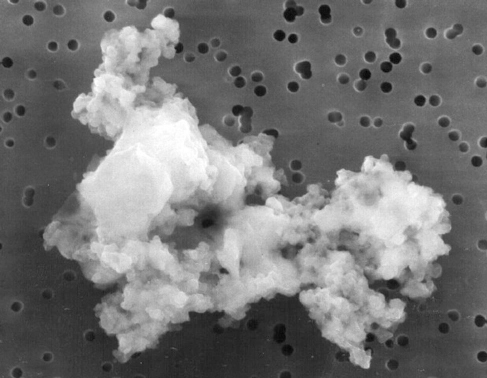
The water vapor and other volatiles that escape from the nucleus when it is heated can be detected in the comet’s head and tail, and therefore, we can use spectra to analyze what atoms and molecules the nucleus ice consists of. However, we are somewhat less certain of the non-icy component. We have never identified a fragment of solid matter from a comet that has survived passage through Earth’s atmosphere. However, spacecraft that have approached comets have carried dust detectors, and some comet dust has even been returned to Earth (see Figure 13.19). It seems that much of the “dirt” in the dirty snowball is dark, primitive hydrocarbons and silicates, rather like the material thought to be present on the dark, primitive asteroids.
英語のヒント
核が温められたときに逃げ出す水蒸気などの揮発性物質は、彗星の頭部や尾で検出できる。したがって、スペクトルを使って核の氷がどんな原子・分子からなるかを分析できる。しかし、氷ではない成分については、それほど確かではない。彗星から来た固体物質の破片が、地球の大気を通り抜けて生き残ったと確認されたことは、まだない。ただ、彗星に近づいた探査機は塵の検出器を積んでおり、彗星の塵の一部は地球に持ち帰られてもいる(図13.19参照)。汚れた雪玉の「汚れ」の多くは、暗く始原的な炭化水素とケイ酸塩らしい。暗い始原的小惑星にあると考えられる物質と、よく似ている。
Captured Comet Dust.採取された彗星の塵。
credit: NASA/JPL · JPL image use policy
Figure 13.19 This particle (seen through a microscope) is believed to be a tiny fragment of cometary dust, collected in the upper atmosphere of Earth. It measures about 10 microns, or 1/100 of a millimeter, across. (credit: NASA/JPL)
図13.19 顕微鏡で見たこの粒子は、地球の上層大気で採取された、ごく小さな彗星の塵の破片と考えられる。幅は約10マイクロメートル、つまり100分の1mmだ。(クレジット:NASA/JPL)
Since the nuclei of comets are small and dark, they are difficult to study from Earth. Spacecraft did obtain direct measurements of a comet nucleus, however, in 1986, when three spacecraft swept past Comet Halley at close range (see Figure 13.20). Subsequently, other spacecraft have flown close to other comets. In 2005, the NASA Deep Impact spacecraft even carried a probe for a high-speed impact with the nucleus of Comet Tempel 1. But by far, the most productive study of a comet has been by the 2015 Rosetta mission, which we will discuss shortly.
英語のヒント
彗星の核は小さく暗いため、地球から調べるのは難しい。それでも1986年、三機の探査機がハレー彗星を間近で通過し、核を直接測定した(図13.20参照)。その後、ほかの探査機も別の彗星の近くを飛んでいる。2005年にはNASAのディープ・インパクト探査機が、テンペル第1彗星の核へ高速で衝突させる小探査機まで運んだ。しかし、彗星について圧倒的に最も多くの成果をもたらしたのは、2015年のロゼッタ探査である。これについてはまもなく述べる。
Close-up of Comet Halley.ハレー彗星の拡大像。

credit: modification of work by ESA · ESA educational/informational image permission
Figure 13.20 This historic photograph of the black, irregularly shaped nucleus of Comet Halley was obtained by the ESA Giotto spacecraft from a distance of about 1000 kilometers. The bright areas are jets of material escaping from the surface. The length of the nucleus is 10 kilometers, and details as small as 1 kilometer can be made out. (credit: modification of work by ESA)
図13.20 この歴史的な、ハレー彗星の黒く不規則な核の写真は、ESAのジオット探査機が約1000kmの距離から撮ったものだ。明るい領域は表面から逃げ出す物質のジェット。核の長さは10kmで、1kmという小さな構造まで見分けられる。(クレジット:ESAの作品を改変)
The Comet’s Atmosphere彗星の大気
The spectacular activity that allows us to see comets is caused by the evaporation of cometary ices heated by sunlight. Beyond the asteroid belt, where comets spend most of their time, these ices are solidly frozen. But as a comet approaches the Sun, it begins to warm up. If water (H2O) is the dominant ice, significant quantities vaporize as sunlight heats the surface above 200 K. This happens for the typical comet somewhat beyond the orbit of Mars. The evaporating H2O in turn releases the dust that was mixed with the ice. Since the comet’s nucleus is so small, its gravity cannot hold back either the gas or the dust, both of which flow away into space at speeds of about 1 kilometer per second.
英語のヒント
彗星を見えるようにする壮観な活動は、太陽光で温められた彗星の氷の蒸発によって起こる。彗星が時間の大部分を過ごす小惑星帯の向こうでは、氷はしっかり凍っている。しかし太陽へ近づくと、彗星は温まり始める。氷の主成分が水(H₂O)なら、太陽光で表面が200Kを超えると、かなりの量が気化する。典型的な彗星では、火星の軌道よりやや外側でこれが起こる。蒸発するH₂Oは、氷に混じっていた塵も放出する。核は非常に小さいため、その重力はガスも塵も引き止められず、どちらも毎秒約1kmで宇宙へ流れ出す。
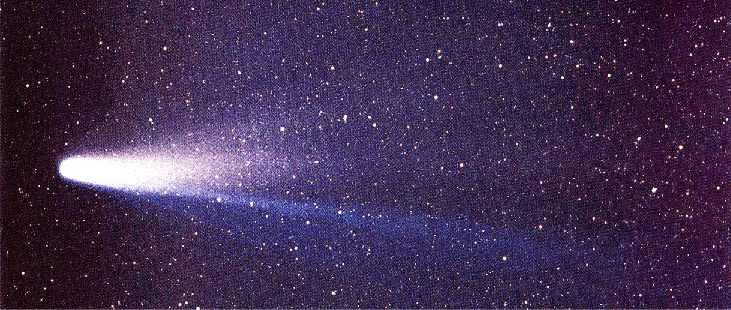
The comet continues to absorb energy as it approaches the Sun. A great deal of this energy goes into the evaporation of its ice, as well as into heating the surface. However, recent observations of many comets indicate that the evaporation is not uniform and that most of the gas is released in sudden spurts, perhaps confined to a few areas of the surface. Expanding into space at a speed of about 1 kilometer per second, the comet’s atmosphere can reach an enormous size. The diameter of a comet’s head is often as large as Jupiter, and it can sometimes approach a diameter of a million kilometers (Figure 13.21).
英語のヒント
彗星は太陽へ近づく間、エネルギーを吸収し続ける。その多くは、表面を温めるとともに、氷を蒸発させるために使われる。しかし、多くの彗星の最近の観測は、蒸発が一様ではなく、ガスの大部分が突然の噴出で放出され、おそらく表面の少数の領域に限られていることを示す。毎秒約1kmで宇宙へ広がる彗星の大気は、途方もなく大きくなりうる。頭部の直径はしばしば木星ほどになり、ときには100万kmに近づくことさえある(図13.21)。
Head of Comet Halley.ハレー彗星の頭部。
credit: modification of work by NASA/W. Liller · NASA media use guidelines
Figure 13.21 Here we see the cloud of gas and dust that make up the head, or coma, of Comet Halley in 1986. On this scale, the nucleus (hidden inside the cloud) would be a dot too small to see. (credit: modification of work by NASA/W. Liller)
図13.21 1986年のハレー彗星の頭部、すなわちコマを作るガスと塵の雲を示す。この縮尺では、雲の中に隠れた核は、小さすぎて見えない点になるだろう。(クレジット:NASA/W. Lillerの作品を改変)
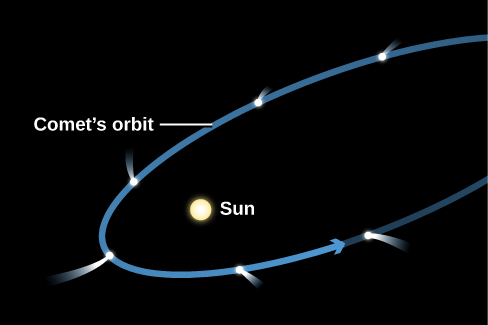
Most comets also develop tails as they approach the Sun. A comet’s tail is an extension of its atmosphere, consisting of the same gas and dust that make up its head. As early as the sixteenth century, observers realized that comet tails always point away from the Sun (Figure 13.22), not back along the comet’s orbit. Newton proposed that comet tails are formed by a repulsive force of sunlight driving particles away from the head—an idea close to our modern view.
英語のヒント
大部分の彗星は、太陽に近づくと尾も発達させる。尾は大気の延長であり、頭部を作るのと同じガスと塵からなる。早くも16世紀には、観測者は、彗星の尾が常に太陽と反対を向き(図13.22)、彗星の軌道に沿って後方を向くわけではないと気づいていた。ニュートンは、太陽光の斥力が粒子を頭部から遠ざけて尾を作ると提案した。現代の見方に近い考えだ。
Comet Orbit and Tail.彗星の軌道と尾。
OpenStax / Rice University · CC BY 4.0
Figure 13.22 The orientation of a typical comet tail changes as the comet passes perihelion. Approaching the Sun, the tail is behind the incoming comet head, but on the way out, the tail precedes the head.
図13.22 典型的な彗星の尾の向きは、彗星が近日点を通過するにつれて変わる。太陽へ近づくとき、尾は入ってくる彗星の頭部の後ろにあるが、外へ向かう途中では、尾が頭部に先行する。
The two different components that make up the tail (the dust and gas) act somewhat differently. The brightest part of the tail is called the dust tail, to differentiate it from a fainter, straight tail made of ionized gas, called the ion tail. The ion tail is carried outward by streams of ions (charged particles) emitted by the Sun. As you can see in Figure 13.23, the smoother dust tail curves a bit, as individual dust particles spread out along the comet’s orbit, whereas the straight ion tail is pushed more directly outward from the Sun by our star’s wind of charged particles
英語のヒント
尾を作る二つの成分、塵とガスは、多少異なる動きをする。尾の最も明るい部分は塵の尾と呼ばれ、イオン化したガスからなる、より淡くまっすぐなイオンの尾と区別される。イオンの尾は、太陽が放出するイオン、つまり電荷を持つ粒子の流れによって外側へ運ばれる。図13.23に見られるように、より滑らかな塵の尾は、個々の塵の粒子が彗星の軌道に沿って広がるため、少し曲がる。これに対し、まっすぐなイオンの尾は、太陽からの荷電粒子の風に押され、太陽からより直接的に外へ向かう。
Comet Tails.彗星の尾。
Figure 13.23 (a) As a comet nears the Sun, its features become more visible. In this illustration from NASA showing Comet Hale-Bopp, you can see a comet’s two tails: the more easily visible dust tail, which can be up to 10 million kilometers long, and the fainter gas tail (or ion tail), which is up to hundreds of millions of kilometers long. The grains that make up the dust tail are the size of smoke particles. (b) Comet Mrkos was photographed in 1957 with a wide-field telescope at Palomar Observatory and also shows a clear distinction between the straight gas tail and the curving dust tail. (credit a: modification of work by ESO/E. Slawik; credit b: modification of work by Charles Kearns, George O. Abell, and Byron Hill)
図13.23 (a)彗星は太陽へ近づくと、その特徴がよりよく見えるようになる。NASAによるこのヘール・ボップ彗星の図では、二本の尾が見える。見やすい塵の尾は長さが最大1000万kmになり、より淡いガスの尾、すなわちイオンの尾は数億kmにもなる。塵の尾を作る粒の大きさは、煙の粒子ほどだ。(b)ムルコス彗星は1957年にパロマー天文台の広視野望遠鏡で撮影され、こちらでも、まっすぐなガスの尾と、曲がった塵の尾の違いがはっきり見える。(aのクレジット:ESO/E. Slawikの作品を改変。bのクレジット:Charles Kearns、George O. Abell、Byron Hillの作品を改変)