第13章彗星と小惑星――太陽系に残されたかけらComets and Asteroids: Debris of the Solar System
13.1 Asteroids13.1 小惑星
Learning Objectives学習の目標
By the end of this section, you will be able to:
この節を終えると、次のことができるようになる。
Outline the story of the discovery of asteroids and describe their typical orbits
小惑星が発見された経緯を概説し、典型的な軌道を説明する。
Describe the composition and classification of the various types of asteroids
さまざまな種類の小惑星の組成と分類を説明する。
Discuss what was learned from spacecraft missions to several asteroids
いくつかの小惑星への探査機によるミッションで何がわかったかを論じる。
The asteroids are mostly found in the broad space between Mars and Jupiter, a region of the solar system called the asteroid belt. Asteroids are too small to be seen without a telescope; the first of them was not discovered until the beginning of the nineteenth century.
英語のヒント
小惑星の大部分は、火星と木星の間の広い空間、太陽系の中で小惑星帯と呼ばれる領域にある。小惑星は小さすぎて望遠鏡なしでは見えず、最初の一つが発見されたのは19世紀の初めになってからだった。
Discovery and Orbits of the Asteroids小惑星の発見と軌道
In the late 1700s, many astronomers were hunting for an additional planet they thought should exist in the gap between the orbits of Mars and Jupiter. The Sicilian astronomer Giovanni Piazzi thought he had found this missing planet in 1801, when he discovered the first asteroid (or as it was later called, “minor planet”) orbiting at 2.8 AU from the Sun. His discovery, which he named Ceres, was quickly followed by the detection of three other little planets in similar orbits.
英語のヒント
1700年代後半、多くの天文学者は、火星と木星の軌道の間の隙間に存在するはずだと考えた、もう一つの惑星を探していた。シチリアの天文学者ジョヴァンニ・ピアッツィは1801年、太陽から2.8天文単位を公転する最初の小惑星、後に「minor planet」と呼ばれる天体を発見したとき、この未発見の惑星を見つけたと思った。彼がケレスと名付けた天体の発見に続き、似た軌道を持つ別の小さな惑星が三つ、ほどなく見つかった。
Clearly, there was not a single missing planet between Mars and Jupiter but rather a whole group of objects, each much smaller than our Moon. (An analogous discovery history has played out in slow motion in the outer solar system. Pluto was discovered beyond Neptune in 1930 and was initially called a planet, but early in the twenty-first century, several other similar objects were found. We now call all of them dwarf planets.)
英語のヒント
明らかに、火星と木星の間にあったのは、未発見の惑星が一つではなく、どれも地球の月よりはるかに小さい天体の集まりだった。(外側の太陽系では、これと似た発見の歴史が、もっとゆっくりと繰り返された。冥王星は1930年に海王星の向こうで発見され、当初は惑星と呼ばれた。しかし21世紀初めには、似た天体がさらにいくつか見つかった。現在では、それらをすべて準惑星と呼んでいる。)
By 1890, more than 300 of these minor planets or asteroids had been discovered by sharp-eyed observers. In that year, Max Wolf at Heidelberg introduced astronomical photography to the search for asteroids, greatly accelerating the discovery of these dim objects. In the twenty-first century, searchers use computer-driven electronic cameras, another leap in technology. Currently many asteroid searches are made with cameras in space. More than a million asteroids now have well-determined orbits.
英語のヒント
1890年までには、注意深い観測者たちが、このような小さな惑星、すなわち小惑星を300個以上発見していた。その年、ハイデルベルクのマックス・ヴォルフが小惑星探しに天体写真を導入し、暗い天体の発見を大幅に加速させた。21世紀の探索者は、さらに技術が飛躍した、コンピューター制御の電子カメラを使っている。現在、小惑星の探索の多くは宇宙にあるカメラで行われる。いまでは100万個を超える小惑星について、軌道が精密に求められている。
Asteroids are given a number (corresponding to the order of discovery) and sometimes also a name. Originally, the names of asteroids were chosen from goddesses in Greek and Roman mythology. After exhausting these and other female names (including, later, those of spouses, friends, flowers, cities, and others), astronomers turned to the names of colleagues (and other people of distinction) whom they wished to honor. For example, asteroids 2410, 4859, and 68448 are named Morrison, Fraknoi, and Sidneywolff, for the three senior authors of this textbook.
英語のヒント
小惑星には、発見の順番に対応する番号が付けられ、ときには名前も付く。当初、小惑星の名前はギリシャ・ローマ神話の女神から選ばれた。それらや、後には配偶者・友人・花・都市などを含む、ほかの女性名を使い尽くすと、天文学者は、顕彰したい同僚や、ほかの著名人の名前に目を向けた。たとえば小惑星2410番、4859番、68448番は、本書の三人の主要著者にちなんで、それぞれMorrison(モリソン)、Fraknoi(フラクノイ)、Sidneywolff(シドニーウルフ)と名付けられている。
The largest asteroid is Ceres (numbered 1), with a diameter just less than 1000 kilometers. As we saw, Ceres was considered a planet when it was discovered but later was called an asteroid (the first of many.) Now, it has again been reclassified and is considered one of the dwarf planets, like Pluto (see the chapter on Moons, Rings and Pluto). We still find it convenient, however, to discuss Ceres as the largest of the asteroids. Two other asteroids, Pallas and Vesta, have diameters of about 500 kilometers, and about 15 more are larger than 250 kilometers (see Table 13.1). The number of asteroids increases rapidly with decreasing size; there are about 100 times more objects 10 kilometers across than there are 100 kilometers across.
英語のヒント
最大の小惑星は1番のケレスで、直径は1000km弱だ。すでに見たように、ケレスは発見時には惑星と考えられたが、後に小惑星と呼ばれるようになった。数多い小惑星の最初の一つである。現在は再び分類が変わり、冥王星と同じ準惑星の一つとされている(「環・衛星・冥王星」の章参照)。それでも、ここではケレスを最大の小惑星として扱うのが便利だ。パラスとベスタというほかの二つの小惑星の直径は約500kmで、そのほか約15個が250kmを超える(表13.1参照)。小惑星の数は、小さくなるほど急速に増える。直径10kmの天体は、直径100kmの天体の約100倍もある。
The Largest Asteroids 大きな小惑星 |
|||||
|---|---|---|---|---|---|
# 番号 |
Name 名前 |
Year of Discovery 発見年 |
Orbit’s Semimajor Axis (AU) 軌道長半径(天文単位) |
Diameter (km) 直径(km) |
Compositional Class 組成による分類 |
| 1 | Ceres ケレス |
1801 | 2.77 | 940 | C (carbonaceous) C型(炭素質) |
| 2 | Pallas パラス |
1802 | 2.77 | 540 | C (carbonaceous) C型(炭素質) |
| 3 | Juno ジュノー |
1804 | 2.67 | 265 | S (stony) S型(岩石質) |
| 4 | Vesta ベスタ |
1807 | 2.36 | 510 | basaltic 玄武岩質 |
| 10 | Hygiea ヒギエア |
1849 | 3.14 | 410 | C (carbonaceous) C型(炭素質) |
| 16 | Psyche プシケ |
1852 | 2.92 | 265 | M (metallic) M型(金属質) |
| 31 | Euphrosyne エウフロシネ |
1854 | 3.15 | 250 | C (carbonaceous) C型(炭素質) |
| 52 | Europa エウロパ |
1858 | 3.10 | 280 | C (carbonaceous) C型(炭素質) |
| 65 | Cybele キュベレー |
1861 | 3.43 | 280 | C (carbonaceous) C型(炭素質) |
| 87 | Sylvia シルヴィア |
1866 | 3.48 | 275 | C (carbonaceous) C型(炭素質) |
| 451 | Patientia パティエンティア |
1899 | 3.06 | 260 | C (carbonaceous) C型(炭素質) |
| 511 | Davida ダヴィダ |
1903 | 3.16 | 310 | C (carbonaceous) C型(炭素質) |
| 704 | Interamnia インテラムニア |
1910 | 3.06 | 310 | C (carbonaceous) C型(炭素質) |
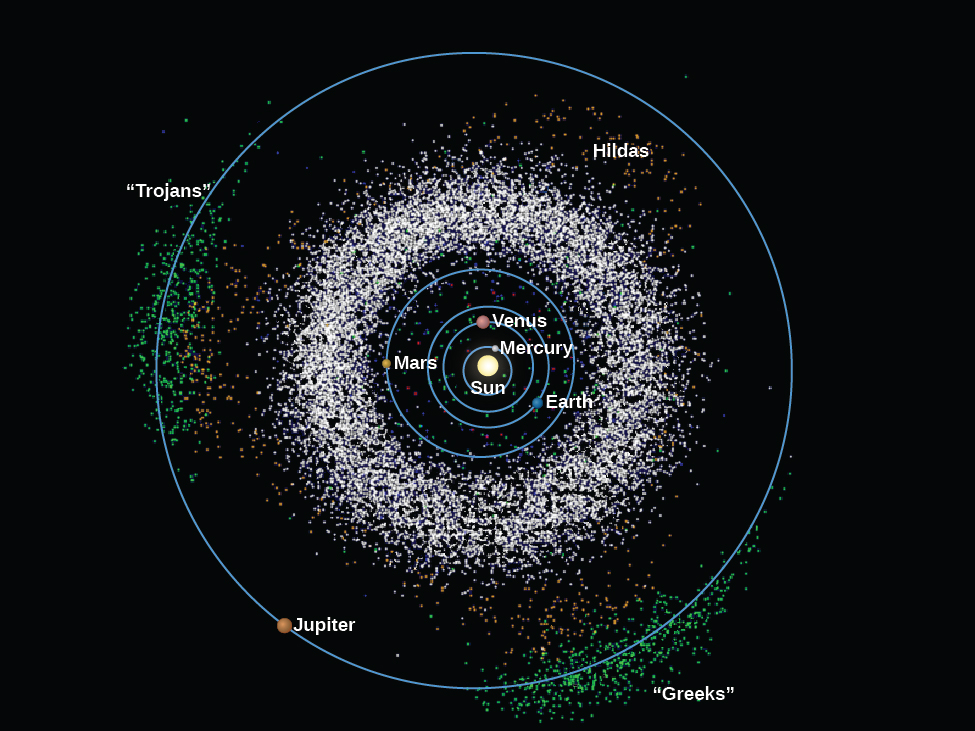
The asteroids all revolve about the Sun in the same direction as the planets, and most of their orbits lie near the plane in which Earth and other planets circle. The majority of asteroids are in the asteroid belt, the region between Mars and Jupiter that contains all asteroids with orbital periods between 3.3 to 6 years (Figure 13.2). Although more than 75% of the known asteroids are in the belt, they are not closely spaced (as they are sometimes depicted in science fiction movies). The volume of the belt is actually very large, and the typical spacing between objects (down to 1 kilometer in size) is several million kilometers. (This was fortunate for spacecraft like Galileo, Cassini, Rosetta, and New Horizons, which needed to travel through the asteroid belt without a collision.)
英語のヒント
小惑星はすべて、惑星と同じ向きに太陽の周りを公転し、その軌道の大部分は、地球などの惑星が回る平面の近くにある。小惑星の大多数は、火星と木星の間の領域である小惑星帯にあり、公転周期が3.3〜6年の小惑星はすべてここに含まれる(図13.2)。既知の小惑星の75%以上がこの帯にあるとはいえ、SF映画でときどき描かれるように、密集しているわけではない。帯の体積は実際には非常に大きく、大きさ1km以上の天体どうしの典型的な間隔は数百万kmもある。(小惑星帯を衝突せず通り抜ける必要があったガリレオ・カッシーニ・ロゼッタ・ニュー・ホライズンズなどの探査機にとっては、幸運なことだった。)
Asteroids in the Solar System.太陽系の小惑星。
OpenStax / Rice University · CC BY 4.0
Figure 13.2 This computer-generated diagram shows the positions of the asteroids known in 2006. If the asteroid sizes were drawn to scale, none of the dots representing an asteroid would be visible. Here, the asteroid dots are too big and give a false impression of how crowded the asteroid belt would look if you were in it. Note that in addition to those in the asteroid belt, there are also asteroids in the inner solar system and some along Jupiter’s orbit (such as the Trojans and Greeks groups), controlled by the giant planet’s gravity.
図13.2 このコンピューターで作った図は、2006年に知られていた小惑星の位置を示す。小惑星の大きさを縮尺どおりに描いたら、それらを表す点は一つも見えないだろう。ここでは小惑星の点が大きすぎるため、小惑星帯の中にいた場合の混み合い方について、誤った印象を与える。小惑星帯のほかにも、太陽系の内側や、木星の重力に制御されて木星の軌道に沿う場所にも、小惑星があることに注目しよう。後者にはトロヤ群やギリシャ群がある。
Still, over the long history of our solar system, there have been a good number of collisions among the asteroids themselves. In 1918, the Japanese astronomer Kiyotsugu Hirayama found that some asteroids fall into families, groups with similar orbital characteristics. He hypothesized that each family may have resulted from the breakup of a larger body or, more likely, from the collision of two asteroids. Slight differences in the speeds with which the various fragments left the collision scene account for the small spread in orbits now observed for the different asteroids in a given family. Several dozen such families exist, and observations have shown that individual members of most families have similar compositions, as we would expect if they were fragments of a common parent.
英語のヒント
それでも、太陽系の長い歴史の中で、小惑星どうしの衝突はかなりの数に上った。1918年、日本の天文学者・平山清次は、一部の小惑星が、似た軌道の特徴を持つ集団である「族」に分けられることを見いだした。各族は大きな天体の崩壊から生じたか、よりありそうなのは二つの小惑星の衝突で生じたのではないか、と彼は考えた。さまざまな破片が衝突現場から離れたときの速度のわずかな差によって、いま一つの族に属する小惑星の軌道に見られる、小さなばらつきを説明できる。このような族は数十個存在する。観測によると、族の大部分では個々の構成員が似た組成を持っており、共通の母天体の破片であれば予想されるとおりだ。