第13章彗星と小惑星――太陽系に残されたかけらComets and Asteroids: Debris of the Solar System
Early Evolution of the Planetary System惑星系の初期進化
Comets from the Oort cloud help us sample material that formed very far from the Sun, whereas the short-period comets from the Kuiper belt sample materials that were planetesimals in the solar nebula disk but did not form planets. Studies of the Kuiper belt also are influencing our understanding of the early evolution of our planetary system.
英語のヒント
オールトの雲から来る彗星は、太陽から非常に遠くでできた物質の試料を提供する。これに対して、カイパーベルトからの短周期彗星は、太陽系星雲の円盤内で微惑星だったが、惑星にならなかった物質の試料だ。カイパーベルトの研究は、惑星系の初期進化についての理解にも影響を与えている。
The objects in the Oort cloud and the Kuiper belt have different histories, and they may therefore have different compositions. Astronomers are therefore very interested in comparing detailed measurements of the comets derived from these two source regions. Most of the bright comets that have been studied in the past (such as Hyakutake and Hale-Bopp) are Oort cloud comets, but P67 and several other comets targeted for spacecraft measurements in the next decade are Jupiter-family comets from the Kuiper belt (see Table 13.2).
英語のヒント
オールトの雲とカイパーベルトの天体は、異なる歴史を持つため、組成も違う可能性がある。そのため天文学者は、この二つの供給源から来る彗星の詳しい測定を比較することに、強い関心を持っている。百武彗星やヘール・ボップ彗星など、過去に研究された明るい彗星の大部分はオールトの雲の彗星だ。しかしP67や、今後10年間に探査機による測定が予定されるほかのいくつかの彗星は、カイパーベルトから来る木星族彗星である(表13.2参照)。
The Kuiper belt is made up of ice-and-rock planetesimals, a remnant of the building blocks of the planets. Since it is gravitationally linked to Neptune, it can help us understand the formation and history of the solar system. As the giant planets formed, their gravity profoundly influenced the orbits of Kuiper belt objects. Computer simulations of the early evolution of the planetary system suggest that the gravitational interactions between the giant planets and the remaining planetesimals caused the orbit of Jupiter to drift inward, whereas the orbits of Saturn, Uranus, and Neptune all expanded, carrying the Kuiper belt with them.
英語のヒント
カイパーベルトは、氷と岩石の微惑星からなり、惑星を組み立てた材料の残りだ。海王星と重力で結び付いているので、太陽系の形成と歴史を理解する手がかりになる。巨大惑星ができるにつれて、その重力はカイパーベルト天体の軌道に大きく影響した。惑星系の初期進化のコンピューターシミュレーションは、巨大惑星と残った微惑星との重力相互作用が、木星の軌道を内側へ移動させたことを示唆する。それに対し、土星・天王星・海王星の軌道はすべて広がり、カイパーベルトも一緒に運んだ。
Another hypotheses involves a fifth giant planet that was expelled from the solar system entirely as the planetary orbits shifted. Neptune’s retrograde (backward-orbiting) moon Triton (which is nearly as large as Pluto) may have been a Kuiper belt object captured by Neptune during the period of shifting orbits. It clearly seems that the Kuiper belt may carry important clues to the way our solar system reached its present planetary configuration.
英語のヒント
別の仮説には、惑星の軌道が変わる際に太陽系から完全に放り出された、第五の巨大惑星が登場する。冥王星に近い大きさの、逆行、つまり逆向きに公転する海王星の衛星トリトンは、軌道が移動した時期に海王星に捕獲された、カイパーベルト天体だったかもしれない。カイパーベルトは、太陽系が現在の惑星配置へ達した過程について、重要な手がかりを持っていそうだ。
The Fate of Comets彗星の運命
Any comet we see today will have spent nearly its entire existence in the Oort cloud or the Kuiper belt at a temperature near absolute zero. But once a comet enters the inner solar system, its previously uneventful life history begins to accelerate. It may, of course, survive its initial passage near the Sun and return to the cold reaches of space where it spent the previous 4.5 billion years. At the other extreme, it may collide with the Sun or come so close that it is destroyed on its first perihelion passage (several such collisions have been observed with space telescopes that monitor the Sun). Sometimes, however, the new comet does not come that close to the Sun but instead interacts with one or more of the planets.
英語のヒント
いま見えているどの彗星も、その存在した期間のほとんどすべてを、オールトの雲かカイパーベルトの、絶対零度近い温度の中で過ごしてきたはずだ。しかし太陽系の内側に入ると、それまで平穏だった歴史は急展開を始める。もちろん、初めての太陽近傍の通過を生き延び、過去45億年を過ごした冷たい宇宙の彼方へ戻ることもある。逆の極端な例では、太陽に衝突するか、近づきすぎて最初の近日点通過で壊れることもある。そのような衝突はいくつか、太陽を監視する宇宙望遠鏡で観測されている。しかし、新しい彗星がそこまで太陽へ近づかず、代わりに一つ以上の惑星と相互作用することもある。
A comet that comes within the gravitational influence of a planet has three possible fates. It can (1) impact the planet, ending the story at once; (2) speed up and be ejected, leaving the solar system forever; or (3) be perturbed into an orbit with a shorter period. In the last case, its fate is sealed. Each time it approaches the Sun, it loses part of its material and also has a significant chance of collision with a planet. Once the comet is in this kind of short-period orbit, its lifetime starts being measured in thousands, not billions, of years.
英語のヒント
惑星の重力の影響下に入る彗星には、三つの運命が考えられる。(1)惑星に衝突し、その場で物語を終える。(2)加速されて放り出され、太陽系を永遠に去る。(3)摂動を受け、周期の短い軌道へ移る。最後の場合、運命は決まったも同然だ。太陽に近づくたびに物質の一部を失い、惑星に衝突する無視できない可能性もある。一度このような短周期軌道に入ると、寿命は何十億年ではなく、何千年という単位で測られ始める。
A few comets end their lives catastrophically by breaking apart (sometimes for no apparent reason) (Figure 13.29). Especially spectacular was the fate of the faint Comet Shoemaker-Levy 9, which broke into about 20 pieces when it passed close to Jupiter in July 1992. The fragments of Shoemaker-Levy were actually captured into a very elongated, two-year orbit around Jupiter, more than doubling the number of known jovian moons. This was only a temporary enrichment of Jupiter’s family, however, because in July 1994, all the comet fragments crashed unto Jupiter, releasing energy equivalent to millions of megatons of TNT.
英語のヒント
彗星の一部は、ばらばらに壊れるという破局的な最期を迎える。はっきりした理由もなく壊れる場合さえある(図13.29)。特に壮観だったのは、暗いシューメーカー・レヴィ第9彗星の運命だ。1992年7月に木星の近くを通ったとき、約20個に分裂した。その破片は実際に、木星の周りの非常に細長い周期2年の軌道へ捕獲され、既知の木星の衛星数を2倍以上に増やした。しかし、木星の仲間が増えたのは一時的なことだった。1994年7月、彗星のすべての破片が木星へ衝突し、TNT数百万メガトンに相当するエネルギーを放出した。
Breakup of Comet LINEAR.リニア彗星の分裂。
Figure 13.29 (a) A ground-based view with much less detail and (b) a much more detailed photo with the Hubble Space Telescope, showing the multiple fragments of the nucleus of Comet LINEAR. The comet disintegrated in July 2000 for no apparent reason. (Note in the left view, the fragments all blend their light together, and can’t be distinguished. The short diagonal white lines are stars that move in the image, which is keeping track of the moving comet.) (credit a: modification of work by the University of Hawaii; credit b: modification of work by NASA, Harold Weaver (the Johns Hopkins University), and the HST Comet LINEAR Investigation Team)
図13.29 リニア彗星の核の多数の破片を示す、(a)細部の少ない地上からの画像と、(b)ハッブル宇宙望遠鏡による、はるかに詳しい写真。彗星は2000年7月、はっきりした理由もなく崩壊した。(左の画像では、破片の光がすべて重なり、個々を区別できない。短い斜めの白線は恒星で、動く彗星を追跡する画像の中では、恒星のほうが動いて見える。)(aのクレジット:University of Hawaiiの作品を改変。bのクレジット:NASA、Harold Weaver[Johns Hopkins University]、HST Comet LINEAR Investigation Teamの作品を改変)
As each cometary fragment streaked into the jovian atmosphere at a speed of 60 kilometers per second, it disintegrated and exploded, producing a hot fireball that carried the comet dust as well as atmospheric gases to high altitudes. These fireballs were clearly visible in profile, with the actual point of impact just beyond the jovian horizon as viewed from Earth (Figure 13.30). As each explosive plume fell back into Jupiter, a region of the upper atmosphere larger than Earth was heated to incandescence and glowed brilliantly for about 15 minutes, a glow we could detect with infrared-sensitive telescopes.
英語のヒント
彗星の各破片は毎秒60kmで木星の大気へ突入すると、崩壊・爆発し、彗星の塵と大気のガスを高高度へ運ぶ、熱い火球を生み出した。実際の衝突点は地球から見た木星の地平線のすぐ向こう側だったため、火球は横からはっきり見えた(図13.30)。爆発でできた噴出物が木星へ落ち戻るたびに、地球より広い上層大気の領域が白熱するまで加熱され、約15分間強く輝いた。その輝きを、赤外線に敏感な望遠鏡で検出できた。
Comet Impact on Jupiter.彗星の木星への衝突。
Figure 13.30 (a) The “string” of white objects are fragments of Comet Shoemaker-Levy 9 approaching Jupiter. (b) The first fragment of the comet impacts Jupiter, with the point of contact on the bottom left side in this image. On the right is Jupiter’s moon, Io. The equally bright spot in the top image is the comet fragment flaring to maximum brightness. The bottom image, taken about 20 minutes later, shows the lingering flare from the impact. The Great Red Spot is visible near the center of Jupiter. These infrared images were taken with a German-Spanish telescope on Calar Alto in southern Spain. (credit a: modification of work by ESA; credit b: modification of work by Tom Herbst, Max-Planck-Institut fuer Astronomie, Heidelberg, Doug Hamilton, Max-Planck-Institut fuer Kernphysik, Heidelberg, Hermann Boehnhardt, Universitaets-Sternewarte, Muenchen, and Jose Luis Ortiz Moreno, Instituto de Astrofisica de Andalucia, Granada)
図13.30 (a)白い物体の「列」は、木星へ近づくシューメーカー・レヴィ第9彗星の破片。(b)彗星の最初の破片が木星に衝突し、接触点はこの画像の左下にある。右側は木星の衛星イオ。上の画像でそれと同じくらい明るい点は、最大の明るさに達した彗星の破片の閃光だ。約20分後の下の画像では、衝突の光がなお残っている。大赤斑は木星の中央付近に見える。これらの赤外線画像は、スペイン南部のカラル・アルトにあるドイツ・スペインの望遠鏡で撮られた。(aのクレジット:ESAの作品を改変。bのクレジット:Tom Herbst[Max-Planck-Institut fuer Astronomie, Heidelberg]、Doug Hamilton[Max-Planck-Institut fuer Kernphysik, Heidelberg]、Hermann Boehnhardt[Universitaets-Sternewarte, Muenchen]、Jose Luis Ortiz Moreno[Instituto de Astrofisica de Andalucia, Granada]の作品を改変)
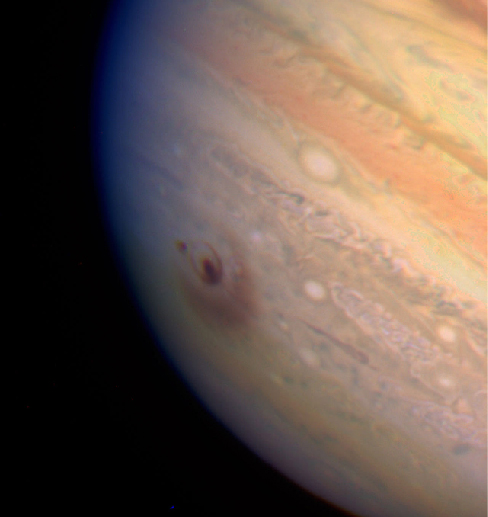
After this event, dark clouds of debris settled into the stratosphere of Jupiter, producing long-lived “bruises” (each still larger than Earth) that could be easily seen through even small telescopes (Figure 13.31). Millions of people all over the world peered at Jupiter through telescopes or followed the event via television or online. Another, smaller, impact feature was seen on Jupiter in summer 2009 (and six more since), indicating that the 1994 events were by no means unique. Seeing these large, impact explosions on Jupiter helps us to appreciate the disaster that would happen to our planet if we were hit by a comet or asteroid.
英語のヒント
この出来事の後、暗い破片の雲が木星の成層圏に落ち着き、長く残る「あざ」を作った。一つひとつがなお地球より大きく、小型望遠鏡でも容易に見えた(図13.31)。世界中の何百万人もの人が望遠鏡で木星をのぞいたり、テレビやインターネットで出来事を追ったりした。2009年の夏には、さらに小さな別の衝突痕が木星に見られ、その後も六つ見つかった。1994年の出来事は決して唯一ではなかったことを示している。木星でのこれらの大きな衝突爆発を見ると、地球に彗星や小惑星が衝突した場合の災害を、実感できる。
Impact Dust Cloud on Jupiter.木星の衝突による塵の雲。
credit: modification of work by H. Hammel, MIT, and NASA/ESA · NASA media use guidelines
Figure 13.31 These features result from the impact of Comet Shoemaker-Levy 9 with Jupiter, seen with the Hubble Space Telescope 105 minutes after the impact that produced the dark rings (the compact back dot came from another fragment). The inner edge of the diffuse, outer ring is about the same size as Earth. Later, the winds on Jupiter blended these features into a broad spot that remained visible for more than a month. (credit: modification of work by H. Hammel, MIT, and NASA/ESA)
図13.31 これらの模様は、シューメーカー・レヴィ第9彗星の木星への衝突によるもの。暗い輪を作った衝突の105分後、ハッブル宇宙望遠鏡で見た姿だ。小さくまとまった黒点は、別の破片による。ぼんやりした外側の輪の内縁は、地球とほぼ同じ大きさである。後に木星の風がこれらの模様を混ぜ、1か月以上見え続ける幅広い斑点にした。(クレジット:H. Hammel、MIT、NASA/ESAの作品を改変)
For comets that do not meet so dramatic an end, measurements of the amount of gas and dust in their atmospheres permit us to estimate the total losses during one orbit. Typical loss rates are up to a million tons per day from an active comet near the Sun, adding up to some tens of millions of tons per orbit. At that rate, a typical comet will be gone after a few thousand orbits. This will probably be the fate of Comet Halley in the long run.
英語のヒント
それほど劇的な最期を迎えない彗星では、大気に含まれるガスと塵の量を測ることで、1周の間に失う総量を推定できる。太陽近くの活動的な彗星の典型的な損失率は、1日最大100万トンに達し、1周で数千万トンほどになる。この率なら、典型的な彗星は数千周後には消えてしまう。長い目で見れば、ハレー彗星もおそらくこの運命をたどるだろう。
Earlier we mentioned that comets can also escape the solar system. In 2019, astronomers discovered comet 2I/Borisov, which came from a planetary system other than ours. It is only the second interstellar object we have found, and the first that is rich in volatile materials such as water and carbon compounds. The presence of an atmosphere allowed its composition to be studied. Borisov contains much more carbon monoxide than normal solar system comets, which tells us that it was probably formed in a cooler location, perhaps around a red dwarf star.
英語のヒント
先に、彗星は太陽系を脱出することもあると述べた。2019年、天文学者は、私たちのものとは別の惑星系から来た、2I/ボリソフ彗星を発見した。見つかった恒星間天体としては二つ目にすぎず、水や炭素化合物のような揮発性物質に富むものとしては初めてだ。大気が存在したので、組成を調べることができた。ボリソフ彗星には通常の太陽系の彗星よりはるかに多くの一酸化炭素が含まれる。このことから、おそらく赤色矮星の周りなど、もっと冷たい場所でできたとわかる。