第13章彗星と小惑星――太陽系に残されたかけらComets and Asteroids: Debris of the Solar System
Composition and Classification組成と分類
Asteroids are as different as black and white. The majority are very dark, with reflectivity of only 3 to 4%, like a lump of coal. However, another large group has a typical reflectivity of 15%. To understand more about these differences and how they are related to chemical composition, astronomers study the spectrum of the light reflected from asteroids for clues about their composition.
英語のヒント
小惑星には、黒と白ほどの違いがある。大多数は石炭の塊のように非常に暗く、反射率はわずか3〜4%だ。しかし、もう一つの大きな集団では典型的な反射率が15%になる。こうした違いや、化学組成との関係をさらに理解するため、天文学者は小惑星が反射する光のスペクトルを調べ、組成の手がかりを探す。
The dark asteroids are revealed from spectral studies to be primitive bodies (those that have changed little chemically since the beginning of the solar system) composed of silicates mixed with dark, organic carbon compounds. These are known as C-type asteroids (“C” for carbonaceous). Two of the largest asteroids, Ceres and Pallas, are primitive, as are almost all of the asteroids in the outer part of the belt. In 2020 and 2021, two of these C-type asteroids, Bennu and Ryugu, were visited by spacecraft that briefly touched their surfaces.
英語のヒント
スペクトルの研究から、暗い小惑星は、ケイ酸塩に暗い有機炭素化合物が混じった、始原的な天体だとわかる。始原的とは、太陽系の始まり以来、化学的にほとんど変化していないという意味だ。これらはC型小惑星と呼ばれる。Cはcarbonaceous、すなわち「炭素質」を表す。大型の小惑星のうちケレスとパラスは始原的で、小惑星帯の外側にある小惑星もほぼすべてがそうだ。2020年と2021年には、C型小惑星のうちベンヌとリュウグウの二つを探査機が訪れ、その表面に短時間接触した。
The second most populous group is the S-type asteroids, where “S” stands for a stony or silicate composition. Here, the dark carbon compounds are missing, resulting in higher reflectivity and clearer spectral signatures of silicate minerals. The S-type asteroids are also chemically primitive, but their different composition indicates that they were probably formed in a different location in the solar system from the C-type asteroids.
英語のヒント
二番目に数の多い集団はS型小惑星で、Sはstonyまたはsilicate、つまり岩石質・ケイ酸塩の組成を表す。この集団では暗い炭素化合物が欠けているため、反射率が高く、ケイ酸塩鉱物のスペクトルの特徴がより明瞭に見える。S型小惑星も化学的には始原的だが、組成の違いは、おそらくC型小惑星とは太陽系内の別の場所でできたことを示している。
Asteroids of a third class, much less numerous than those of the first two, are composed primarily of metal and are called M-type asteroids (“M” for metallic). Spectroscopically, the identification of metal is difficult, but for at least the largest M-type asteroid, Psyche, this identification has been confirmed by radar. Since a metal asteroid, like an airplane or ship, is a much better reflector of radar than is a stony object, Psyche appears bright when we aim a radar beam at it. In 2023, a NASA mission, conveniently named Psyche, was launched toward this asteroid, with a scheduled arrival in 2029.
英語のヒント
第三の分類の小惑星は、前の二種類に比べてはるかに数が少なく、主に金属からなる。M型小惑星と呼ばれ、Mはmetallic、すなわち「金属質」を表す。スペクトルから金属を特定するのは難しいが、少なくとも最大のM型小惑星プシケでは、レーダーによって金属だと確認されている。金属の小惑星は、飛行機や船と同じように、岩石の天体よりはるかによくレーダーを反射する。そのため、プシケにレーダービームを向けると、明るく見える。2023年には、わかりやすくプシケと名付けられたNASAの探査機がこの小惑星へ向けて打ち上げられ、2029年の到着が予定されている。
How did such metal asteroids come to be? We suspect that each came from a parent body large enough for its molten interior to settle out or differentiate, and the heavier metals sank to the center. When this parent body shattered in a later collision, the fragments from the core were rich in metals. There is enough metal in even a 1-kilometer M-type asteroid to supply the world with iron and many other industrial metals for the foreseeable future, if we could bring one safely to Earth.
英語のヒント
このような金属の小惑星は、どうやってできたのだろうか。それぞれ、溶けた内部で物質が分かれて沈降する、つまり分化するほど大きな母天体から来たのではないかと考えられている。そこで重い金属が中心へ沈んだ。その母天体が後の衝突で砕けた際、核から来た破片は金属に富んでいたのだ。M型小惑星は、わずか1kmのものにも、予見できる将来にわたって世界へ鉄や多くの工業用金属を供給するのに十分な金属が含まれる。もし安全に一つを地球へ運ぶことができれば、という話だが。
In addition to the M-type asteroids, a few other asteroids show signs of early heating and differentiation. These have basaltic surfaces like the volcanic plains of the Moon and Mars; the large asteroid Vesta (discussed in a moment) is in this last category.
英語のヒント
M型小惑星のほかにも、初期に加熱と分化を経験した兆候を示す小惑星が少数ある。これらは月や火星の火山性の平原に似た玄武岩質の表面を持つ。まもなく取り上げる大型の小惑星ベスタは、この最後の分類に入る。
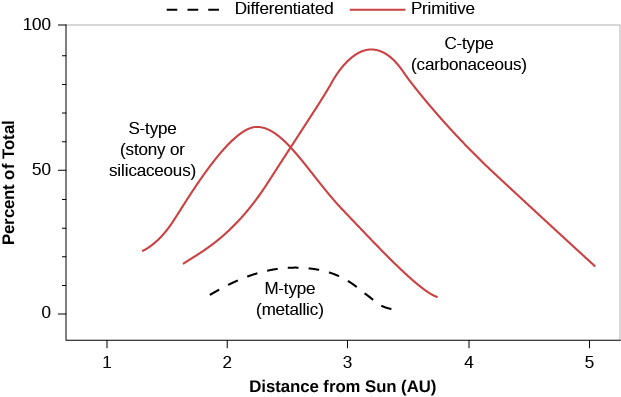
The different classes of asteroids are found at different distances from the Sun (Figure 13.3). By tracing how asteroid compositions vary with distance from the Sun, we can reconstruct some of the properties of the solar nebula from which they originally formed.
英語のヒント
異なる分類の小惑星は、太陽から異なる距離に見つかる(図13.3)。小惑星の組成が太陽からの距離によってどう変わるかをたどることで、もともとそれらが生まれた太陽系星雲の性質の一部を復元できる。
Where Different Types of Asteroids Are Found.小惑星の種類ごとに見られる場所。
OpenStax / Rice University · CC BY 4.0
Figure 13.3 Asteroids of different composition are distributed at different distances from the Sun. The S-type and C-type are both primitive; the M-type consists of cores of differentiated parent bodies.
図13.3 組成の異なる小惑星は、太陽から異なる距離に分布する。S型とC型はどちらも始原的で、M型は分化した母天体の核からなる。
Vesta: A Differentiated Asteroidベスタ――分化した小惑星
Vesta is one of the most interesting of the asteroids. It orbits the Sun with a semi-major axis of 2.4 AU in the inner part of the asteroid belt. Its relatively high reflectivity of almost 30% makes it the brightest asteroid, so bright that it is actually visible to the unaided eye if you know just where to look. But its real claim to fame is that its surface is covered with basalt, indicating that Vesta is a differentiated object that must once have been volcanically active, in spite of its small size (about 500 kilometers in diameter).
英語のヒント
ベスタは、小惑星の中でも特に興味深い天体の一つだ。小惑星帯の内側で、軌道長半径2.4天文単位の軌道に沿って太陽を回る。約30%という比較的高い反射率のおかげで最も明るい小惑星となり、見る場所を正確に知っていれば、実際に肉眼で見えるほど明るい。しかし、ベスタが本当に注目される理由は、表面が玄武岩に覆われていることだ。これは、ベスタが分化した天体で、直径約500kmという小ささにもかかわらず、かつて火山活動をしていたに違いないことを示す。
Meteorites from Vesta’s surface (Figure 13.4), identified by comparing their spectra with that of Vesta itself, have landed on Earth and are available for direct study in the laboratory. We thus know a great deal about this asteroid. The age of the lava flows from which these meteorites derived has been measured at 4.4 to 4.5 billion years, very soon after the formation of the solar system. This age is consistent with what we might expect for volcanoes on Vesta; whatever process heated such a small object was probably intense and short-lived. In 2016, a meteorite fell in Turkey that could be identified with a particular lava flow as revealed by the orbiting Dawn spacecraft.
英語のヒント
ベスタ表面に由来する隕石(図13.4)が地球に落ちてきており、実験室で直接調べることができる。隕石とベスタ本体のスペクトルを比較して、その出自が特定された。このため、私たちはこの小惑星について多くを知っている。隕石のもととなった溶岩流の年代は44億〜45億年前と測定されており、太陽系が形成された直後に当たる。この年代は、ベスタの火山について予想されることと整合する。このような小さな天体を加熱した過程が何であれ、おそらく激しく、短期間で終わったのだろう。2016年にはトルコに隕石が落下し、周回中のドーン探査機が明らかにした、特定の溶岩流に由来すると特定できた。
Piece of Vesta.ベスタのかけら。
Figure 13.4 This meteorite (rock that fell from space) has been identified as a volcanic fragment from the crust of asteroid Vesta. (credit: modification of work by R. Kempton (New England Meteoritical Services))
図13.4 この隕石、すなわち宇宙から落ちてきた岩石は、小惑星ベスタの地殻から来た火山性の破片だと特定された。(クレジット:R. Kempton[New England Meteoritical Services]の作品を改変)
Asteroids Up Close小惑星を間近で見る
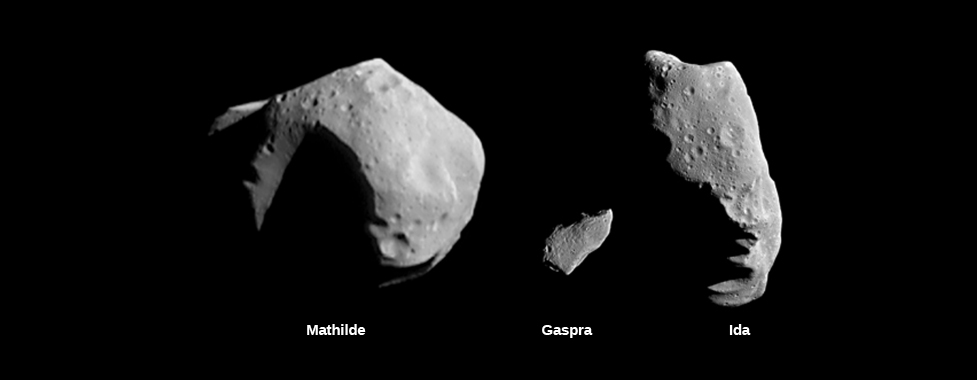
On the way to its 1995 encounter with Jupiter, the Galileo spacecraft was targeted to fly close to two main-belt S-type asteroids called Gaspra and Ida. The Galileo camera revealed both as long and highly irregular (resembling a battered potato), as befits fragments from a catastrophic collision (Figure 13.5).
英語のヒント
1995年に木星へ到達するまでの道中、ガリレオ探査機は、小惑星帯にあるガスプラとイダという二つのS型小惑星の近くを飛ぶよう設定された。ガリレオのカメラが捉えた両者は、壊滅的な衝突の破片にふさわしく、細長く、ひどく不規則な形をしていた。傷だらけのジャガイモに似ている(図13.5)。
Mathilde, Gaspra, and Ida.マチルド、ガスプラ、イダ。
credit: modification of work by NEAR Project, Galileo Project, NASA · NASA media use guidelines
Figure 13.5 The first three asteroids photographed from spacecraft flybys, printed to the same scale. Gaspra and Ida are S-type and were investigated by the Galileo spacecraft; Mathilde is C-type and was a flyby target for the NEAR-Shoemaker spacecraft. (credit: modification of work by NEAR Project, Galileo Project, NASA)
図13.5 探査機のフライバイによって最初に撮影された三つの小惑星を、同じ縮尺で並べたもの。ガスプラとイダはS型で、ガリレオ探査機が調べた。マチルドはC型で、NEARシューメーカー探査機のフライバイの対象だった。(クレジット:NEAR Project、Galileo Project、NASAの作品を改変)
The detailed images allowed us to count the craters on Gaspra and Ida, and to estimate the length of time their surfaces have been exposed to collisions. The Galileo scientists concluded that these asteroids are only about 200 million years old (that is, the collisions that formed them took place about 200 million years ago). Calculations suggest that an asteroid the size of Gaspra or Ida can expect another catastrophic collision sometime in the next billion years, at which time it will be disrupted to form another generation of still-smaller fragments.
英語のヒント
詳しい画像のおかげで、ガスプラとイダのクレーターを数え、表面が衝突にさらされてきた期間を推定できた。ガリレオの科学者たちは、これらの小惑星の年齢はわずか約2億年だと結論づけた。つまり、両者を作った衝突が約2億年前に起こったということだ。計算によると、ガスプラやイダ程度の小惑星は、今後10億年のどこかで、再び壊滅的な衝突に遭うと予想される。そのときには粉砕され、さらに小さな次の世代の破片を作るだろう。
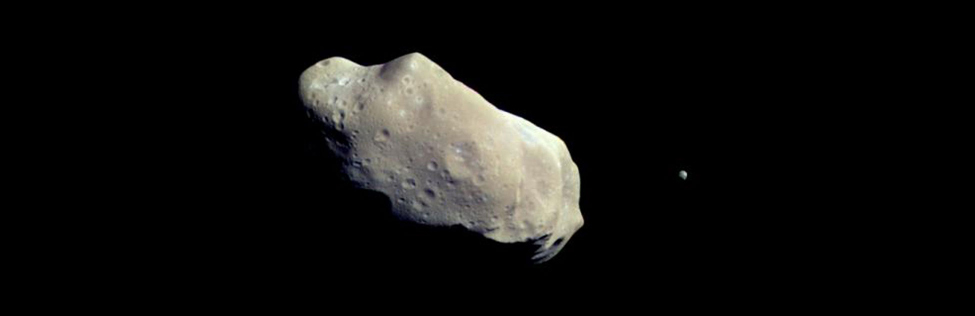
The greatest surprise of the Galileo flyby of Ida was the discovery of a moon (which was then named Dactyl), in orbit about the asteroid (Figure 13.6). Although only 1.5 kilometers in diameter, smaller than many college campuses, Dactyl provides scientists with something otherwise beyond their reach—a measurement of the mass and density of Ida using Kepler’s laws. The moon’s distance of about 100 kilometers and its orbital period of about 24 hours indicate that Ida has a density of approximately 2.5 g/cm3, which matches the density of primitive rocks. Subsequently, both large visible-light telescopes and high-powered planetary radar have discovered many other asteroid moons, so that we are now able to accumulate valuable data on asteroid masses and densities.
英語のヒント
ガリレオがイダをフライバイした際の最大の驚きは、小惑星の周りを回る衛星の発見だった。衛星は後にダクティルと名付けられた(図13.6)。直径はわずか1.5kmで、多くの大学キャンパスより小さい。それでもダクティルのおかげで、科学者は、それがなければ手の届かないもの、すなわちケプラーの法則を使ったイダの質量と密度の測定を得られる。衛星までの距離は約100km、公転周期は約24時間で、この値からイダの密度は約2.5g/cm³とわかる。これは始原的な岩石の密度に合う。その後、大型の可視光望遠鏡と強力な惑星レーダーの両方が、小惑星の衛星をさらに多数発見した。そのため、いまでは小惑星の質量と密度について、貴重なデータを蓄積できるようになっている。
Ida and Dactyl.イダとダクティル。
credit: modification of work by NASA/JPL · JPL image use policy
Figure 13.6 The asteroid Ida and its tiny moon Dactyl (the small body off to its right), were photographed by the Galileo spacecraft in 1993. Irregularly shaped Ida is 56 kilometers in its longest dimension, while Dactyl is about 1.5 kilometers across. The colors have been intensified in this image; to the eye, all asteroids look basically gray. (credit: modification of work by NASA/JPL)
図13.6 小惑星イダと、その小さな衛星ダクティル(右側に離れて見える小天体)を、1993年にガリレオ探査機が撮影した。不規則な形のイダは最も長い方向で56km、ダクティルは約1.5kmだ。この画像では色が強調されている。目で見れば、どの小惑星も基本的には灰色に見える。(クレジット:NASA/JPLの作品を改変)
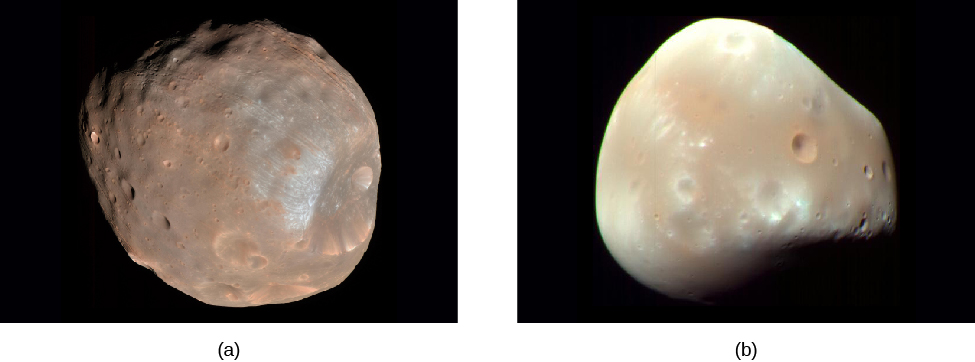
By the way, Phobos and Deimos, the two small moons of Mars, are probably captured asteroids (Figure 13.7). They were first studied at close range by the Viking orbiters in 1977 and later by Mars Global Surveyor. Both are irregular, somewhat elongated, and heavily created, resembling other smaller asteroids. Their largest dimensions are about 26 kilometers and 16 kilometers, respectively. The small outer moons of Jupiter and Saturn were probably also captured asteroids, perhaps early in the history of the solar system.
英語のヒント
ところで、火星の二つの小衛星フォボスとダイモスは、おそらく捕獲された小惑星だ(図13.7)。1977年にバイキングの周回機が初めて間近で調べ、後にマーズ・グローバル・サーベイヤーも調べた。両者は不規則でやや細長く、多数のクレーターがあり、ほかの小さな小惑星に似ている。最も長い方向の大きさはそれぞれ約26kmと16kmだ。木星や土星の外側の小衛星も、おそらく太陽系の歴史の初期に捕獲された小惑星だったのだろう。
Moons of Mars.火星の衛星。
credit a: modification of work by NASA; credit b: modification of work by NASA/JPL-Caltech/University of Arizona · JPL image use policy
Figure 13.7 The two small moons of Mars, (a) Phobos and (b) Deimos, were discovered in 1877 by American astronomer Asaph Hall. Their surface materials are similar to many of the asteroids in the outer asteroid belt, leading astronomers to believe that the two moons may be captured asteroids. (credit a: modification of work by NASA; credit b: modification of work by NASA/JPL-Caltech/University of Arizona)
図13.7 火星の二つの小さな衛星、(a)フォボスと(b)ダイモスは、1877年に米国の天文学者アサフ・ホールが発見した。表面の物質が、小惑星帯の外側にある多くの小惑星に似ていることから、天文学者は、二つの衛星が捕獲された小惑星かもしれないと考えている。(aのクレジット:NASAの作品を改変。bのクレジット:NASA/JPL-Caltech/University of Arizonaの作品を改変)
Beginning in the 1990s, spacecraft have provided close looks at several more asteroids. The Near Earth Asteroid Rendezvous (NEAR) spacecraft went into orbit around the S-type asteroid Eros, becoming a temporary moon of this asteroid. On its way to Eros, the NEAR spacecraft was renamed after planetary geologist Eugene Shoemaker, a pioneer in our understanding of craters and impacts.
英語のヒント
1990年代以降、探査機はさらにいくつかの小惑星の近接観測を提供してきた。地球近傍小惑星ランデブー、略してNEARという探査機は、S型小惑星エロスの周回軌道に入り、一時的にこの小惑星の衛星となった。エロスへ向かう道中、NEAR探査機は、クレーターと衝突の理解を切り開いた惑星地質学者ユージン・シューメーカーにちなんで改名された。
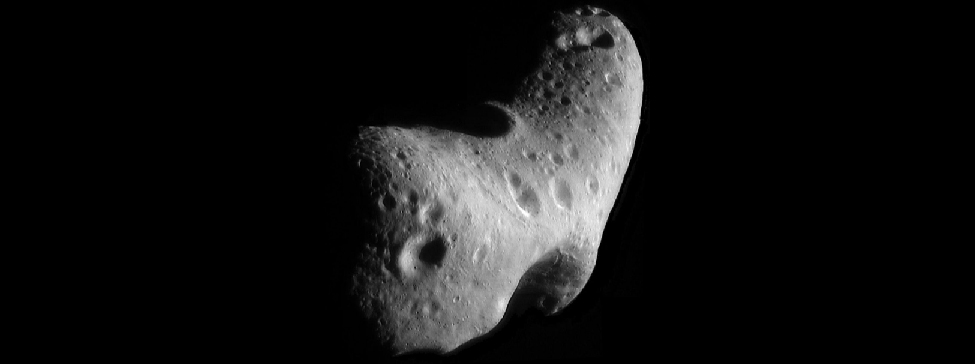
For a year, the NEAR-Shoemaker spacecraft orbited the little asteroid at various altitudes, measuring its surface and interior composition as well as mapping Eros from all sides (Figure 13.8). The data showed that Eros is made of some of the most chemically primitive materials in the solar system. Several other asteroids have been revealed as made of loosely bound rubble throughout, but not Eros. Its uniform density (about the same as that of Earth’s crust) and extensive global-scale grooves and ridges show that it is a cracked but solid rock.
英語のヒント
NEARシューメーカー探査機は1年間、小さな小惑星の周りをさまざまな高度で回り、表面と内部の組成を測定するとともに、あらゆる方向からエロスを地図化した(図13.8)。データは、エロスが太陽系で最も化学的に始原的な部類の物質でできていることを示した。ほかのいくつかの小惑星は、全体が緩く結び付いたがれきからなるとわかっているが、エロスは違う。地球の地殻とほぼ同じ一様な密度と、天体全体に広がる溝や尾根は、エロスがひび割れてはいても、一体の岩石であることを示す。
Looking Down on the North Pole of Eros.エロスの北極を見下ろす。
credit: modification of work by NASA/JHUPL · NASA media use guidelines
Figure 13.8 This view was constructed from six images of the asteroid taken from an altitude of 200 kilometers. The large crater at the top has been named Psyche (after the maiden who was Eros’ lover in classical mythology) and is about 5.3 kilometers wide. A saddle-shaped region can be seen directly below it. Craters of many different sizes are visible. (credit: modification of work by NASA/JHUPL)
図13.8 この眺めは、高度200kmから撮った六枚の小惑星の画像から構成したもの。上部の大きなクレーターは、古典神話でエロスの恋人だった乙女にちなんでプシケと名付けられ、幅は約5.3kmある。そのすぐ下には、鞍のような形の領域が見える。さまざまな大きさのクレーターも見える。(クレジット:NASA/JHUPLの作品を改変)
Eros has a good deal of loose surface material that appears to have slid down toward lower elevations. In some places, the surface rubble layer is 100 meters deep. The top of loose soil is dotted with scattered, half-buried boulders. There are so many of these boulders that they are more numerous than the craters. Of course, with the gravity so low on this small world, a visiting astronaut would find loose boulders rolling toward her pretty slowly and could easily leap high enough to avoid being hit by one. Although the NEAR-Shoemaker spacecraft was not constructed as a lander, at the end of its orbital mission in 2000, it was allowed to fall gently to the surface, where it continued its chemical analysis for another week.
英語のヒント
エロスの表面には、低い場所へ滑り落ちたように見える、固まっていない物質が大量にある。場所によっては、表面のがれきの層の厚さは100mに達する。緩い土の表面には、半ば埋まった巨石が点在する。その巨石は非常に多く、クレーターの数を上回るほどだ。もちろん、この小さな天体では重力が非常に弱いので、訪れた宇宙飛行士のほうへ転がってくる不安定な巨石も、かなりゆっくり動くだろう。石にぶつからないよう、十分高く跳び上がるのも容易なはずだ。NEARシューメーカーは着陸機として作られてはいなかったが、2000年に周回任務を終えると、表面へ静かに降下させられ、そこでもさらに1週間、化学分析を続けた。
In 2003, Japan’s Hayabusa 1 mission not only visited a small asteroid but also brought back samples to study in laboratories on Earth. The target S-type asteroid, Itokawa (shown in Figure 13.9), is much smaller than Eros, only about 500 meters long. This asteroid is elongated and appears to be the result of the collision of two separate asteroids long ago. There are almost no impact craters, but an abundance of boulders (like a pile of rubble) on the surface.
英語のヒント
2003年、日本の「はやぶさ1」の探査は、小さな小惑星を訪れただけでなく、地球の実験室で調べる試料も持ち帰った。対象のS型小惑星イトカワ(図13.9)はエロスよりはるかに小さく、長さは約500mしかない。この小惑星は細長く、はるか昔に別々の二つの小惑星が衝突した結果のように見える。表面には衝突クレーターがほとんどなく、代わりに、がれきの山のように巨石が豊富にある。
Asteroid Itokawa.小惑星イトカワ。
Figure 13.9 The surface of asteroid Itokawa appears to have no craters. Astronomers have hypothesized that its surface consists of rocks and ice chunks held together by a small amount of gravity, and its interior is probably also a similar rubble pile. (credit: JAXA)
図13.9 小惑星イトカワの表面には、クレーターがないように見える。天文学者は、その表面が弱い重力によって結び付いた岩石と氷の塊からなり、内部もおそらく同じようながれきの集まりだという仮説を立てている。(クレジット:JAXA)
The Hayabusa spacecraft was designed not to land, but to touch the surface just long enough to collect a small sample. This tricky maneuver failed on its first try, with the spacecraft briefly toppling over on its side. Eventually, the controllers were successful in picking up a few grains of surface material and transferring them into the return capsule. We estimate that the dust grains Hayabusa picked up had been exposed on the surface of the asteroid for about 8 million years.
英語のヒント
はやぶさ探査機は、着陸するのではなく、少量の試料を集めるのに必要な時間だけ表面に触れるように設計された。この難しい操作は最初の試みでは失敗し、探査機は短時間、横向きに倒れてしまった。最終的には、管制担当者は表面物質の粒をいくつか取り込み、帰還カプセルへ移すことに成功した。はやぶさが集めた塵の粒は、小惑星の表面で約800万年にわたって外部にさらされていたと推定される。
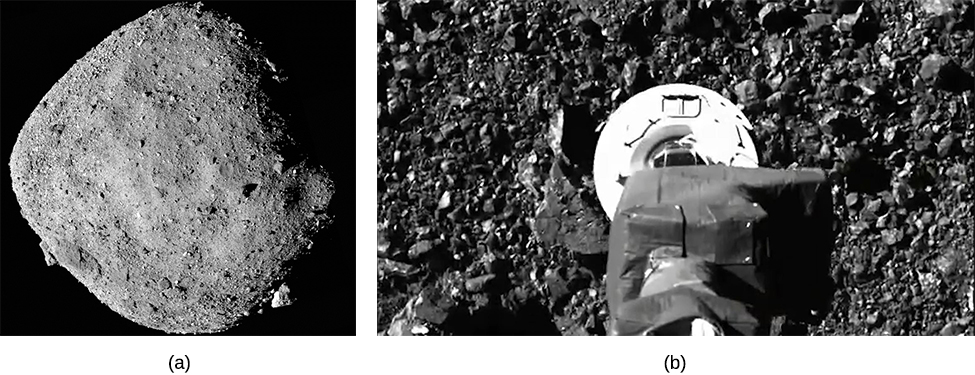
Following on the success of Hayabusa, both NASA and the Japanese space agency, JAXA, sent more advanced asteroid sample-return missions. Both targeted small Earth-approaching asteroids, only about 1 km in diameter. Each target is a dark object, apparently a rubble pile formed relatively recently after being broken apart in a collision. Hayabusa-2 visited the asteroid Ryugu, collected a small sample, and successfully returned it to Earth in December 2020. The U.S. mission called OSIRIS-REx visited Bennu, an asteroid that actually has a small chance of colliding with Earth in the next century (Figure 13.10). Its larger sample was returned in 2023.
英語のヒント
はやぶさの成功に続き、NASAと日本の宇宙機関JAXAは、ともにさらに進んだ小惑星サンプルリターン探査機を送り出した。どちらも、直径がわずか約1kmの、地球へ接近する小さな小惑星を対象とした。いずれの対象も暗い天体で、衝突でばらばらになった後、比較的最近できたがれきの集まりらしい。はやぶさ2は小惑星リュウグウを訪れ、少量の試料を集めて、2020年12月に無事に地球へ持ち帰った。米国のOSIRIS-RExという探査機はベンヌを訪れた。この小惑星には、実際に来世紀、地球に衝突する小さな可能性がある(図13.10)。その、より多い量の試料は2023年に帰還した。
After the analysis, Bennu turned out to be one of the most interesting targets of NASA exploration missions. Its composition indicates that Bennu was once part of a much larger object, which had liquid water and many organic compounds on its surface, including a variety of amino acids which are thought to have been precursors of life on Earth. Remarkably, these chemicals survived the collision that broke up the original object and have been preserved for billions of years in the vacuum of space for us to collect from this little asteroid.
英語のヒント
分析の結果、ベンヌはNASAの探査対象の中でも特に興味深いものの一つだとわかった。その組成は、ベンヌがかつて、表面に液体の水と多くの有機化合物を持つ、はるかに大きな天体の一部だったことを示す。有機化合物には、地球上の生命の前駆物質だったと考えられる、さまざまなアミノ酸も含まれる。驚くべきことに、これらの化学物質は元の天体を壊した衝突を生き延び、宇宙の真空中で何十億年も保存され、私たちがこの小さな小惑星から採取できるまで残っていた。
Examining an Asteroid Up Close.小惑星を間近で調べる。
OpenStax / Rice University · CC BY 4.0
Figure 13.10 (a) Near-Earth Asteroid Bennu, imaged by the Osiris-Rex Spacecraft in 2020. Bennu is a small (half-km diameter), rapidly spinning dark asteroid. Its low density suggests it is a loosely-bound rubble pile. The surface is very rough, with protruding rocks and boulders. (b) Preparing to collect a sample, the collection arm is shown just before touch-down on Bennu. For scale, the diameter of the sampling device is 30 cm. The sample of about 100 grams of surface rocks and dust will be returned to Earth in 2023. a: modification of work by NASA Goddard/University of Arizona; credit b: modification of work by NASA Goddard/University of Arizona
図13.10 (a)OSIRIS-REx探査機が2020年に撮影した、地球近傍小惑星ベンヌ。直径0.5kmの小さく暗い小惑星で、速く自転している。密度の低さは、緩く結び付いたがれきの集まりであることを示唆する。表面は非常に粗く、岩石や巨石が突き出している。(b)試料の採取に備え、ベンヌに接地する直前の採取アーム。大きさの目安として、採取装置の直径は30cmだ。約100gの表面の岩石と塵の試料は、2023年に地球へ持ち帰られる予定である。(aのクレジット:NASA Goddard/University of Arizonaの作品を改変。bのクレジット:NASA Goddard/University of Arizonaの作品を改変)
The most ambitious asteroid space mission (called Dawn) has visited the two largest main belt asteroids, Ceres and Vesta, orbiting each for about a year (Figure 13.11). Their large sizes (diameters of about 1000 and 500 kilometers, respectively) make them appropriate for comparison with the planets and large moons. Both turned out to be heavily cratered, implying their surfaces are old. On Vesta, we have now actually located the large impact craters that ejected the basaltic meteorites previously identified as coming from this asteroid. These craters are so large that they sample several layers of Vesta’s crustal material.
英語のヒント
最も意欲的な小惑星探査計画であるドーンは、小惑星帯の二大天体、ケレスとベスタを訪れ、それぞれ約1年間周回した(図13.11)。両者は直径がそれぞれ約1000kmと500kmと大きく、惑星や大型衛星と比較するのに適している。どちらもクレーターが非常に多いことがわかり、表面が古いことを示している。ベスタでは、この小惑星から来たと以前に特定されていた玄武岩質隕石を放出した、大きな衝突クレーターを、いまでは実際に突き止めている。クレーターは非常に大きく、ベスタの地殻物質の複数の層を掘り出している。