第14章宇宙からの試料と太陽系の起源Cosmic Samples and the Origin of the Solar System
Thinking Aheadまず考えてみよう
Planetesimals.微惑星。
credit: modification of work by University of Copenhagen/Lars Buchhave, NASA · NASA media use guidelines
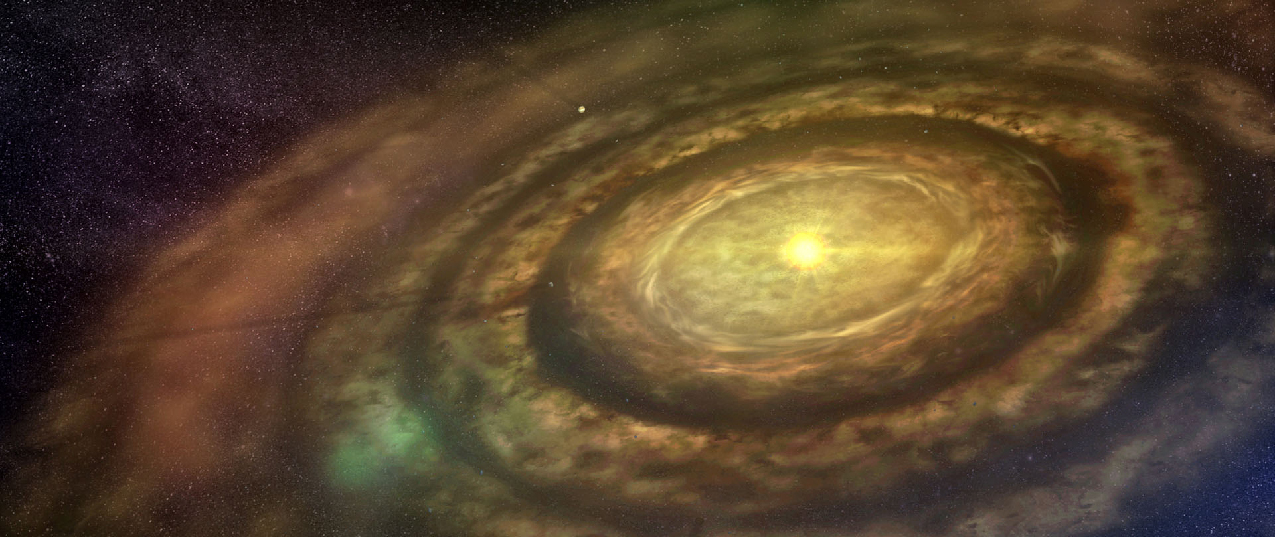
Figure 14.1 This illustration depicts a disk of dust and gas around a new star. Material in this disk comes together to form planetesimals. (credit: modification of work by University of Copenhagen/Lars Buchhave, NASA)
図14.1 この図は、新しい恒星の周囲にある塵とガスの円盤を描いたものだ。円盤内の物質が集まり、微惑星を形成する。(クレジット:University of Copenhagen/Lars Buchhave、NASAの作品を改変)
Imagine you are a scientist examining a sample of rock that had fallen from space a few days earlier and you find within it some of the chemical building blocks of life. How could you determine whether those “organic” materials came from space or were merely the result of earthly contamination?
英語のヒント
数日前に宇宙から落ちてきた岩石の試料を調べる科学者になったつもりで考えてみよう。その中から、生命の化学的な構成材料の一部が見つかったとする。その「有機物」が宇宙から来たものなのか、それとも単に地球上の物質が混入した結果なのか、どうすれば判断できるだろうか。
We conclude our survey of the solar system with a discussion of its origin and evolution. Some of these ideas were introduced in Other Worlds: An Introduction to the Solar System; we now return to them, using the information we have learned about individual planets and smaller members of the solar system. In addition, astronomers have recently discovered thousands of planets around other stars, including numerous multiplanet systems. This is an important new source of data, providing us a perspective that extends beyond our own particular (and perhaps atypical) solar system.
英語のヒント
太陽系の概観を締めくくるにあたり、その起源と進化を考えよう。これらの考え方の一部は「ほかの世界――太陽系入門」ですでに紹介した。ここでは個々の惑星や太陽系の小天体について学んだ知識を使って、改めてその話題に戻る。さらに近年、天文学者はほかの恒星の周囲に数千個の惑星を発見しており、複数の惑星を持つ系も数多く見つかっている。これは重要な新しいデータ源であり、私たちの太陽系という一つの例を超えて物事を見る視点を与えてくれる。私たちの太陽系は、もしかすると典型的な例ではないかもしれない。
But first, we want to look at another crucial way that astronomers learn about the ancient history of the solar system: by examining samples of primitive matter, the debris of the processes that formed the solar system some 4.5 billion years ago. Unlike the Apollo Moon rocks, these samples of cosmic material come to us free of charge—they literally fall from the sky. We call this material cosmic dust and meteorites.
英語のヒント
その前に、太陽系の遠い過去を知るための、もう一つのきわめて重要な方法を見ておこう。原始的な物質の試料、すなわち約45億年前に太陽系を形成した過程の残骸を調べる方法だ。アポロ計画で持ち帰られた月の岩石と違い、こうした宇宙の物質の試料は無料で手に入る。文字どおり空から降ってくるのだ。この物質を宇宙塵や隕石と呼ぶ。