第14章宇宙からの試料と太陽系の起源Cosmic Samples and the Origin of the Solar System
Discovering Exoplanets太陽系外惑星を発見する
You might think that with the advanced telescopes and detectors astronomers have today, they could directly image planets around nearby stars (which we call exoplanets). This has proved extremely difficult, however, not only because the exoplanets are faint, but also because they are generally lost in the brilliant glare of the star they orbit. As we discuss in more detail in The Birth of Stars and the Discovery of Planets outside the Solar System, the detection techniques that work best are indirect: they observe the effects of the planet on the star it orbits, rather than seeing the planet itself.
英語のヒント
今日の天文学者が持つ高度な望遠鏡や検出器なら、近くの恒星を回る惑星、すなわち太陽系外惑星を、直接撮影できそうだと思うかもしれない。しかし、これはきわめて難しいことが分かった。太陽系外惑星が暗いだけでなく、通常は、周回する恒星のまぶしい光に埋もれてしまうからだ。「星の誕生と太陽系外惑星の発見」で詳しく論じるように、最もうまく働く検出法は間接的なものである。惑星自身を見る代わりに、それが周回する恒星に及ぼす影響を観測する。
The first technique that yielded many planet detections is very high-resolution stellar spectroscopy. The Doppler effect lets astronomers measure the star’s radial velocity: that is, the speed of the star, toward us or away from us, relative to the observer. If there is a massive planet in orbit around the star, the gravity of the planet causes the star to wobble, changing its radial velocity by a small but detectable amount. The distance of the star does not matter, as long as it is bright enough for us to take very high quality spectra.
英語のヒント
多くの惑星の発見をもたらした第一の技法は、きわめて高い分解能で恒星のスペクトルを調べる方法である。ドップラー効果によって、恒星の視線速度、つまり観測者に対して近づく、または遠ざかる向きの速度を測れる。恒星の周りを大質量の惑星が公転していれば、その重力で恒星がふらつき、視線速度が小さく、しかし検出できる量だけ変化する。非常に質の高いスペクトルを取得できるほど明るければ、恒星までの距離は問題にならない。
Measurements of the variation in the star’s radial velocity as the planet goes around the star can tell us the mass and orbital period of the planet. If there are several planets present, their effects on the radial velocity can be disentangled, so the entire planetary system can be deciphered—as long as the planets are massive enough to produce a measureable Doppler effect. This detection technique is most sensitive to large planets orbiting close to the star, since these produce the greatest wobble in their stars. It has been used on large ground-based telescopes to detect hundreds of planets, including one around Proxima Centauri, the nearest star to the Sun.
英語のヒント
惑星が恒星を一周する間の視線速度の変動を測ると、惑星の質量と公転周期が分かる。複数の惑星があっても、視線速度へのそれぞれの影響を分離できるので、惑星系全体の構成を読み解ける。ただし惑星は、測定できるドップラー効果を生むほどの質量を持っていなければならない。この検出法は、恒星の近くを回る大きな惑星に最も敏感である。そうした惑星が、恒星を最も大きくふらつかせるからだ。大型の地上望遠鏡で使われ、数百個の惑星を検出してきた。その中には、太陽に最も近い恒星、プロキシマ・ケンタウリの周りの惑星も含まれる。
The second indirect technique is based on the slight dimming of a star when one of its planets transits, or crosses over the face of the star, as seen from Earth. Astronomers do not see the planet, but only detect its presence from careful measurements of a change in the brightness of the star over long periods of time. If the slight dips in brightness repeat at regular intervals, we can determine the orbital period of the planet. From the amount of starlight obscured, we can measure the planet’s size.
英語のヒント
第二の間接的な技法は、惑星がトランジットする、つまり地球から見て恒星の手前を横切るときに、恒星がわずかに暗くなることを利用する。天文学者が惑星を見ているわけではなく、長期間にわたって恒星の明るさの変化を注意深く測ることで、その存在を検出する。明るさの小さな低下が一定の間隔で繰り返されれば、惑星の公転周期が求められる。遮られた星の光の量からは、惑星の大きさを測れる。
While some transits have been measured from Earth, large-scale application of this transit technique requires a telescope in space, above the atmosphere and its distortions of the star images. It has been most successfully applied from the NASA Kepler space observatory, which was built for the sole purpose of “staring” for 5 years at a single part of the sky, continuously monitoring the light from more than 150,000 stars. The primary goal of Kepler was to determine the frequency of occurrence of exoplanets of different sizes around different classes of stars. Like the Doppler technique, the transit observations favor discovery of large planets and short-period orbits. The Kepler observations closed down in 2018 when the spacecraft ran out of the fuel needed to point the telescope. However, other space telescopes are now continuing the search.
英語のヒント
地上から測定されたトランジットもあるが、この技法を大規模に適用するには、大気と、それが星像に生じさせるゆがみの影響を避けるため、宇宙の望遠鏡が必要になる。最も大きな成果を挙げたのはNASAのケプラー宇宙望遠鏡だった。空の一つの領域を5年間「見つめ」、15万個を超える恒星の光を連続して監視するという目的だけのために作られた。ケプラーの主な目標は、種類の異なる恒星の周りに、さまざまな大きさの太陽系外惑星がどれほどの頻度で存在するかを調べることだった。ドップラー法と同様、トランジット観測でも、大きな惑星や短周期の軌道にある惑星を見つけやすい。ケプラーの観測は、望遠鏡の向きを定めるのに必要な燃料を使い切った2018年に終了した。しかし現在は、ほかの宇宙望遠鏡が探索を引き継いでいる。
Recent detection of exoplanets using both the Doppler and transit techniques has been incredibly successful. Within two decades, we went from no knowledge of other planetary systems to a catalog of thousands of exoplanets. Most of the exoplanets found so far are more massive than or larger in size than Earth. It is not that Earth analogs do not exist. Rather, the shortage of small rocky planets is an observational bias: smaller planets are more difficult to detect.
英語のヒント
近年、ドップラー法とトランジット法の両方による太陽系外惑星の検出は、驚くほど大きな成果を収めてきた。わずか20年のうちに、ほかの惑星系について何も知らなかった状態から、数千個の太陽系外惑星を収めた一覧表を持つまでになった。これまでに見つかった太陽系外惑星の大部分は、地球より質量が大きいか、大きさが大きい。地球に似た惑星が存在しないということではない。小さな岩石惑星が少ないのは、むしろ観測の偏りである。小さい惑星ほど検出が難しいのだ。
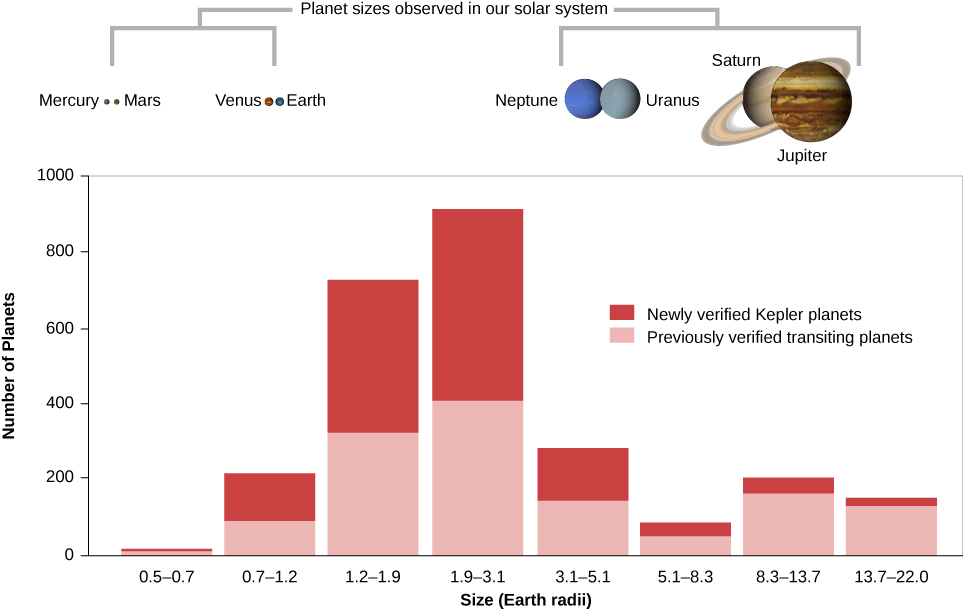
Analyses of the data to correct for such biases or selection effects indicate that small planets (like the terrestrial planets in our system) are actually much more common than giant planets. Also relatively common are “super Earths,” planets with two to ten times the mass of our planet (Figure 14.16). We don’t have any of these in our solar system, but nature seems to have no trouble making them elsewhere. Overall, the Kepler data suggest that perhaps one half of all stars (or more) have exoplanets, implying the existence of at least 100 billion planets in our Galaxy alone. That is a staggering number.
英語のヒント
このような偏り、すなわち選択効果を補正してデータを分析すると、太陽系の地球型惑星のような小さな惑星は、実際には巨大惑星よりはるかに多いと分かる。地球の2〜10倍の質量を持つ「スーパーアース」も比較的よく見られる(図14.16)。太陽系にはこの種類の惑星が一つもないが、自然はほかの場所では難なく作っているようだ。全体としてケプラーのデータは、おそらく全恒星の半分かそれ以上が太陽系外惑星を持つことを示唆する。これは、私たちの銀河系だけでも少なくとも1000億個の惑星が存在することを意味する。途方もない数である。
Transiting Planets by Size.大きさ別に見たトランジット惑星。
credit: modification of work by NASA · NASA media use guidelines
Figure 14.16 This bar graph shows the planets found so far using the transit method (the vast majority found by the Kepler mission). The orange parts of each bar indicate the planets announced by the Kepler team in May 2016. Note that the largest number of planets found so far are in two categories that we don’t have in our own solar system—planets whose size is between Earth’s and Neptune’s. (credit: modification of work by NASA)
図14.16 この棒グラフは、これまでトランジット法で見つかった惑星を示し、その圧倒的多数はケプラー計画による発見である。各棒のオレンジ色の部分は、ケプラーチームが2016年5月に発表した惑星を示す。最も多く見つかったのは、太陽系には存在しない二つの分類、すなわち地球と海王星の間の大きさの惑星であることに注目しよう。(クレジット:NASAの作品を改変)
The Configurations of Other Planetary Systemsほかの惑星系の配置
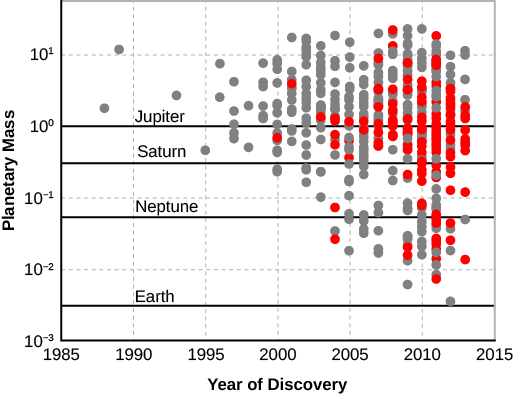
Let’s look more closely at the progress in the detection of exoplanets. Figure 14.17 shows the planets that were discovered each year by the two techniques we discussed. In the early years of exoplanet discovery, most of the planets were similar in mass to Jupiter. This is because, as mentioned above, the most massive planets were easiest to detect. In more recent years, planets smaller than Neptune and even close to the size of Earth have been detected.
英語のヒント
太陽系外惑星の検出がどのように進んだか、詳しく見よう。図14.17は、これまで述べた二つの技法によって、各年に発見された惑星を示している。太陽系外惑星の発見の初期には、大部分の惑星が木星に似た質量を持っていた。前に述べたように、質量が大きい惑星ほど検出しやすかったためだ。近年には、海王星より小さい惑星や、地球に近い大きさの惑星さえ検出されている。
Masses of Exoplanets Discovered by Year.発見年別に見た太陽系外惑星の質量。
OpenStax / Rice University · CC BY 4.0
Figure 14.17 Horizontal lines are drawn to reference the masses of Jupiter, Saturn, Neptune, and Earth. The gray dots indicate planets discovered by measuring the radial velocity of the star, and the red dots are for planets that transit their stars. In the early years, the only planets that could be detected were similar in mass to Jupiter. Improvements in technology and observing strategies enabled the detection of lower mass planets as time went on, and now even smaller worlds are being found. (Note that this tally ends in 2014, but the trend should be clear.)
図14.17 木星、土星、海王星、地球の質量を参照するための水平線が引かれている。灰色の点は恒星の視線速度を測って発見した惑星、赤い点は恒星の手前を通過する惑星を示す。初期には、検出できる惑星は木星に似た質量のものだけだった。技術と観測方法の向上によって、時間とともに低質量の惑星を検出できるようになり、今ではさらに小さい天体も見つかっている。(この集計は2014年までだが、傾向ははっきり分かるだろう。)
We also know that many exoplanets are in multiplanet systems. This is one characteristic that our solar system shares with exosystems. Looking back at Figure 14.15 and seeing how such large disks can give rise to more than one center of condensation, it is not too surprising that multiplanet systems are a typical outcome of planet formation. Astronomers have tried to measure whether multiple planet systems all lie in the same plane using astrometry. This is a difficult measurement to make with current technology, but it is an important measurement that could help us understand the origin and evolution of planetary systems.
英語のヒント
多くの太陽系外惑星が、複数の惑星を持つ系に属することも分かっている。これは太陽系とほかの惑星系に共通する特徴の一つだ。図14.15に戻り、あのような大きな円盤から複数の凝縮の中心が生まれることを考えれば、複数の惑星を持つ系が惑星形成の典型的な結果となるのは、さほど不思議ではない。天文学者は位置天文学の技法を使い、複数惑星の系がすべて同じ平面上にあるかどうかを測ろうとしてきた。現在の技術では難しい測定だが、惑星系の起源と進化の理解に役立つ可能性がある重要な測定である。