第14章宇宙からの試料と太陽系の起源Cosmic Samples and the Origin of the Solar System
Meteorite Classification隕石の分類
The meteorites in our collections have a wide range of compositions and histories, but traditionally they have been placed into three broad classes. First are the irons, composed of nearly pure metallic nickel-iron. Second are the stones, the term used for any silicate or rocky meteorite. Third are the rarer stony-irons, made (as the name implies) of mixtures of stone and metallic iron (Figure 14.9).
英語のヒント
私たちのコレクションにある隕石の組成や歴史はさまざまだが、伝統的には三つの大きな種類に分けられてきた。第一は鉄隕石で、ほぼ純粋な金属の鉄・ニッケルからなる。第二は石質隕石で、ケイ酸塩、すなわち岩石質の隕石を指す。第三は、より珍しい石鉄隕石で、名前のとおり、石と金属鉄の混合物からできている(図14.9)。
Meteorite Types.隕石の種類。
Figure 14.9 (a) This piece of the Allende carbonaceous meteorite has white inclusions that may date back to before the formation of the solar nebula. (b) This fragment is from the iron meteorite responsible for the formation of Meteor Crater in Arizona. (c) This piece of the Imilac stony-iron meteorite is a beautiful mixture of green olivine crystals and metallic iron. (credit a: modification of work by James St. John; credit b: modification of work by “Taty2007”/Wikimedia Commons; credit c: modification of work by Juan Manuel Fluxà)
図14.9 (a)このアエンデ炭素質隕石のかけらには、原始太陽系星雲の形成以前にまでさかのぼる可能性のある、白い包有物が含まれている。(b)この破片は、アリゾナ州のメテオ・クレーターを作った鉄隕石の一部である。(c)このイミラック石鉄隕石のかけらは、緑色のかんらん石の結晶と金属鉄が美しく混じり合っている。(aのクレジット:James St. Johnの作品を改変。bのクレジット:「Taty2007」/Wikimedia Commonsの作品を改変。cのクレジット:Juan Manuel Fluxàの作品を改変)
Of these three types, the irons and stony-irons are the most obviously extraterrestrial because of their metallic content. Pure iron almost never occurs naturally on Earth; it is generally found here as an oxide (chemically combined with oxygen) or other mineral ore. Therefore, if you ever come across a chunk of metallic iron, it is sure to be either human-made or a meteorite.
英語のヒント
この三種類のうち、鉄隕石と石鉄隕石は金属を含むため、地球外に由来することが最もはっきり分かる。純粋な鉄は地球上では自然にはほとんど生じない。通常は、酸素と化学的に結び付いた酸化物や、ほかの鉱石の形で見つかる。したがって、金属鉄の塊を見つけたなら、それは人工物か隕石のどちらかであるはずだ。
The stones are much more common than the irons but more difficult to recognize. Often laboratory analysis is required to demonstrate that a particular sample is really of extraterrestrial origin, especially if it has lain on the ground for some time and been subject to weathering. The most scientifically valuable stones are those collected immediately after they fall, or the Antarctic samples preserved in a nearly pristine state by ice.
英語のヒント
石質隕石は鉄隕石よりはるかに多いが、見分けるのは難しい。ある試料が本当に地球外に由来することを示すには、実験室での分析が必要になることが多い。しばらく地面に横たわり、風化を受けていたなら、なおさらだ。科学的に最も価値が高い石質隕石は、落下直後に採集されたものや、氷によってほぼ元のままの状態で保存された南極の試料である。
Table 14.2 summarizes the frequencies of occurrence of the different classes of meteorites among the fall, find, and Antarctic categories.
表14.2は、落下が観測されたもの、後から発見されたもの、南極で得られたものという分類ごとに、各種の隕石が占める割合をまとめている。
Frequency of Occurrence of Meteorite Classes 隕石の種類別の出現割合 |
|||
|---|---|---|---|
Class 種類 |
Falls (%) 落下を観測(%) |
Finds (%) 後から発見(%) |
Antarctic (%) 南極(%) |
Primitive stones 原始的な石質隕石 |
88 | 51 | 85 |
Differentiated stones 分化した石質隕石 |
8 | 2 | 12 |
Irons 鉄隕石 |
3 | 42 | 2 |
Stony-irons 石鉄隕石 |
1 | 5 | 1 |
Ages and Compositions of Meteorites隕石の年代と組成
It was not until the ages of meteorites were measured and their compositions analyzed in detail that scientists appreciated their true significance. The meteorites include the oldest and most primitive materials available for direct study in the laboratory. The ages of stony meteorites can be determined from the careful measurement of radioactive isotopes and their decay products. Almost all meteorites have radioactive ages between 4.50 and 4.56 billion years, as old as any ages we have measured in the solar system. The few younger exceptions are igneous rocks that have been ejected from cratering events on the Moon or Mars (and have made their way to Earth).
英語のヒント
科学者が隕石の本当の重要性を理解したのは、その年代が測られ、組成が詳しく分析されてからだった。隕石には、実験室で直接調べられる物質のうち、最も古く、最も原始的なものが含まれている。石質隕石の年代は、放射性同位体とその崩壊生成物を注意深く測定することで求められる。ほぼすべての隕石の放射年代は45.0億〜45.6億年で、太陽系で測定された最古の年代に匹敵する。より若い少数の例外は、月や火星でクレーターを生じた衝突によって放出され、その後、地球にたどり着いた火成岩である。
The average age for the most primitive meteorites, calculated using the most accurate values now available for radioactive half-lives, is 4.56 billion years, with an uncertainty of less than 0.01 billion years. This value (which we round off to 4.5 billion years in this book) is taken to represent the age of the solar system—the time since the first solids condensed and began to form into larger bodies.
英語のヒント
最も原始的な隕石の平均年代を、現在得られる最も正確な放射性同位体の半減期を使って計算すると、45.6億年であり、その不確かさは0.1億年未満である。この値は、本書では丸めて45億年とするが、太陽系の年齢を表すとされている。つまり、最初の固体が凝縮し、集まってより大きな天体を作り始めてからの時間である。
The traditional classification of meteorites into irons, stones, and stony-irons is easy to use because it is obvious from inspection which category a meteorite falls into (although it may be much more difficult to distinguish a meteoritic stone from a terrestrial rock). More scientifically significant, however, is the distinction between primitive and differentiated meteorites. The differentiated meteorites are fragments of larger parent bodies that were molten before they broke up, allowing the denser materials (such as metals) to sink to their centers. Like many rocks on Earth, they have been subject to a degree of chemical reshuffling, with the different materials sorted according to density. Differentiated meteorites include the irons, which come from the metal cores of their parent bodies; stony-irons, which probably originate in regions between a metal core and a stony mantle; and some stones that are composed of mantle or crust material from their differentiated parent bodies.
英語のヒント
隕石を鉄隕石・石質隕石・石鉄隕石に分ける伝統的な分類は、見ればどの種類に入るかが明らかなので使いやすい。ただし、隕石として来た石と地球の岩石を区別することは、はるかに難しい場合がある。しかし、科学的により重要なのは、原始的な隕石と分化した隕石の違いである。分化した隕石は、分裂する前に溶融していた、より大きな母天体の破片だ。溶けることによって、金属など密度の高い物質が中心へ沈むことができた。地球上の多くの岩石と同じく、こうした隕石もある程度の化学的な組み替えを受け、物質が密度に応じて分かれている。分化した隕石には、母天体の金属核から来た鉄隕石、金属核と岩石質マントルの間の領域に由来すると考えられる石鉄隕石、そして分化した母天体のマントルや地殻の物質からなる一部の石質隕石が含まれる。
The Most Primitive Meteorites最も原始的な隕石
For information on the earliest history of the solar system, we turn to the primitive meteorites—those made of materials that have not been subject to great heat or pressure since their formation. We can look at the spectrum of sunlight reflected from asteroids and compare their compositions with those of primitive meteorites. Such analysis indicates that their parent bodies are almost certainly asteroids. Since asteroids are believed to be fragments left over from the formation process of the solar system, it makes sense that they should be the parent bodies of the primitive meteorites.
英語のヒント
太陽系の最初期の歴史を知るには、原始的な隕石を調べる。これは、形成されてから強い熱や圧力を受けていない物質からできた隕石のことだ。小惑星が反射した太陽光のスペクトルを調べると、その組成を原始的な隕石の組成と比較できる。こうした分析から、隕石の母天体はほぼ間違いなく小惑星だと分かる。小惑星は、太陽系が形成される過程で取り残されたかけらだと考えられている。そのため、それらが原始的な隕石の母天体であるのは理にかなっている。
The great majority of the meteorites that reach Earth are primitive stones. Many of them are composed of light-colored gray silicates with some metallic grains mixed in, but there is also an important group of darker stones called carbonaceous meteorites. As their name suggests, these meteorites contain carbon, but we also find various complex organic molecules in them—chemicals based on carbon, which on Earth are the chemical building blocks of life. In addition, some of them contain chemically bound water, and many are depleted in metallic iron. The carbonaceous (or C-type) asteroids are concentrated in the outer part of the asteroid belt.
英語のヒント
地球に届く隕石の大多数は、原始的な石質隕石である。その多くは、明るい灰色のケイ酸塩に金属粒が少し混じったものだが、炭素質隕石と呼ばれる、より暗い色の石の重要なグループもある。名前が示すように、これらの隕石は炭素を含む。しかし、それだけでなく、さまざまな複雑な有機分子も見つかる。これは炭素を基盤とする化学物質で、地球上では生命の化学的な構成材料となる。さらに、化学的に結合した水を含むものもあり、多くは金属鉄に乏しい。炭素質、すなわちC型小惑星は、小惑星帯の外側の部分に集中している。
Among the most useful of these meteorites have been the Allende meteorite that fell in Mexico (see Figure 14.9), the Murchison meteorite that fell in Australia (both in 1969), and the Tagish Lake meteorite that landed in a winter snowdrift on Tagish Lake, Canada, in 2000. (The fragile bits of dark material from the Tagish Lake meteorite were readily visible against the white snow, although at first they were mistaken for wolf droppings.)
英語のヒント
こうした隕石のうち、特に役に立ってきたのが、メキシコに落ちたアエンデ隕石(図14.9参照)、オーストラリアに落ちたマーチソン隕石、そして2000年にカナダのタギシュ湖の冬の吹きだまりへ落ちたタギシュ・レイク隕石である。最初の二つはいずれも1969年に落下した。タギシュ・レイク隕石の暗い物質のもろいかけらは、白い雪の上でよく目立った。ただし最初は、オオカミのふんと間違えられた。
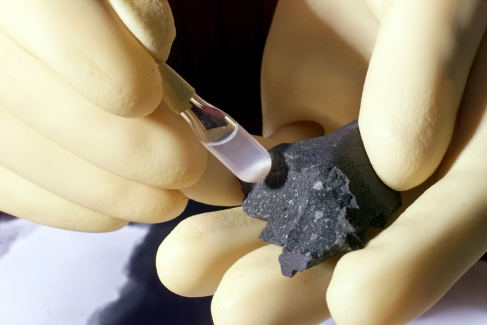
The Murchison meteorite (Figure 14.10) is known for the variety of organic chemicals it has yielded. Most of the carbon compounds in carbonaceous meteorites are complex, tarlike substances that defy exact analysis. Murchison also contains 16 amino acids (the building blocks of proteins), 11 of which are rare on Earth. The most remarkable thing about these organic molecules is that they include equal numbers with right-handed and left-handed molecular symmetry. Amino acids can have either kind of symmetry, but all life on Earth has evolved using only the left-handed versions to make proteins. The presence of both kinds of amino acids clearly demonstrates that the ones in the meteorites had an extraterrestrial origin.
英語のヒント
マーチソン隕石(図14.10)は、そこから得られた有機化学物質の種類の多さで知られている。炭素質隕石に含まれる炭素化合物の多くは、タールのような複雑な物質で、正確な分析が難しい。マーチソン隕石はまた、タンパク質の構成材料であるアミノ酸を16種類含み、そのうち11種類は地球上では珍しいものだ。これらの有機分子で最も驚くべき点は、右手型と左手型の分子対称性を持つものが同数ずつ含まれることだ。アミノ酸にはどちらの対称性もありうるが、地球上の生命はすべて、タンパク質を作るのに左手型だけを使うように進化してきた。両方の種類のアミノ酸が存在することは、隕石中のものが地球外に由来することを明確に示す。
Murchison Meteorite.マーチソン隕石。
OpenStax / Rice University · CC BY 4.0
Figure 14.10 A fragment of the meteorite that fell near the small town of Murchison, Australia, is shown next to a small sample of its material in a test tube, used for analysis of its chemical makeup.
図14.10 オーストラリアの小さな町マーチソン付近に落ちた隕石の破片。その隣には、化学組成の分析に使われる、隕石物質の少量の試料を入れた試験管がある。
These naturally occurring amino acids and other complex organic molecules in Murchison—formed without the benefit of the sheltering environment of planet Earth—show that a great deal of interesting chemistry must have taken place when the solar system was forming. If so, then perhaps some of the molecular building blocks of life on Earth were first delivered by primitive meteorites and comets. This is an interesting idea because our planet was probably much too hot for any organic materials to survive its earliest history. But after Earth’s surface cooled, the asteroid and comet fragments that pelted it could have refreshed its supply of organic materials.
英語のヒント
マーチソン隕石に自然に存在するこれらのアミノ酸や、ほかの複雑な有機分子は、地球という惑星の保護的な環境に頼らずに形成された。それらは、太陽系の形成中に、興味深い化学反応が盛んに起きたはずだということを示している。そうであれば、地球上の生命の分子レベルの構成材料の一部は、原始的な隕石や彗星によって初めて運ばれてきたのかもしれない。地球の最初期は、有機物が生き残るにはおそらくはるかに高温すぎたため、これは興味深い考えだ。しかし地表が冷えた後、降り注ぐ小惑星や彗星の破片が、有機物の供給を補い直した可能性がある。