第14章宇宙からの試料と太陽系の起源Cosmic Samples and the Origin of the Solar System
14.5 Planetary Evolution14.5 惑星の進化
Learning Objectives学習の目標
By the end of this section, you will be able to:
この節を読み終えると、次のことができるようになる。
Describe the geological activity during the evolution of the planets, particularly on the terrestrial planets
惑星、特に地球型惑星の進化に伴う地質活動を説明する
Describe the factors that affect differences in elevation on the terrestrial planets
地球型惑星の高低差に影響する要因を説明する
Explain how the differences in atmosphere on Venus, Earth, and Mars evolved from similar starting points in the early history of the solar system
太陽系の初期には似た出発点にあった金星・地球・火星の大気が、どのように違ったものへ進化したかを説明する
While we await more discoveries and better understanding of other planetary systems, let us look again at the early history of our own solar system, after the dissipation of our dust disk. The era of giant impacts was probably confined to the first 100 million years of solar system history, ending by about 4.4 billion years ago. Shortly thereafter, the planets cooled and began to assume their present aspects. Up until about 4 billion years ago, they continued to acquire volatile materials, and their surfaces were heavily cratered from the remaining debris that hit them. However, as external influences declined, all the terrestrial planets as well as the moons of the outer planets began to follow their own evolutionary courses. The nature of this evolution depended on each object’s composition, mass, and distance from the Sun.
英語のヒント
ほかの惑星系について、さらなる発見と理解の進展を待つ間に、私たちの太陽系の初期の歴史を、塵の円盤が消えた後からもう一度見てみよう。巨大衝突の時代は、おそらく太陽系の最初の1億年に限られ、約44億年前までには終わった。その後まもなく、惑星は冷え、現在の姿を取り始めた。約40億年前までは揮発性物質を獲得し続け、残っていた破片の衝突によって、表面には多数のクレーターができた。しかし外部からの影響が弱まるにつれ、地球型惑星も外側の惑星の衛星も、それぞれ独自の進化の道を歩み始めた。その進化の性質は、各天体の組成・質量・太陽からの距離に依存した。
Geological Activity地質活動
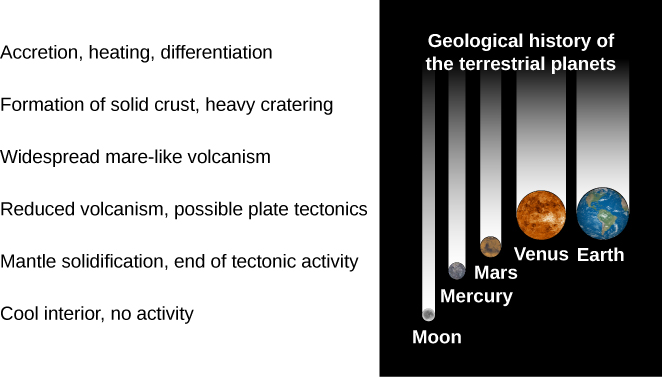
We have seen a wide range in the level of geological activity on the terrestrial planets and icy moons. Internal sources of such activity (as opposed to pummeling from above) require energy, either in the form of primordial heat left over from the formation of a planet or from the decay of radioactive elements in the interior. The larger the planet or moon, the more likely it is to retain its internal heat and the more slowly it cools—this is the “baked potato effect” mentioned in Other Worlds: An Introduction to the Solar System. Therefore, we are more likely to see evidence of continuing geological activity on the surface of larger (solid) worlds (Figure 14.18). Jupiter’s moon Io is an interesting exception to this rule; we saw that it has an unusual source of heat from the gravitational flexing of its interior by the tidal pull of Jupiter. Europa is probably also heated by jovian tides. Saturn may be having a similar effect on its moon Enceladus.
英語のヒント
地球型惑星や氷衛星では、地質活動の程度に大きな幅があることを見てきた。上からの衝突による打撃とは違い、内部から起こる活動にはエネルギーが必要である。その源は、惑星形成から残る原始の熱か、内部の放射性元素の崩壊である。惑星や衛星が大きいほど、内部の熱を保ちやすく、冷えるのも遅い。これは「ほかの世界――太陽系入門」で述べた「ベイクドポテト効果」である。したがって、より大きな固体天体の表面ほど、現在も地質活動が続いている証拠が見つかりやすい(図14.18)。木星の衛星イオは、この規則の興味深い例外だ。木星の潮汐力によって内部が重力的に繰り返し変形するという、特殊な熱源を持つことを見た。エウロパも、おそらく木星の潮汐によって加熱されている。土星も、その衛星エンケラドゥスに同様の効果を及ぼしているかもしれない。
Stages in the Geological History of a Terrestrial Planet.地球型惑星の地質史の段階。
OpenStax / Rice University · CC BY 4.0
Figure 14.18 In this image, time increases downward along the left side, where the stages are described. Each planet is shown roughly in its present stage. The smaller the planet, the more quickly it passes through these stages.
図14.18 この図では、左側の段階の説明に沿って、下へ進むほど時間がたつ。それぞれの惑星は、おおよその現在の段階に示されている。惑星が小さいほど、これらの段階を速く通り過ぎる。
The Moon, the smallest of the terrestrial worlds, was internally active until about 3.3 billion years ago, when its major volcanism ceased. Since that time, its mantle has cooled and become solid, and today even internal seismic activity has declined to almost zero. The Moon is a geologically dead world. Although we know much less about Mercury, it seems likely that this planet, too, ceased most volcanic activity about the same time the Moon did.
英語のヒント
地球型の天体で最も小さい月は、約33億年前に主要な火山活動が止まるまで、内部で活動していた。それ以後、マントルは冷えて固まり、今日では内部の地震活動さえほぼゼロまで低下している。月は地質学的に死んだ世界である。水星についての知識はずっと少ないが、この惑星も月とほぼ同じ時期に、火山活動の大半を終えた可能性が高い。
Mars represents an intermediate case, and it has been much more active than the Moon. The southern hemisphere crust had formed by 4 billion years ago, and the northern hemisphere volcanic plains seem to be contemporary with the lunar maria. However, the Tharsis bulge formed somewhat later, and activity in the large Tharsis volcanoes has apparently continued on and off to the present era.
英語のヒント
火星は中間的な例で、月よりはるかに活発だった。南半球の地殻は40億年前までに形成され、北半球の火山性平原は月の海と同時代のものらしい。しかし、タルシスの隆起はやや後に形成され、大きなタルシス火山の活動は、どうやら現在の時代まで断続的に続いてきた。
Earth and Venus are the largest and most active terrestrial planets. Our planet experiences global plate tectonics driven by convection in its mantle. As a result, our surface is continually reworked, and most of Earth’s surface material is less than 200 million years old. Venus has generally similar levels of volcanic activity, but unlike Earth, it has not experienced plate tectonics. Most of its surface appears to be no more than 500 million years old. We did see that the surface of our sister planet is being modified by a kind of “blob tectonics”—where hot material from below puckers and bursts through the surface, leading to coronae, pancake volcanoes, and other such features. A better understanding of the geological differences between Venus and Earth is a high priority for planetary geologists.
英語のヒント
地球と金星は、地球型惑星の中で最も大きく、最も活発である。地球ではマントルの対流に駆動され、全球的なプレートテクトニクスが起こる。その結果、表面は絶えず作り替えられ、地表の物質の大半は2億年より若い。金星の火山活動も全般的には同程度だが、地球と違い、プレートテクトニクスを経験していない。その表面の大部分は5億年以下の年代であるように見える。姉妹惑星の表面が、一種の「塊によるテクトニクス」で変化していることを見た。下から上がる高温の物質が表面をよじらせ、突き破り、コロナやパンケーキ状火山などの地形を生じるのだ。金星と地球の地質学的な違いをよりよく理解することは、惑星地質学者にとって優先度の高い課題である。
The geological evolution of the icy moons and Pluto has been somewhat different from that of the terrestrial planets. Tidal energy sources have been active, and the materials nature has to work with are not the same. On these outer worlds, we see evidence of low-temperature volcanism, with the silicate lava of the inner planets being supplemented by sulfur compounds on Io, and replaced by water and other ices on Pluto and other outer-planet moons.
英語のヒント
氷衛星や冥王星の地質学的な進化は、地球型惑星とはやや異なっていた。潮汐のエネルギー源が働き、自然が材料として使える物質も同じではない。これらの外側の天体には低温の火山活動の証拠が見られる。内側の惑星にあるケイ酸塩の溶岩に対し、イオでは硫黄化合物が加わり、冥王星やほかの外惑星の衛星では、水やほかの氷が代わりを務める。
Elevation Differences高低差
Let’s look at some specific examples of how planets differ. The mountains on the terrestrial planets owe their origins to different processes. On the Moon and Mercury, the major mountains are ejecta thrown up by the large basin-forming impacts that took place billions of years ago. Most large mountains on Mars are volcanoes, produced by repeated eruptions of lava from the same vents. There are similar (but smaller) volcanoes on Earth and Venus. However, the highest mountains on Earth and Venus are the result of compression and uplift of the surface. On Earth, this crustal compression results from collisions of one continental plate with another.
英語のヒント
惑星どうしの違いの具体例を見よう。地球型惑星の山は、さまざまな過程から生まれた。月と水星の主な山は、数十億年前、大きな衝突盆地を作った衝突で放り上げられた放出物である。火星の大きな山の大半は、同じ火口から溶岩が繰り返し噴出してできた火山だ。地球や金星にも、これに似た、ただしもっと小さい火山がある。しかし地球と金星の最も高い山は、地表の圧縮と隆起の結果である。地球では、この地殻の圧縮は大陸プレートどうしの衝突によって生じる。
It is interesting to compare the maximum heights of the volcanoes on Earth, Venus, and Mars (Figure 14.19). On Venus and Earth, the maximum elevation differences between these mountains and their surroundings are about 10 kilometers. Olympus Mons, in contrast, towers more than 20 kilometers above its surroundings and nearly 30 kilometers above the lowest elevation areas on Mars.
英語のヒント
地球・金星・火星の火山の最大の高さを比べると興味深い(図14.19)。金星と地球では、これらの山と周囲との最大の標高差は約10kmである。これに対してオリンポス山は周囲より20km以上高くそびえ、火星の最も低い地域からは30km近くの高さになる。
Highest Mountains on Mars, Venus, and Earth.火星・金星・地球の最も高い山。

OpenStax / Rice University · CC BY 4.0
Figure 14.19 Mountains can rise taller on Mars because Mars has less surface gravity and no moving plates. The vertical scale is exaggerated by a factor of three to make comparison easier. The label “sea level” refers only to Earth, of course, since the other two planets don’t have oceans. Mauna Loa and Mt. Everest are on Earth, Olympus Mons is on Mars, and the Maxwell Mountains are on Venus.
図14.19 火星では地表重力が小さく、プレートも移動しないため、山はより高く成長できる。比較を分かりやすくするため、縦の縮尺は3倍に誇張されている。「海面」という表示は、もちろん地球だけに関係する。ほかの二惑星には海がないからだ。マウナロア山とエベレスト山は地球、オリンポス山は火星、マクスウェル山脈は金星にある。
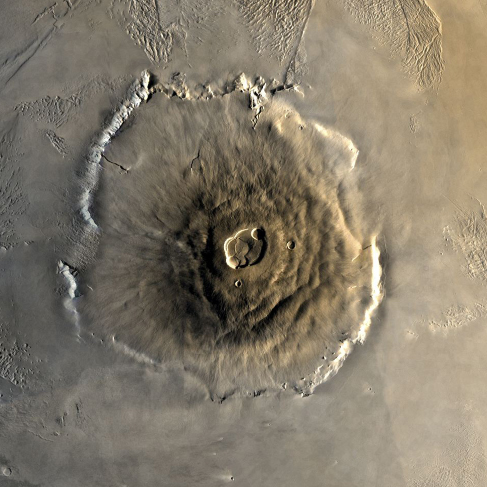
One reason Olympus Mons (Figure 14.20) is so much higher than its terrestrial counterparts is that the crustal plates on Earth never stop moving long enough to let a really large volcano grow. Instead, the moving plate creates a long row of volcanoes like the Hawaiian Islands. On Mars (and perhaps Venus) the crust remains stationary with respect to the underlying hot spot, and so a single volcano can continue to grow for hundreds of millions of years.
英語のヒント
オリンポス山(図14.20)が地球の同種の山よりはるかに高い理由の一つは、地球の地殻プレートが、非常に大きな火山を育てられるほど長くは動きを止めないことだ。その代わり、動くプレートは、ハワイ諸島のような長く連なる火山列を作る。火星では、そしておそらく金星でも、地殻はその下のホットスポットに対して静止している。そのため、一つの火山が数億年にわたって成長し続けることができる。
Olympus Mons.オリンポス山。
credit: modification of work by NASA/USGS · NASA media use guidelines
Figure 14.20 The largest martian volcano is seen from above in this spectacular composite image created from many Viking orbiter photographs. The volcano is nearly 500 kilometers wide at its base and more than 20 kilometers high. (Its height is almost three times the height of the tallest mountain on Earth.) (credit: modification of work by NASA/USGS)
図14.20 多数のバイキング周回機の写真を合わせたこの見事な合成画像は、火星最大の火山を上から見たものだ。山の裾野の幅は約500km、高さは20kmを超える。その高さは、地球で最も高い山のほぼ3倍である。(クレジット:NASA/USGSの作品を改変)
A second difference relates to the strength of gravity on the three planets. The surface gravity on Venus is nearly the same as that on Earth, but on Mars it is only about one third as great. In order for a mountain to survive, its internal strength must be great enough to support its weight against the force of gravity. Volcanic rocks have known strengths, and we can calculate that on Earth, 10 kilometers is about the limit. For instance, when new lava is added to the top of Mauna Loa in Hawaii, the mountain slumps downward under its own weight. The same height limit applies on Venus, where the force of gravity is the same as Earth’s. On Mars, however, with its lesser surface gravity, much greater elevation differences can be supported, which helps explain why Olympus Mons is more than twice as high as the tallest mountains of Venus or Earth.
英語のヒント
第二の違いは、三惑星の重力の強さに関係する。金星の地表重力は地球とほぼ同じだが、火星ではその約3分の1しかない。山が崩れずに存在するには、重力に抗して自分の重さを支えるだけの内部の強度が必要だ。火山岩の強度は分かっているので、地球では約10kmが限界だと計算できる。例えばハワイのマウナロア山の頂上に新しい溶岩が加わると、山は自重で下へ沈み込む。重力の強さが地球と同じ金星にも、同じ高さの限界が当てはまる。しかし、地表重力の小さい火星では、はるかに大きな高低差を支えられる。このことは、オリンポス山が金星や地球の最も高い山の2倍以上ある理由を説明する助けとなる。
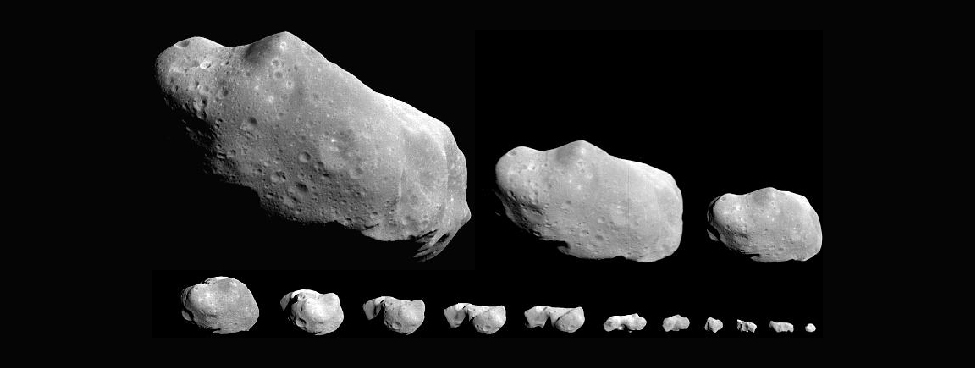
By the way, the same kind of calculation that determines the limiting height of a mountain can be used to ascertain the largest body that can have an irregular shape. Gravity, if it can, pulls all objects into the most “efficient” shape (where all the outside points are equally distant from the center). All the planets and larger moons are nearly spherical, due to the force of their own gravity pulling them into a sphere. But the smaller the object, the greater the departure from spherical shape that the strength of its rocks can support. For silicate bodies, the limiting diameter is about 400 kilometers; larger objects will always be approximately spherical, while smaller ones can have almost any shape (as we see in photographs of asteroids, such as Figure 14.21).
英語のヒント
ちなみに、山の限界の高さを求めるのと同じ種類の計算は、不規則な形を保てる天体の最大の大きさを調べるのにも使える。重力は可能なら、どんな物体も最も「効率のよい」形、つまり外側のすべての点が中心から等距離になる形へ引き寄せる。惑星と大きな衛星がほぼ球形なのは、自らの重力が球へと引き寄せるからだ。しかし天体が小さいほど、岩石の強度で支えられる球形からのずれは大きくなる。ケイ酸塩の天体では、限界の直径は約400kmである。それより大きい天体は常にほぼ球形となり、小さい天体は、図14.21のような小惑星の写真に見られるとおり、ほとんどどんな形でも保つことができる。
Irregular Asteroid.不規則な形の小惑星。
credit: modification of work by NASA/JPL · JPL image use policy
Figure 14.21 Small objects such as asteroid Ida (shown here in multiple views taken by the Galileo spacecraft camera as it flew past) are generally irregular or elongated; they do not have strong enough gravity to pull them into a spherical shape. Ida is about 60 kilometers long in its longest dimension. (credit: modification of work by NASA/JPL)
図14.21 小惑星イダのような小天体は、一般に不規則な形や細長い形をしている。ここには、ガリレオ探査機が通過時に撮影した複数の姿を示した。自らを球形へ引き寄せるほどの強い重力を持たないからである。イダは最も長い方向で約60kmある。(クレジット:NASA/JPLの作品を改変)