第14章宇宙からの試料と太陽系の起源Cosmic Samples and the Origin of the Solar System
14.1 Meteors14.1 流星
Learning Objectives学習の目標
By the end of this section, you will be able to:
この節を読み終えると、次のことができるようになる。
Explain what a meteor is and why it is visible in the night sky
流星とは何か、なぜ夜空に見えるのかを説明する
Describe the origins of meteor showers
流星群がどこから来るかを説明する
As we saw in Comets and Asteroids: Debris of the Solar System, the ices in comets evaporate when they get close to the Sun, together spraying millions of tons of rock and dust into the inner solar system. There is also dust from asteroids that have collided and broken up. Earth is surrounded by this material. As each of the larger dust or rock particles enters Earth’s atmosphere, it creates a brief fiery trail; this is often called a shooting star, but it is properly known as a meteor.
英語のヒント
「彗星と小惑星――太陽系に残されたかけら」で見たように、彗星が太陽に近づくと氷が蒸発し、それに伴って数百万トンもの岩石や塵が太陽系の内側へまき散らされる。衝突して砕けた小惑星から生じた塵もある。地球はこうした物質に取り囲まれている。比較的大きな塵や岩石の粒子が地球の大気に入るたびに、一瞬の燃えるような光の跡を作る。英語ではしばしば shooting star(流れ星)と呼ぶが、正式な名称は meteor(流星)である。
Observing Meteors流星を観察する
Meteors are created as tiny solid particles that enter Earth’s atmosphere from interplanetary space. Since the particles move at speeds of many kilometers per second, friction with the air vaporizes them at altitudes between 80 and 130 kilometers. The resulting flashes of light fade out within a few seconds. These “shooting stars” got their name because at night their luminous vapors look like stars moving rapidly across the sky. To be visible, a meteor must be within about 200 kilometers of the observer. On a typical dark, moonless night, an alert observer can see half a dozen meteors per hour. These sporadic meteors—those not associated with a meteor shower (explained in the next section)—are random occurrences. Over the entire Earth, the total number of meteors bright enough to be visible totals about 25 million per day.
英語のヒント
流星は、惑星間空間から微小な固体粒子が地球の大気に入ることで生じる。粒子は秒速数km以上という速さで移動するため、空気との摩擦によって高度80〜130kmで蒸発する。その結果生じる閃光は、数秒以内に消えてしまう。夜には、その明るく光る蒸気が空を急速に横切る星のように見えるため、「流れ星」という名が付いた。見えるためには、流星は観測者からおよそ200km以内になければならない。月明かりのない普通の暗い夜なら、注意深く見ている観測者は1時間に6個ほどの流星を見つけられる。こうした散在流星、つまり次の項で説明する流星群とは関係しない流星は、不規則に現れる。地球全体では、目に見えるほど明るい流星の総数は1日に約2500万個になる。
The typical meteor is produced by a particle with a mass of less than 1 gram—no larger than a pea. How can we see such a small particle? The light you see comes from the much larger region of heated, glowing gas surrounding this little grain of interplanetary material. Because of its high speed, the energy in a pea-sized meteor is as great as that of an artillery shell fired on Earth, but this energy is dispersed high in Earth’s atmosphere. (When these tiny projectiles hit an airless body like the Moon, they do make small craters and generally pulverize the surface.)
英語のヒント
典型的な流星を作る粒子の質量は1g未満で、大きさはエンドウ豆ほどか、それより小さい。そんな小さな粒子が、どうして見えるのだろうか。目にしている光は、惑星間物質のこの小さな粒を取り巻く、はるかに大きな、高温で発光するガスの領域から来ている。非常に速く動くため、エンドウ豆ほどの流星が持つエネルギーは、地上で発射される砲弾と同程度もある。ただし、このエネルギーは地球の大気の高いところで散らばって失われる。(こうした微小な飛来物が月のような大気のない天体にぶつかると、小さなクレーターを実際に作り、全般的に表面を細かく砕く。)
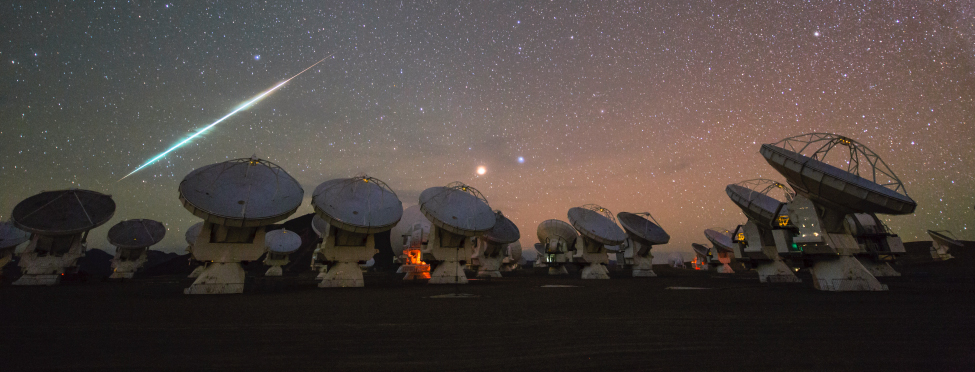
If a particle the size of a golf ball strikes our atmosphere, it produces a much brighter trail called a fireball (Figure 14.2). A piece as large as a bowling ball has a fair chance of surviving its fiery entry if its approach speed is not too high. The total mass of meteoric material entering Earth’s atmosphere is estimated to be about 100 tons per day (which seems like a lot if you imagine it all falling in one place, but remember it is spread out all over our planet’s surface).
英語のヒント
ゴルフボールほどの粒子が大気に突入すると、火球と呼ばれる、はるかに明るい光の跡を生じる(図14.2)。ボウリングの球ほどのかけらなら、接近速度が高すぎなければ、燃えるような突入を生き延びる見込みはかなりある。地球の大気に入る流星物質の総質量は、1日に約100トンと推定されている。一か所に全部落ちるところを想像すれば大量に思えるが、地球の表面全体に分散していることを忘れないでほしい。
Fireball.火球。
credit: modification of work by ESO/C Malin · CC BY 4.0
Figure 14.2 When a larger piece of cosmic material strikes Earth’s atmosphere, it can make a bright fireball. This time-lapse meteor image was captured in April 2014 at the Atacama Large Millimeter/Submillimeter Array (ALMA). The visible trail results from the burning gas around the particle. (credit: modification of work by ESO/C Malin)
図14.2 比較的大きな宇宙の物質が地球の大気に突入すると、明るい火球を生じることがある。この流星を写した時間経過を記録する画像は、2014年4月、アタカマ大型ミリ波サブミリ波干渉計(ALMA)で撮影された。見えている光の跡は、粒子の周囲の燃えるように光るガスによる。(クレジット:ESO/C Malinの作品を改変)
Meteor Showers流星群
Many—perhaps most—of the meteors that strike Earth are associated with specific comets. Some of these periodic comets still return to our view; others have long ago fallen apart, leaving only a trail of dust behind them. The dust particles from a given comet retain approximately the orbit of their parent, continuing to move together through space but spreading out over the orbit with time. When Earth, in its travels around the Sun, crosses such a dust stream, we see a sudden burst of meteor activity that usually lasts several hours; such an event is called a meteor shower.
英語のヒント
地球に飛び込む流星の多くは、もしかすると大部分は、特定の彗星と関係している。これらの周期彗星の中には、今も繰り返し私たちの視界に戻ってくるものがある。ずっと昔に崩壊し、塵の列だけを後に残したものもある。ある彗星から放出された塵の粒子は、母天体の軌道をほぼ保ち、空間を一緒に移動し続ける。ただし時間とともに、軌道に沿って広がっていく。地球が太陽の周りを公転する途中でこのような塵の流れを横切ると、通常は数時間続く、流星活動の急激な増加が見られる。この現象を流星群と呼ぶ。
The dust particles and pebbles that produce meteor showers are moving together in space before they encounter Earth. Thus, as we look up at the atmosphere, their parallel paths seem to come toward us from a place in the sky called the radiant. This is the direction in space from which the meteor stream seems to be diverging, just as long railroad tracks seem to diverge from a single spot on the horizon (Figure 14.3). Meteor showers are often designated by the constellation in which this radiant is located: for example, the Perseid meteor shower has its radiant in the constellation of Perseus. But you are likely to see shower meteors anywhere in the sky, not just in the constellation of the radiant. The characteristics of some of the more famous meteor showers are summarized in Table 14.1.
英語のヒント
流星群を生じる塵の粒子や小石は、地球に出会う前から空間を一緒に移動している。そのため、私たちが大気を見上げると、それぞれの平行な経路が、空のある一点からこちらへ向かってくるように見える。この点を放射点という。これは流星の流れが広がってくるように見える方向であり、長く続く線路が地平線上の一点から広がっているように見えるのと同じだ(図14.3)。流星群は、この放射点がある星座にちなんで名付けられることが多い。例えば、ペルセウス座流星群の放射点はペルセウス座にある。ただし、流星群の流星は放射点のある星座だけでなく、空のどこにでも見える可能性がある。比較的よく知られた流星群の特徴を表14.1にまとめた。
Radiant of a Meteor Shower.流星群の放射点。
Figure 14.3 The tracks of the meteors diverge from a point in the distance, just as long, parallel railroad tracks appear to do. (credit “tracks”: Nathan Vaughn)
図14.3 流星の経路は、遠くの一点から広がってくる。長い平行な線路が、そのように見えるのと同じである。(線路のクレジット:Nathan Vaughn)
Major Annual Meteor Showers 毎年見られる主な流星群 |
|||
|---|---|---|---|
Shower Name 流星群名 |
Date of Maximum 極大日 |
Associated Parent Object 関連する母天体 |
Comet’s Period (years) 彗星の周期(年) |
Quadrantid しぶんぎ座流星群 |
January 3–4 1月3〜4日 |
2003EH (asteroid) 2003EH(小惑星) |
— |
Lyrid こと座流星群 |
April 22 4月22日 |
Comet Thatcher サッチャー彗星 |
415 |
Eta Aquarid みずがめ座η流星群 |
May 4–5 5月4〜5日 |
Comet Halley ハレー彗星 |
76 |
Delta Aquarid みずがめ座δ流星群 |
July 29–30 7月29〜30日 |
Comet Machholz マックホルツ彗星 |
— |
Perseid ペルセウス座流星群 |
August 11–12 8月11〜12日 |
Comet Swift-Tuttle スイフト・タットル彗星 |
133 |
Orionid オリオン座流星群 |
October 20–21 10月20〜21日 |
Comet Halley ハレー彗星 |
76 |
Southern Taurid おうし座南流星群 |
October 31 10月31日 |
Comet Encke エンケ彗星 |
3 |
Leonid しし座流星群 |
November 16–17 11月16〜17日 |
Comet Tempel-Tuttle テンペル・タットル彗星 |
33 |
Geminid ふたご座流星群 |
December 13 12月13日 |
Phaethon (asteroid) ファエトン(小惑星) |
1.4 |
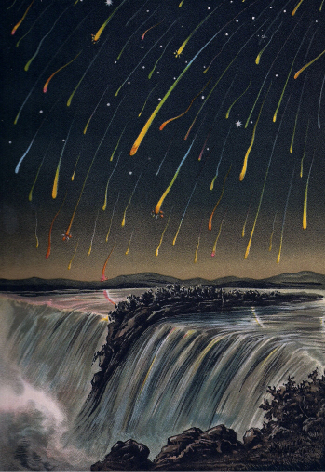
The meteoric dust is not always evenly distributed along the orbit of the comet, so during some years more meteors are seen when Earth intersects the dust stream, and in other years fewer. For example, a very clumpy distribution is associated with the Leonid meteors, which in 1833 and again in 1866 (after an interval of 33 years—the period of the comet) yielded the most spectacular showers (sometimes called meteor storms) ever recorded (Figure 14.4). During the Leonid storm on November 17, 1866, up to a hundred meteors were observed per second in some locations. The Leonid shower of 2001 was not this intense, but it peaked at nearly a thousand meteors per hour—one every few seconds—observable from any dark viewing site.
英語のヒント
流星となる塵は、彗星の軌道に沿って常に均一に分布しているとは限らない。そのため、地球が塵の流れと交わる際、流星が多く見える年もあれば、少なくなる年もある。例えば、しし座流星群の塵は非常にむらの大きい分布をしている。1833年と、それから彗星の周期に当たる33年後の1866年には、記録上最も壮観な流星群が見られた。こうした現象は流星雨と呼ばれることもある(図14.4)。1866年11月17日のしし座流星雨では、場所によっては1秒に100個もの流星が観測された。2001年のしし座流星群はそれほど激しくはなかったが、極大時には1時間に1000個近く、つまり数秒に1個の流星が、暗い観測場所ならどこでも見られた。
Leonid Meteor Storm.しし座流星雨。
OpenStax / Rice University · CC BY 4.0
Figure 14.4 A painting depicts the great meteor shower or storm of 1833, shown with a bit of artistic license.
図14.4 1833年の大流星群、あるいは流星雨を描いた絵。多少の芸術的な脚色が加えられている。
The most dependable annual meteor display is the Perseid shower, which appears each year for about three nights near August 11. In the absence of bright moonlight, you can see one meteor every few minutes during a typical Perseid shower. Astronomers estimate that the total combined mass of the particles in the Perseid swarm is nearly a billion tons; the comet that gave rise to the particles in that swarm, called Swift-Tuttle, must originally have had at least that much mass. However, if its initial mass were comparable to the mass measured for Comet Halley, then Swift-Tuttle would have contained several hundred billion tons, suggesting that only a very small fraction of the original cometary material survives in the meteor stream.
英語のヒント
毎年最も確実に楽しめる流星の出現は、8月11日ごろの約3晩に見られるペルセウス座流星群である。明るい月光がなければ、通常のペルセウス座流星群では数分ごとに1個の流星を見ることができる。天文学者は、ペルセウス座流星群の粒子の集まりの総質量を、10億トン近くと推定している。この粒子群を生み出したスイフト・タットル彗星は、もともと少なくともそれだけの質量を持っていたはずだ。しかし、初めの質量がハレー彗星で測定された質量と同程度だったなら、スイフト・タットル彗星には数千億トンの物質があったことになる。そうだとすると、元の彗星の物質のうち、流星の流れに残っているのはごくわずかな割合にすぎない。
No shower meteor has ever survived its flight through the atmosphere and been recovered for laboratory analysis. However, there are other ways to investigate the nature of these particles and thereby gain additional insight into the comets from which they are derived. Analysis of the flight paths of meteors shows that most of them are very light or porous, with densities typically less than 1.0 g/cm3. If you placed a fist-sized lump of meteor material on a table in Earth’s gravity, it might well fall apart under its own weight.
英語のヒント
流星群に属する流星が大気中の飛行を生き延び、実験室で分析するために回収された例は、これまで一つもない。それでも、粒子の性質を調べ、その供給源となる彗星について理解を深める方法はほかにもある。流星の飛行経路を分析すると、大半は非常に軽い、あるいは多孔質で、密度は通常1.0g/cm³未満だと分かる。流星物質の拳ほどの塊を地球の重力のもとで机に置いたら、それ自身の重さで崩れてしまってもおかしくない。
Such light particles break up very easily in the atmosphere, accounting for the failure of even relatively large shower meteors to reach the ground. Comet dust is apparently fluffy, rather inconsequential stuff. NASA’s Stardust mission used a special substance, called aerogel, to collect these particles. We can also infer this from the tiny comet particles recovered in Earth’s atmosphere with high-flying aircraft (see Figure 13.19). This fluff, by its very nature, cannot reach Earth’s surface intact. However, more substantial fragments from asteroids do make it into our laboratories, as we will see in the next section.
英語のヒント
このような軽い粒子は大気中で非常に容易に砕ける。このことが、比較的大きな流星群の流星でさえ地面に届かない理由を説明する。彗星の塵は、どうやらふわふわとして、あまり実体のない物質らしい。NASAのスターダスト計画では、エアロゲルと呼ばれる特殊な物質を使ってこれらの粒子を集めた。高高度を飛ぶ航空機を用いて地球の大気中で回収された微小な彗星粒子からも、この性質を推測できる(図13.19参照)。このふわふわした物質は、その性質上、無傷のまま地表に達することができない。しかし次の節で見るように、小惑星から来た、もっとしっかりした破片は実際に私たちの実験室に届く。