第14章宇宙からの試料と太陽系の起源Cosmic Samples and the Origin of the Solar System
14.4 Comparison with Other Planetary Systems14.4 ほかの惑星系との比較
Learning Objectives学習の目標
By the end of this section, you will be able to:
この節を読み終えると、次のことができるようになる。
Describe how the observations of protoplanetary disks provides evidence for the existence of other planetary systems
原始惑星系円盤の観測が、ほかの惑星系の存在を裏付ける証拠をどのように与えるかを説明する
Explain the two primary methods for detection of exoplanets
太陽系外惑星を検出する主な二つの方法を説明する
Compare the main characteristics of other planetary systems with the features of the solar system
ほかの惑星系の主な特徴を、太陽系の特徴と比較する
Until the middle 1990s, the practical study of the origin of planets focused on our single known example—the solar system. Although there had been a great deal of speculation about planets circling other stars, none had actually been detected. Logically enough, in the absence of data, most scientists assumed that our own system was likely to be typical. They were in for a big surprise.
英語のヒント
1990年代半ばまで、惑星の起源を実際のデータに基づいて研究する際、対象は唯一知られていた例、すなわち太陽系に限られていた。ほかの恒星の周りを回る惑星については多くの推測があったものの、実際には一つも検出されていなかった。データがない以上、科学者の多くが自分たちの太陽系を典型的なものだろうと考えたのは、もっともなことだった。しかし、彼らには大きな驚きが待っていた。
Discovery of Other Planetary Systemsほかの惑星系の発見
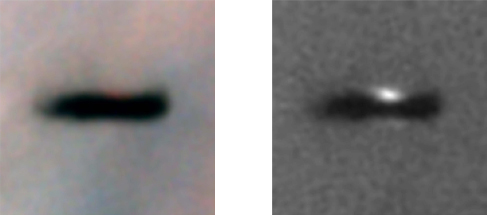
In The Birth of Stars and the Discovery of Planets outside the Solar System, we discuss the formation of stars and planets in some detail. Stars like our Sun are formed when dense regions in a molecular cloud (made of gas and dust) feel an extra gravitational force and begin to collapse. This is a runaway process: as the cloud collapses, the gravitational force gets stronger, concentrating material into a protostar. Roughly half of the time, the protostar will fragment or be gravitationally bound to other protostars, forming a binary or multiple star system—stars that are gravitationally bound and orbit each other. The rest of the time, the protostar collapses in isolation, as was the case for our Sun. In all cases, as we saw, conservation of angular momentum results in a spin-up of the collapsing protostar, with surrounding material flattened into a disk. Today, this kind of structure can actually be observed. The Hubble and James Webb Space Telescopes, as well as powerful new ground-based telescopes, enable astronomers to study directly the nearest of these circumstellar disks in regions of space where stars are being born today, such as the Orion Nebula (Figure 14.14) or the Taurus star-forming region.
英語のヒント
「星の誕生と太陽系外惑星の発見」では、恒星や惑星の形成をやや詳しく論じる。太陽のような恒星は、ガスと塵からなる分子雲の高密度領域に、さらに重力が働き、収縮し始めることで形成される。これは加速して進む過程である。雲が収縮すると重力が強まり、物質が原始星に集中していく。およそ半分の場合、原始星は分裂するか、ほかの原始星と重力で結び付き、連星系や多重星系を形成する。これは、互いに重力で結び付き、相手の周りを公転する恒星たちだ。残りの場合、原始星は単独で収縮する。太陽もその例である。すでに見たように、どの場合も角運動量保存によって収縮する原始星の回転が速まり、周囲の物質は平たい円盤になる。今日では、このような構造を実際に観測できる。ハッブル宇宙望遠鏡やジェイムズ・ウェッブ宇宙望遠鏡、さらに強力な新しい地上望遠鏡を使い、現在も星が生まれている領域にある、比較的近い星周円盤を直接調べられる。オリオン星雲(図14.14)や、おうし座の星形成領域などがその例だ。
Protoplanetary Disk in the Orion Nebula.オリオン星雲の原始惑星系円盤。
credit: modification of work by Mark McCaughrean (Max-Planck-Institute for Astronomy), C. Robert O’Dell (Rice University), and NASA · NASA media use guidelines
Figure 14.14 The Hubble Space Telescope imaged this protoplanetary disk in the Orion Nebula, a region of active star formation, using two different filters. The disk, about 17 times the size of our solar system, is in an edge-on orientation to us, and the newly formed star is shining at the center of the flattened dust cloud. The dark areas indicate absorption, not an absence of material. In the left image we see the light of the nebula and the dark cloud; in the right image, a special filter was used to block the light of the background nebula. You can see gas above and below the disk set to glow by the light of the newborn star hidden by the disk. (credit: modification of work by Mark McCaughrean (Max-Planck-Institute for Astronomy), C. Robert O’Dell (Rice University), and NASA)
図14.14 ハッブル宇宙望遠鏡は、星形成が活発なオリオン星雲にあるこの原始惑星系円盤を、二種類のフィルターで撮影した。円盤の大きさは太陽系の約17倍で、私たちからは真横に見える向きにある。平たくなった塵の雲の中心では、生まれたばかりの星が輝いている。暗い部分は光が吸収されている場所であり、物質がない場所ではない。左の画像には星雲の光と暗い雲が見える。右の画像では、背景の星雲の光を遮る特殊なフィルターを使った。円盤に隠れた生まれたばかりの星の光によって、円盤の上下のガスが発光しているのが分かる。(クレジット:Mark McCaughrean〈Max-Planck-Institute for Astronomy〉、C. Robert O’Dell〈Rice University〉、NASAの作品を改変)
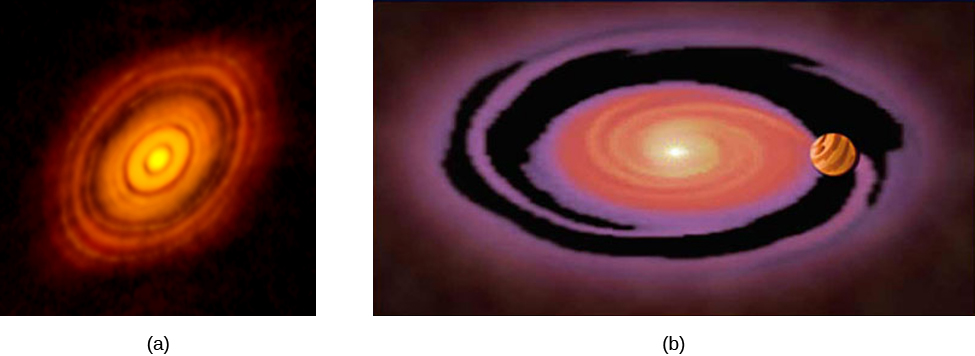
Many of the circumstellar disks we have discovered show internal structure. The disks appear to be donut-shaped, with gaps close to the star. Such gaps indicate that the gas and dust in the disk have already collapsed to form large planets (Figure 14.15). The newly born protoplanets are too small and faint to be seen directly, but the depletion of raw materials in the gaps hints at the presence of something invisible in the inner part of the circumstellar disk—and that something is almost certainly one or more planets. Theoretical models of planet formation, like the one seen at right in Figure 14.15, have long supported the idea that planets would clear gaps as they form in disks.
英語のヒント
発見された星周円盤の多くには、内部構造が見られる。円盤はドーナツのような形をしており、恒星の近くに隙間があるように見える。このような隙間は、円盤のガスと塵がすでに集まって、大きな惑星を作ったことを示す(図14.15)。生まれたばかりの原始惑星は、小さく暗すぎて直接は見えない。しかし隙間で原材料が減っていることは、星周円盤の内側に見えない何かがあることを示唆する。その何かは、ほぼ間違いなく一つ、あるいは複数の惑星である。図14.15の右側のような惑星形成の理論モデルは、惑星が円盤内で形成される際に隙間を空けるという考え方を、以前から支持してきた。
Protoplanetary Disk around HL Tau.おうし座HL星の原始惑星系円盤。
credit a: modification of work by ALMA (ESO/NAOJ/NRAO); credit b: modification of work by NASA/ESA and A. Feild (STScI) · CC BY 4.0
Figure 14.15 (a) This image of a protoplanetary disk around HL Tau was taken with the Atacama Large Millimeter/submillimeter Array (ALMA), which allows astronomers to construct radio images that rival those taken with visible light. (b) Newly formed planets that orbit the central star clear out dust lanes in their paths, just as our theoretical models predict. This computer simulation shows the empty lane and spiral density waves that result as a giant planet is forming within the disk. The planet is not shown to scale. (credit a: modification of work by ALMA (ESO/NAOJ/NRAO); credit b: modification of work by NASA/ESA and A. Feild (STScI))
図14.15 (a)おうし座HL星の周りの原始惑星系円盤を、アタカマ大型ミリ波サブミリ波干渉計(ALMA)で撮影した画像。ALMAにより、天文学者は可視光で撮影したものに匹敵する電波画像を作れる。(b)中心星を公転する新たな惑星は、理論モデルが予測するとおり、その通り道の塵を除いて帯状の隙間を作る。このコンピューターシミュレーションは、円盤の中で巨大惑星が形成される際に生じる、空の帯と渦巻き状の密度波を示す。惑星の大きさは実際の縮尺どおりではない。(aのクレジット:ALMA〈ESO/NAOJ/NRAO〉の作品を改変。bのクレジット:NASA/ESA、A. Feild〈STScI〉の作品を改変)
Our figure shows HL Tau, a one-million-year-old “newborn” star in the Taurus star-forming region. The star is embedded in a shroud of dust and gas that obscures our visible-light view of a circumstellar disk around the star. In 2014 astronomers obtained a dramatic view of the HL Tau circumstellar disk using millimeter waves, which pierce the cocoon of dust around the star, showing dust lanes being carved out by several newly formed protoplanets. As the mass of the protoplanets increases, they travel in their orbits at speeds that are faster than the dust and gas in the circumstellar disk. As the protoplanets plow through the disk, their gravitational reach begins to exceed their cross-sectional area, and they become very efficient at sweeping up material and growing until they clear a gap in the disk. The image of Figure 14.15 shows us that a number of protoplanets are forming in the disk and that they were able to form faster than our earlier ideas had suggested—all in the first million years of star formation.
英語のヒント
図に示したおうし座HL星は、おうし座の星形成領域にある、誕生から100万年の「生まれたばかり」の星だ。星は塵とガスの覆いに包まれ、その周囲の星周円盤は可視光では見えにくくなっている。2014年、天文学者はミリ波を用い、この星周円盤の鮮明な姿を捉えた。ミリ波は星を包む塵の繭を透過し、新たに形成された複数の原始惑星が塵の帯を削り取っている様子を示した。原始惑星の質量が増すと、それらは星周円盤の塵やガスより速く軌道を移動する。円盤をかき分けて進むにつれ、重力が届く範囲が天体自身の断面積を超え、効率よく物質を取り込みながら成長し、ついには円盤に隙間を空ける。図14.15の画像は、円盤内で複数の原始惑星が形成されつつあることと、従来の考え方が示していたより速く、星形成の最初の100万年以内に形成できたことを示している。