第29章ビッグバンThe Big Bang
Thinking Aheadまず考えてみよう
The Largest Space Telescope.最大の宇宙望遠鏡。
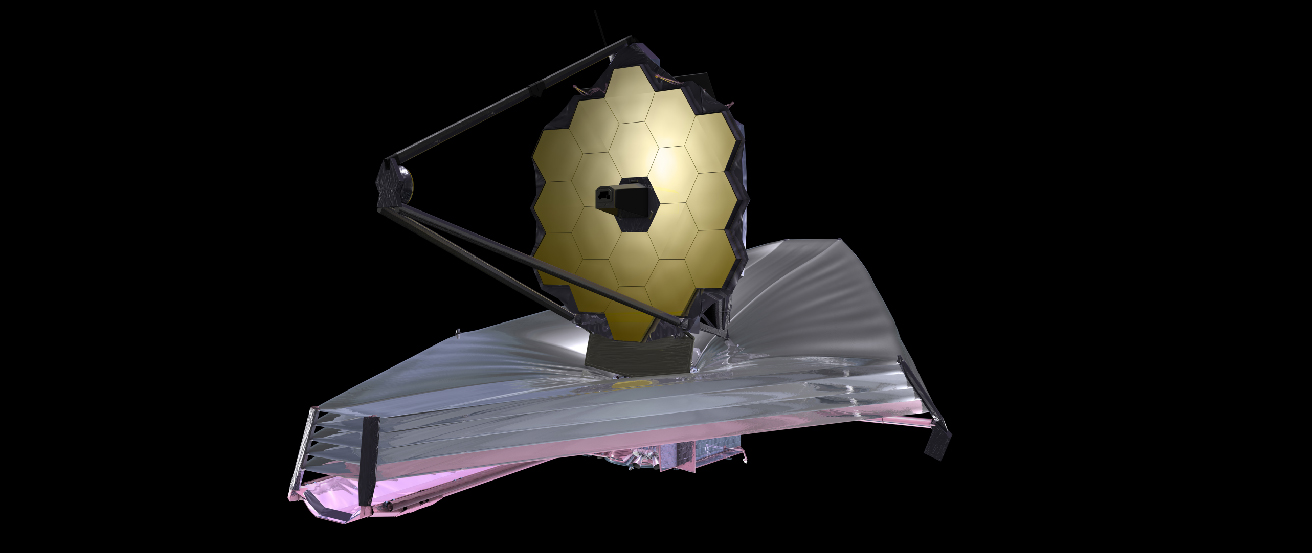
credit: modification of work by NASA · NASA media use guidelines
Figure 29.1 This drawing shows the James Webb Space Telescope, which launched in 2021 and began operations in 2022. The silver sunshade shadows the 18-segment mirror and the science instruments, which operate at extremely cold temperatures. The primary mirror is 6.5 meters (21 feet) in diameter. To see distant galaxies whose light has been shifted to long wavelengths, the telescope will carry several instruments for taking infrared images and spectra. (credit: modification of work by NASA)
英語のヒント
図29.1 この図は、2021年に打ち上げられ、2022年に運用を始めたジェイムズ・ウェッブ宇宙望遠鏡を描いている。銀色の日よけが、18枚に分割された鏡と観測装置を日陰に保つ。これらは極めて低い温度で動作する。主鏡の直径は6.5m(21フィート)である。光が長波長側へずれた遠方の銀河を観測するため、赤外線画像とスペクトルを取得する複数の装置を搭載する。(クレジット:NASAの作品を改変)
In previous chapters, we explored the contents of the universe—planets, stars, and galaxies—and learned about how these objects change with time. But what about the universe as a whole? How old is it? What did it look like in the beginning? How has it changed since then? What will be its fate?
英語のヒント
これまでの章では、宇宙の中身である惑星、恒星、銀河を調べ、それらが時間とともにどう変化するかを学んだ。では、宇宙全体はどうだろうか。年齢はいくつなのか。初めはどのような姿だったのか。それからどう変わったのか。最後にはどうなるのか。
Cosmology is the study of the universe as a whole and is the subject of this chapter. The story of observational cosmology really begins in 1929 when Edwin Hubble published observations of redshifts and distances for a small sample of galaxies and showed the then-revolutionary result that we live in an expanding universe—one which in the past was denser, hotter, and smoother. From this early discovery, astronomers developed many predictions about the origin and evolution of the universe and then tested those predictions with observations. In this chapter, we will describe what we already know about the history of our dynamic universe and highlight some of the mysteries that remain.
英語のヒント
宇宙論は宇宙全体を研究する学問であり、この章の主題である。観測的宇宙論の歩みが本格的に始まったのは1929年だった。エドウィン・ハッブルが少数の銀河の赤方偏移と距離の観測結果を発表し、私たちが膨張する宇宙に住んでいることを示したのである。その宇宙は、過去にはもっと高密度で、高温で、むらが少なかった。これは当時としては革命的な結果だった。この最初の発見を出発点として、天文学者たちは宇宙の起源と進化について多くの予測を立て、観測によって確かめてきた。この章では、変化する宇宙の歴史についてすでにわかっていることを説明し、なお残る謎のいくつかに光を当てる。