第29章ビッグバンThe Big Bang
The Role of Deceleration減速の役割
The Hubble time is the right age for the universe only if the expansion rate has been constant throughout the time since the expansion of the universe began. Continuing with our end-of-the-semester-party analogy, this is equivalent to assuming that you traveled home from the party at a constant rate, when in fact this may not have been the case. At first, mad about having to leave, you may have driven fast, but then as you calmed down—and thought about police cars on the highway—you may have begun to slow down until you were driving at a more socially acceptable speed (such as 80 kilometers/hour). In this case, given that you were driving faster at the beginning, the trip home would have taken less than a half-hour.
英語のヒント
ハッブル時間が宇宙の正しい年齢になるのは、宇宙の膨張が始まって以来、その速さがずっと一定だった場合だけである。学期末のパーティーのたとえでいえば、会場から家まで一定の速度で帰ったと仮定することに当たる。実際にはそうでなかったかもしれない。初めは帰らされることに腹を立てて、速く走ったかもしれない。しかし、気持ちが落ち着き、幹線道路のパトカーのことを考えるにつれて減速し、時速80kmなど、社会的により受け入れられる速度になったとしよう。その場合、最初は速く走っていたのだから、帰宅までにかかった時間は30分より短かったはずである。
In the same way, in calculating the Hubble time, we have assumed that the expansion rate has been constant throughout all of time. It turns out that this is not a good assumption. Earlier in their thinking about this, astronomers expected that the rate of expansion should be slowing down. We know that matter creates gravity, whereby all objects pull on all other objects. The mutual attraction between galaxies was expected to slow the expansion as time passed. This means that, if gravity were the only force acting (a big if, as we shall see in the next section), then the rate of expansion must have been faster in the past than it is today. In this case, we would say the universe has been decelerating since the beginning.
英語のヒント
同じように、ハッブル時間の計算では、膨張の速さが全期間を通じて一定だったと仮定した。しかし、これは適切な仮定ではないことがわかっている。天文学者がこの問題を考え始めたころは、膨張は減速しているはずだと予想していた。物質は重力を生み、それによってあらゆる物体がほかのすべての物体を引き寄せる。銀河同士の引力は、時間がたつほど膨張を遅くすると考えられた。これは、もし作用する力が重力だけなら、過去の膨張は現在より速かったはずだ、ということである。もっとも、次の節で見るように、この「もし」は大きな条件である。その場合、宇宙は初めから減速してきたと言うことになる。
How much it has decelerated depends on the importance of gravity in slowing the expansion. If the universe were nearly empty, the role of gravity would be minor. Then the deceleration would be close to zero, and the universe would have been expanding at a constant rate. But in a universe with any significant density of matter, the pull of gravity means that the rate of expansion should be slower now than it used to be. If we use the current rate of expansion to estimate how long it took the galaxies to reach their current separations, we will overestimate the age of the universe—just as we may have overestimated the time it took for you to get home from the party.
英語のヒント
どれほど減速したかは、膨張を遅くする重力の重要さにかかっている。宇宙がほとんど空なら、重力の役割は小さい。減速はほぼゼロとなり、宇宙は一定の速さで膨張してきたことになる。しかし、無視できない密度の物質を含む宇宙なら、重力の引力によって、現在の膨張は昔より遅いはずだ。現在の膨張の速さを使って、銀河同士が今の距離まで離れるのにかかった時間を求めると、宇宙の年齢を大きく見積もりすぎる。パーティーから帰宅する時間を、長く見積もりすぎたかもしれないのと同じである。
A Universal Acceleration宇宙の加速
Astronomers spent several decades looking for evidence that the expansion was decelerating, but they were not successful. What they needed were 1) larger telescopes so that they could measure the redshifts of more distant galaxies and 2) a very luminous standard bulb (or standard candle), that is, some astronomical object with known luminosity that produces an enormous amount of energy and can be observed at distances of a billion light-years or more.
英語のヒント
天文学者は、膨張が減速している証拠を何十年も探したが、成功しなかった。必要だったのは、(1)もっと遠い銀河の赤方偏移を測れる大型望遠鏡と、(2)非常に光度の高い標準電球、別名「標準光源」だった。後者は、光度が既知で、膨大なエネルギーを放ち、10億光年以上離れていても観測できる天体ということである。
Recall that we discussed standard bulbs in the chapter on Galaxies. If we compare how luminous a standard bulb is supposed to be and how dim it actually looks in our telescopes, the difference allows us to calculate its distance. The redshift of the galaxy such a bulb is in can tell us how fast it is moving in the universe. So we can measure its distance and motion independently.
英語のヒント
「銀河」の章で標準電球を扱ったことを思い出そう。標準電球が本来どれほどの光度を持つはずかと、望遠鏡で実際にどれほど暗く見えるかを比べれば、その違いから距離を計算できる。その標準電球を含む銀河の赤方偏移を測れば、宇宙の中をどれほど速く動いているかがわかる。こうして、距離と運動を独立に測れるのである。
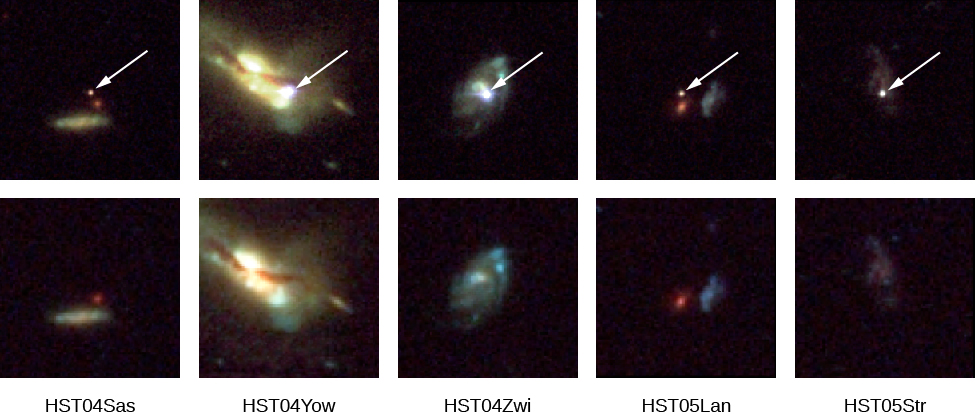
These two requirements were finally met in the 1990s. Astronomers showed that supernovae of type Ia (see The Death of Stars), with some corrections based on the shapes of their light curves, are standard bulbs. This type of supernova is a thermonuclear explosion of a white dwarf, which may be triggered by accretion from a companion star or by interaction with another white dwarf. At the time of maximum brightness, these dramatic supernovae can briefly outshine the galaxies that host them, and hence, they can be observed at very large distances. Large 8- to 10-meter telescopes can be used to obtain the spectra needed to measure the redshifts of the host galaxies (Figure 29.3).
英語のヒント
この二つの条件がようやく満たされたのは1990年代だった。天文学者は、Ia型超新星が、光度曲線の形に基づく補正を施せば標準電球になることを示した。「恒星の死」を参照しよう。この型の超新星は白色矮星の熱核爆発であり、伴星からの降着や、別の白色矮星との相互作用などが引き金になると考えられている。最大光度のころには、この劇的な超新星は、所属する銀河全体より一時的に明るく輝くことがある。そのため、極めて遠くからでも観測できる。口径8〜10mの大型望遠鏡を使えば、母銀河の赤方偏移を測るのに必要なスペクトルを取得できる(図29.3)。
Five Supernovae and Their Host Galaxies.五つの超新星と母銀河。
credit: modification of work by NASA, ESA, and A. Riess (STScI) · CC BY 4.0
Figure 29.3 The top row shows each galaxy and its supernova (arrow). The bottom row shows the same galaxies either before or after the supernovae exploded. (credit: modification of work by NASA, ESA, and A. Riess (STScI))
図29.3 上段はそれぞれの銀河と超新星(矢印)を示す。下段は同じ銀河の、超新星爆発前または爆発後の姿である。(クレジット:NASA、ESA、A. Riess〈STScI〉の作品を改変)
The result of painstaking, careful study of these supernovae in a range of galaxies, carried out by two groups of researchers, was published in 1998. It was shocking—and so revolutionary that their discovery received the 2011 Nobel Prize in Physics. What the researchers found was that these type Ia supernovae in distant galaxies were fainter than expected from Hubble’s law, given the measured redshifts of their host galaxies. In other words, distances estimated from the supernovae used as standard bulbs disagreed with the distances measured from the redshifts.
英語のヒント
二つの研究グループが、さまざまな銀河の超新星を丹念に調べた結果が、1998年に発表された。その結果は衝撃的だった。あまりに革命的な発見であったため、2011年のノーベル物理学賞が贈られたほどである。遠方銀河のIa型超新星は、母銀河の測定された赤方偏移を踏まえてハッブルの法則から予想するより、暗かったのである。言い換えると、超新星を標準電球として見積もった距離は、赤方偏移から求めた距離と一致しなかった。
If the universe were decelerating, we would expect the far-away supernovae to be brighter than expected. The slowing down would have kept them closer to us. Instead, they were fainter, which at first seemed to make no sense.
英語のヒント
宇宙が減速しているなら、遠くの超新星は予想より明るく見えるはずだった。減速によって、私たちに近いところにとどまっていたはずだからである。ところが実際には暗かった。初めは、どうにもつじつまが合わないように思われた。
Before accepting this shocking development, astronomers first explored the possibility that the supernovae might not really be as useful as standard bulbs as they thought. Perhaps the supernovae appeared too faint because dust along our line of sight to them absorbed some of their light. Or perhaps the supernovae at large distances were for some reason intrinsically less luminous than nearby supernovae of type Ia.
英語のヒント
この衝撃的な結果を受け入れる前に、天文学者はまず、超新星が考えていたほど標準電球として役立たない可能性を調べた。超新星への視線上にある塵が光の一部を吸収し、暗すぎるように見せているのかもしれない。あるいは、遠い超新星は何らかの理由で、近くのIa型超新星より本来の光度が低いのかもしれない。
A host of more detailed observations ruled out these possibilities. Scientists then had to consider the alternative that the distance estimated from the redshift was incorrect. Distances derived from redshifts depend on a model of the expansion history. Our simple age estimate assumed that the scale of the universe increased at a constant rate, and we also considered the possibility that the expansion is slowing down. But suppose neither assumption is right (steady speed or slowing down.)
英語のヒント
さらに詳しい数多くの観測によって、こうした可能性は排除された。そこで科学者は、赤方偏移から見積もった距離が誤っているという、別の可能性を考えざるをえなかった。赤方偏移から求める距離は、膨張の歴史についてのモデルに依存する。単純な年齢の見積もりでは宇宙の尺度が一定の速さで増えると仮定し、さらに膨張が減速する場合も考えた。しかし、一定の速さという仮定も、減速しているという仮定も、どちらも正しくないとしたらどうだろうか。
Suppose, instead, that the universe is accelerating. If the universe is expanding faster now than it was billions of years ago, our motion away from the distant supernovae has sped up since the explosion occurred, sweeping us farther away from them. The light of the explosion has to travel a greater distance to reach us than if the expansion rate were constant. The farther the light travels, the fainter it appears. This conclusion would explain the supernova observations in a natural way, and this has now been substantiated by many additional observations over the last couple of decades. It really seems that the expansion of the universe is accelerating, a notion so unexpected that astronomers at first resisted considering it.
英語のヒント
代わりに、宇宙が加速していると考えよう。現在の宇宙が数十億年前より速く膨張しているなら、超新星爆発が起こってから、私たちが遠方の超新星から離れる運動は加速し、いっそう遠くへ運ばれてきたことになる。爆発の光は、膨張の速さが一定だった場合より長い距離を進まなければ、私たちに届かない。光の進む距離が長いほど、暗く見える。この結論なら、超新星の観測を自然に説明できる。その後20年ほどの多くの追加観測によって、実際に裏付けられてきた。宇宙の膨張は、本当に加速しているらしい。あまりに予想外の考えで、天文学者は初め、それを検討することにすら抵抗した。
How can the expansion of the universe be speeding up? If you want to accelerate your car, you must supply energy by stepping on the gas. Similarly, energy must be supplied to accelerate the expansion of the universe. The discovery of the acceleration was shocking because scientists still have no idea what the source of the energy is. Scientists call whatever it is dark energy, which is a clear sign of how little we understand it.
英語のヒント
どうして宇宙の膨張が速まるのだろうか。車を加速させるなら、アクセルを踏んでエネルギーを供給しなければならない。同じように、宇宙の膨張を加速させるにもエネルギーの供給が必要である。加速の発見が衝撃的だったのは、そのエネルギーの源が何なのか、科学者にもまだ見当がつかないからだ。科学者は、正体が何であれ、それを暗黒エネルギーと呼んでいる。この名称そのものが、私たちがいかに理解していないかをよく示している。
Note that this new component of the universe is not the dark matter we talked about in earlier chapters. Dark energy is something else that we have also not yet detected in our laboratories on Earth.
英語のヒント
この宇宙の新しい成分は、前の章で扱った暗黒物質とは違うことに注意しよう。暗黒エネルギーは別のものであり、こちらも地球の実験室ではまだ検出されていない。
What is dark energy? One possibility is that it is the cosmological constant, which is an energy associated with the vacuum of “empty” space itself. Quantum mechanics (the intriguing theory of how things behave at the atomic and subatomic levels) tells us that the source of this vacuum energy might be tiny elementary particles that flicker in and out of existence everywhere throughout the universe. Various attempts have been made to calculate how big the effects of this vacuum energy should be, but so far these attempts have been unsuccessful. In fact, the order of magnitude of theoretical estimates of the vacuum energy based on the quantum mechanics of matter and the value required to account for the acceleration of the expansion of the universe differ by an incredible factor of at least 10120 (that is a 1 followed by 120 zeros)! Various other theories have been suggested, but the bottom line is that, although there is compelling evidence that dark energy exists, we do not yet know the source of that energy.
英語のヒント
暗黒エネルギーとは何だろうか。一つの可能性は宇宙定数、すなわち「空っぽ」の空間そのものの真空に伴うエネルギーだというものである。原子や、それより小さいスケールでの物の振る舞いを扱う興味深い理論である量子力学によれば、この真空のエネルギーの源は、宇宙のあらゆる場所で現れては消える微小な素粒子かもしれない。真空エネルギーの効果がどれほどになるはずか、さまざまな計算が試みられたが、今のところ成功していない。実際、物質の量子力学に基づく真空エネルギーの理論的見積もりと、宇宙の加速膨張を説明するのに必要な値には、少なくとも10120倍という途方もない桁の開きがある。1の後ろにゼロが120個も続く数である。ほかにもさまざまな理論が提案されている。結局のところ、暗黒エネルギーの存在には強い証拠があるが、そのエネルギーの源はまだわかっていない。
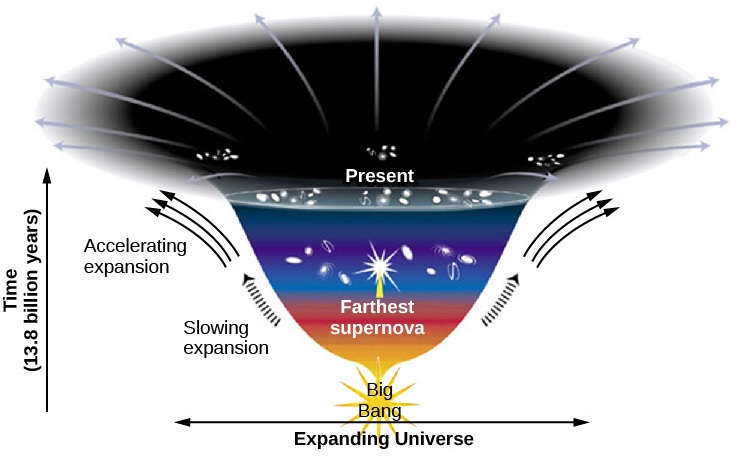
Whatever the dark energy turns out to be, we should note that the discovery that the rate of expansion has not been constant since the beginning of the universe complicates the calculation of the age of the universe. Interestingly, the acceleration seems not to have started with the Big Bang. During the first several billion years after the Big Bang, when galaxies were close together, gravity was strong enough to slow the expansion. As galaxies moved farther apart, the effect of gravity weakened. Several billion years after the Big Bang, dark energy took over, and the expansion began to accelerate (Figure 29.4).
英語のヒント
暗黒エネルギーの正体が何であろうと、宇宙が始まってから膨張の速さが一定ではなかったという発見は、宇宙年齢の計算を複雑にする点に注意したい。興味深いことに、加速はビッグバンと同時に始まったわけではないらしい。ビッグバン後の最初の数十億年には銀河が近接していて、重力が十分に強く、膨張を遅くした。銀河が離れるにつれて重力の効果は弱まった。ビッグバンから数十億年後には暗黒エネルギーが優勢となり、膨張が加速し始めた(図29.4)。
Changes in the Rate of Expansion of the Universe Since Its Beginning 13.8 Billion Years Ago.138億年前の始まりから、宇宙の膨張の速さがどう変化したか。
credit: modification of work by Ann Feild (STScI) · CC BY 4.0
Figure 29.4 The more the diagram spreads out horizontally, the faster the change in the velocity of expansion. After a period of very rapid expansion at the beginning, which scientists call inflation and which we will discuss later in this chapter, the expansion began to decelerate. Galaxies were then close together, and their mutual gravitational attraction slowed the expansion. After a few billion years, when galaxies were farther apart, the influence of gravity began to weaken. Dark energy then took over and caused the expansion to accelerate. (credit: modification of work by Ann Feild (STScI))
英語のヒント
図29.4 図が横に大きく広がるほど、膨張速度の変化は速い。初めに非常に急速な膨張が起こった後、膨張は減速に転じた。科学者は初めの急膨張をインフレーションと呼んでおり、この章の後半で取り上げる。その後は銀河同士が近くにあり、相互の引力が膨張を遅くした。数十億年たって銀河の間隔が広がると、重力の影響が弱まり始めた。そこで暗黒エネルギーが優勢となり、膨張を加速させた。(クレジット:Ann Feild〈STScI〉の作品を改変)
Deceleration works to make the age of the universe estimated by the simple relation seem older than it really is, whereas acceleration works to make it seem younger. By happy coincidence, our best estimates of how much deceleration and acceleration occurred lead to an answer for the age very close to . The best current estimate is that the universe is 13.8 billion years old with an uncertainty of only about 100 million years.
英語のヒント
減速の効果は、単純な関係式 で見積もる宇宙年齢を、実際より大きく見せる。加速の効果は、反対に小さく見せる。幸いな偶然により、減速と加速の大きさについての最良の推定を使うと、年齢は に非常に近くなる。現在の最良の見積もりでは、宇宙の年齢は138億年で、不確かさは約1億年しかない。
Throughout this chapter, we have referred to the Hubble constant. We now know that the Hubble constant does change with time. It is, however, constant everywhere in the universe at any given time. When we say the Hubble constant is about 70 kilometers/second/million parsecs, we mean that this is the value of the Hubble constant at the current time.
英語のヒント
この章では一貫してハッブル「定数」と呼んできた。しかし、その値が時間とともに変わることが今ではわかっている。それでも、ある一つの時刻を取れば、宇宙のどこでも一定である。ハッブル定数が約70km/s/100万パーセクだと言うとき、それは現在のハッブル定数の値を指している。