第29章ビッグバンThe Big Bang
The Evolution of the Early Universe初期宇宙の進化
Keeping these three ideas in mind, we can trace the evolution of the universe from the time it was about 0.01 second old and had a temperature of about 100 billion K. Why not begin at the very beginning? There are as yet no theories that allow us to penetrate to a time before about 10–43 second (this number is a decimal point followed by 42 zeros and then a one). It is so small that we cannot relate it to anything in our everyday experience. When the universe was that young, its density was so high that the general theory of relativity is not adequate to describe it, and even the concept of time breaks down.
英語のヒント
この三つの考え方を念頭に置けば、宇宙が約0.01秒齢で、温度が約1000億Kだった時点から、進化をたどれる。なぜ最初の瞬間から始めないのだろうか。約10–43秒より前へ踏み込める理論は、まだないのである。この数は、小数点の後にゼロが42個続き、その後に1が来る。あまりに小さく、日常のどんな経験とも結び付けられない。そのように若い宇宙の密度は極端に高く、一般相対性理論では十分に記述できない。時間という概念さえ、通用しなくなる。
Scientists, by the way, have been somewhat more successful in describing the universe when it was older than 10–43 second but still less than about 0.01 second old. We will take a look at some of these ideas later in this chapter, but for now, we want to start with somewhat more familiar situations.
なお、10–43秒より後で、まだ約0.01秒に達していない宇宙の記述については、科学者はもう少し成功を収めている。そうした考えのいくつかは、この章の後半で取り上げる。今は、いくらか馴染みのある状況から始めたい。
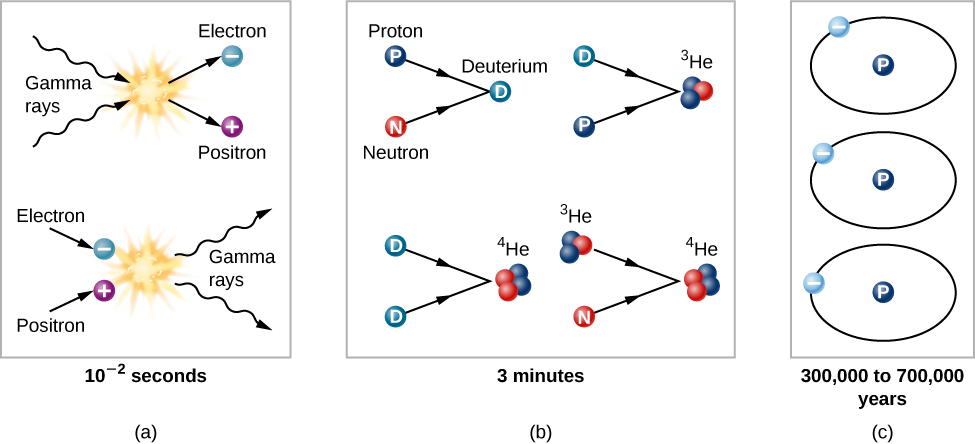
By the time the universe was 0.01 second old, it consisted of a soup of matter and radiation; the matter included protons and neutrons, leftovers from an even younger and hotter universe. Each particle collided rapidly with other particles. The temperature was no longer high enough to allow colliding photons to produce neutrons or protons, but it was sufficient for the production of electrons and positrons (Figure 29.14). There was probably also a sea of exotic subatomic particles that would later play a role as dark matter. All the particles jiggled about on their own; it was still much too hot for protons and neutrons to combine to form the nuclei of atoms.
英語のヒント
宇宙が0.01秒齢になったころには、物質と放射が混ざったスープのような状態だった。物質には、もっと若く高温だった宇宙から残った陽子と中性子が含まれていた。各粒子は、ほかの粒子と頻繁に衝突した。温度はもはや、光子の衝突で陽子や中性子を作るほど高くはなかったが、電子と陽電子を作るには十分だった(図29.14)。おそらく、後に暗黒物質として働く、見慣れない種類の微小な粒子も大量に存在した。各粒子はそれぞれ激しく動き回り、陽子と中性子が結び付いて原子核になるには、まだはるかに高温すぎた。
Particle Interactions in the Early Universe.初期宇宙での粒子の相互作用。
OpenStax / Rice University · CC BY 4.0
Figure 29.14 (a) In the first fractions of a second, when the universe was very hot, energy was converted into particles and antiparticles. The reverse reaction also happened: a particle and antiparticle could collide and produce energy. (b) As the temperature of the universe decreased, the energy of typical photons became too low to create matter. Instead, existing particles fused to create such nuclei as deuterium and helium. (c) Later, it became cool enough for electrons to settle down with nuclei and make neutral atoms. Most of the universe was still hydrogen.
英語のヒント
図29.14 (a)最初の1秒未満の間、宇宙は非常に高温で、エネルギーが粒子と反粒子に変わった。逆反応も起こり、粒子と反粒子が衝突してエネルギーを生むこともあった。(b)宇宙の温度が下がると、典型的な光子のエネルギーは、物質を作るには低すぎるようになった。代わって、すでにある粒子が融合し、重水素やヘリウムなどの原子核を作った。(c)さらに後には、電子が原子核と落ち着いて結び付き、中性の原子を作れるほど冷えた。宇宙の大部分は、依然として水素だった。
Think of the universe at this time as a seething cauldron, with photons colliding and interchanging energy, and sometimes being destroyed to create a pair of particles. The particles also collided with one another. Frequently, a matter particle and an antimatter particle met and turned each other into a burst of gamma-ray radiation.
英語のヒント
このころの宇宙を、煮えたぎる大釜だと思ってみよう。光子が衝突してエネルギーをやり取りし、ときには消えて一組の粒子を生む。粒子同士も衝突する。物質の粒子と反物質の粒子は、しばしば出会って互いを消し、ガンマ線の放射へ変わった。
Among the particles created in the early phases of the universe was the ghostly neutrino (see The Sun: A Nuclear Powerhouse), which today interacts only very rarely with ordinary matter. In the crowded conditions of the very early universe, however, neutrinos ran into so many electrons and positrons that they experienced frequent interactions despite their “antisocial” natures.
英語のヒント
初期宇宙で生まれた粒子には、幽霊のようなニュートリノもある。「太陽――核エネルギーの源」を参照しよう。今日では普通の物質と相互作用することが極めて少ない粒子だ。しかし、非常に若い宇宙の混み合った状態では、ニュートリノもあまりに多くの電子や陽電子と出会い、その「人付き合いの悪さ」にもかかわらず、頻繁に相互作用した。
By the time the universe was a little more than 1 second old, the density had dropped to the point where neutrinos no longer interacted with matter but simply traveled freely through space. In fact, these neutrinos should now be all around us. Since they have been traveling through space unimpeded (and hence unchanged) since the universe was 1 second old, measurements of their properties would offer one of the best tests of the Big Bang model. Unfortunately, the very characteristic that makes them so useful—the fact that they interact so weakly with matter that they have survived unaltered for all but the first second of time—also renders them unable to be measured, at least with present techniques. Perhaps someday someone will devise a way to capture these elusive messengers from the past.
英語のヒント
宇宙が1秒を少し超える年齢になったころ、密度は、ニュートリノが物質と相互作用しなくなり、空間を自由に進むだけになるところまで下がった。そのニュートリノは、実際、今も私たちの周りを満たしているはずである。宇宙が1秒齢だったときから邪魔されず、したがって変化せずに空間を進んできたのだから、その性質を測れば、ビッグバンモデルを検証する最高の方法の一つになるはずだ。残念ながら、まさに役立つ理由となる性質が、少なくとも現在の技術では、測定を不可能にもしている。物質との相互作用があまりに弱く、最初の1秒を除くすべての時間を、変わらず生き延びたという性質である。いつか誰かが、この捉えがたい過去からの使者を捕まえる方法を考え出すかもしれない。
Atomic Nuclei Form原子核の形成
When the universe was about 3 minutes old and its temperature was down to about 900 million K, protons and neutrons could combine. At higher temperatures, these atomic nuclei had immediately been blasted apart by interactions with high-energy photons and thus could not survive. But at the temperatures and densities reached between 3 and 4 minutes after the beginning, deuterium (a proton and neutron) lasted long enough that collisions could convert some of it into helium, (Figure 29.14). In essence, the entire universe was acting the way centers of stars do today—fusing new elements from simpler components. In addition, a little bit of element 3, lithium, could also form.
英語のヒント
宇宙が約3分齢となり、温度が約9億Kまで下がると、陽子と中性子が結び付けるようになった。もっと高温のときには、こうした原子核は高エネルギー光子との相互作用ですぐに壊され、存在し続けられなかった。しかし、始まりから3〜4分の間に達した温度と密度では、陽子と中性子からなる重水素が十分長く残り、衝突によってその一部をヘリウムへ変えることができた(図29.14)。要するに宇宙全体が、今日の恒星の中心と同じように、単純な材料を融合して新しい元素を作っていたのである。原子番号3のリチウムも、少量ながら作られた。
This burst of cosmic fusion was only a brief interlude, however. By 4 minutes after the Big Bang, more helium was having trouble forming. The universe was still expanding and cooling down. After the formation of helium and some lithium, the temperature had dropped so low that the fusion of helium nuclei into still-heavier elements could not occur. No elements beyond lithium could form in the first few minutes. That 4-minute period was the end of the time when the entire universe was a fusion factory. In the cool universe we know today, the fusion of new elements is limited to the centers of stars and the explosions of supernovae.
英語のヒント
しかし、宇宙規模の核融合が盛んだったのは、ほんの短い間だった。ビッグバンから4分たつころには、それ以上のヘリウムの形成が難しくなっていた。宇宙はなお膨張し、冷え続けていた。ヘリウムと少量のリチウムができた後、温度は低くなりすぎ、ヘリウムの原子核が融合してさらに重い元素を作ることはできなかった。最初の数分間に、リチウムより先の元素は形成されなかった。この4分間で、宇宙全体が核融合工場として働く時代は終わった。現在の冷えた宇宙では、新しい元素を作る核融合は、恒星の中心と超新星爆発に限られている。
Still, the fact that the Big Bang model allows the creation of a good deal of helium is the answer to a long-standing mystery in astronomy. Put simply, there is just too much helium in the universe to be explained by what happens inside stars. All the generations of stars that have produced helium since the Big Bang cannot account for the quantity of helium we observe. Furthermore, even the oldest stars and the most distant galaxies show significant amounts of helium. These observations find a natural explanation in the synthesis of helium by the Big Bang itself during the first few minutes of time. We estimate that 10 times more helium was manufactured in the first 4 minutes of the universe than in all the generations of stars during the succeeding 10 to 15 billion years.
英語のヒント
それでも、ビッグバンモデルが大量のヘリウムの生成を可能にすることは、天文学の長年の謎への答えとなる。簡単に言えば、宇宙には、恒星内部で起こることだけでは説明できないほど多くのヘリウムがある。ビッグバン以来、ヘリウムを作ってきたあらゆる世代の星を合わせても、観測される量に届かない。さらに、最も古い星や最も遠い銀河にも、相当量のヘリウムがある。これらの観測は、時間の始まりの最初の数分間に、ビッグバンそのものがヘリウムを合成したと考えれば自然に説明できる。宇宙の最初の4分間には、その後100〜150億年の全世代の星で作られた量の、10倍のヘリウムが作られたと推定される。