第29章ビッグバンThe Big Bang
29.2 A Model of the Universe29.2 宇宙のモデル
Learning Objectives学習の目標
By the end of this section, you will be able to:
この節を終えると、次のことができるようになる。
Explain how the rate of expansion of the universe affects its evolution
宇宙の膨張の速さが、その進化にどう影響するか説明する。
Describe four possibilities for the evolution of the universe
宇宙の進化について四つの可能性を説明する。
Explain what is expanding when we say that the universe is expanding
宇宙が膨張していると言うとき、何が膨張しているのか説明する。
Define critical density and the evidence that matter alone in the universe is much smaller than the critical density
臨界密度を定義し、宇宙の物質だけの密度が臨界密度よりはるかに低いことを示す証拠を説明する。
Describe what the observations say about the likely long-term future of the universe
宇宙の長期的な将来について、観測からどのような姿が有力と考えられるか説明する。
Let’s now use the results about the expansion of the universe to look at how these ideas might be applied to develop a model for the evolution of the universe as a whole. With this model, astronomers can make predictions about how the universe has evolved so far and what will happen to it in the future.
英語のヒント
ここからは、宇宙の膨張について得た結果を使い、宇宙全体の進化モデルをどう組み立てられるか考えよう。このモデルを用いれば、宇宙がこれまでどのように進化してきたか、また今後どうなるかを、天文学者は予測できる。
The Expanding Universe膨張する宇宙
Every model of the universe must include the expansion we observe. Another key element of the models is that the cosmological principle (which we discussed in The Evolution and Distribution of Galaxies) is valid: on the large scale, the universe at any given time is the same everywhere (homogeneous and isotropic). As a result, the expansion rate must be the same everywhere during any epoch of cosmic time. If so, we don’t need to think about the entire universe when we think about the expansion, we can just look at any sufficiently large portion of it. (Some models for dark energy would allow the expansion rate to be different in different directions, and scientists are designing experiments to test this idea. However, until such evidence is found, we will assume that the cosmological principle applies throughout the universe.)
英語のヒント
どの宇宙モデルも、観測される膨張を含まなければならない。もう一つの重要な要素は、「銀河の進化と分布」で論じた宇宙原理が成り立つことである。すなわち、十分に大きなスケールで見ると、ある時刻の宇宙はどこでも同じで、一様かつ等方的だとする。そのため、宇宙のどの時代でも、同じ時刻なら膨張の速さはどこでも等しいはずである。そうであれば、膨張を考えるために宇宙全体を扱う必要はなく、十分に大きな一部分を見ればよい。暗黒エネルギーのモデルには、方向によって膨張の速さが異なることを許すものもあり、この考えを確かめる実験が計画されている。しかし、そのような証拠が見つかるまでは、宇宙原理が宇宙全体で成り立つと仮定する。
In Galaxies, we hinted that when we think of the expansion of the universe, it is more correct to think of space itself stretching rather than of galaxies moving through static space. Nevertheless, we have since been discussing the redshifts of galaxies as if they resulted from the motion of the galaxies themselves.
英語のヒント
「銀河」では、宇宙の膨張を考えるには、静止した空間を銀河が移動すると捉えるより、空間そのものが伸びると捉えるほうが正確だと触れた。それでも、それ以降も、銀河の赤方偏移を、あたかも銀河自身の運動から生じるかのように論じてきた。
Now, however, it is time to finally put such simplistic notions behind us and take a more sophisticated look at the cosmic expansion. Recall from our discussion of Einstein’s general theory of relativity (in the chapter on Black Holes and Curved Spacetime) that space—or, more precisely, spacetime—is not a mere backdrop to the action of the universe, as Newton thought. Rather, it is an active participant—affected by and in turn affecting the matter and energy in the universe.
英語のヒント
しかし今こそ、そのような単純すぎる考えから先へ進み、宇宙の膨張をもう一段深く捉えるときである。「ブラックホールと曲がった時空」で説明したアインシュタインの一般相対性理論を思い出そう。空間、より正確には時空は、ニュートンが考えたような、宇宙の出来事を載せるだけの背景ではない。自らその出来事に関わる存在であり、宇宙の物質やエネルギーの影響を受け、今度はそれらに影響を及ぼすのである。
Since the expansion of the universe is the stretching of all spacetime, all points in the universe are stretching together. Thus, the expansion began everywhere at once. Unfortunately for tourist agencies of the future, there is no location you can visit where the stretching of space began or where we can say that the Big Bang happened.
英語のヒント
宇宙の膨張は時空全体が伸びることなので、宇宙のあらゆる場所が一緒に引き伸ばされる。したがって、膨張はすべての場所で同時に始まった。未来の旅行会社には残念だが、空間の伸びが始まった場所、あるいは「ここでビッグバンが起きた」と言える場所へ、観光に行くことはできない。
To describe just how space stretches, we say the cosmic expansion causes the universe to undergo a uniform change in scale over time. By scale we mean, for example, the distance between two clusters of galaxies. It is customary to represent the scale by the factor R; if R doubles, then the distance between the clusters has doubled. Since the universe is expanding at the same rate everywhere, the change in R tells us how much it has expanded (or contracted) at any given time. For a static universe, R would be constant as time passes. In an expanding universe, R increases with time.
英語のヒント
空間が具体的にどう伸びるかを述べるため、宇宙の膨張は、時間とともに宇宙の尺度を一様に変化させる、と表現する。尺度とは、たとえば二つの銀河団の間の距離のことである。通常、この尺度を因子 R で表す。R が2倍になれば、銀河団の間隔も2倍になる。宇宙はどこでも同じ速さで膨張するので、R の変化を見れば、ある時刻までにどれほど膨張、あるいは収縮したかがわかる。静的な宇宙なら、時間がたっても R は一定である。膨張する宇宙では、R は時間とともに増す。
If it is space that is stretching rather than galaxies moving through space, then why do the galaxies show redshifts in their spectra? When you were young and naïve—a few chapters ago—it was fine to discuss the redshifts of distant galaxies as if they resulted from their motion away from us. But now that you are an older and wiser student of cosmology, this view will simply not do.
英語のヒント
空間の中を銀河が動くのではなく、空間そのものが伸びるのなら、なぜ銀河のスペクトルは赤方偏移を示すのだろうか。まだ若く、素朴だったころ、つまり数章前には、遠方銀河の赤方偏移を、私たちから遠ざかる運動によって生じるものとして論じてよかった。しかし、宇宙論を学んで年を重ね、知恵もついた今では、その見方だけでは済まない。
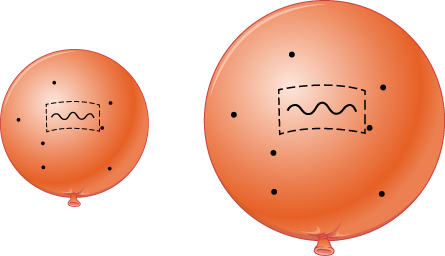
A more accurate view of the redshifts of galaxies is that the light waves are stretched by the stretching of the space they travel through. Think about the light from a remote galaxy. As it moves away from its source, the light has to travel through space. If space is stretching during all the time the light is traveling, the light waves will be stretched as well. A redshift is a stretching of waves—the wavelength of each wave increases (Figure 29.7). Light from more distant galaxies travels for more time than light from closer ones. This means that the light has stretched more than light from closer ones and thus shows a greater redshift.
英語のヒント
銀河の赤方偏移をより正確に言えば、光が通る空間の伸びによって、光の波も引き伸ばされるということである。遠くの銀河から来る光を考えよう。光は源から離れ、空間を通って進まなければならない。その旅の間じゅう空間が伸びていれば、光の波も同じように伸びる。赤方偏移とは波が引き伸ばされること、つまり各波の波長が長くなることである(図29.7)。遠い銀河からの光は、近い銀河からの光より長い時間をかけて届く。そのため、より大きく引き伸ばされ、より大きい赤方偏移を示す。
Expansion and Redshift.膨張と赤方偏移。
OpenStax / Rice University · CC BY 4.0
Figure 29.7 As an elastic surface expands, a wave on its surface stretches. For light waves, the increase in wavelength would be seen as a redshift.
英語のヒント
図29.7 弾性のある表面が広がると、そこに描かれた波も引き伸ばされる。光の波であれば、波長が長くなることは赤方偏移として観測される。
Thus, what the measured redshift of light from an object is telling us is how much the universe has expanded since the light left the object. If the universe has expanded by a factor of 2, then the wavelength of the light (and all electromagnetic waves from the same source) will have doubled.
英語のヒント
したがって、ある天体の光で測った赤方偏移が教えるのは、その光が天体を離れて以来、宇宙がどれほど膨張したかである。宇宙の尺度が2倍になったなら、光の波長も2倍になる。同じ源から来るあらゆる電磁波についても同様である。
Models of the Expansion膨張のモデル
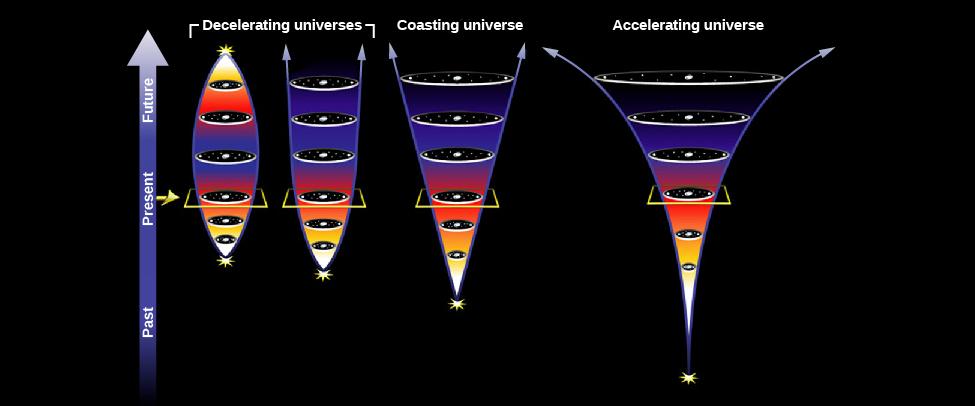
Before astronomers knew about dark energy or had a good measurement of how much matter exists in the universe, they made speculative models about how the universe might evolve over time. The four possible scenarios are shown in Figure 29.8. In this diagram, time moves forward from the bottom upward, and the scale of space increases by the horizontal circles becoming wider.
英語のヒント
暗黒エネルギーが知られ、宇宙の物質量が精度よく測られるより前から、天文学者は宇宙が時間とともにどう進化しうるか、仮説的なモデルを作っていた。考えられる四つの筋書きを図29.8に示す。この図では、時間は下から上へ進み、水平方向の円が広がることで空間の尺度の増大を表す。
Four Possible Models of the Universe.考えられる四つの宇宙モデル。
credit: modification of work by NASA/ESA · NASA media use guidelines
Figure 29.8 The yellow square marks the present in all four cases, and for all four, the Hubble constant is equal to the same value at the present time. Time is measured in the vertical direction. The first two universes on the left are ones in which the rate of expansion slows over time. The one on the left will eventually slow, come to a stop and reverse, ending up in a “big crunch,” while the one next to it will continue to expand forever, but ever-more slowly as time passes. The “coasting” universe is one that expands at a constant rate throughout all of cosmic time. The accelerating universe on the right will continue to expand faster and faster forever. (credit: modification of work by NASA/ESA)
英語のヒント
図29.8 黄色い四角は、どのモデルでも現在を示す。四つとも、現在のハッブル定数は同じ値である。縦方向が時間を表す。左の二つは、時間とともに膨張が遅くなる宇宙だ。左端の宇宙は、やがて減速して停止し、収縮に転じ、最後には「ビッグクランチ」を迎える。その隣は、ますますゆっくりになりながらも、永遠に膨張し続ける。等速で膨張する宇宙では、宇宙の全期間を通じて膨張の速さが一定である。右の加速する宇宙は、永久に、ますます速く膨張し続ける。(クレジット:NASA/ESAの作品を改変)
The simplest scenario of an expanding universe would be one in which R increases with time at a constant rate. But you already know that life is not so simple. The universe contains a great deal of mass and its gravity decelerates the expansion—by a large amount if the universe contains a lot of matter, or by a negligible amount if the universe is nearly empty. Then there is the observed acceleration, which astronomers blame on a kind of dark energy.
英語のヒント
膨張する宇宙の最も単純な筋書きは、R が時間とともに一定の速さで増えるというものだ。しかし、話がそう単純でないことは、もう知っている。宇宙には大量の質量があり、その重力は膨張を減速させる。物質が多ければ減速は大きく、ほとんど空なら減速も無視できるほど小さい。さらに、観測される加速もある。天文学者は、その原因をある種の暗黒エネルギーに求めている。
Let’s first explore the range of possibilities with models for different amounts of mass in the universe and for different contributions by dark energy. In some models—as we shall see—the universe expands forever. In others, it stops expanding and starts to contract. After looking at the extreme possibilities, we will look at recent observations that allow us to choose the most likely scenario.
英語のヒント
まず、宇宙の質量の量と、暗黒エネルギーの寄与の大きさを変えたモデルで、可能性の範囲を調べよう。これから見るように、永遠に膨張する宇宙のモデルもある。一方、膨張が止まって収縮に転じるものもある。極端な場合を見た後で、最もありそうな筋書きを選ぶ手がかりとなる最近の観測を調べる。
We should perhaps pause for a minute to note how remarkable it is that we can do this at all. Our understanding of the principles that underlie how the universe works on the large scale and our observations of how the objects in the universe change with time allow us to model the evolution of the entire cosmos these days. It is one of the loftiest achievements of the human mind.
英語のヒント
ここで少し立ち止まり、こんなことがそもそも可能だという驚きを味わってもよいだろう。大きなスケールで宇宙を動かす原理を理解し、その中の天体が時間とともに変わる様子を観測することによって、今や宇宙全体の進化をモデルにできる。これは、人間の知性が成し遂げた、最も高い到達点の一つである。
What astronomers look at in practice, to determine the kind of universe we live in, is the average density of the universe. This is the mass of matter (including the equivalent mass of energy)By equivalent mass we mean that which would result if the energy were turned into mass using Einstein’s formula, E = mc2. that would be contained in each unit of volume (say, 1 cubic centimeter) if all the stars, galaxies, and other objects were taken apart, atom by atom, and if all those particles, along with the light and other energy, were distributed throughout all of space with absolute uniformity. If the average density is low, there is less mass and less gravity, and the universe will not decelerate very much. It can therefore expand forever. Higher average density, on the other hand, means there is more mass and more gravity and that the stretching of space might slow down enough that the expansion will eventually stop. An extremely high density might even cause the universe to collapse again.
英語のヒント
私たちがどんな宇宙に住むかを決めるために、天文学者が実際に調べるのは宇宙の平均密度である。これは、恒星、銀河、その他の天体をすべて原子一つひとつにまでばらし、その全粒子を、光やその他のエネルギーとともに、空間全体へ完全に一様に分散させたときの、単位体積、たとえば1立方センチメートル当たりの物質の質量を指す。エネルギーに相当する質量も含める。ここで相当する質量とは、アインシュタインの式 E = mc2 を用いて、エネルギーを質量に変えた場合に得られる量のことである。平均密度が低ければ、質量も重力も小さく、宇宙はあまり減速しない。そのため永遠に膨張できる。反対に、平均密度が高ければ質量と重力が大きく、空間の伸びが十分に遅くなって、ついには膨張が止まるかもしれない。密度が極めて高ければ、宇宙が再び潰れる可能性さえある。
For a given rate of expansion, there is a critical density—the mass per unit volume that will be just enough to slow the expansion to zero at some time infinitely far in the future. If the actual density is higher than this critical density, then the expansion will ultimately reverse and the universe will begin to contract. If the actual density is lower, then the universe will expand forever.
英語のヒント
膨張の速さを一つ定めると、それに対して臨界密度が決まる。これは、無限に遠い未来に膨張の速さをゼロにするのに、ちょうど十分な単位体積当たりの質量である。実際の密度が臨界密度を上回れば、膨張はいずれ逆転し、宇宙は収縮し始める。実際の密度が下回れば、宇宙は永遠に膨張する。
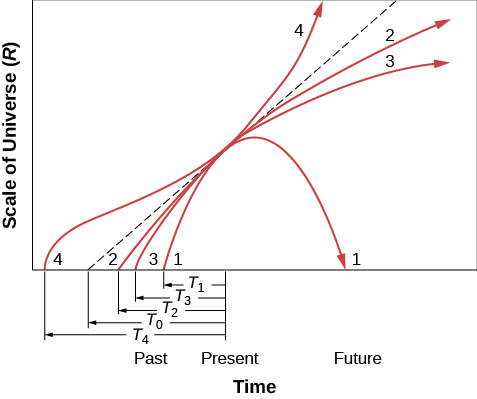
These various possibilities are illustrated in Figure 29.9. In this graph, one of the most comprehensive in all of science, we chart the development of the scale of space in the cosmos against the passage of time. Time increases to the right, and the scale of the universe, R, increases upward in the figure. Today, at the point marked “present” along the time axis, R is increasing in each model. We know that the galaxies are currently expanding away from each other, no matter which model is right. (The same situation holds for a baseball thrown high into the air. While it may eventually fall back down, near the beginning of the throw it moves upward most rapidly.)
英語のヒント
こうした可能性を図29.9に示す。科学の中でも特に多くの内容を盛り込んだこのグラフは、宇宙の空間の尺度が、時間の経過とともにどう変わるかを描いている。右へ行くほど時間が進み、上へ行くほど宇宙の尺度 R が大きくなる。時間軸の「現在」のところでは、どのモデルでも R は増加している。どのモデルが正しいとしても、現在、銀河同士の間隔が広がっていることはわかっている。これは、空高く投げ上げた野球のボールと同じである。いずれ落ちてくるかもしれないが、投げた直後には最も速く上昇している。
The various lines moving across the graph correspond to different models of the universe. The straight dashed line corresponds to the empty universe with no deceleration; it intercepts the time axis at a time, T0 (the Hubble time), in the past. This is not a realistic model but gives us a measure to compare other models to. The curves below the dashed line represent models with no dark energy and with varying amounts of deceleration, starting from the Big Bang at shorter times in the past. The curve above the dashed line shows what happens if the expansion is accelerating. Let’s take a closer look at the future according to the different models.
英語のヒント
グラフ上の各線は、異なる宇宙モデルに対応する。直線の破線は、減速のない空の宇宙に対応し、過去の T0、すなわちハッブル時間のところで時間軸と交わる。現実的なモデルではないが、ほかのモデルと比べる基準になる。破線の下の曲線は、暗黒エネルギーがなく、減速の大きさが異なるモデルを示す。ビッグバンから現在までの時間は、いずれも破線の場合より短い。破線の上の曲線は、膨張が加速するとどうなるかを示す。各モデルでの将来を、もう少し詳しく見てみよう。
Models of the Universe.宇宙のモデル。
OpenStax / Rice University · CC BY 4.0
Figure 29.9 This graph plots R, the scale of the universe, against time for various cosmological models. Curve 1 represents a universe where the density is greater than the critical value; this model predicts that the universe will eventually collapse. Curve 2 represents a universe with a density lower than critical; the universe will continue to expand but at an ever-slower rate. Curve 3 is a critical-density universe; in this universe, the expansion will gradually slow to a stop infinitely far in the future. Curve 4 represents a universe that is accelerating because of the effects of dark energy. The dashed line is for an empty universe, one in which the expansion is not slowed by gravity or accelerated by dark energy. Time is very compressed on this graph.
図29.9 各種の宇宙論モデルについて、宇宙の尺度 R を時間に対して描いたグラフ。曲線1は密度が臨界値より高い宇宙で、いずれ宇宙が再び潰れると予測する。曲線2は臨界値より低い密度の宇宙で、ますます遅くなりながらも膨張を続ける。曲線3は臨界密度の宇宙であり、膨張は徐々に遅くなり、無限に遠い未来に停止へ近づく。曲線4は暗黒エネルギーの効果で加速する宇宙を表す。破線は空の宇宙で、膨張は重力で減速せず、暗黒エネルギーによって加速もしない。このグラフでは時間が大幅に圧縮されている。
Let’s start with curve 1 in Figure 29.9. In this case, the actual density of the universe is higher than the critical density and there is no dark energy. This universe will stop expanding at some time in the future and begin contracting. This model is called a closed universe and corresponds to the universe on the left in Figure 29.8. Eventually, the scale drops to zero, which means that space will have shrunk to an infinitely small size. The noted physicist John Wheeler called this the “big crunch,” because matter, energy, space, and time would all be crushed out of existence. Note that the “big crunch” is the opposite of the Big Bang—it is an implosion. The universe is not expanding but rather collapsing in upon itself.
英語のヒント
図29.9の曲線1から見よう。この場合、宇宙の実際の密度は臨界密度より高く、暗黒エネルギーはない。将来のある時点で膨張が止まり、収縮に転じる。このモデルは閉じた宇宙と呼ばれ、図29.8の左端に対応する。やがて尺度はゼロにまで落ち、空間は無限に小さく縮んだことになる。著名な物理学者ジョン・ホイーラーは、物質、エネルギー、空間、時間がすべて押し潰されて存在を失うとして、これを「ビッグクランチ」と呼んだ。ビッグクランチはビッグバンの逆、すなわち内側への崩壊である。宇宙は膨張するのでなく、自分自身の中へ潰れていく。
Some scientists speculated that another Big Bang might follow the crunch, giving rise to a new expansion phase, and then another contraction—perhaps oscillating between successive Big Bangs and big crunches indefinitely in the past and future. Such speculation was sometimes referred to as the oscillating theory of the universe. The challenge for theorists was how to describe the transition from collapse (when space and time themselves disappear into the big crunch) to expansion. With the discovery of dark energy, however, it does not appear that the universe will experience a big crunch, so we can put worrying about it on the back burner.
英語のヒント
ビッグクランチの後に別のビッグバンが起こり、新しい膨張期、さらに次の収縮期が生まれるのではないかと考えた科学者もいた。過去にも未来にも際限なく、ビッグバンとビッグクランチの間を繰り返し振動するのかもしれない、という推測である。これは振動宇宙論と呼ばれることがあった。理論家にとっての難問は、空間も時間もビッグクランチの中へ消えてしまう崩壊状態から、膨張への移行をどう記述するかだった。しかし、暗黒エネルギーの発見により、宇宙はビッグクランチを経験しそうにないとわかったので、この心配はいったん後回しにできる。
If the density of the universe is less than the critical density (curve 2 in Figure 29.9 and the universe second from the left in Figure 29.8), gravity is never important enough to stop the expansion, and so the universe expands forever. Such a universe is infinite and this model is called an open universe. Time and space begin with the Big Bang, but they have no end; the universe simply continues expanding, always a bit more slowly as time goes on. Groups of galaxies eventually get so far apart that it would be difficult for observers in any of them to see the others. (See the feature box on What Might the Universe Be Like in the Distant Future? for more about the distant future in the closed and open universe models.)
英語のヒント
宇宙の密度が臨界密度より低ければ、重力は膨張を止めるほど強くなることがなく、宇宙は永遠に膨張する。図29.9の曲線2、図29.8の左から2番目がこれに当たる。このような宇宙は無限に広く、このモデルは開いた宇宙と呼ばれる。時間と空間はビッグバンに始まるが、終わりはない。宇宙は、時間とともに少しずつ遅くなりながら膨張を続ける。銀河群はやがてあまりに遠く離れ、一つの銀河群の観測者から、ほかの銀河群を見ることが難しくなる。閉じた宇宙と開いた宇宙の遠い将来については、囲み記事「遠い未来の宇宙はどのような姿だろうか」を参照しよう。
At the critical density (curve 3), the universe can just barely expand forever. The critical-density universe has an age of exactly two-thirds T0, where T0 is the age of the empty universe. Universes that will someday begin to contract have ages less than two-thirds T0.
英語のヒント
臨界密度の場合(曲線3)、宇宙はぎりぎりのところで永遠に膨張できる。臨界密度の宇宙の年齢は、ちょうど T0 の3分の2となる。ここで T0 は、空の宇宙の年齢である。いつか収縮に転じる宇宙の年齢は、T0 の3分の2より短い。
In an empty universe (the dashed line Figure 29.9 and the coasting universe in Figure 29.8), neither gravity nor dark energy is important enough to affect the expansion rate, which is therefore constant throughout all time.
空の宇宙では、重力も暗黒エネルギーも、膨張の速さに影響するほど強くない。したがって膨張の速さは、全期間を通じて一定である。図29.9の破線と、図29.8の等速で膨張する宇宙がこれに対応する。