第29章ビッグバンThe Big Bang
Comparing Ages年齢を比較する
We now have one estimate for the age of the universe from its expansion. Is this estimate consistent with other observations? For example, are the oldest stars or other astronomical objects younger than 13.8 billion years? After all, the universe has to be at least as old as the oldest objects in it.
英語のヒント
これで、膨張から宇宙の年齢を一つ見積もることができた。この推定はほかの観測と整合するだろうか。たとえば、最も古い恒星などの天体は、138億歳より若いのだろうか。宇宙は少なくとも、その中で最も古い天体と同じだけ古くなければならない。
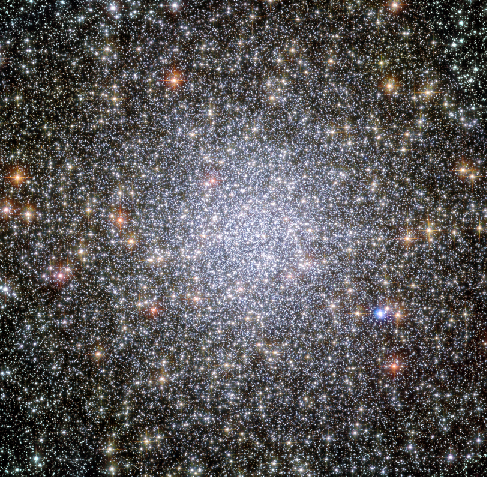
In our Galaxy and others, the oldest stars are found in the globular clusters (Figure 29.5), which can be dated using the models of stellar evolution described in the chapter Stars from Adolescence to Old Age.
英語のヒント
天の川銀河でもほかの銀河でも、最も古い恒星は球状星団に見つかる(図29.5)。「恒星の青年期から老年期まで」で説明した恒星進化モデルを用いれば、これらの星団の年齢を求められる。
Globular Cluster 47 Tucanae.球状星団きょしちょう座47。
credit: NASA, ESA, and the Hubble Heritage (STScI/AURA)-ESA/Hubble Collaboration · CC BY 4.0
Figure 29.5 This NASA/ESA Hubble Space Telescope image shows a globular cluster known as 47 Tucanae, since it is in the constellation of Tucana (The Toucan) in the southern sky. The second-brightest globular cluster in the night sky, it includes hundreds of thousands of stars. Globular clusters are among the oldest objects in our Galaxy and can be used to estimate its age. (credit: NASA, ESA, and the Hubble Heritage (STScI/AURA)-ESA/Hubble Collaboration)
英語のヒント
図29.5 NASAとESAのハッブル宇宙望遠鏡による、きょしちょう座47と呼ばれる球状星団の画像。南天のきょしちょう座にあるため、この名前で呼ばれる。夜空で2番目に明るい球状星団であり、数十万個の星を含む。球状星団は天の川銀河で最も古い天体群の一つで、銀河の年齢の推定に使える。(クレジット:NASA、ESA、Hubble Heritage〈STScI/AURA〉–ESA/Hubble Collaboration)
The accuracy of the age estimates of the globular clusters has improved markedly in recent years for two reasons. First, models of interiors of globular cluster stars have been improved, mainly through better information about how atoms absorb radiation as the radiation makes its way from the center of a star out into space. Second, observations from satellites have improved the accuracy of our measurements of the distances to these clusters. The conclusion is that the oldest stars formed about 12–13 billion years ago.
英語のヒント
球状星団の年齢推定の精度は、近年、二つの理由で大きく向上した。第一に、星団の恒星内部のモデルが改善された。主として、恒星の中心から宇宙空間へと放射が進む間に、原子がどのようにそれを吸収するかについて、よりよい情報が得られたためである。第二に、衛星観測によって、これらの星団までの距離の測定精度が向上した。その結果、最も古い恒星は約120〜130億年前に形成されたと結論された。
This age estimate has recently been confirmed by the study of the spectrum of uranium in the stars. The isotope uranium-238 is radioactive and decays (changes into another element) over time. (Uranium-238 gets its designation because it has 92 protons and 146 neutrons.) We know (from how stars and supernovae make elements) how much uranium-238 is generally made compared to other elements. Suppose we measure the amount of uranium relative to nonradioactive elements in a very old star and in our own Sun, and compare the abundances. With those pieces of information, we can estimate how much longer the uranium has been decaying in the very old star because we know from our own Sun how much uranium decays in 4.5 billion years.
英語のヒント
この年齢推定は最近、恒星中のウランのスペクトルの研究によっても裏付けられた。ウラン238という同位体は放射性であり、時間とともに崩壊して別の元素に変わる。ウラン238という名称は、陽子92個と中性子146個を持つことによる。恒星や超新星で元素が作られる仕組みから、ほかの元素に対してウラン238が通常どれほど生成されるかはわかっている。非常に古い恒星と太陽について、非放射性元素に対するウランの量を測り、その存在量を比較するとしよう。それらの情報から、非常に古い星のウランが、太陽のものより何年長く崩壊を続けてきたか見積もることができる。太陽から、45億年の間にウランがどれほど崩壊するかがわかるからである。
The line of uranium is very weak and hard to make out even in the Sun, but it has now been measured in one extremely old star using the European Very Large Telescope (Figure 29.6). Comparing the abundance with that in the solar system, whose age we know, astronomers estimate the star is 12.5 billion years old, with an uncertainty of about 3 billion years. While the uncertainty is large, this work is important confirmation of the ages estimated by studies of the globular cluster stars. Note that the uranium age estimate is completely independent; it does not depend on either the measurement of distances or on models of the interiors of stars.
英語のヒント
ウランのスペクトル線は非常に弱く、太陽でさえ見分けにくい。それでも、欧州の超大型望遠鏡VLTを用いて、極めて古い恒星の一つで測定された(図29.6)。年齢がわかっている太陽系での存在量と比べると、その星の年齢は125億年、不確かさは約30億年と見積もられる。不確かさは大きいが、この研究は球状星団の恒星から推定した年齢の重要な裏付けになる。ウランによる年齢の見積もりは完全に独立している点に注目しよう。距離の測定にも、恒星内部のモデルにも依存しないのである。
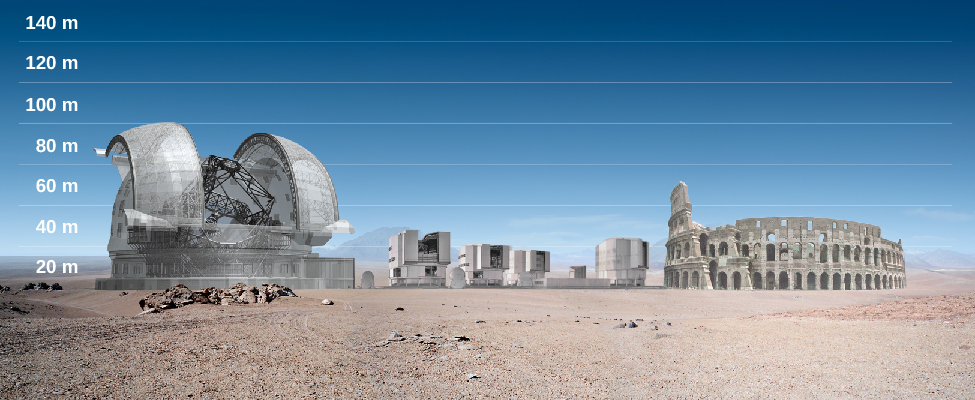
European Extremely Large Telescope, European Very Large Telescope, and the Colosseum.欧州超大型望遠鏡E-ELT、欧州のVLT、コロッセオ。
credit: modification of work by ESO · CC BY 4.0
Figure 29.6 The European Extremely Large Telescope (E-ELT) is currently under construction in Chile. This image compares the size of the E-ELT (left) with the four 8-meter telescopes of the European Very Large Telescope (center) and with the Colosseum in Rome (right). The mirror of the E-ELT will be 39 meters in diameter. Astronomers are building a new generation of giant telescopes in order to observe very distant galaxies and understand what they were like when they were newly formed and the universe was young. (credit: modification of work by ESO)
英語のヒント
図29.6 欧州超大型望遠鏡E-ELTは、現在チリで建設中である。この図はE-ELT(左)、欧州のVLTを構成する4基の8m望遠鏡(中央)、ローマのコロッセオ(右)の大きさを比べている。E-ELTの鏡の直径は39mとなる予定だ。天文学者は、極めて遠い銀河を観測し、宇宙が若く、銀河が形成されたばかりのころの姿を理解するために、次世代の巨大望遠鏡を建設している。(クレジット:ESOの作品を改変)
As we shall see later in this chapter, the globular cluster stars probably did not form until the expansion of the universe had been underway for at least a few hundred million years. Accordingly, their ages are consistent with the 13.8 billion-year age estimated from the expansion rate.
英語のヒント
この章の後半で見るように、球状星団の恒星が形成されたのは、おそらく宇宙の膨張が始まってから、少なくとも数億年たってからだった。したがって、その年齢は、膨張の速さから見積もった138億年という宇宙年齢と整合する。
Key Concepts and Summary重要事項のまとめ
Cosmology is the study of the organization and evolution of the universe. The universe is expanding, and this is one of the key observational starting points for modern cosmological theories. Modern observations show that the rate of expansion has not been constant throughout the life of the universe. Initially, when galaxies were close together, the effects of gravity were stronger than the effects of dark energy, and the expansion rate gradually slowed. As galaxies moved farther apart, the influence of gravity on the expansion rate weakened. Measurements of distant supernovae show that when the universe was about half its current age, dark energy began to dominate the rate of expansion and caused it to speed up. In order to estimate the age of the universe, we must allow for changes in the rate of expansion. After allowing for these effects, astronomers estimate that all of the matter within the observable universe was concentrated in an extremely small volume 13.8 billion years ago, a time we call the Big Bang.
英語のヒント
宇宙論は、宇宙の構成と進化を研究する学問である。宇宙が膨張していることは、現代の宇宙論の重要な観測上の出発点の一つだ。現代の観測によれば、膨張の速さは宇宙の生涯を通じて一定ではなかった。初めは銀河同士が近く、暗黒エネルギーより重力の効果が強かったため、膨張は次第に遅くなった。銀河が離れるにつれて、膨張の速さに対する重力の影響は弱まった。遠方の超新星の測定は、宇宙年齢が今の約半分だったころ、暗黒エネルギーが膨張の速さを支配するようになり、加速を引き起こしたことを示す。宇宙の年齢を見積もるには、膨張の速さの変化を考慮しなければならない。これらの効果を考慮すると、観測可能な宇宙のすべての物質は、138億年前に極めて小さな体積に集中していたと推定される。この時をビッグバンと呼ぶ。
Big Bang
ビッグバン
the theory of cosmology in which the expansion of the universe began with a primeval explosion (of space, time, matter, and energy)
英語のヒント
宇宙の膨張が、空間・時間・物質・エネルギーの原初の爆発によって始まったとする宇宙論の理論。
cosmological constant
宇宙定数
the term in the equations of general relativity that represents a repulsive force in the universe
一般相対性理論の方程式に含まれる、宇宙の反発力を表す項。
cosmology
宇宙論
the study of the organization and evolution of the universe
宇宙の構成と進化を研究する学問。
dark energy
暗黒エネルギー
the energy that is causing the expansion of the universe to accelerate; its existence is inferred from observations of distant supernovae
宇宙の膨張を加速させているエネルギー。遠方の超新星の観測から、その存在が推定される。