第29章ビッグバンThe Big Bang
Dark Matter and the Formation of Galaxies暗黒物質と銀河の形成
As elusive as dark matter may be in the current-day universe, galaxies could not have formed quickly without it. Galaxies grew from density fluctuations in the early universe, and some had already formed only about 400–500 million years after the Big Bang. The observations with WMAP, Planck, and other experiments give us information on the size of those density fluctuations. It turns out that the density variations we observe are too small to have formed galaxies so soon after the Big Bang. In the hot, early universe, energetic photons collided with hydrogen and helium, and kept them moving so rapidly that gravity was still not strong enough to cause the atoms to come together to form galaxies. How can we reconcile this with the fact that galaxies did form and are all around us?
英語のヒント
現在の宇宙で暗黒物質を捉えるのがどれほど難しくても、それなしには銀河は素早く形成できなかった。銀河は初期宇宙の密度ゆらぎから成長し、ビッグバンから約4〜5億年後には、すでに存在したものがある。WMAP、プランクなどの観測は、その密度ゆらぎの大きさを教えている。観測されるゆらぎは小さすぎて、ビッグバン後それほど早く銀河を作れないことがわかった。高温の初期宇宙では、高エネルギー光子が水素やヘリウムに衝突し、それらを高速で動かし続けた。そのため、原子を集めて銀河を作るには、重力はまだ弱すぎた。だが銀河は実際に生まれ、私たちの周りにある。この事実とどう折り合いを付ければよいのだろうか。
Our instruments that measure the CMB give us information about density fluctuations only for ordinary matter, which interacts with radiation. Dark matter, as its name indicates, does not interact with photons at all. Dark matter could have had much greater variations in density and been able to come together to form gravitational “traps” that could then have begun to attract ordinary matter immediately after the universe became transparent. As ordinary matter became increasingly concentrated, it could have turned into galaxies quickly thanks to these dark matter traps.
英語のヒント
CMBを測る装置からわかるのは、放射と相互作用する通常の物質の密度ゆらぎだけである。暗黒物質は、名前が示すとおり、光子とまったく相互作用しない。暗黒物質にはもっと大きな密度差があり、集まって重力の「わな」を作れた可能性がある。そのわなは、宇宙が透明になった直後から、通常の物質を引き寄せ始めたはずだ。通常の物質は次第に集中し、この暗黒物質のわなのおかげで、急速に銀河へ変わることができたのだろう。
For an analogy, imagine a boulevard with traffic lights every half mile or so. Suppose you are part of a motorcade of cars accompanied by police who lead you past each light, even if it is red. So, too, when the early universe was opaque, radiation interacted with ordinary matter, imparting energy to it and carrying it along, sweeping past the concentrations of dark matter. Now suppose the police leave the motorcade, which then encounters some red lights. The lights act as traffic traps; approaching cars now have to stop, and so they bunch up. Likewise, after the early universe became transparent, ordinary matter interacted with radiation only occasionally and so could fall into the dark matter traps.
英語のヒント
たとえとして、およそ半マイルごとに信号のある大通りを想像しよう。あなたは、警察が先導する車列の一員だとする。警察は、赤信号であっても一つひとつ通過させてくれる。同じように、初期宇宙が不透明だったころ、放射は通常の物質と相互作用してエネルギーを与え、それを運び、暗黒物質の集まりも通り過ぎさせていた。今度は警察が車列を離れ、車が赤信号に出会うとしよう。信号は車を捕まえるわなのように働く。近づいた車は止まらなければならず、かたまってくる。同じく、初期宇宙が透明になった後は、通常の物質と放射の相互作用はまれになり、物質は暗黒物質のわなに落ち込めるようになった。
The Universe in a Nutshell宇宙の歴史を一望する
In the previous sections of this chapter, we traced the evolution of the universe progressively further back in time. Astronomical discovery has followed this path historically, as new instruments and new techniques have allowed us to probe ever closer to the beginning of time. The rate of expansion of the universe was determined from measurements of nearby galaxies. Determinations of the abundances of deuterium, helium, and lithium based on nearby stars and galaxies were used to put limits on how much ordinary matter is in the universe. The motions of stars in galaxies and of galaxies within clusters of galaxies could only be explained if there were large quantities of dark matter. Measurements of supernovae that exploded when the universe was about half as old as it is now indicated that the rate of expansion of the universe has sped up since those explosions occurred. Observations of extremely faint galaxies show that galaxies had begun to form when the universe was only 400–500 million years old. And observations of the CMB confirmed early theories that the universe was initially very hot.
英語のヒント
この章では、時間をさらに遠くまでさかのぼりながら、宇宙の進化を追ってきた。天文学の発見も歴史的に、この道筋をたどった。新しい装置と技術によって、時間の始まりへ、ますます近づけるようになったのである。近くの銀河の測定から宇宙の膨張の速さを求めた。近くの恒星や銀河の重水素、ヘリウム、リチウムの存在量から、宇宙にある通常の物質の量に制限を付けた。銀河の中の星の動きや、銀河団の中の銀河の動きは、大量の暗黒物質がなければ説明できなかった。宇宙が今の約半分の年齢だったときに爆発した超新星の測定から、その爆発以来、宇宙の膨張が加速してきたとわかった。極めて暗い銀河の観測は、宇宙がわずか4〜5億歳だったころには銀河が形成され始めていたと示した。そしてCMBの観測は、宇宙が初めは非常に高温だったとする、先に立てられた理論を確かめた。
But all this moving further and further backward in time might have left you a bit dizzy. So now let’s instead show how the universe evolves as time moves forward.
英語のヒント
しかし、こうして過去へ過去へと進んできて、少し目が回ったかもしれない。今度は、時間を前へ進めながら宇宙の進化を見よう。
Figure 29.24 summarizes the entire history of the observable universe from the beginning in a single diagram. The universe was very hot when it began to expand. We have fossil remnants of the very early universe in the form of neutrons, protons, electrons, and neutrinos, and the atomic nuclei that formed when the universe was 3–4 minutes old: deuterium, helium, and a small amount of lithium. Dark matter also remains, but we do not yet know what form it is in.
英語のヒント
図29.24は、観測可能な宇宙の始まりからの全歴史を、一枚にまとめている。宇宙は膨張を始めたとき、非常に高温だった。極初期の宇宙の化石のような名残が、中性子、陽子、電子、ニュートリノとして、そして宇宙が3〜4分齢だったときにできた重水素、ヘリウム、少量のリチウムの原子核として残っている。暗黒物質も残るが、どんな形をしているかは、まだわからない。
History of the Universe.宇宙の歴史。
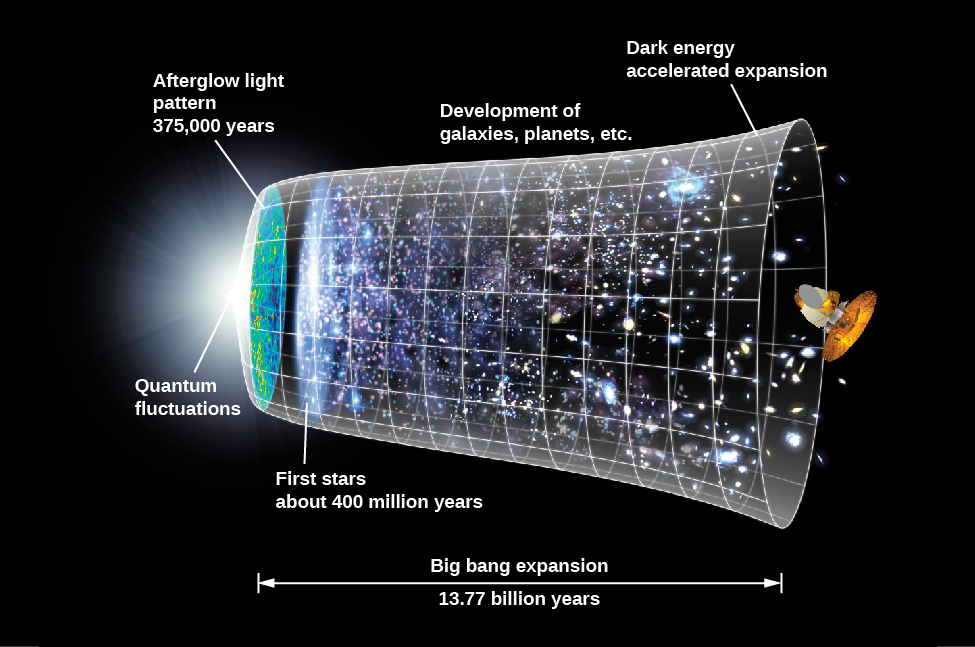
credit: modification of work by NASA/WMAP Science Team · NASA media use guidelines
Figure 29.24 This image summarizes the changes that have occurred in the universe during the last 13.8 billion years. Protons, deuterium, helium, and some lithium were produced in the initial fireball. About 380,000 years after the Big Bang, the universe became transparent to electromagnetic radiation for the first time. COBE, WMAP, Planck, and other instruments have been used to study the radiation that was emitted at that time and that is still visible today (the CMB). The universe was then dark (except for this background radiation) until the first stars and galaxies began to form only a few hundred million years after the Big Bang. Existing space and ground-based telescopes have made substantial progress in studying the subsequent evolution of galaxies. (credit: modification of work by NASA/WMAP Science Team)
図29.24 過去138億年の宇宙の変化をまとめた画像。最初の火の玉で、陽子、重水素、ヘリウム、少量のリチウムが作られた。ビッグバンから約38万年後、宇宙は初めて電磁波に対して透明になった。その時に放たれ、今も見えるCMBを、COBE、WMAP、プランクなどの装置が調べてきた。その後は、この背景放射を除けば宇宙は暗かった。ビッグバンから数億年後に、初めて恒星や銀河が生まれ始めた。現在の宇宙望遠鏡と地上望遠鏡によって、その後の銀河の進化の研究も大きく進んでいる。(クレジット:NASA/WMAP Science Teamの作品を改変)
The universe gradually cooled; when it was about 380,000 years old, and at a temperature of about 3000 K, electrons combined with protons to form hydrogen atoms. At this point, as we saw, the universe became transparent to light, and astronomers have detected the CMB emitted at this time. The universe still contained no stars or galaxies, and so it entered what astronomers call “the dark ages” (since stars were not lighting up the darkness). During the next several hundred million years, small fluctuations in the density of the dark matter grew, forming gravitational traps that concentrated the ordinary matter, which began to form galaxies about 400–500 million years after the Big Bang.
英語のヒント
宇宙は徐々に冷え、約38万歳、約3000Kになったとき、電子と陽子が結び付いて水素原子を作った。すでに見たように、この時点で宇宙は光に対して透明になり、その時に放たれたCMBを天文学者は検出している。恒星も銀河もまだなく、星が闇を照らさないので、宇宙は「暗黒時代」に入った。その後の数億年間に、暗黒物質の小さな密度ゆらぎが成長して重力のわなを作り、通常の物質を集めた。それがビッグバンから約4〜5億年後、銀河を形成し始めた。
By the time the universe was about a billion years old, it had entered its own renaissance: it was again blazing with radiation, but this time from newly formed stars, star clusters, and small galaxies. Over the next several billion years, small galaxies merged to form the giants we see today. Clusters and superclusters of galaxies began to grow, and the universe eventually began to resemble what we see nearby.
英語のヒント
宇宙が約10億歳になるころには、独自のルネサンスを迎えていた。再び放射に満ちて輝いていたが、今度は生まれたばかりの恒星、星団、小さな銀河が光を放っていた。その後の数十億年間で、小銀河は合体し、今日見える巨大銀河になった。銀河団や超銀河団も成長し始め、宇宙はやがて、近くで見るような姿へ近づいていった。
Astronomers are now building giant new telescopes, both in space and on the ground, to explore further back in time. In 2022, the 6.5-meter James Webb Space Telescope (see Figure 29.1) was put into operation. With it, astronomers can detect distant galaxies whose great redshifts have moved much of the radiation they give off to the infrared. The predictions are that with this powerful infrared instrument, we should be able to look back far enough to analyze in detail the formation of the first galaxies—only a few hundred million years after the expansion of the universe began 13.8 billion years ago.
英語のヒント
天文学者は、過去をさらに深く探るため、宇宙にも地上にも新しい巨大望遠鏡を建設している。2022年には、口径6.5mのジェイムズ・ウェッブ宇宙望遠鏡が運用を開始した(図29.1)。大きな赤方偏移によって、放つ放射の多くが赤外線へ移った遠方銀河も、これで検出できる。この強力な赤外線観測装置なら、138億年前に宇宙が膨張を始めてからわずか数億年後までさかのぼり、最初の銀河の形成を詳しく解析できるはずだと予測されている。