第29章ビッグバンThe Big Bang
29.5 What Is the Universe Really Made Of?29.5 宇宙は本当は何からできているのか
Learning Objectives学習の目標
By the end of this section, you will be able to:
この節を終えると、次のことができるようになる。
Specify what fraction of the density of the universe is contributed by stars and galaxies and how much ordinary matter (such as hydrogen, helium, and other elements we are familiar with here on Earth) makes up the overall density
宇宙の密度のうち、恒星と銀河がどれほどを占め、水素、ヘリウムなど地球で馴染みのある通常の物質が、全密度のどれほどを占めるか示す。
Describe how ideas about the contents of the universe have changed over the last 50 years
宇宙の構成成分についての考え方が、過去50年間でどう変わったか説明する。
Explain why it is so difficult to determine what dark matter really is
暗黒物質の正体を突き止めるのが、なぜこれほど難しいか説明する。
Explain why dark matter helped galaxies form quickly in the early universe
初期宇宙で、暗黒物質が銀河の速やかな形成を助けた理由を説明する。
Summarize the evolution of the universe from the time the CMB was emitted to the present day
CMBが放たれた時から現在までの、宇宙の進化をまとめる。
The model of the universe we described in the previous section is the simplest model that explains the observations. It assumes that general relativity is the correct theory of gravity throughout the universe. With this assumption, the model then accounts for the existence and structure of the CMB; the abundances of the light elements deuterium, helium, and lithium; and the acceleration of the expansion of the universe. All of the observations to date support the validity of the model, which is referred to as the standard (or concordance) model of cosmology.
英語のヒント
前の節で述べた宇宙モデルは、観測を説明する最も単純なモデルである。宇宙全体を通じて、一般相対性理論が正しい重力理論だと仮定する。その仮定のもとで、CMBの存在と構造、軽い元素である重水素・ヘリウム・リチウムの存在量、宇宙の加速膨張を説明できる。これまでの観測はすべて、このモデルの妥当性を支持している。これを宇宙論の標準モデル、または一致モデルと呼ぶ。
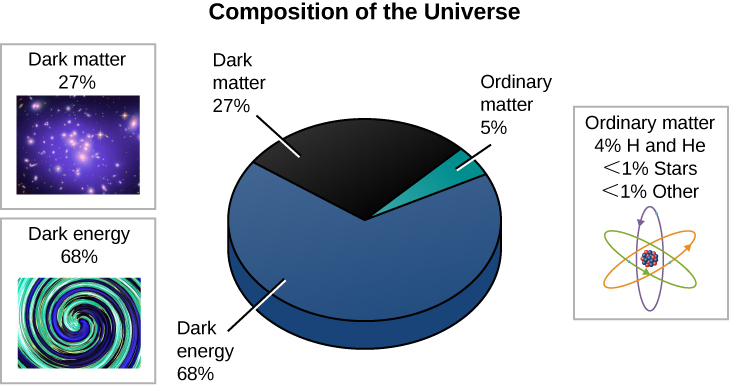
Figure 29.21 and Table 29.2 summarize the current best estimates of the contents of the universe. Luminous matter in stars and galaxies and neutrinos contributes about 1% of the mass required to reach critical density. Another 4% is mainly in the form of hydrogen and helium in the space between stars and in intergalactic space. Dark matter accounts for about an additional 27% of the critical density. The mass equivalent of dark energy (according to E = mc2) then supplies the remaining 68% of the critical density.
図29.21と表29.2は、宇宙の中身についての現在の最良の推定をまとめている。恒星や銀河で光る物質とニュートリノは、臨界密度に達するのに必要な質量の約1%を占める。別の4%は、主として恒星間や銀河間の空間にある水素とヘリウムである。暗黒物質がさらに臨界密度の約27%を担う。E = mc2 に従って質量に換算した暗黒エネルギーが、残る68%を占める。
Composition of the Universe.宇宙の構成。
OpenStax / Rice University · CC BY 4.0
Figure 29.21 Only about 5% of all the mass and energy in the universe is matter with which we are familiar here on Earth. Most ordinary matter consists of hydrogen and helium located in interstellar and intergalactic space. Only about one-half of 1% of the critical density of the universe is found in stars. Dark matter and dark energy, which have not yet been detected in earthbound laboratories, account for 95% of the contents of the universe.
図29.21 宇宙の全質量・エネルギーのうち、地球で馴染みのある物質は約5%にすぎない。通常の物質の大部分は、恒星間・銀河間空間の水素とヘリウムである。恒星の中にあるのは、宇宙の臨界密度の約0.5%だけだ。地上の実験室ではまだ検出されていない暗黒物質と暗黒エネルギーが、宇宙の構成成分の95%を占める。
What Different Kinds of Objects Contribute to the Density of the Universe 各種の天体・成分が宇宙の密度に占める割合 |
|
|---|---|
Object 天体・成分 |
Density as a Percent of Critical Density 臨界密度に対する密度の割合(%) |
Luminous matter (stars, etc.) 発光する物質(恒星など) |
<1 1未満 |
Hydrogen and helium in interstellar and intergalactic space 恒星間・銀河間空間の水素とヘリウム |
4 |
Dark matter 暗黒物質 |
27 |
Equivalent mass density of the dark energy 暗黒エネルギーの質量換算密度 |
68 |
This table should shock you. What we are saying is that 95% of the stuff of the universe is either dark matter or dark energy—neither of which has ever been detected in a laboratory here on Earth. This whole textbook, which has focused on objects that emit electromagnetic radiation, has generally been ignoring 95% of what is out there. Who says there aren’t big mysteries yet to solve in science!
英語のヒント
この表には驚くはずだ。私たちが言っているのは、宇宙の中身の95%が暗黒物質か暗黒エネルギーであり、そのどちらも地上の実験室で検出されたことがない、ということである。電磁波を放つ天体を中心にしてきたこの教科書全体が、宇宙にあるものの95%を、おおむね扱わずにいたのだ。科学にはもう解くべき大きな謎がない、などと誰が言えるだろう。
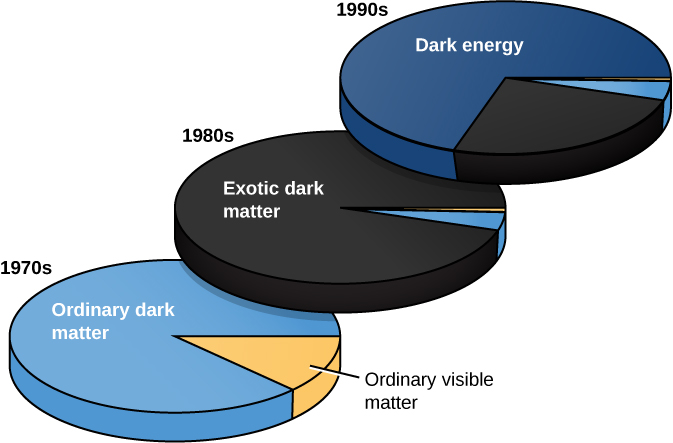
Figure 29.22 shows how our ideas of the composition of the universe have changed over just the past three decades. The fraction of the universe that we think is made of the same particles as astronomy students has been decreasing steadily.
図29.22は、宇宙の構成についての考え方が、わずか30年の間にどう変わったかを示す。宇宙のうち、天文学の学生と同じ粒子からできていると考えられる割合は、着実に小さくなってきた。
Changing Estimates of the Content of the Universe.宇宙の中身について変わってきた見積もり。
OpenStax / Rice University · CC BY 4.0
Figure 29.22 This diagram shows the changes in our understanding of the contents of the universe over the past three decades. In the 1970s, we suspected that most of the matter in the universe was invisible, but we thought that this matter might be ordinary matter (protons, neutrons, etc.) that was simply not producing electromagnetic radiation. By the 1980s, it was becoming likely that most of the dark matter was made of something we had not yet detected on Earth. By the late 1990s, a variety of experiments had shown that we live in a critical -density universe and that dark energy contributes about 70% of what is required to reach critical density. Note how the estimate of the relative importance of ordinary luminous matter (shown in yellow) has diminished over time.
英語のヒント
図29.22 過去30年間で、宇宙の構成についての理解がどう変わったかを示す図。1970年代には、宇宙の物質の大半は見えないと考えていたが、それは電磁波を出さないだけの、陽子や中性子などの通常の物質かもしれないと思われていた。1980年代には、暗黒物質の大半は、地球でまだ検出されていない何かでできている可能性が高まった。1990年代末までには、さまざまな実験が、宇宙は臨界密度にあり、そこに達するのに必要な量の約70%を暗黒エネルギーが担うと示していた。黄色で描かれた通常の発光物質の相対的重要さが、時間とともに小さく見積もられるようになった点に注目しよう。
What Is Dark Matter?暗黒物質とは何か
Many astronomers find the situation we have described very satisfying. Several independent experiments now agree on the type of universe we live in and on the inventory of what it contains. We seem to be very close to having a cosmological model that explains nearly everything. Others are not yet ready to jump on the bandwagon. They say, “show me the 95% of the universe we can’t detect directly—for example, find me some dark matter!”
英語のヒント
多くの天文学者は、ここまで述べた状況に大いに満足している。複数の独立した実験が、宇宙の型と、その構成成分について一致するようになった。ほぼすべてを説明する宇宙論モデルが、もうすぐ手に入りそうに見えるのである。まだ流行に飛びつくつもりのない人もいる。彼らは言う。「直接検出できない宇宙の95%を見せてほしい。たとえば、暗黒物質を実際に見つけてほしい!」と。
At first, astronomers thought that dark matter might be hidden in objects that appear dark because they emit no light (e.g., black holes) or that are too faint to be observed at large distances (e.g., planets or white dwarfs). However, these objects would be made of ordinary matter, and the deuterium abundance tells us that no more than 5% of the critical density consists of ordinary matter.
初め、天文学者は、暗黒物質が暗く見える天体の中に隠れているのではないかと考えた。ブラックホールのように光を放たないものや、惑星・白色矮星のように遠くでは暗すぎて見えないものだ。しかし、これらは通常の物質からできているはずである。重水素の存在量からわかる通常の物質は、臨界密度の5%以下でしかない。
Another possible form that dark matter can take is some type of elementary particle that we have not yet detected here on Earth—a particle that has mass and exists in sufficient abundance to contribute 27% of the critical density. Some physics theories predict the existence of such particles. One class of these particles has been given the name WIMPs, which stands for weakly interacting massive particles. Since these particles do not participate in nuclear reactions leading to the production of deuterium, the deuterium abundance puts no limits on how many WIMPs might be in the universe. (A number of other exotic particles have also been suggested as prime constituents of dark matter, but we will confine our discussion to WIMPs as a useful example.)
英語のヒント
暗黒物質の別の候補は、地球ではまだ検出されていない素粒子である。質量を持ち、臨界密度の27%を担えるほど大量に存在する粒子ということになる。物理学の理論の中には、その存在を予測するものがある。その一群はWIMPと名付けられた。弱く相互作用する重い粒子、という英語の頭文字を取ったものだ。これらの粒子は重水素を作る核反応に加わらないので、重水素の存在量から宇宙のWIMPの数に制限は付かない。暗黒物質の主成分としては、ほかにも未知の粒子がいくつも提案されているが、ここではわかりやすい例としてWIMPに話を絞る。
If large numbers of WIMPs do exist, then some of them should be passing through our physics laboratories right now. The trick is to catch them. Since by definition they interact only weakly (infrequently) with other matter, the chances that they will have a measurable effect are small. We don’t know the mass of these particles, but various theories suggest that it might be a few to a few hundred times the mass of a proton. If WIMPs are 60 times the mass of a proton, there would be about 10 million of them passing through your outstretched hand every second—with absolutely no effect on you. If that seems too mind-boggling, bear in mind that neutrinos interact weakly with ordinary matter, and yet we were able to “catch” them eventually.
英語のヒント
WIMPが大量に存在するなら、今この瞬間も、物理学の実験室を通り抜けているものがあるはずだ。問題はそれを捕まえることである。定義上、他の物質とは弱く、つまりまれにしか相互作用しないので、測れる効果を生む見込みは小さい。質量は未知だが、さまざまな理論は、陽子の数倍から数百倍の可能性を示す。陽子の60倍の質量なら、差し出した手を毎秒約1000万個も通り抜けることになる。それでもあなたには、まったく影響がない。信じがたい話に思えたら、ニュートリノも通常の物質と弱くしか相互作用しないのに、ついには「捕まえる」ことができたと覚えておこう。
Despite the challenges, more than 30 experiments designed to detect WIMPS are in operation or in the planning stages. Predictions of how many times WIMPs might actually collide with the nucleus of an atom in the instrument designed to detect them are in the range of 1 event per year to 1 event per 1000 years per kilogram of detector. The detector must therefore be large. It must be shielded from radioactivity or other types of particles, such as neutrons, passing through it, and hence these detectors are placed in deep mines. The energy imparted to an atomic nucleus in the detector by collision with a WIMP will be small, and so the detector must be cooled to a very low temperature.
英語のヒント
難しさにもかかわらず、WIMPを検出するための実験は、稼働中または計画段階のものを合わせて30件以上ある。検出器中の原子核とWIMPが実際に衝突する回数の予測は、検出器1kg当たり年1回から1000年に1回ほどまで幅がある。そのため、検出器は大型でなければならない。放射能や、通過する中性子などのほかの粒子から遮る必要もあり、深い鉱山の中に設置される。WIMPの衝突が検出器の原子核へ与えるエネルギーは小さいので、装置は極めて低温に冷やさなければならない。
Some WIMP detectors use germanium or silicon crystals cooled to a few thousandths of a kelvin—very close to absolute zero. Other detectors use liquid xenon and detect light and ionization rather than vibrations of an ultracold crystal. In the crystal detectors, that means that the atoms in the detector are so cold that they are scarcely vibrating at all. If a dark matter particle collides with one of the atoms, it will cause the whole crystal to vibrate and the temperature therefore to increase ever so slightly. Some other interactions may generate a detectable flash of light.
英語のヒント
WIMP検出器には、ゲルマニウムやシリコンの結晶を、絶対零度にごく近い数千分の1 Kまで冷やす方式がある。別の方式では液体キセノンを使い、極低温の結晶の振動ではなく、発光や電離を検出する。ここからは結晶を使う方式について述べる。すると検出器の原子は、ほとんど振動しないほど冷たくなる。暗黒物質の粒子が原子の一つに衝突すると、結晶全体が振動し、温度がごくわずか上がる。相互作用によっては、検出できる光の閃きが生じることもある。
A different kind of search for WIMPs is being conducted at the Large Hadron Collider (LHC) at CERN, Europe’s particle physics lab near Geneva, Switzerland. In this experiment, protons collide with enough energy potentially to produce WIMPs. The LHC detectors cannot detect the WIMPs directly, but if WIMPs are produced, they will pass through the detectors, carrying energy away with them. Experimenters will then add up all the energy that they detect as a result of the collisions of protons to determine if any energy is missing.
英語のヒント
スイスのジュネーブ近郊にある欧州の素粒子物理研究所CERNでは、大型ハドロン衝突型加速器LHCを使って、別の方法でWIMPを探している。陽子同士を、WIMPを作れるかもしれないほど高いエネルギーで衝突させる実験である。LHCの検出器はWIMPを直接検出できないが、生成されれば、WIMPはエネルギーを持ち去りながら装置を通り抜ける。そこで実験者は、陽子衝突から検出したエネルギーをすべて足し合わせ、足りないエネルギーがないか調べる。
So far, none of these experiments has detected WIMPs. Will the newer experiments pay off? Or will scientists have to search for some other explanation for dark matter? Only time will tell (Figure 29.23).
英語のヒント
今のところ、どの実験もWIMPを検出していない。新しい実験は実を結ぶのか。それとも、科学者は暗黒物質の別の説明を探さなければならないのか。答えは時が教えてくれるだろう(図29.23)。
Dark Matter.暗黒物質。

credit: NASA · NASA media use guidelines
Figure 29.23 This cartoon from NASA takes a humorous look at how little we yet understand about dark matter. (credit: NASA)
図29.23 NASAのこの漫画は、暗黒物質について私たちがまだほとんど理解していないことを、ユーモラスに描いている。(クレジット:NASA)