第29章ビッグバンThe Big Bang
29.4 The Cosmic Microwave Background29.4 宇宙マイクロ波背景放射
Learning Objectives学習の目標
By the end of this section, you will be able to:
この節を終えると、次のことができるようになる。
Explain why we can observe the afterglow of the hot, early universe
高温だった初期宇宙の残光を、なぜ観測できるか説明する。
Discuss the properties of this afterglow as we see it today, including its average temperature and the size of its temperature fluctuations
現在見える残光の平均温度や、温度ゆらぎの大きさなどの性質を論じる。
Describe open, flat, and curved universes and explain which type of universe is supported by observations
開いた宇宙、平坦な宇宙、曲がった宇宙を説明し、どの型が観測に支持されるか述べる。
Summarize our current knowledge of the basic properties of the universe including its age and contents
年齢や構成成分を含め、宇宙の基本的な性質について現在わかっていることをまとめる。
The description of the first few minutes of the universe is based on theoretical calculations. It is crucial, however, that a scientific theory should be testable. What predictions does it make? And do observations show those predictions to be accurate? One success of the theory of the first few minutes of the universe is the correct prediction of the amount of helium in the universe.
英語のヒント
宇宙最初の数分間の説明は、理論計算に基づいている。しかし、科学の理論は検証可能であることが欠かせない。どんな予測をするのか。そして、その予測が正しいことを観測は示すのか。最初の数分間を扱う理論の成功の一つは、宇宙のヘリウムの量を正しく予測したことである。
Another prediction is that a significant milestone in the history of the universe occurred about 380,000 years after the Big Bang. Scientists have directly observed what the universe was like at this early stage, and these observations offer some of the strongest support for the Big Bang theory. To find out what this milestone was, let’s look at what theory tells us about what happened during the first few hundred thousand years after the Big Bang.
英語のヒント
もう一つの予測は、ビッグバンから約38万年後に、宇宙の歴史の重要な節目があったというものである。科学者は、この初期段階の宇宙の姿を直接観測しており、それはビッグバン理論を支える最も強い証拠の一つとなっている。その節目が何だったのかを知るため、ビッグバン後の数十万年間に起きたことを、理論がどう説明するか見てみよう。
The fusion of helium and lithium was completed when the universe was about 4 minutes old. The universe then continued to resemble the interior of a star in some ways for a few hundred thousand years more. It remained hot and opaque, with radiation being scattered from one particle to another. It was still too hot for electrons to “settle down” and become associated with a particular nucleus; such free electrons are especially effective at scattering photons, thus ensuring that no radiation ever got very far in the early universe without having its path changed. In a way, the universe was like an enormous crowd right after a popular concert; if you get separated from a friend, even if he is wearing a flashing button, it is impossible to see through the dense crowd to spot him. Only after the crowd clears is there a path for the light from his button to reach you.
英語のヒント
宇宙が約4分齢になると、ヘリウムとリチウムを作る核融合は終わった。その後も数十万年にわたり、宇宙はある点で恒星内部に似た状態を保っていた。高温で不透明なまま、放射は粒子から粒子へと散乱された。電子が特定の原子核に結び付いて「落ち着く」には、まだ熱すぎたのである。自由な電子は特に効率よく光子を散乱するので、初期宇宙では、放射は長く進む前に必ず進路を変えられた。ある意味で、宇宙は人気のコンサートが終わった直後の、大きな人混みに似ていた。友人とはぐれると、その友人が点滅するバッジを付けていても、密集した人の向こうに見つけることはできない。人混みが引いて初めて、バッジの光が自分に届く道が開ける。
The Universe Becomes Transparent宇宙が透明になる
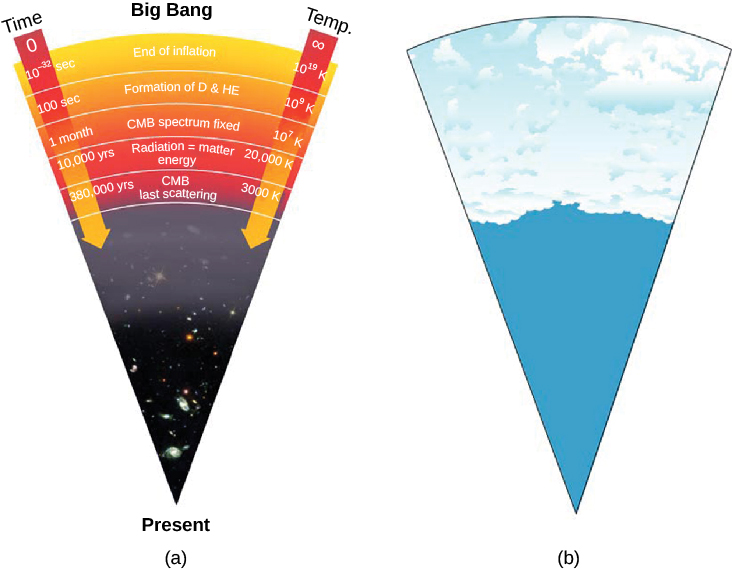
Not until a few hundred thousand years after the Big Bang, when the temperature had dropped to about 3000 K and the density of atomic nuclei to about 1000 per cubic centimeter, did the electrons and nuclei manage to combine to form stable atoms of hydrogen and helium (Figure 29.14). With no free electrons to scatter photons, the universe became transparent for the first time in cosmic history. From this point on, matter and radiation interacted much less frequently; we say that they decoupled from each other and evolved separately. Suddenly, electromagnetic radiation could really travel, and it has been traveling through the universe ever since.
英語のヒント
ビッグバンから数十万年後、温度が約3000Kに、原子核の密度が1立方センチメートル当たり約1000個に下がって、ようやく電子と原子核は結び付けるようになった。安定した水素原子とヘリウム原子ができたのである(図29.14)。光子を散乱する自由電子がなくなり、宇宙は歴史上初めて透明になった。この時点から、物質と放射が相互作用する頻度は大きく減った。両者が互いに脱結合し、別々に進化するようになったと言う。突然、電磁波は本当に遠くへ進めるようになり、それ以来ずっと、宇宙を旅している。
Discovery of the Cosmic Background Radiation宇宙背景放射の発見
If the model of the universe described in the previous section is correct, then—as we look far outward in the universe and thus far back in time—the first “afterglow” of the hot, early universe should still be detectable. Observations of it would be very strong evidence that our theoretical calculations about how the universe evolved are correct. As we shall see, we have indeed detected the radiation emitted at this photon decoupling time, when radiation began to stream freely through the universe without interacting with matter (Figure 29.15).
英語のヒント
前の節で述べた宇宙モデルが正しければ、宇宙の遠くを見て、時間を遠くまでさかのぼったとき、高温だった初期宇宙の最初の「残光」は、今も検出できるはずである。その観測は、宇宙がどう進化したかという理論計算の正しさを示す、非常に強い証拠となるだろう。これから見るように、物質と相互作用せずに放射が自由に宇宙を進み始めた、光子の脱結合の時期に放たれた放射は、実際に検出されている(図29.15)。
Cosmic Microwave Background and Clouds Compared.宇宙マイクロ波背景放射と雲の比較。
credit: modification of work by NASA · NASA media use guidelines
Figure 29.15 (a) Early in the universe, photons (electromagnetic energy) were scattering off the crowded, hot, charged particles and could not get very far without colliding with another particle. But after electrons and protons settled into neutral atoms, there was far less scattering, and photons could travel over vast distances. The universe became transparent. As we look out in space and back in time, we can’t see back beyond this time. (b) This is similar to what happens when we see clouds in Earth’s atmosphere. Water droplets in a cloud scatter light very efficiently, but clear air lets light travel over long distances. So as we look up into the atmosphere, our vision is blocked by the cloud layers and we can’t see beyond them. (credit: modification of work by NASA)
英語のヒント
図29.15 (a)初期宇宙では、光子、すなわち電磁波のエネルギーは、密集した高温の荷電粒子に散乱され、別の粒子にぶつかるまであまり遠くへ進めなかった。しかし、電子と陽子が中性原子に落ち着くと、散乱ははるかに少なくなり、光子は膨大な距離を進めるようになった。宇宙が透明になったのである。宇宙の遠くを見て過去へさかのぼっても、この時点より前は光で見通せない。(b)地球の大気中の雲を見るときと似ている。雲の水滴は光を非常に効率よく散乱するが、澄んだ空気の中なら光は長く進める。そのため、大気を見上げた視線は雲の層で遮られ、その先を見ることができない。(クレジット:NASAの作品を改変)
The detection of this afterglow was initially an accident. In the late 1940s, Ralph Alpher and Robert Herman, working with George Gamow, realized that just before the universe became transparent, it must have been radiating like a blackbody at a temperature of about 3000 K—the temperature at which hydrogen atoms could begin to form. If we could have seen that radiation just after neutral atoms formed, it would have resembled radiation from a reddish star. It was as if a giant fireball filled the whole universe.
英語のヒント
この残光が最初に検出されたのは、偶然だった。1940年代末、ジョージ・ガモフと研究していたラルフ・アルファーとロバート・ハーマンは、宇宙が透明になる直前には、約3000Kの黒体のように放射していたはずだと気づいた。それは水素原子が形成され始められる温度である。中性原子ができた直後にその放射を見られたなら、赤みを帯びた星の放射に似ていただろう。巨大な火の玉が宇宙全体を満たしているかのようだったはずだ。
But that was nearly 14 billion years ago, and, in the meantime, the scale of the universe has increased a thousand fold. This expansion has increased the wavelength of the radiation by a factor of 1000 (see Figure 29.7). According to Wien’s law, which relates wavelength and temperature, the expansion has correspondingly lowered the temperature by a factor of 1000 (see the chapter on Radiation and Spectra). The cosmic background behaves like a blackbody and should therefore have a spectrum that obeys Wien’s Law.
英語のヒント
しかし、それは約140億年前のことであり、その間に宇宙の尺度は1000倍に増した。この膨張によって、放射の波長も1000倍になった(図29.7)。波長と温度を結び付けるウィーンの法則によれば、膨張はそれに対応して温度を1000分の1に下げたことになる。「放射とスペクトル」を参照しよう。宇宙背景放射は黒体のように振る舞うので、そのスペクトルはウィーンの法則に従うはずである。
Alpher and Herman predicted that the glow from the fireball should now be at radio wavelengths and should resemble the radiation from a blackbody at a temperature only a few degrees above absolute zero. Since the fireball was everywhere throughout the universe, the radiation left over from it should also be everywhere. If our eyes were sensitive to radio wavelengths, the whole sky would appear to glow very faintly. However, our eyes can’t see at these wavelengths, and at the time Alpher and Herman made their prediction, there were no instruments that could detect the glow. Over the years, their prediction was forgotten.
英語のヒント
アルファーとハーマンは、火の玉からの光は現在、電波の波長になっており、絶対零度よりわずか数度高い黒体の放射に似ているはずだと予測した。火の玉は宇宙のどこにでもあったのだから、そこから残った放射も、どこにでもあるはずである。目が電波の波長に感じるなら、空全体がごくかすかに光って見えるだろう。しかし、人の目はその波長を見られず、アルファーとハーマンが予測した当時は、その光を検出できる装置もなかった。年月がたつにつれ、この予測は忘れられた。
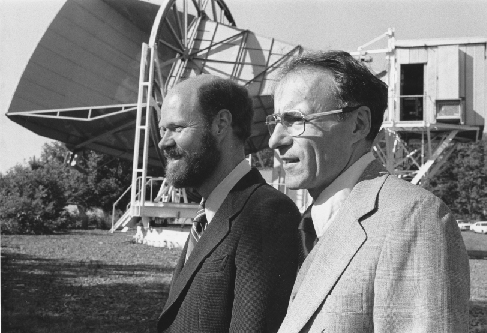
In the mid-1960s, in Holmdel, New Jersey, Arno Penzias and Robert Wilson of AT&T’s Bell Laboratories used a sensitive microwave antenna (Figure 29.16) to measure astronomical sources, including supernova remnants like Cassiopeia A (see the chapter on The Death of Stars). They were plagued with some unexpected background noise, just like faint static on a radio, which they could not get rid of. The puzzling thing about this radiation was that it seemed to be coming from all directions at once. This is very unusual in astronomy: after all, most radiation has a specific direction where it is strongest—the direction of the Sun, or a supernova remnant, or the disk of the Milky Way, for example.
英語のヒント
1960年代半ば、ニュージャージー州ホルムデルでは、AT&Tベル研究所のアーノ・ペンジアスとロバート・ウィルソンが、感度の高いマイクロ波アンテナを使っていた(図29.16)。カシオペヤ座Aのような超新星残骸を含む、天体の電波源を測るためである。「恒星の死」を参照しよう。二人は、ラジオのかすかな雑音のような、予期しない背景ノイズに悩まされ、それを取り除けずにいた。不思議なのは、その放射がすべての方向から同時に来るように見えることだった。天文学では、これは非常に珍しい。普通の放射には、太陽、超新星残骸、天の川銀河の円盤など、最も強くなる特定の方向があるからだ。
Robert Wilson (left) and Arno Penzias (right).ロバート・ウィルソン(左)とアーノ・ペンジアス(右)。
OpenStax / Rice University · CC BY 4.0
Figure 29.16 These two scientists are standing in front of the horn-shaped antenna with which they discovered the cosmic background radiation. The photo was taken in 1978, just after they received the Nobel Prize in physics.
英語のヒント
図29.16 二人は、宇宙背景放射を発見したホーン型アンテナの前に立っている。写真は、1978年にノーベル物理学賞を受けた直後に撮影された。
Penzias and Wilson at first thought that any radiation appearing to come from all directions must originate from inside their telescope, so they took everything apart to look for the source of the noise. They even found that some pigeons had roosted inside the big horn-shaped antenna and had left (as Penzias delicately put it) “a layer of white, sticky, dielectric substance coating the inside of the antenna.” However, nothing the scientists did could reduce the background radiation to zero, and they reluctantly came to accept that it must be real, and it must be coming from space.
英語のヒント
ペンジアスとウィルソンは初め、全方向から来るように見える放射なら、望遠鏡の内部から出ているに違いないと考えた。そこで装置をすべて分解し、雑音の源を探した。大きなホーン型アンテナの中にハトがねぐらを作り、ペンジアスの婉曲な言い方を借りれば、「アンテナの内側を覆う、白く粘り気のある誘電体の層」を残していたことまで見つけた。しかし、何をしても背景放射をゼロにできなかった。二人はしぶしぶながら、その放射は実在し、宇宙から来るに違いないと受け入れるようになった。
Penzias and Wilson were not cosmologists, but as they began to discuss their puzzling discovery with other scientists, they were quickly put in touch with a group of astronomers and physicists at Princeton University (a short drive away). These astronomers had—as it happened—been redoing the calculations of Alpher and Herman from the 1940s and also realized that the radiation from the decoupling time should be detectable as a faint afterglow of radio waves. The different calculations of what the observed temperature would be for this cosmic microwave background (CMB)Recall that microwaves are in the radio region of the electromagnetic spectrum. were uncertain, but all predicted less than 40 K.
英語のヒント
ペンジアスとウィルソンは宇宙論の専門家ではなかった。しかし、その不可解な発見をほかの科学者に話し始めると、すぐに、車ですぐ行ける距離のプリンストン大学の天文学者・物理学者のグループへ紹介された。偶然にも、その研究者たちはアルファーとハーマンの1940年代の計算をやり直しており、脱結合時の放射が、電波のかすかな残光として検出できるはずだと気づいていた。この宇宙マイクロ波背景放射、略してCMBの観測温度の計算値にはばらつきがあったが、どれも40K未満を予測していた。マイクロ波は電磁波スペクトルの電波領域に属することを思い出そう。
Penzias and Wilson found the distribution of intensity at different radio wavelengths to correspond to a temperature of 3.5 K. This is very cold—closer to absolute zero than most other astronomical measurements—and a testament to how much space (and the waves within it) has stretched. Their measurements have been repeated with better instruments, which give us a reading of 2.73 K. So Penzias and Wilson came very close. Rounding this value, scientists often refer to “the 3-degree microwave background.”
英語のヒント
ペンジアスとウィルソンは、電波の各波長での強度分布が、3.5Kの温度に対応することを見いだした。これは、天文学のほかのほとんどの測定より絶対零度に近い、非常に低い温度だ。空間と、その中の波が、どれほど引き伸ばされたかを物語っている。もっとよい装置で繰り返し測ると、2.73Kという値が得られた。二人の値は、かなり近かったのである。この値を丸め、科学者はしばしば「3度のマイクロ波背景放射」と呼ぶ。
Many other experiments on Earth and in space soon confirmed the discovery by Penzias and Wilson: The radiation was indeed coming from all directions (it was isotropic) and matched the predictions of the Big Bang theory with remarkable precision. Penzias and Wilson had inadvertently observed the glow from the primeval fireball. They received the Nobel Prize for their work in 1978. And just before his death in 1966, Lemaître learned that his “vanished brilliance” had been discovered and confirmed.
英語のヒント
ほどなく、地上や宇宙での多くの別の実験が、ペンジアスとウィルソンの発見を確認した。放射は確かにあらゆる方向から来ており、等方的だった。そして、ビッグバン理論の予測と驚くほどの精度で一致した。二人は、原初の火の玉からの光を、思いがけず観測していたのである。この仕事によって、1978年にノーベル賞を受けた。1966年に亡くなる直前のルメートルも、自らの言った「失われた輝き」が発見され、確認されたことを知った。