第12章環・衛星・冥王星Rings, Moons, and Pluto
Thinking Aheadまず考えてみよう
Jupiter Family.木星の家族。
credit: modification of work by NASA · NASA media use guidelines
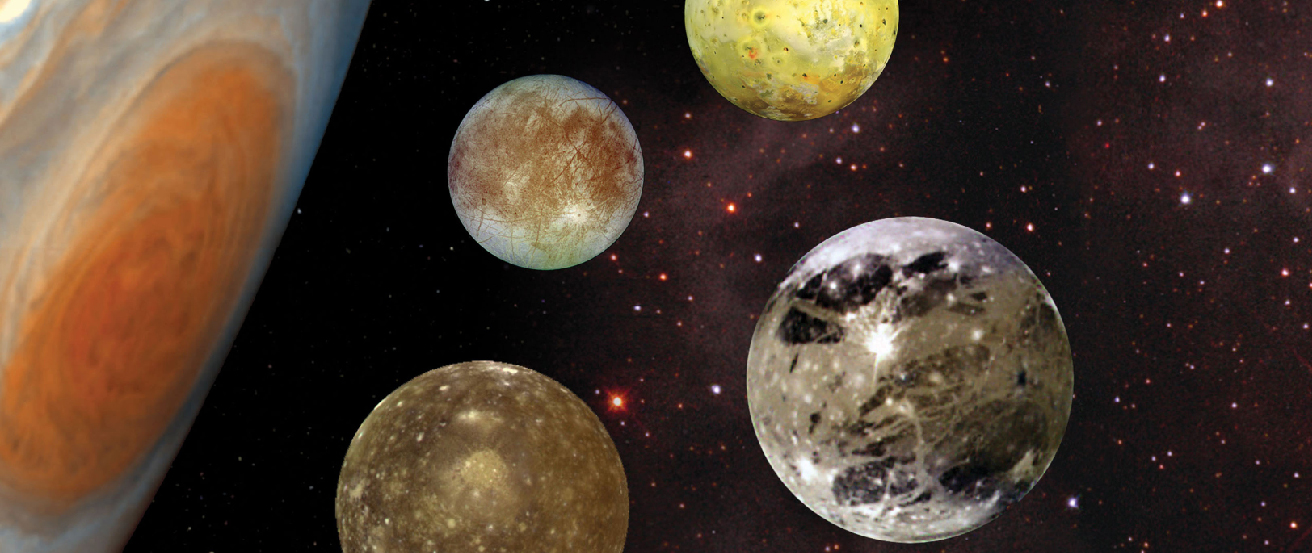
Figure 12.1 This montage, assembled from individual Galileo and Voyager images, shows a “family portrait” of Jupiter (with its giant red spot) and its four large moons. From top to bottom, we see Io, Europa, Ganymede, and Callisto. The colors are exaggerated by image processing to emphasize contrasts. (credit: modification of work by NASA)
図12.1 ガリレオとボイジャーが撮影した個々の画像を組み合わせたこのモンタージュは、大赤斑を持つ木星と、その4つの大きな衛星の「家族写真」である。衛星は上からイオ、エウロパ、ガニメデ、カリスト。違いを強調するため、画像処理で色を強くしている。(クレジット:NASAの作品を改変)
This quotation is omitted for copyright reasons.
この引用は権利の関係で割愛。
All four giant planets are accompanied by moons that orbit about them like planets in a miniature solar system. Nearly 200 moons are known in the outer solar system—too many to name individually or discuss in any detail. Astronomers anticipate that additional small moons await future discovery. We have also discovered a fascinating variety of rings around each of the jovian planets.
英語のヒント
4つの巨大惑星はすべて、ミニチュアの太陽系の惑星のように、その周りを回る衛星を伴っている。外側の太陽系では200個近い衛星が知られており、一つずつ名前を挙げたり、詳しく取り上げたりするには多すぎる。天文学者は、さらに小さな衛星が今後の発見を待っていると予想している。また、それぞれの木星型惑星の周囲には、興味深い多様な環も発見されている。
Before the Voyager missions, even the largest of the outer-planet moons were mere points of light in our telescopes. Then, in less than a decade, we had close-up images, and these moons became individual worlds for us, each with unique features and peculiarities. The Galileo mission added greatly to our knowledge of the moons of Jupiter, and the Cassini mission has done the same for the Saturn system. In 2015, the NASA New Horizons spacecraft completed the initial exploration of the “classical” planets in the solar system with its flyby of Pluto and its moons. We include Pluto here because in some ways it resembles some of the larger moons in the outer solar system. Each new spacecraft mission has revealed many surprises, as the objects in the outer solar system are much more varied and geologically active than scientists had anticipated.
英語のヒント
ボイジャー計画以前には、外惑星の最も大きな衛星でさえ、望遠鏡で見ると光の点にすぎなかった。その後、10年も経たないうちに近接画像が得られ、これらの衛星は、それぞれ独自の特徴や風変わりな性質を備えた、個別の世界として私たちの前に現れた。ガリレオ計画は木星の衛星についての知識を大きく増やし、カッシーニ計画は土星系について同じ役割を果たした。2015年にはNASAのニュー・ホライズンズ探査機が、冥王星とその衛星のそばを通過し、太陽系の「古典的な」惑星の最初の探査を完結させた。冥王星をここで取り上げるのは、いくつかの点で外側の太陽系の大きな衛星と似ているためである。新しい探査が行われるたびに、多くの驚きがもたらされた。太陽系の外側の天体は、科学者の予想よりもはるかに多様で、地質活動も活発だったのである。