第12章環・衛星・冥王星Rings, Moons, and Pluto
12.3 Titan and Triton12.3 タイタンとトリトン
Learning Objectives学習の目標
By the end of this section, you will be able to:
この節を学び終えると、次のことができるようになる。
Explain how the thick atmosphere of Titan makes bodies of liquid on its surface possible
タイタンの厚い大気が、表面に液体のたまりを存在させられる理由を説明する。
Describe what we learned from the landing on Titan with the Huygens probe
ホイヘンス・プローブのタイタン着陸から何を学んだかを説明する。
Discuss the features we observed on the surface of Triton when Voyager 2 flew by
ボイジャー2号のフライバイで観測された、トリトン表面の特徴について述べる。
We shift our attention now to small worlds in the more distant parts of the solar system. Saturn’s large moon Titan turns out to be a weird cousin of Earth, with many similarities in spite of frigid temperatures. The Cassini observations of Titan have provided some of the most exciting recent discoveries in planetary science. Neptune’s moon Triton also has unusual characteristics and resembles Pluto, which we will discuss in the following section.
英語のヒント
今度は、太陽系のさらに遠い領域にある小さな世界へ目を向けよう。土星の大衛星タイタンは、極寒であるにもかかわらず多くの共通点を持つ、地球の奇妙ないとこであることがわかった。カッシーニによるタイタン観測は、近年の惑星科学で特に心を躍らせる発見をいくつももたらした。海王星の衛星トリトンにも変わった特徴があり、次の節で取り上げる冥王星に似ている。
Titan, a Moon with Atmosphere and Hydrocarbon Lakes大気と炭化水素の湖を持つ衛星、タイタン
Titan, first seen in 1655 by the Dutch astronomer Christiaan Huygens, was the first moon discovered after Galileo saw the four large moons of Jupiter. Titan has roughly the same diameter, mass, and density as Callisto or Ganymede. Presumably it also has a similar composition—about half ice and half rock. However, Titan is unique among moons, with a thick atmosphere and lakes and rivers and falling rain (although these are not composed of water but of hydrocarbons such as ethane and methane, which can stay liquid at the frigid temperatures on Titan). Titan is the only moon or planet other than Earth where we have found evidence of bodies of surface liquids.
英語のヒント
タイタンは1655年、オランダの天文学者クリスティアーン・ホイヘンスによって初めて観測された。ガリレオが木星の4つの大衛星を見つけて以来、初めて発見された衛星である。直径、質量、密度はカリストやガニメデとほぼ同じで、おそらく組成も同様に、約半分が氷、半分が岩石なのだろう。しかし、厚い大気、湖、川、降り注ぐ雨を持つ点で、タイタンは衛星の中でも独特である。ただし、これらは水ではなく、タイタンの極寒の温度でも液体を保てるエタンやメタンなどの炭化水素からなる。表面に液体がたまっている証拠が見つかった衛星または惑星は、地球を除けばタイタンだけである。
The 1980 Voyager flyby of Titan determined that the surface density of its atmosphere is four times greater than that on Earth. The atmospheric pressure on this moon is 1.6 bars, higher than that on any other moon and, remarkably, even higher than that of the terrestrial planets Mars and Earth. The atmospheric composition is primarily nitrogen, an important way in which Titan’s atmosphere resembles Earth’s.
英語のヒント
1980年のボイジャーのフライバイによって、タイタンの地表での大気密度は地球の4倍だと判明した。この衛星の大気圧は1.6バールで、ほかのどの衛星より高く、驚くことに地球型惑星の火星や地球よりさえ高い。大気の主成分は窒素であり、これはタイタン大気が地球の大気に似ている重要な点である。
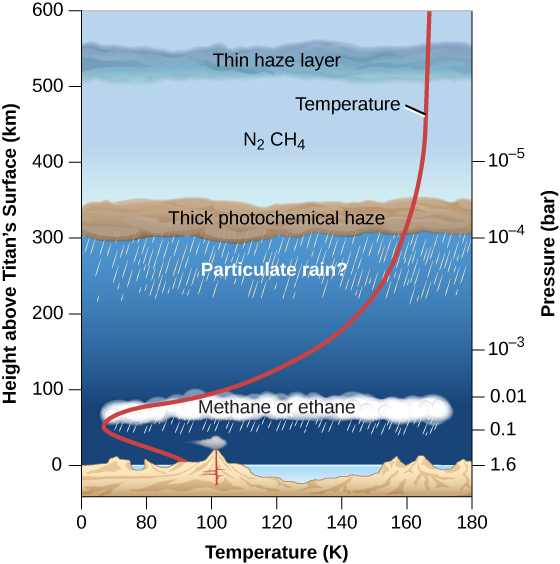
Also detected in Titan’s atmosphere were carbon monoxide (CO), hydrocarbons (compounds of hydrogen and carbon) such as methane (CH4), ethane (C2H6), and propane (C3H8), and nitrogen compounds such as hydrogen cyanide (HCN), cyanogen (C2N2), and cyanoacetylene (HC3N). Their presence indicates an active chemistry in which sunlight interacts with atmospheric nitrogen and methane to create a rich mix of organic molecules. There are also multiple layers of hydrocarbon haze and clouds in the atmosphere, as illustrated in Figure 12.12.
英語のヒント
タイタンの大気では、一酸化炭素(CO)も検出された。さらに、メタン(CH₄)、エタン(C₂H₆)、プロパン(C₃H₈)などの炭化水素、すなわち水素と炭素の化合物や、シアン化水素(HCN)、ジシアン(C₂N₂)、シアノアセチレン(HC₃N)などの窒素化合物も見つかった。これらの存在は、太陽光が大気中の窒素やメタンと相互作用し、多様な有機分子の混合物を作る、活発な化学反応が起きていることを示す。図12.12のように、大気には炭化水素のもやと雲の層も複数ある。
Structure of Titan’s Atmosphere.タイタンの大気構造。
OpenStax / Rice University · CC BY 4.0
Figure 12.12 Some characteristics of Titan’s atmosphere resemble those of Earth’s atmosphere, although it is much colder than our planet. The red line indicates the temperature of Titan’s atmosphere at different altitudes.
図12.12 タイタンは地球よりずっと低温だが、その大気のいくつかの特徴は地球大気と似ている。赤線は、高度ごとのタイタン大気の温度を示す。
These Voyager discoveries motivated a much more ambitious exploration program using the NASA Cassini Saturn orbiter and a probe to land on Titan called Huygens, built by the European Space Agency. The orbiter, which included several cameras, spectrometers, and a radar imaging system, made dozens of close flybys of Titan between 2004 and 2015, each yielding radar and infrared images of portions of the surface (see Exploring the Outer Planets). The Huygens probe successfully descended by parachute through the atmosphere, photographing the surface from below the clouds, and landing on January 14, 2005. This was the first (and so far the only) spacecraft landing on a moon in the outer solar system.
英語のヒント
ボイジャーのこうした発見は、さらに野心的な探査計画につながった。NASAの土星周回機カッシーニと、ヨーロッパ宇宙機関が作った、タイタンに着陸するホイヘンスというプローブを使う計画である。周回機は複数のカメラ、分光計、レーダー画像装置を搭載し、2004~2015年にタイタンへ数十回接近した。そのたびに、表面の一部のレーダー画像と赤外線画像が得られた(「外側の惑星を探る」参照)。ホイヘンスはパラシュートで無事に大気を降下し、雲の下から地表を撮影しながら、2005年1月14日に着陸した。これは太陽系の外側の衛星への、初めての、そして今のところ唯一の探査機着陸だった。
At the end of its parachute descent, the 319-kilogram Huygens probe safely touched down, slid a short distance, and began sending data back to Earth, including photos and analyses of the atmosphere. It appeared to have landed on a flat, boulder-strewn plain, but both the surface and the boulders were composed of water ice, which is as hard as rock at the temperature of Titan (see Figure 12.13).
英語のヒント
パラシュート降下の最後に、質量319キログラムのホイヘンス・プローブは安全に着地し、少し滑ってから、写真や大気の分析などのデータを地球へ送り始めた。大きな石が散らばる平らな平原に着陸したように見えたが、地面も石も水の氷でできていた。タイタンの温度では、氷は岩石と同じくらい硬いのである(図12.13参照)。
The photos taken during descent showed a variety of features, including drainage channels, suggesting that Huygens had landed on the shore of an ancient hydrocarbon lake. The sky was deep orange, and the brightness of the Sun was a thousand times less than sunlight on Earth (but still more than a hundred times brighter than under the full moon on Earth). Titan’s surface temperature was 94 K (−179 °C). The warmer spacecraft heated enough of the ice where it landed for its instruments to measure released hydrocarbon gas. Measurements on the surface continued for more than an hour before the probe succumbed to the frigid temperature.
英語のヒント
降下中の写真には、排水路を含む多様な地形が見え、ホイヘンスが古い炭化水素の湖の岸に降りたことを示していた。空は濃い橙色で、太陽の明るさは地球の太陽光の1000分の1だった。それでも、地球の満月の下より100倍以上明るかった。タイタンの表面温度は94 K、−179℃だった。より温かい探査機は、着陸地点の氷を十分に加熱し、放出された炭化水素のガスを機器で測定できた。地表での測定は1時間以上続き、その後、プローブは極寒の温度に耐えられなくなった。
Views of the Surface of Titan.タイタン表面の眺め。
Figure 12.13 The left image shows the views of Titan from the descent camera, in a flattened projection, at different altitudes. The right image, taken after landing, shows a boulder-strewn surface illuminated by faint reddish sunlight. The boulders are composed of water ice. (credit left: modification of work by ESA/NASA/JPL/University of Arizona; credit right: modification of work by ESA/NASA/JPL/University of Arizona; processed by Andrey Pivovarov)
図12.13 左は降下カメラが異なる高度で捉えたタイタンの眺めを、平面上に投影した画像。着陸後に撮られた右の画像では、かすかな赤みのある太陽光に照らされ、大きな石が散らばった表面が見える。石は水の氷でできている。(左:ESA/NASA/JPL/University of Arizonaの作品を改変。右:ESA/NASA/JPL/University of Arizonaの作品を改変、Andrey Pivovarovが処理)
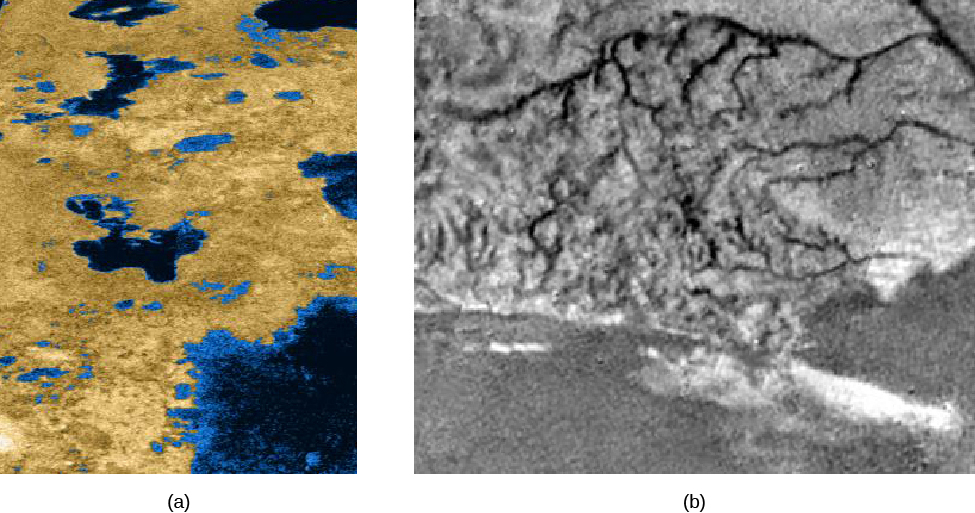
Radar and infrared imaging of Titan from the Cassini orbiter gradually built up a picture of a remarkably active surface on this moon, complex and geologically young (Figure 12.14). There are large methane lakes near the polar regions that interact with the methane in the atmosphere, much as Earth’s water oceans interact with the water vapor in our atmosphere. The presence of many erosional features indicates that atmospheric methane can condense and fall as rain, then flow down valleys to the big lakes. Thus, Titan has a low-temperature equivalent of the water cycle on Earth, with liquid on the surface that evaporates, forms clouds, and then condenses to fall as rain—but on Titan the liquid is a combination of methane, ethane, and a trace of other hydrocarbons. It is a weirdly familiar and yet utterly alien landscape.
英語のヒント
カッシーニ周回機によるレーダーと赤外線の撮影から、タイタンの表面は驚くほど活発で、複雑かつ地質学的に若いという像が、しだいに浮かび上がってきた(図12.14)。極域の近くには大きなメタンの湖があり、大気中のメタンと相互作用している。地球の水の海が、大気の水蒸気と相互作用するのとよく似ている。浸食地形が数多く存在することは、大気中のメタンが凝結して雨として降り、谷を流れ下って大きな湖へ入ることを示す。つまりタイタンには、地球の水循環に相当する低温の循環がある。地表の液体が蒸発して雲を作り、やがて凝結して雨として戻る。ただしその液体は、メタン、エタン、そして微量のほかの炭化水素の混合物である。それは奇妙になじみ深く、それでいてまったく異質な風景である。
Titan’s Lakes.タイタンの湖。
credit a: modification of work by NASA/JPL-Caltech/USGS; credit b; modification of work by NASA/JPL/ESA/University of Arizona · JPL image use policy
Figure 12.14 (a) This Cassini image from a September 2006 flyby shows the liquid lakes on Titan. Their composition is most likely a combination of methane and ethane. (Since this is a radar image, the colors are artificially added. The dark blue areas are the smooth surfaces of the liquid lakes, and yellow is the rougher solid terrain around them.) (b) This mosaic of Titan’s surface from the Cassini-Huygens mission shows in detail a high ridge area and many narrow, sinuous erosion channels that appear to be part of a widespread network of “rivers” carved by flowing hydrocarbons. (credit a: modification of work by NASA/JPL-Caltech/USGS; credit b; modification of work by NASA/JPL/ESA/University of Arizona)
図12.14 (a)2006年9月のフライバイでカッシーニが撮影した、タイタンの液体の湖。組成はおそらく、メタンとエタンの混合物である。レーダー画像なので、色は人工的に付けてある。濃い青色は湖の滑らかな液面、黄色は周囲のより粗い固体の地形を示す。(b)カッシーニ=ホイヘンス計画によるタイタン表面のモザイク画像。高い尾根の領域と、細く蛇行する多数の浸食水路が詳しく見える。これらは、流れる炭化水素によって刻まれた、広大な「河川網」の一部に見える。(クレジットa:NASA/JPL-Caltech/USGSの作品を改変。b:NASA/JPL/ESA/University of Arizonaの作品を改変)
These discoveries raise the question of whether there could be life on Titan. Hydrocarbons are fundamental for the formation of the large carbon molecules that are essential to life on our planet. However, the temperature on Titan is far too low for liquid water or for many of the chemical processes that are essential to life as we know it. There remains, though, an intriguing possibility that Titan might have developed a different form of low-temperature carbon-based life that could operate with liquid hydrocarbons playing the role of water. The discovery of such “life as we don’t know it” could be even more exciting than finding life like ours on Mars. If such a truly alien life is present on Titan, its existence would greatly expand our understanding of the nature of life and of habitable environments.
英語のヒント
こうした発見は、タイタンに生命がいる可能性はあるのかという問いを生む。炭化水素は、地球の生命に不可欠な大きな炭素分子ができるための基礎になる。しかしタイタンの温度は、液体の水や、私たちが知る生命に不可欠な化学過程の多くにとって、あまりにも低い。それでも、タイタンでは液体炭化水素が水の役割を果たすことで活動できる、別の形の低温の炭素系生命が発達したかもしれないという、興味深い可能性が残る。このような「私たちが知らない形の生命」の発見は、火星で私たちに似た生命を見つける以上に心を躍らせるかもしれない。タイタンにそのような真に異質な生命が存在すれば、生命の本質と、生命が存在できる環境についての理解は大きく広がるだろう。
NASA has selected a new mission to Titan for launch in 2027. Called Dragonfly, this mission is a drone that will fly in Titan’s atmosphere, with emphasis on study of pre-biotic chemistry. Other future proposed missions include a balloon operating in the atmosphere and a “boat” floating in one of the Titan lakes.
英語のヒント
NASAは、2027年の打ち上げに向けて、新しいタイタン探査計画を選定した。ドラゴンフライと呼ばれるこの計画は、タイタンの大気を飛ぶドローンであり、生命誕生前の化学の研究に重点を置く。ほかにも将来の探査案として、大気中で活動する気球や、タイタンの湖の一つに浮かぶ「ボート」がある。