第12章環・衛星・冥王星Rings, Moons, and Pluto
A Quick Look at Charonカロンをひと目見る
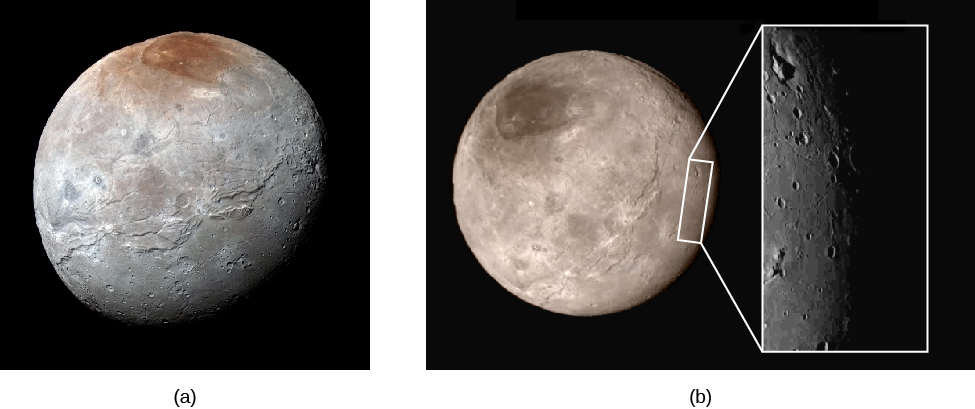
To add to the mysteries of Pluto, we show in Figure 12.24 one of the best New Horizons images of Pluto’s large moon Charon. Recall from earlier that Charon is roughly half Pluto’s size (its diameter is about the size of Texas). Charon keeps the same side toward Pluto, just as our Moon keeps the same side toward Earth. What is unique about the Pluto-Charon system, however, is that Pluto also keeps its same face toward Charon. Like two dancers embracing, these two constantly face each other as they spin across the celestial dance floor. Astronomers call this a double tidal lock.
英語のヒント
冥王星の謎にさらに加わるものとして、図12.24に、大衛星カロンを捉えたニュー・ホライズンズの最良の画像の一つを示す。先に見たように、カロンの大きさは冥王星のおよそ半分で、その直径はテキサス州の幅ほどである。地球の月がいつも同じ面を地球へ向けるように、カロンも同じ面を冥王星へ向けている。しかし冥王星=カロン系が独特なのは、冥王星もまた、いつも同じ面をカロンへ向けていることだ。抱き合う2人の踊り手のように、両者は天上のダンスフロアを回りながら、常に互いを向いている。天文学者はこれを、双方の潮汐固定と呼ぶ。
Pluto’s Large Moon Charon.冥王星の大衛星カロン。
credit a, b: modification of work by NASA/JHUAPL/SwRI · NASA media use guidelines
Figure 12.24 (a) In this New Horizons image, the color has been enhanced to bring out the color of the moon’s strange red polar cap. Charon has a diameter of 1214 kilometers, and the resolution of this image is 3 kilometers. (b) Here we see the moon from a slightly different angle, in true color. The inset shows an area about 390 kilometers from top to bottom. Near the top left is an intriguing feature—what appears to be a mountain in the middle of a depression or moat. (credit a, b: modification of work by NASA/JHUAPL/SwRI)
図12.24 (a)ニュー・ホライズンズのこの画像では、衛星の奇妙な赤い極冠の色を浮かび上がらせるため、色を強調している。カロンの直径は1214キロメートルで、画像の解像度は3キロメートルである。(b)少し違う角度から、実際に近い色で見た衛星。挿入図は上下約390キロメートルの領域を示す。左上付近には、くぼみや堀の中央に山があるように見える、興味深い特徴がある。(クレジットa・b:NASA/JHUAPL/SwRIの作品を改変)
What New Horizons showed was another complex world. There are scattered craters in the lower part of the image, but much of the rest of the surface appears smooth. Crossing the center of the image is a belt of rough terrain, including what appear to be tectonic valleys, as if some forces had tried to split Charon apart. Topping off this strange image is a distinctly red polar cap, of unknown composition. Many features on Charon are not yet understood, including what appears to be a mountain in the midst of a low-elevation region.
英語のヒント
ニュー・ホライズンズが見せたのは、もう一つの複雑な世界だった。画像の下部にはクレーターが点在するが、残りの表面の大半は滑らかに見える。中央を横切るのは、起伏の激しい地形の帯で、地殻変動による谷のようなものを含む。まるで何らかの力がカロンを引き裂こうとしたかのようだ。この奇妙な画像の上部を飾るのは、組成不明の、はっきりと赤い極冠である。低い領域の真ん中に山があるように見えるものを含め、カロンの多くの特徴はまだ理解されていない。
Key Concepts and Summary重要事項のまとめ
Pluto and Charon have been revealed by the New Horizons spacecraft to be two of the most fascinating objects in the outer solar system. Pluto is small (a dwarf planet) but also surprisingly active, with contrasting areas of dark cratered terrain, light-colored basins of nitrogen ice, and mountains of frozen water that may be floating in the nitrogen ice. Even Pluto’s largest moon Charon shows evidence of geological activity. Both Pluto and Charon turn out to be far more dynamic and interesting than could have been imagined before the New Horizons mission.
ニュー・ホライズンズによって、冥王星とカロンは、外側の太陽系で最も魅力的な天体の二つだと明らかになった。冥王星は小さな準惑星だが、驚くほど活発でもある。暗いクレーター地形、明るい窒素氷の盆地、窒素氷の中に浮いているかもしれない凍った水の山々など、対照的な領域がある。最大の衛星カロンでさえ、地質活動の証拠を示す。冥王星もカロンも、ニュー・ホライズンズの探査以前に想像できたよりはるかに変化に富み、興味深い世界だった。