第12章環・衛星・冥王星Rings, Moons, and Pluto
lo, a Volcanic Moon火山の衛星、イオ
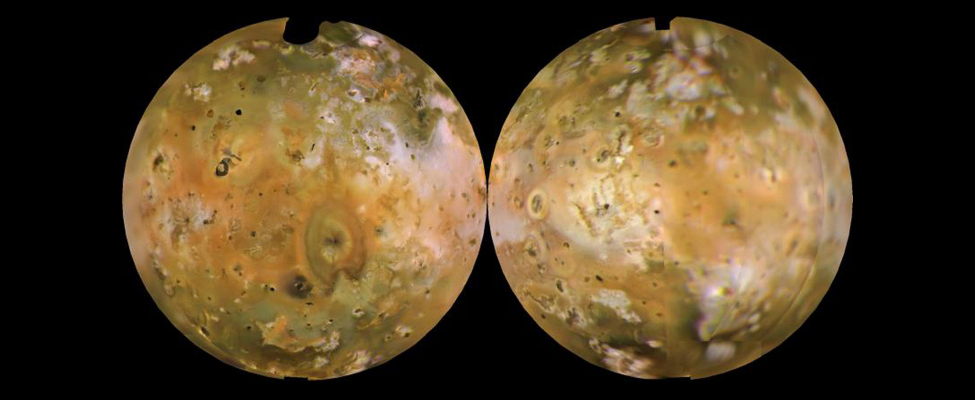
Io, the innermost of Jupiter’s Galilean moons, is in many ways a close twin of our Moon, with nearly the same size and density. We might therefore expect it to have experienced a similar history. Its appearance, as photographed from space, tells us another story, however (Figure 12.7). Instead of being a dead cratered world, Io turns out to have the highest level of volcanism in the solar system, greatly exceeding that of Earth.
英語のヒント
ガリレオ衛星の最も内側にあるイオは、大きさも密度もほぼ同じで、多くの点で地球の月とよく似た双子のような存在である。したがって、似た歴史をたどったと予想してもよいだろう。しかし宇宙から撮影された姿は、別の物語を語っている(図12.7)。クレーターに覆われた死んだ世界であるどころか、イオは太陽系で最も火山活動が活発で、その活動は地球をはるかに上回っていることがわかった。
Two Sides of Io.イオの二つの面。
credit: modification of work by NASA/JPL/USGS · JPL image use policy
Figure 12.7 This composite image shows both sides of the volcanically active moon Io. The orange deposits are sulfur snow; the white is sulfur dioxide. (Carl Sagan once quipped that Io looks as if it desperately needs a shot of penicillin.) (credit: modification of work by NASA/JPL/USGS)
図12.7 火山活動が活発な衛星イオの両側を示す合成画像。橙色の堆積物は硫黄の雪、白いものは二酸化硫黄である。カール・セーガンはかつて、イオはどうしてもペニシリン注射が必要に見える、と冗談を言った。(クレジット:NASA/JPL/USGSの作品を改変)
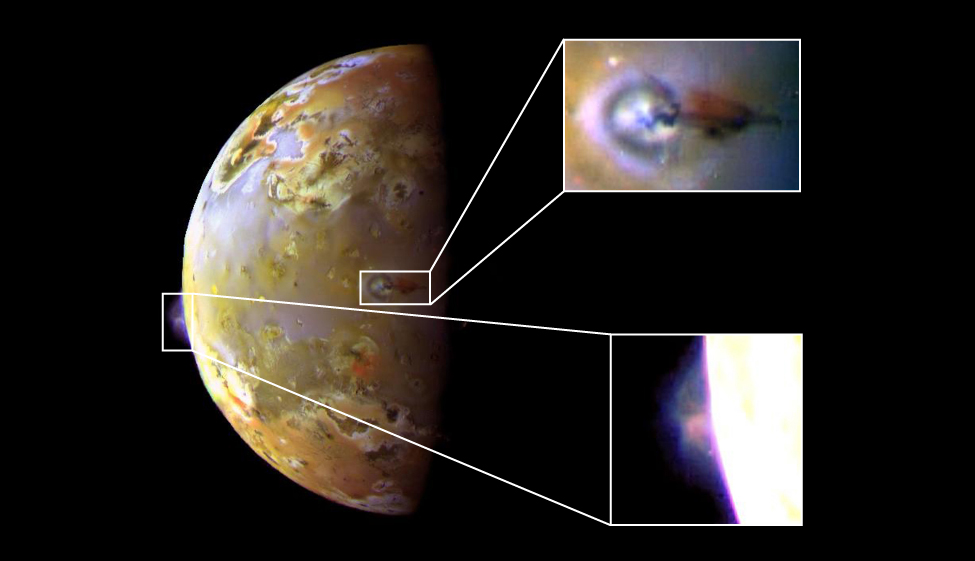
Io’s active volcanism was discovered by the Voyager spacecraft. Eight volcanoes were seen erupting when Voyager 1 passed in March 1979, and six of these were still active four months later when Voyager 2 passed. With the improved instruments carried by the Galileo spacecraft, more than 50 eruptions were found during 1997 alone. Many of the eruptions produce graceful plumes that extend hundreds of kilometers out into space (Figure 12.8).
英語のヒント
イオの活発な火山活動は、ボイジャー探査機によって発見された。1979年3月にボイジャー1号が通過したとき、8つの火山が噴火しており、4か月後にボイジャー2号が通過したときにも、そのうち6つは活動を続けていた。ガリレオ探査機に搭載された改良型の機器では、1997年だけでも50回を超える噴火が見つかった。多くの噴火は優美な噴煙を生み出し、宇宙空間へ数百キロメートルも延びる(図12.8)。
Volcanic Eruptions on Io.イオの火山噴火。
credit: modification of work by NASA/JPL · JPL image use policy
Figure 12.8 This composite image from NASA’s Galileo spacecraft shows close-ups (the two inset photos) of two separate volcanic eruptions on Jupiter’s volcanic moon, Io. In the upper inset image, you can see a close up of a bluish plume rising about 140 kilometers above the surface of the volcano. In the lower inset image is the Prometheus plume, rising about 75 kilometers from Io’s surface. The Prometheus plume is named for the Greek god of fire. (credit: modification of work by NASA/JPL)
図12.8 NASAのガリレオ探査機による合成画像。木星の火山衛星イオで起きた、別々の2つの噴火を近くから捉えた写真を挿入している。上の挿入画像には、火山の表面から約140キロメートル上がる青みがかった噴煙が見える。下の挿入画像は、イオの表面から約75キロメートル上がるプロメテウスの噴煙である。この噴煙の名は、ギリシャの火の神に由来する。(クレジット:NASA/JPLの作品を改変)
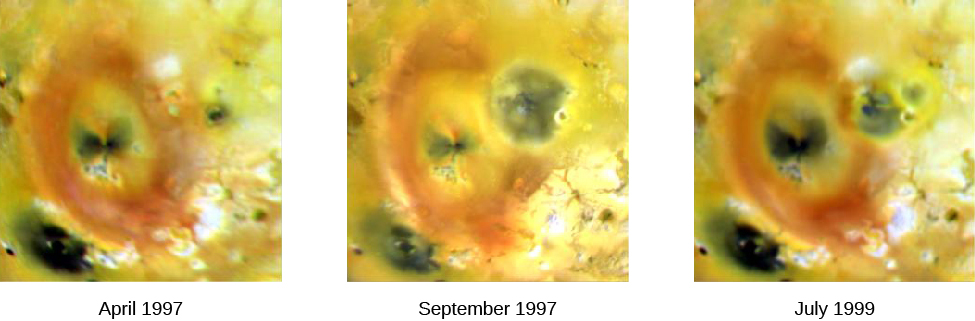
The Galileo data show that most of the volcanism on Io consists of hot silicate lava, like the volcanoes on Earth. Sometimes the hot lava encounters frozen deposits of sulfur and sulfur dioxide. When these icy deposits are suddenly heated, the result is great eruptive plumes far larger than any ejected from terrestrial volcanoes. As the rising plumes cool, the sulfur and sulfur dioxide recondense as solid particles that fall back to the surface in colorful “snowfalls” that extend as much as a thousand kilometers from the vent. Major new surface features were even seen to appear between Galileo orbits, as shown in Figure 12.9.
英語のヒント
ガリレオのデータによれば、イオの火山活動の大半は、地球の火山と同じように、高温のケイ酸塩溶岩によるものである。高温の溶岩が、凍った硫黄や二酸化硫黄の堆積物に出会うこともある。こうした氷状の堆積物が急激に加熱されると、地球の火山から出るものよりはるかに大きな噴煙が生じる。噴煙が上昇して冷えると、硫黄と二酸化硫黄は再び凝結して固体粒子になり、色とりどりの「降雪」として表面へ戻る。その範囲は噴出口から1000キロメートルにも達する。図12.9に示すように、ガリレオが周回する間に、大規模な新しい表面の特徴が現れる様子さえ見られた。
Volcanic Changes on Io.イオの火山による変化。
credit: modification of work by NASA/JPL/University of Arizona · JPL image use policy
Figure 12.9 These three images were taken of the same 1700-kilometer-square region of Io in April 1997, September 1997, and July 1999. The dark volcanic center called Pillan Patera experienced a huge eruption, producing a dark deposit some 400 kilometers across (seen as the grey area in the upper center of the middle image). In the right image, however, some of the new dark deposit is already being covered by reddish material from the volcano Pele. Also, a small unnamed volcano to the right of Pillan has erupted since 1997, and some of its dark deposit and a yellow ring around it are visible on the right image (to the right of the grey spot). The color range is exaggerated in these images. (credit: modification of work by NASA/JPL/University of Arizona)
図12.9 1997年4月、1997年9月、1999年7月に撮影された、イオの同じ一辺1700キロメートルの正方形領域の3枚の画像。ピラン・パテラと呼ばれる暗い火山中心で巨大な噴火が起こり、幅約400キロメートルの暗い堆積物ができた。中央の画像の上部中央に、灰色の領域として見えている。しかし右の画像では、新しい暗色堆積物の一部は、すでにペレ火山からの赤みを帯びた物質に覆われつつある。また、ピランの右にある名のない小さな火山も1997年以後に噴火しており、右の画像の灰色の斑点の右側に、その暗い堆積物の一部と周囲の黄色い環が見える。これらの画像では色の幅を強調している。(クレジット:NASA/JPL/University of Arizonaの作品を改変)
As the Galileo mission drew to a close, controllers were willing to take risks in getting close to Io. Approaching this moon is a dangerous maneuver because the belts of atomic particles trapped in Jupiter’s magnetic environment are at their most intense near Io’s orbit. Indeed, in its very first pass by Io, the spacecraft absorbed damaging radiation beyond its design levels. To keep the system working at all, controllers had to modify or disable various fault-protection software routines in the onboard computers. In spite of these difficulties, the spacecraft achieved four successful Io flybys, obtaining photos and spectra of the surface with unprecedented resolution.
英語のヒント
ガリレオ計画が終わりに近づくと、管制担当者はリスクを取ってイオへ接近することにした。イオへの接近は危険な操作である。木星の磁気環境に捉えられた原子由来の粒子の帯は、イオ軌道付近で最も強烈だからだ。実際、イオのそばを最初に通過した際、探査機は設計上の限度を超える有害な放射線を浴びた。システムを何とか動かし続けるために、担当者は搭載コンピューターのさまざまな障害保護ソフトウェアの処理を、修正したり無効にしたりしなければならなかった。こうした困難にもかかわらず、探査機は4回のイオ・フライバイに成功し、かつてない解像度の表面写真とスペクトルを得た。
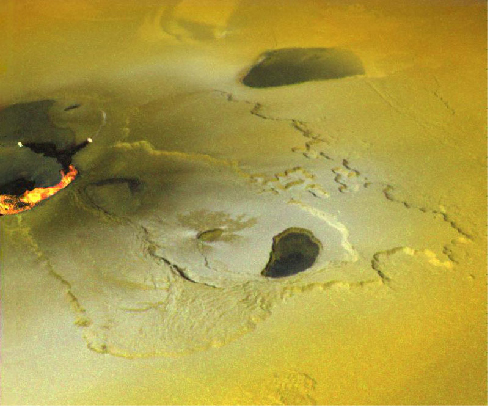
Maps of Io reveal more than 100 recently active volcanoes. Huge flows spread out from many of these vents, covering about 25% of the moon’s total surface with still-warm lava. From these measurements, it seems clear that the bright surface colors that first attracted attention to Io are the result of a thin veneer of sulfur compounds. The underlying volcanism is driven by eruptions of molten silicates, just like on Earth (Figure 12.10).
英語のヒント
イオの地図には、最近まで活動していた火山が100を超えて見つかる。多くの噴出口から巨大な溶岩流が広がり、衛星の全表面の約25%を、まだ温かい溶岩で覆っている。これらの測定から、最初にイオへ関心を集めた明るい表面の色は、硫黄化合物の薄い上掛けの層によるものだと明らかに思える。その下の火山活動を駆動するのは、地球と同じように、溶けたケイ酸塩の噴出である(図12.10)。
Lava Fountains on Io.イオの溶岩噴泉。
credit: modification of work by NASA/JPL · JPL image use policy
Figure 12.10 Galileo captured a number of eruptions along the chain of huge volcanic calderas (or pits) on Io called Tvashtar Catena in this false-color image combining infrared and visible light. The bright orange-yellow areas at left are places where fresh, hot lava is erupting from below ground. (credit: modification of work by NASA/JPL)
図12.10 ガリレオは、イオのトヴァシュトル・カテナと呼ばれる巨大な火山カルデラ、すなわちくぼみの列に沿って、いくつもの噴火を捉えた。この疑似カラー画像は赤外線と可視光を組み合わせている。左の明るい橙黄色の領域は、新しい高温の溶岩が地下から噴出している場所である。(クレジット:NASA/JPLの作品を改変)
Tidal Heating潮汐加熱
How can Io remain volcanically active in spite of its small size? The answer, as we hinted earlier, lies in the effect of gravity, through tidal heating. Io is about the same distance from Jupiter as our Moon is from Earth. Yet Jupiter is more than 300 times more massive than Earth, causing forces that pull Io into an elongated shape, with a several-kilometer-high bulge extending toward Jupiter.
英語のヒント
イオは小さいのに、どうして火山活動を続けられるのだろうか。先にほのめかしたように、答えは潮汐加熱を通じた重力の効果にある。イオと木星の距離は、地球の月と地球の距離とほぼ同じである。しかし木星の質量は地球の300倍以上もあり、その力がイオを細長く引き延ばす。木星へ向かって、高さ数キロメートルの膨らみができるのである。
If Io always kept exactly the same face turned toward Jupiter, this bulge would not generate heat. However, Io’s orbit is not exactly circular due to gravitational perturbations (tugs) from Europa and Ganymede. In its slightly eccentric orbit, Io twists back and forth with respect to Jupiter, at the same time moving nearer and farther from the planet on each revolution. The twisting and flexing heat Io, much as repeated flexing of a wire coat hanger heats the wire.
英語のヒント
イオが常にまったく同じ面を木星に向けていたなら、この膨らみは熱を生じない。しかし、エウロパとガニメデからの重力による摂動、つまり引っ張りのため、イオの軌道は完全な円ではない。わずかに離心率のある軌道を進むイオは、木星に対して前後にねじれるように向きを変え、同時に、一周する間に木星へ近づいたり遠ざかったりする。このねじれとたわみがイオを加熱する。針金のハンガーを繰り返し曲げると針金が熱くなるのと、よく似ている。
After billions of years, this constant flexing and heating have taken their toll on Io, driving away water and carbon dioxide and other gases, so that now sulfur and sulfur compounds are the most volatile materials remaining. Its interior is entirely melted, and the crust itself is constantly recycled by volcanic activity.
英語のヒント
何十億年も続くこの絶え間ない変形と加熱は、イオに大きな影響を及ぼし、水や二酸化炭素などのガスを追い出してきた。その結果、現在残っている物質のうち、最も揮発しやすいものは硫黄と硫黄化合物になっている。内部は完全に溶けており、地殻自体も火山活動によって絶えず作り直されている。
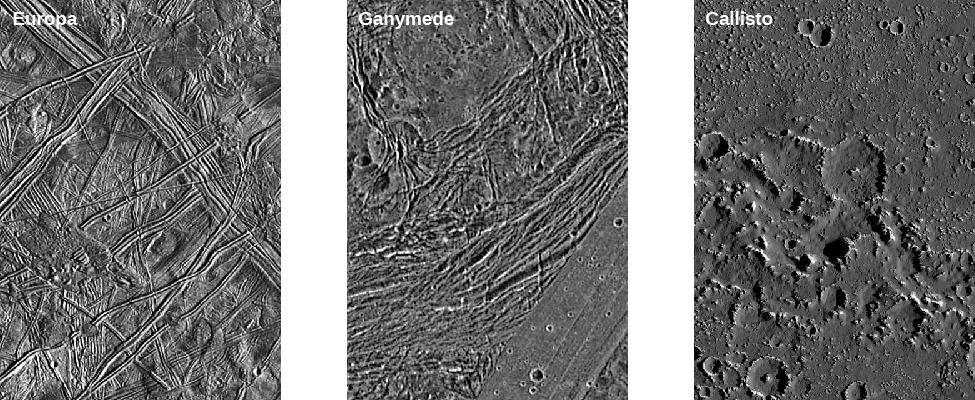
In moving inward toward Jupiter from Callisto to Io, we have encountered more and more evidence of geological activity and internal heating, culminating in the violent volcanism on Io. Three of these surfaces are compared in Figure 12.11. Just as the character of the planets in our solar system depends in large measure on their distance from the Sun (and on the amount of heat they receive), so it appears that distance from a giant planet like Jupiter can play a large role in the composition and evolution of its moons (at least partly due to differences in internal heating of each moon by Jupiter’s unrelenting tidal forces).
英語のヒント
カリストからイオへ、木星に向かって内側へ進むにつれ、地質活動と内部加熱の証拠は増え続け、イオの激しい火山活動で頂点に達した。図12.11では、このうち3つの表面を比較している。太陽系の惑星の性質が、太陽からの距離と、受け取る熱の量に大きく左右されるのと同じように、木星のような巨大惑星からの距離も、衛星の組成と進化に大きな役割を果たすように見える。少なくともその一部は、木星の絶え間ない潮汐力によって生じる内部加熱が、衛星ごとに違うためである。
Three Icy Moons.3つの氷衛星。
credit: modification of work by NASA/JPL/DLR · JPL image use policy
Figure 12.11 These Galileo images compare the surfaces of Europa, Ganymede, and Callisto at the same resolution. Note that the number of craters (and thus the age of the surface we see) increases as we go from Europa to Ganymede to Callisto. The Europa image is one of those where the system of cracks and ridges resembles a freeway system. (credit: modification of work by NASA/JPL/DLR)
図12.11 同じ解像度のガリレオ画像で、エウロパ、ガニメデ、カリストの表面を比較している。エウロパからガニメデ、カリストへ進むにつれ、クレーターの数と、それによってわかる目に見える表面の年代が増すことに注目しよう。エウロパの画像では、亀裂と尾根の系が高速道路網に似て見える。(クレジット:NASA/JPL/DLRの作品を改変)
In 2023, the European Space Agency launched the Jupiter Icy Moons Explorer spacecraft (abbreviated Juice) to explore Europa, Ganymede, and Callisto. It will arrive in the Jupiter system in 2031, fly by the moons of interest, and eventually go into orbit around Ganymede.
英語のヒント
2023年、ヨーロッパ宇宙機関は、エウロパ、ガニメデ、カリストを探る木星氷衛星探査機(略称Juice)を打ち上げた。2031年に木星系へ到着し、対象の衛星をフライバイした後、最終的にガニメデの周回軌道へ入る予定である。