第12章環・衛星・冥王星Rings, Moons, and Pluto
12.5 Planetary Rings (and Enceladus)12.5 惑星の環(そしてエンケラドゥス)
Learning Objectives学習の目標
By the end of this section, you will be able to:
この節を終えると、次のことができるようになる。
Describe the two theories of planetary ring formation
惑星の環ができる仕組みについて、二つの説を説明する。
Compare the major rings of Saturn and explain the role of the moon Enceladus in the formation of the E ring
土星の主な環を比較し、E環の形成に衛星エンケラドゥスが果たす役割を説明する。
Explain how the rings of Uranus and Neptune differ in composition and appearance from the rings of Saturn
天王星と海王星の環が、組成や見た目の点で土星の環とどう違うかを説明する。
Describe how ring structure is affected by the presence of moons
衛星の存在が環の構造にどう影響するかを説明する。
In addition to their moons, all four of the giant planets have rings, with each ring system consisting of billions of small particles or “moonlets” orbiting close to their planet. Each of these rings displays a complicated structure that is related to interactions between the ring particles and the larger moons. However, the four ring systems are very different from each other in mass, structure, and composition, as outlined in Table 12.2.
英語のヒント
四つの巨大惑星はすべて、衛星に加えて環も持っている。それぞれの環の系は、惑星の近くを公転する何十億もの小さな粒子、いわば「小衛星」からなる。どの環も複雑な構造を示し、その構造は環の粒子と大きな衛星との相互作用に関係している。しかし、表12.2にまとめたように、四つの環の系は質量・構造・組成が大きく異なる。
Properties of the Ring Systems 環の系の性質 |
||||
|---|---|---|---|---|
Planet 惑星 |
Outer Radius 外縁までの半径(km) |
Outer Radius 外縁までの半径(惑星半径 Rplanet を単位として) |
Mass 質量(kg) |
Reflectivity 反射率(%) |
Jupiter 木星 |
128,000 | 1.8 | 1010(?) 10¹⁰(?) |
? |
Saturn 土星 |
140,000 | 2.3 | 1019 10¹⁹ |
60 |
Uranus 天王星 |
51,000 | 2.2 | 1014 10¹⁴ |
5 |
Neptune 海王星 |
63,000 | 2.5 | 1012 10¹² |
5 |
Saturn’s large ring system is made up of icy particles spread out into several vast, flat rings containing a great deal of fine structure. The Uranus and Neptune ring systems, on the other hand, are nearly the reverse of Saturn’s: they consist of dark particles confined to a few narrow rings with broad empty gaps in between. Jupiter’s ring and at least one of Saturn’s are merely transient dust bands, constantly renewed by dust grains eroded from small moons. In this section, we focus on the two most massive ring systems, those of Saturn and Uranus.
英語のヒント
土星の大規模な環は氷の粒子でできている。粒子は広大で平らな複数の環に広がり、その中には数多くの微細な構造がある。これに対して天王星と海王星の環は、土星の環とほぼ正反対だ。暗い粒子が少数の細い環に閉じ込められ、環と環の間には幅の広い空隙がある。木星の環と土星の環の少なくとも一つは、一時的に存在する塵の帯にすぎない。小衛星から削り取られた塵の粒子が、絶えず補給されている。この節では、質量が最も大きい二つの環の系、土星と天王星の環に注目する。
We should mention that the four giant planets are not the only worlds in the solar system now known to have rings. Recently, rings have been discovered around the dwarf planets Haumea and Quaoar (distant worlds that are discussed in The Origin and Fate of Comets and Related Objects) and at least one asteroid.
英語のヒント
いまでは、太陽系で環を持つとわかっている天体が四つの巨大惑星だけではないことにも触れておこう。最近、準惑星ハウメアとクワオアーの周り、そして少なくとも一つの小惑星の周りにも環が発見された。ハウメアとクワオアーは遠方にある天体で、「彗星と関連天体の起源と運命」で取り上げる。
What Causes Rings?環は何によってできるのか
A ring is a collection of vast numbers of particles, each like a tiny moon obeying Kepler’s laws as it follows its own orbit around the planet. Thus, the inner particles revolve faster than those farther out, and the ring as a whole does not rotate as a solid body. In fact, it is better not to think of a ring rotating at all, but rather to consider the revolution (or motion in orbit) of its individual moonlets.
英語のヒント
環とは膨大な数の粒子の集まりで、一つひとつの粒子は小さな衛星のように、それぞれの軌道で惑星を回りながらケプラーの法則に従っている。したがって、内側の粒子は外側の粒子より速く公転し、環全体が固体のように一体となって回転するわけではない。実際には、「環が回転する」と考えること自体をやめ、それを構成する小衛星の一つひとつが公転する、つまり軌道上を運動すると考えるほうが適切だ。
If the ring particles were widely spaced, they would move independently, like separate moonlets. However, in the main rings of Saturn and Uranus the particles are close enough to exert mutual gravitational influence, and occasionally even to rub together or bounce off each other in low-speed collisions. Because of these interactions, we see phenomena such as waves that move across the rings—just the way water waves move over the surface of the ocean.
英語のヒント
環の粒子どうしが大きく離れていれば、それぞれ別々の小衛星のように独立して動くだろう。しかし、土星と天王星の主な環では、粒子は互いに重力を及ぼすほど近接している。ときにはこすれ合ったり、低速で衝突して跳ね返ったりもする。こうした相互作用によって、ちょうど海面を水の波が進むように、環を横切って進む波などの現象が現れる。
There are two basic ideas of how such rings come to be. First is the breakup hypothesis, which suggests that the rings are the remains of a shattered moon. A passing comet or asteroid might have collided with the moon, breaking it into pieces. Tidal forces then pulled the fragments apart, and they dispersed into a disk. The second hypothesis, which takes the reverse perspective, suggests that the rings are made of particles that were unable to come together to form a moon in the first place.
英語のヒント
このような環がどう生まれるかについては、基本的に二つの考え方がある。一つ目は崩壊仮説で、環は砕けた衛星の残骸だとするものだ。通りかかった彗星や小惑星が衛星に衝突し、ばらばらにしたのかもしれない。その後、潮汐力が破片を引き離し、破片は円盤状に広がったという考えだ。二つ目の仮説は逆の見方をする。環は、そもそも集まって一つの衛星になることができなかった粒子からできているというのだ。
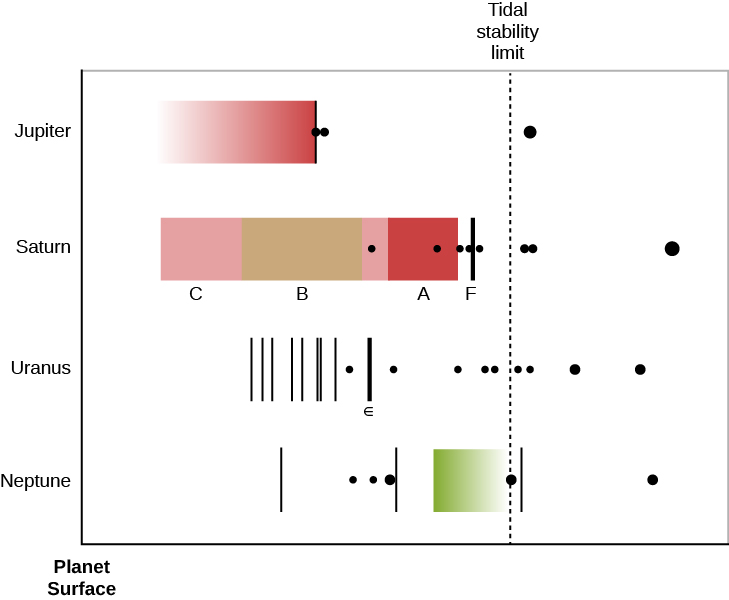
In either theory, the gravity of the planet plays an important role. Close to the planet (see Figure 12.25), tidal forces can tear bodies apart or inhibit loose particles from coming together. We do not know which explanation holds for any given ring, although many scientists have concluded that at least a few of the rings are relatively young and must therefore be the result of breakup.
英語のヒント
どちらの説でも、惑星の重力が重要な役割を果たす。惑星の近くでは(図12.25参照)、潮汐力が天体を引き裂いたり、ばらばらの粒子が集まるのを妨げたりする。個々の環にどちらの説明が当てはまるのかは、わかっていない。ただ、多くの科学者は、環の少なくとも一部は比較的若く、したがって崩壊によってできたはずだと結論づけている。
Four Ring Systems.四つの環の系。
OpenStax / Rice University · CC BY 4.0
Figure 12.25 This diagram shows the locations of the ring systems of the four giant planets. The left axis represents the planet’s surface. The dotted vertical line is the limit inside which gravitational forces can break up moons (each planet’s system is drawn to a different scale, so that this stability limit lines up for all four of them). The black dots are the inner moons of each planet on the same scale as its rings. Notice that only really small moons survive inside the stability limit.
図12.25 この図は、四つの巨大惑星の環の位置を示している。左の軸は惑星の表面を表す。垂直の点線は、その内側で重力が衛星を壊しうる境界だ。四つの系の安定限界が同じ位置に並ぶよう、惑星ごとに異なる縮尺で描いてある。黒い点は各惑星の内側の衛星で、同じ惑星の環と同じ縮尺になっている。安定限界より内側で生き残るのは、本当に小さな衛星だけであることに注目しよう。
Rings of Saturn土星の環
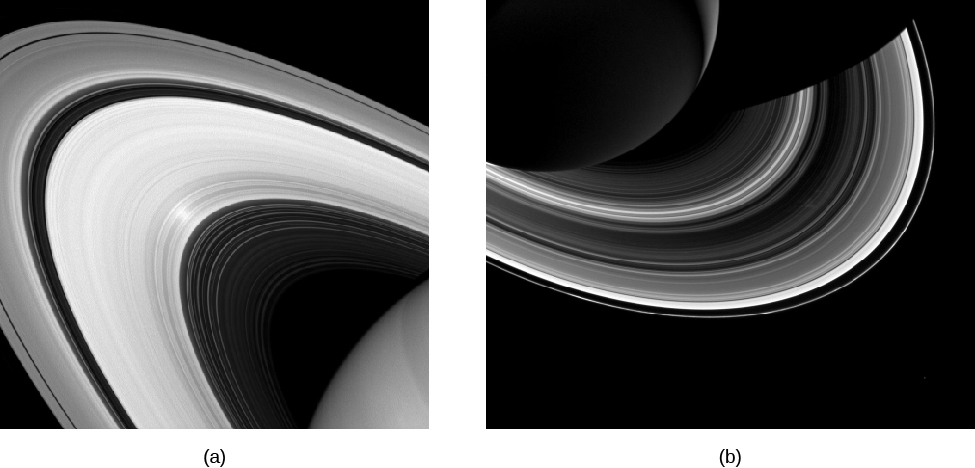
Saturn’s rings are one of the most beautiful sights in the solar system (Figure 12.26). From outer to inner, the three brightest rings are labeled with the extremely unromantic names of A, B, and C Rings. Table 12.3 gives the dimensions of the rings in both kilometers and units of the radius of Saturn, RSaturn. The B Ring is the brightest and has the most closely packed particles, whereas the A and C Rings are translucent.
英語のヒント
土星の環は、太陽系で最も美しい眺めの一つだ(図12.26)。最も明るい三つの環には、外側から順にA環・B環・C環という、まるでロマンのない名前が付いている。表12.3には、環の大きさをkmと土星半径 RSaturn の両方を単位として示した。B環が最も明るく、粒子も最も密に詰まっている。一方、A環とC環は光を通す。
The total mass of the B Ring, which is probably close to the mass of the entire ring system, is about equal to that of an icy moon 250 kilometers in diameter (suggesting that the ring could have originated in the breakup of such a moon). Between the A and B Rings is a wide gap named the Cassini Division after Gian Domenico Cassini, who first glimpsed it through a telescope in 1675 and whose name planetary scientists also gave to the Cassini spacecraft that explored the Saturn system.
英語のヒント
B環の総質量は、おそらく環全体の質量に近く、直径250kmの氷の衛星とほぼ同じだ。このことは、そのような衛星が壊れて環が生まれた可能性を示唆する。A環とB環の間には、カッシーニの間隙と呼ばれる幅広い隙間がある。名前は、1675年に望遠鏡でこれを初めてかすかに見たジャン・ドメニコ・カッシーニにちなんでいる。惑星科学者たちは、土星系を探査したカッシーニ探査機にも彼の名を付けた。
Saturn’s Rings as Seen from Above and Below.上と下から見た土星の環。
credit a, b: modification of work by NASA/JPL-Caltech/Space Science Institute · JPL image use policy
Figure 12.26 (a) The view from above is illuminated by direct sunlight. (b) The illumination seen from below is sunlight that has diffused through gaps in the rings. (credit a, b: modification of work by NASA/JPL-Caltech/Space Science Institute)
図12.26 (a)上から見た面は、太陽光を直接受けて照らされている。(b)下から見えている光は、環の隙間を通って拡散してきた太陽光だ。(a・bのクレジット:NASA/JPL-Caltech/Space Science Instituteの作品を改変)
Selected Features in the Rings of Saturn 土星の環の主な特徴 |
|||
|---|---|---|---|
Ring NameThe ring letters are assigned in the order of their discovery. 環の名前。環の文字は発見された順に付けられている。 |
Outer Edge 外縁(RSaturn) |
Outer Edge 外縁(km) |
Width 幅(km) |
| F | 2.324 | 140,180 | 90 |
| A | 2.267 | 136,780 | 14,600 |
Cassini Division カッシーニの間隙 |
2.025 | 122,170 | 4590 |
| B | 1.949 | 117,580 | 25,580 |
| C | 1.525 | 92,000 | 17,490 |
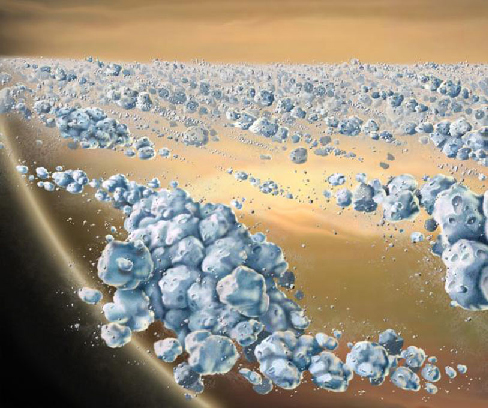
Saturn’s rings are very broad and very thin. The width of the main rings is 70,000 kilometers, yet their average thickness is only 20 meters. If we made a scale model of the rings out of paper, we would have to make them 1 kilometer across. On this scale, Saturn itself would loom as high as an 80-story building. The ring particles are composed primarily of water ice, and they range from grains the size of sand up to house-sized boulders. An insider’s view of the rings would probably resemble a bright cloud of floating snowflakes and hailstones, with a few snowballs and larger objects, many of them loose aggregates of smaller particles (Figure 12.27).
英語のヒント
土星の環はとても幅広く、しかも非常に薄いものだ。主な環の幅は7万kmもあるのに、平均の厚さはわずか20mだ。紙で環の縮尺模型を作るとすれば、全体の大きさを1kmにしなければならない。その縮尺では、土星自体は80階建てのビルほどの高さにそびえ立つ。環の粒子は主に水の氷からなり、砂粒ほどの粒から家ほどの巨塊まである。環の内部から眺めれば、浮かぶ雪片やひょうが明るい雲となり、その中に雪玉やもっと大きな物体が少し混じった光景に似ているだろう。そうした物体の多くは、小さな粒子が緩く集まったものだ(図12.27)。
Artist’s Idealized Impression of the Rings of Saturn as Seen from the Inside.土星の環の内側からの眺めを理想化して描いた想像図。
credit: modification of work by NASA/JPL/University of Colorado · JPL image use policy
Figure 12.27 Note that the rings are mostly made of pieces of water ice of different sizes. Toward the end of its mission, the Cassini spacecraft got nearer to the rings of Saturn, but it never got this close. (credit: modification of work by NASA/JPL/University of Colorado)
図12.27 環の大部分が、さまざまな大きさの水の氷のかけらからなることに注目しよう。カッシーニ探査機は任務の終盤に土星の環へさらに近づいたが、これほど近くまで行ったことはない。(クレジット:NASA/JPL/University of Coloradoの作品を改変)
In addition to the broad A, B, and C Rings, Saturn has a handful of very narrow rings no more than 100 kilometers wide. The most substantial of these, which lies just outside the A Ring, is called the F Ring; its surprising appearance is discussed below. In general, Saturn’s narrow rings resemble the rings of Uranus and Neptune.
英語のヒント
幅広いA環・B環・C環に加え、土星には幅100km以下の非常に細い環がいくつかある。そのうち最も規模が大きいのはA環のすぐ外側にあるF環で、その驚くべき姿については後で述べる。一般に、土星の細い環は天王星や海王星の環に似ている。
There is also a very faint, tenuous ring, called the E Ring, associated with Saturn’s small icy moon Enceladus. The particles in the E Ring are very small and composed of water ice. Since such a tenuous cloud of ice crystals will tend to dissipate, the ongoing existence of the E Ring strongly suggests that it is being continually replenished by a source at Enceladus. This icy moon is very small—only 500 kilometers in diameter—but the Voyager images showed that the craters on about half of its surface have been erased, indicating geological activity sometime in the past few million years. It was with great anticipation that the Cassini scientists maneuvered the spacecraft orbit to allow multiple close flybys of Enceladus starting in 2005.
英語のヒント
土星には、エンケラドゥスという小さな氷の衛星に関係する、E環と呼ばれる非常に淡く希薄な環もある。E環の粒子はとても小さく、水の氷でできている。このような希薄な氷の結晶の雲は散逸しやすいため、E環が存在し続けていることは、エンケラドゥスにある供給源から絶えず補充されていることを強く示唆する。この氷の衛星は直径がわずか500kmと、とても小さい天体だ。それでもボイジャーの画像は、表面の約半分でクレーターが消えていることを示した。過去数百万年のどこかの時点で、地質活動があったことを示している。カッシーニの科学者たちは大きな期待を抱きながら探査機の軌道を調整し、2005年からエンケラドゥスの近接フライバイを何度も行えるようにした。
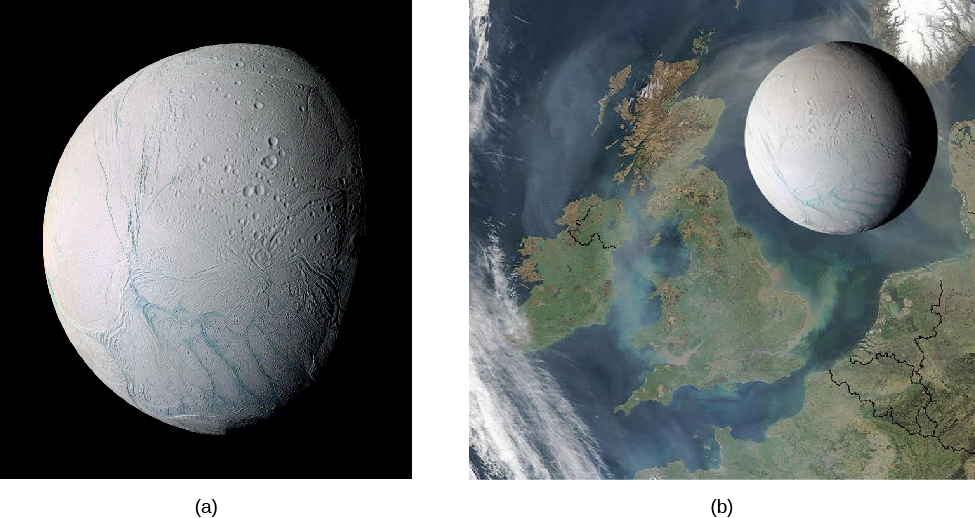
Those awaiting the Cassini flyby results were not disappointed. High-resolution images showed long, dark stripes of smooth ground near its south pole, which were soon nicknamed “tiger stripes” (Figure 12.28). Infrared measurements revealed that these tiger stripes are warmer than their surroundings. Best of all, dozens of cryovolcanic vents on the tiger stripes were seen to be erupting geysers of salty water and ice (Figure 12.29). Estimates suggested that 200 kilograms of material were shooting into space each second—not a lot, but enough for the spacecraft to sample.
英語のヒント
カッシーニのフライバイの成果を待ち望んでいた人々は、失望しなかった。高解像度画像には、南極近くの滑らかな地表に長く暗い縞が写っており、すぐに「タイガーストライプ(虎の縞)」という愛称が付いた(図12.28)。赤外線測定からは、これらの縞が周囲より暖かいことも明らかになった。何よりすばらしいことに、縞の上の何十もの氷火山の噴出口から、塩水と氷の間欠泉が噴き出しているのが見つかったのだ(図12.29)。推定では毎秒200kgの物質が宇宙へ放出されていた。大量とはいえないが、探査機が試料を採取するには十分だ。
Enceladus.エンケラドゥス。
credit a, b: modification of work by NASA/JPL/Space Science Institute · JPL image use policy
Figure 12.28 (a) This image shows both smooth and cratered terrain on Saturn’s moon, and also “tiger stripes” in the south polar region (lower part of image). These dark stripes (shown here in exaggerated color) have elevated temperatures and are the source of the many geysers discovered on Enceladus. They are about 130 kilometers long and 40 kilometers apart. (b) Here Enceladus is shown to scale with Great Britain and the coast of Western Europe, to emphasize that it is a small moon, only about 500 kilometers in diameter. (credit a, b: modification of work by NASA/JPL/Space Science Institute)
図12.28 (a)この画像では、土星の衛星の滑らかな地形とクレーターのある地形、そして南極域(画像下部)の「タイガーストライプ」が見える。暗い縞は、ここでは色を強調してある。この部分は温度が高く、エンケラドゥスで発見された多数の間欠泉の源だ。縞は長さ約130kmで、約40kmずつ離れている。(b)ここではエンケラドゥスをグレートブリテン島と西ヨーロッパの海岸に同じ縮尺で重ね、直径が約500kmしかない小さな衛星であることを強調している。(a・bのクレジット:NASA/JPL/Space Science Instituteの作品を改変)
When Cassini was directed to fly into the plumes, it measured their composition and found them to be similar to material we see liberated from comets (see Comets and Asteroids: Debris of the Solar System). The vapor and ice plumes consisted mostly of water, but with trace amounts of nitrogen, ammonia, methane, and other hydrocarbons. Minerals found in the geysers in trace amounts included ordinary salt, meaning that the geyser plumes were high-pressure sprays of salt water.
英語のヒント
カッシーニは噴出物の中を飛ぶように軌道を設定され、その組成を測定した。その結果、噴出物は彗星から放出される物質に似ているとわかった(「彗星と小惑星――太陽系に残されたかけら」参照)。蒸気と氷の噴出物は主に水からなるが、ごく少量の窒素・アンモニア・メタン・その他の炭化水素も含んでいた。間欠泉から微量に検出された鉱物には普通の塩も含まれ、噴出物が高圧で噴き出す塩水のしぶきであることを意味していた。
Based on the continuing study of Enceladus’ bulk properties and the ongoing geysers, in 2015 the Cassini mission scientists tentatively identified a subsurface ocean of water feeding the geysers. These discoveries suggested that in spite of its small size, Enceladus should be added to the list of worlds that we would like to explore for possible life. Since its subsurface ocean is conveniently escaping into space, it might be much easier to sample than the ocean of Europa, which is deeply buried below its thick crust of ice. Additional analyses of Cassini data in 2023 indicated the presence in the plumes of hydrogen cyanide, a key chemical compound for the origin of life.
英語のヒント
エンケラドゥス全体の性質と、噴出し続ける間欠泉の研究を基に、カッシーニの科学者たちは2015年、間欠泉へ水を供給する地下の海があると暫定的に判断した。これらの発見は、エンケラドゥスが小さくても、生命の可能性を探るために探査したい天体の一覧に加えるべきだと示唆している。地下の海の物質が都合よく宇宙へ漏れ出しているので、厚い氷の地殻の下深くに埋もれたエウロパの海より、はるかに容易に試料を採取できるかもしれない。2023年にカッシーニのデータをさらに解析したところ、生命の起源にとって重要な化合物であるシアン化水素が、噴出物に含まれることが示された。
Geysers on Enceladus.エンケラドゥスの間欠泉。
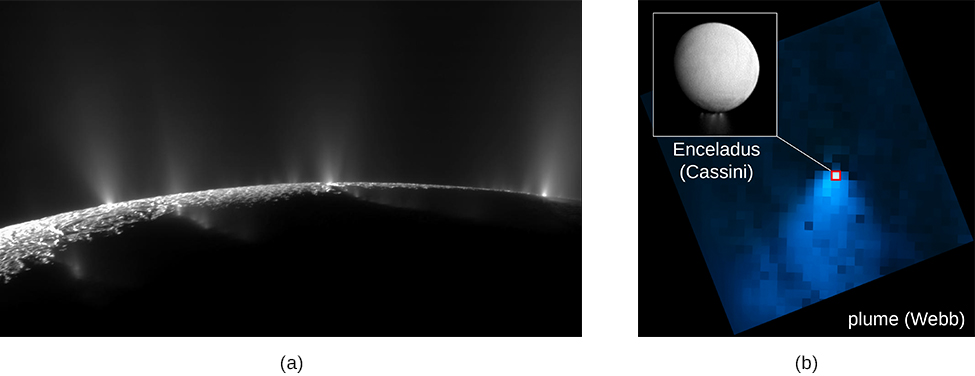
credit a: modification of work by NASA/JPL/Space Science Institute; credit b: modification of work by NASA/ESA · JPL image use policy
Figure 12.29 (a) This Cassini image shows a number of water geysers on Saturn’s small moon Enceladus, apparently salty water from a subsurface source escaping through cracks in the surface. You can see curved lines of geysers along the four “tiger stripes” on the surface. (b) In this 2023 infrared image from the James Webb Space Telescope, we see a plume of water vapor (in blue) more than 9600 km long, extending out from the southern hemisphere of Enceladus (the moon is within the white box in this highly enlarged image). Mission scientists estimate that water vapor was being expelled at such a rate that the water could fill an Olympic-sized swimming pool in just a couple of hours. (credit a: modification of work by NASA/JPL/Space Science Institute; credit b: modification of work by NASA/ESA)
図12.29 (a)このカッシーニの画像には、土星の小さな衛星エンケラドゥスの水の間欠泉が多数写っている。地下の供給源から来た塩水が、表面の割れ目から噴き出していると考えられる。表面の四本の「タイガーストライプ」に沿って、間欠泉が曲線状に並ぶ様子が見える。(b)2023年にジェイムズ・ウェッブ宇宙望遠鏡が撮影したこの赤外線画像では、エンケラドゥスの南半球から長さ9600kmを超える水蒸気の噴出物(青)が伸びている。この大きく拡大した画像では、衛星は白枠の中にある。観測チームの科学者たちの推定によれば、水蒸気は、わずか2時間ほどでオリンピック規格のプールを満たせるほどの勢いで放出されていた。(aのクレジット:NASA/JPL/Space Science Instituteの作品を改変。bのクレジット:NASA/ESAの作品を改変)