第12章環・衛星・冥王星Rings, Moons, and Pluto
12.1 Ring and Moon Systems Introduced12.1 環と衛星の系への入門
Learning Objectives学習の目標
By the end of this section, you will be able to:
この節を学び終えると、次のことができるようになる。
Briefly describe the system of moons around each of the jovian planets
各木星型惑星の周りにある衛星の系を簡潔に説明する。
Describe the basic composition of each jovian planet’s ring system
各木星型惑星の環の基本的な組成を説明する。
The rings and moons (see the moons in Figure 12.2) of the outer solar system are not composed of the same materials as the mostly rocky objects in the inner solar system. We should expect this, since they formed in regions of lower temperature, cool enough so that large quantities of water ice were available as building materials. Most of these objects also contain dark, organic compounds mixed with their ice and rock. Don’t be surprised, therefore, to find that many objects in the ring and moon systems are both icy and dark.
英語のヒント
外側の太陽系の環と衛星(衛星は図12.2参照)は、内側の太陽系の、主として岩石からなる天体と同じ材料でできているわけではない。これは予想できることである。形成された場所の温度が低く、水の氷が大量に存在して、材料として使えるほど寒かったからだ。これらの天体の大半には、氷や岩石に混じって、暗い色の有機化合物も含まれている。したがって、環や衛星の系の天体の多くが、氷に富むと同時に暗い色をしていても、不思議ではない。
Roughly a quarter of the moons in the outer solar system are in direct or regular orbits; that is, they revolve about their parent planet in a west-to-east direction and in the plane of the planet’s equator. The majority are irregular moons that orbit in a retrograde (east-to-west) direction or else have orbits of high eccentricity (more elliptical than circular) or high inclination (moving in and out of the planet’s equatorial plane). These irregular moons are mostly located relatively far from their planet; they were probably formed elsewhere and subsequently captured by the planet they now orbit.
英語のヒント
外側の太陽系の衛星のおよそ4分の1は、順行の、すなわち規則的な軌道を回る。つまり、親惑星の周囲を西から東の方向へ、惑星の赤道面内で公転している。大多数は不規則衛星で、逆行、すなわち東から西へ回るか、離心率の大きな軌道(円よりも楕円に近い形)や、軌道傾斜角の大きな軌道(惑星の赤道面から上下にはみ出して動く軌道)を持つ。これらの不規則衛星は、ほとんどが惑星から比較的遠いところにある。おそらく別の場所ででき、その後、現在回っている惑星に捕獲されたのだろう。
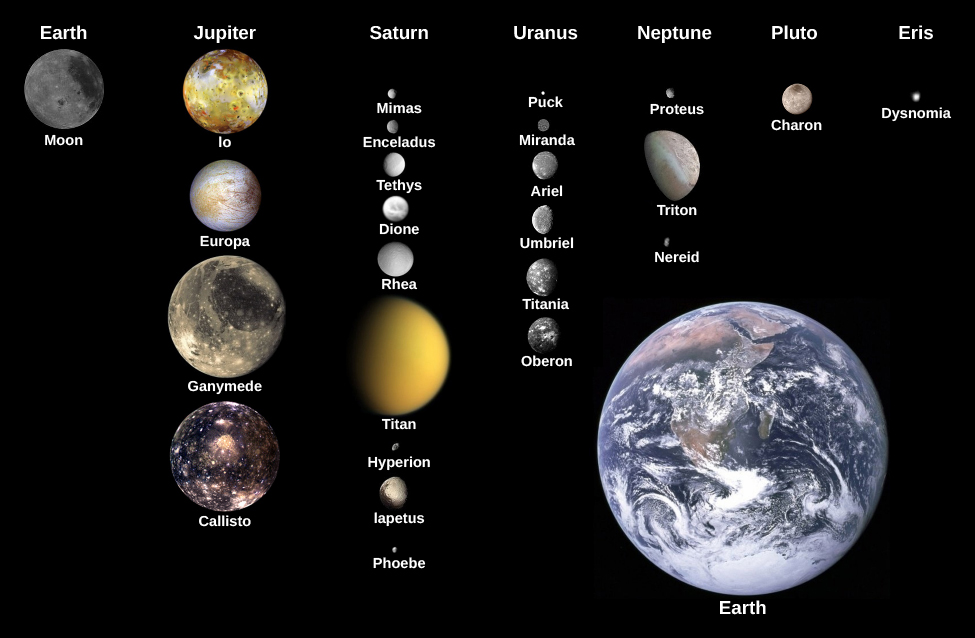
Moons of the Solar System.太陽系の衛星。
credit: modification of work by NASA · NASA media use guidelines
Figure 12.2 This image shows some selected moons of our solar system and their comparison to the size of Earth’s Moon and Earth itself. (credit: modification of work by NASA)
図12.2 太陽系から選んだいくつかの衛星を、地球の月および地球自体の大きさと比較した画像。(クレジット:NASAの作品を改変)
The Jupiter System木星系
Jupiter has 97 known moons (that’s the number as we write) and a faint ring. These include four large moons—Callisto, Ganymede, Europa, and Io (see Figure 12.1)—discovered in 1610 by Galileo and therefore often called the Galilean moons. The smaller of these, Europa and Io, are about the size of our Moon, while the larger, Ganymede and Callisto, are about the same size as the planet Mercury. Most of Jupiter’s moons are much smaller. The majority are in retrograde orbits more than 20 million kilometers from Jupiter; these are very likely small captured asteroids.
英語のヒント
木星には97個の既知の衛星(執筆時点の数)と淡い環がある。その中には、カリスト、ガニメデ、エウロパ、イオという4つの大きな衛星が含まれる(図12.1参照)。1610年にガリレオが発見したため、これらはよくガリレオ衛星と呼ばれる。小さい方のエウロパとイオは地球の月ほどの大きさで、大きい方のガニメデとカリストは水星ほどの大きさである。木星の衛星の大半は、それよりずっと小さい。大多数は木星から2000万キロメートル以上離れた逆行軌道にあり、捕獲された小さな小惑星である可能性が非常に高い。
The Saturn System土星系
Saturn has at least 274 known moons (including 128 small ones announced in early 2025), in addition to a magnificent set of rings. The largest of the moons, Titan, is almost as big as Ganymede in Jupiter’s system, and it is the only moon with a substantial atmosphere and lakes or seas of liquid hydrocarbons (such as methane and ethane) on the surface. Saturn has six other large regular moons with diameters between 400 and 1600 kilometers, a collection of small moons orbiting in or near the rings, and many captured strays similar to those of Jupiter. Mysteriously, one of Saturn’s smaller moons, Enceladus, has active geysers of water being expelled into space.
英語のヒント
土星には壮麗な環に加え、少なくとも274個の既知の衛星がある。この数には、2025年初めに発表された128個の小さな衛星も含まれる。最大のタイタンは、木星系のガニメデとほぼ同じ大きさである。また、厚い大気と、地表にメタンやエタンなどの液体炭化水素の湖や海を持つ、唯一の衛星でもある。土星にはさらに、直径400~1600キロメートルの大きな規則衛星が6個あり、環の中や近くを回る小さな衛星群と、木星と同様の、捕獲された多数の迷い込んだ天体がある。不思議なことに、小さな衛星の一つであるエンケラドゥスには、水を宇宙空間へ噴き出す活発な間欠泉がある。
The rings of Saturn, one of the most impressive sights in the solar system, are broad and flat, with a few major and many minor gaps. They are not solid, but rather a huge collection of icy fragments, all orbiting the equator of Saturn in a traffic pattern that makes rush hour in a big city look simple by comparison. Individual ring particles are composed primarily of water ice and are typically the size of ping-pong balls, tennis balls, and basketballs.
英語のヒント
太陽系でも特に印象的な光景の一つである土星の環は、幅広く平たく、いくつかの大きな隙間と数多くの小さな隙間を持つ。環は一枚の固体ではなく、膨大な氷の破片の集まりである。破片はすべて土星の赤道を周回しており、その交通の様子に比べれば、大都市のラッシュアワーさえ単純に見える。個々の環の粒子は主として水の氷でできており、典型的には卓球の球、テニスボール、バスケットボールほどの大きさである。
The Uranus System天王星系
The ring and moon system of Uranus is tilted at 98°, just like the planet itself. It consists of 11 rings and 29 currently known moons. The five largest moons are similar in size to the six regular moons of Saturn, with diameters of 500 to 1600 kilometers. Discovered in 1977, the rings of Uranus are narrow ribbons of dark material with broad gaps in between. Astronomers suppose that the ring particles are confined to these narrow paths by the gravitational effects of numerous small moons, many of which we have not yet glimpsed.
英語のヒント
天王星の環と衛星の系は、惑星本体と同じように98°傾いている。11本の環と、現在知られている29個の衛星からなる。最大の5衛星は、土星の6つの規則衛星と似た大きさで、直径は500~1600キロメートルである。1977年に発見された天王星の環は、暗い物質の細いリボン状の帯で、その間には広い隙間がある。天文学者は、数多くの小さな衛星の重力の作用によって、環の粒子がこうした細い経路に閉じ込められていると考えている。そのような小衛星の多くは、まだ姿さえ捉えられていない。
The Neptune System海王星系
Neptune has 16 known moons. The most interesting of these is Triton, a relatively large moon in a retrograde orbit—which is unusual. Triton has a very thin atmosphere, and active eruptions were discovered there by Voyager in its 1989 flyby. To explain its unusual characteristics, astronomers have suggested that Triton may have originated beyond the Neptune system, as a dwarf planet like Pluto. The rings of Neptune are narrow and faint. Like those of Uranus, they are composed of dark materials and are thus not easy to see.
英語のヒント
海王星には16個の既知の衛星がある。その中で最も興味深いのはトリトンで、比較的大きいにもかかわらず、珍しいことに逆行軌道を回る。トリトンは非常に薄い大気を持ち、1989年のボイジャーのフライバイでは、活動中の噴出現象が発見された。その変わった特徴を説明するため、天文学者は、トリトンがもともと海王星系の外にあり、冥王星のような準惑星だった可能性を提案している。海王星の環は細くて淡い。天王星の環と同様、暗い物質からできているため、見つけるのは容易ではない。
Key Concepts and Summary重要事項のまとめ
The four jovian planets are accompanied by impressive systems of moons and rings. Over 410 moons have been discovered in the outer solar system. Of the four ring systems, Saturn’s is the largest and is composed primarily of water ice; in contrast, Uranus and Neptune have narrow rings of dark material, and Jupiter has a tenuous ring of dust.
4つの木星型惑星は、見事な衛星と環の系を伴っている。外側の太陽系では410個を超える衛星が発見されている。4つの環の系のうち、土星のものが最大で、主として水の氷からなる。対照的に、天王星と海王星は暗い物質の細い環を持ち、木星はちりの非常に薄い環を持つ。