第27章活動銀河・クエーサー・超大質量ブラックホールActive Galaxies, Quasars, and Supermassive Black Holes
Thinking Aheadまず考えてみよう
Hubble Ultra-Deep Field.ハッブル・ウルトラ・ディープ・フィールド
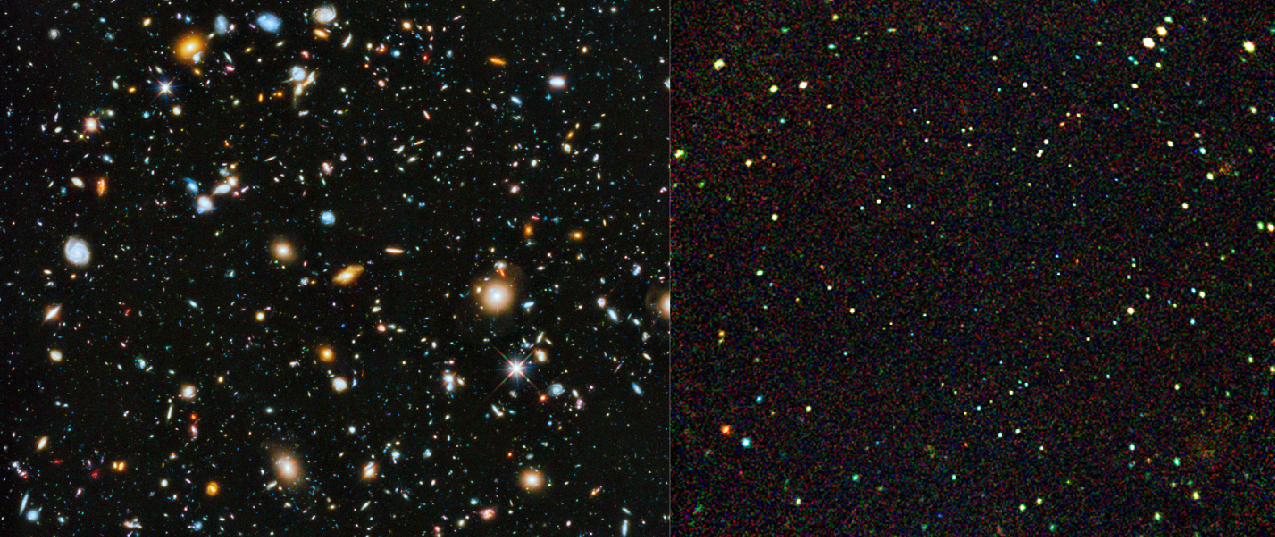
credit left: modification of work by NASA, ESA, H. Teplitz and M. Rafelski (IPAC/Caltech), A. Koekemoer (STScI), R. Windhorst (Arizona State University), and Z. Levay (STScI); credit right: modification of work by ESO/Mario Nonino, Piero Rosati, ESO GOODS Team · CC BY 4.0
Figure 27.1 The deepest picture of the sky in visible light (left) shows huge numbers of galaxies in a tiny patch of sky, only 1/100 the area of the full Moon. In contrast, the deepest picture of the sky taken in X-rays (right) shows large numbers of point-like quasars, which astronomers have shown are supermassive black holes at the very centers of galaxies. (credit left: modification of work by NASA, ESA, H. Teplitz and M. Rafelski (IPAC/Caltech), A. Koekemoer (STScI), R. Windhorst (Arizona State University), and Z. Levay (STScI); credit right: modification of work by ESO/Mario Nonino, Piero Rosati, ESO GOODS Team)
図27.1 可視光で最も深く撮った空の画像(左)は、満月の面積のわずか100分の1という小さな空の範囲に、膨大な数の銀河を示している。それに対し、X線で最も深く撮った空の画像(右)には、点状のクエーサーが多数見える。天文学者は、これらが銀河のまさに中心にある超大質量ブラックホールだと明らかにしている。(左:NASA、ESA、H. TeplitzとM. Rafelski[IPAC/Caltech]、A. Koekemoer[STScI]、R. Windhorst[アリゾナ州立大学]、Z. Levay[STScI]の作品を改変。右:ESO/Mario Nonino、Piero Rosati、ESO GOODS Teamの作品を改変。)
During the first half of the twentieth century, astronomers viewed the universe of galaxies as a mostly peaceful place. They assumed that galaxies formed billions of years ago and then evolved slowly as the populations of stars within them formed, aged, and died. That placid picture completely changed in the last few decades of the twentieth century.
英語のヒント
20世紀前半、天文学者は、銀河からなる宇宙を、ほとんど平穏な場所と見ていた。銀河は数十億年前に形成され、その後は内部の星々が生まれ、年を取り、死んでいくにつれて、ゆっくり進化してきたと考えていたのである。この穏やかな描像は、20世紀最後の数十年で一変した。
Today, astronomers can see that the universe is often shaped by violent events, including cataclysmic explosions of supernovae, collisions of whole galaxies, and the tremendous outpouring of energy as matter interacts in the environment surrounding very massive black holes. The key event that began to change our view of the universe was the discovery of a new class of objects: quasars.
英語のヒント
今日の天文学者には、宇宙がしばしば激しい出来事によって形づくられることがわかる。超新星の激烈な爆発、銀河全体の衝突、そして非常に大質量のブラックホールを取り巻く環境で物質が相互作用することによる、途方もないエネルギーの放出などである。この宇宙観の変化のきっかけとなった重要な出来事は、新しい種類の天体、クエーサーの発見だった。