第27章活動銀河・クエーサー・超大質量ブラックホールActive Galaxies, Quasars, and Supermassive Black Holes
27.1 Quasars27.1 クエーサー
Learning Objectives学習の目標
By the end of this section, you will be able to:
この節を終えると、次のことができるようになる。
Describe how quasars were discovered
クエーサーがどのように発見されたかを説明する。
Explain how astronomers determined that quasars are at the distances implied by their redshifts
クエーサーが、その赤方偏移から示唆される距離にあると、天文学者がどのように確かめたかを説明する。
Justify the statement that the enormous amount of energy produced by quasars is generated in a very small volume of space
クエーサーの膨大なエネルギーは、非常に小さな空間の中で生み出される、という主張の根拠を示す。
The name “quasars” started out as short for “quasi-stellar radio sources” (here “quasi-stellar” means “sort of like stars”). The discovery of radio sources that appeared point-like, just like stars, came with the use of surplus World War II radar equipment in the 1950s. Although few astronomers would have predicted it, the sky turned out to be full of strong sources of radio waves. As they improved the images that their new radio telescopes could make, scientists discovered that some radio sources were in the same location as faint blue “stars.” No known type of star in our Galaxy emits such powerful radio radiation. What then were these “quasi-stellar radio sources”?
英語のヒント
「クエーサー」という名称は、quasi-stellar radio sources、すなわち「準恒星状電波源」の略として始まった。quasi-stellarは「どことなく星のような」という意味である。星と同じように点に見える電波源が見つかったのは、1950年代、第二次世界大戦で使われた余剰のレーダー装置を利用するようになってからだった。予想した天文学者はほとんどいなかっただろうが、空は強い電波の発生源でいっぱいだとわかった。新しい電波望遠鏡で得られる画像が改良されると、いくつかの電波源は、暗く青い「星」と同じ位置にあることがわかった。しかし、私たちの銀河で知られているどの種類の星も、それほど強い電波を放射しない。それなら、この「準恒星状電波源」は何だったのだろうか。
Redshifts: The Key to Quasars赤方偏移――クエーサーを解く鍵
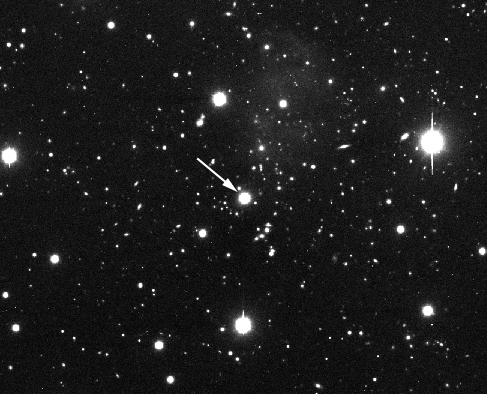
The answer came when astronomers obtained visible-light spectra of two of those faint “blue stars” that were strong sources of radio waves (Figure 27.2). Spectra of these radio “stars” only deepened the mystery: they had emission lines, but astronomers at first could not identify them with any known substance. By the 1960s, astronomers had a century of experience in identifying elements and compounds in the spectra of stars. Elaborate tables had been published showing the lines that each element would produce under a wide range of conditions. A “star” with unidentifiable lines in the ordinary visible light spectrum had to be something completely new.
英語のヒント
答えが得られたのは、強い電波源となっている暗い「青い星」のうち二つについて、可視光スペクトルを得たときだった(図27.2)。この電波を出す「星」のスペクトルは、かえって謎を深めた。輝線はあるのに、当初、天文学者はそれを既知のどの物質とも結びつけられなかったのである。1960年代までに、天文学者は、恒星のスペクトルから元素や化合物を同定する仕事を1世紀にわたって積み重ねていた。さまざまな条件のもとで各元素がどの線を出すかを示す、精緻な表も出版されていた。普通の可視光スペクトルに同定できない線を持つ「星」は、まったく新しい何かに違いなかった。
Typical Quasar.典型的なクエーサー
credit: modification of work by WIYN Telescope, Kitt Peak National Observatory, NOAO · CC BY 4.0
Figure 27.2 The arrow in this image marks the quasar known by its catalog number, PKS 1117-248. Note that nothing in this image distinguishes the quasar from an ordinary star. Its spectrum, however, shows that it is moving away from us at a speed of 36% the speed of light, or 67,000 miles per second. In contrast, the maximum speed observed for any star is only a few hundred miles per second. (credit: modification of work by WIYN Telescope, Kitt Peak National Observatory, NOAO)
図27.2 矢印は、カタログ番号PKS 1117-248で知られるクエーサーを示す。この画像だけでは、普通の恒星とクエーサーを見分けるものはないことに注意しよう。しかし、そのスペクトルは、光速の36%、すなわち秒速6万7000マイルで、私たちから遠ざかっていることを示す。それに対し、恒星で観測される最大速度は、秒速数百マイルにすぎない。(キットピーク国立天文台、NOAOのWIYN望遠鏡の作品を改変。)
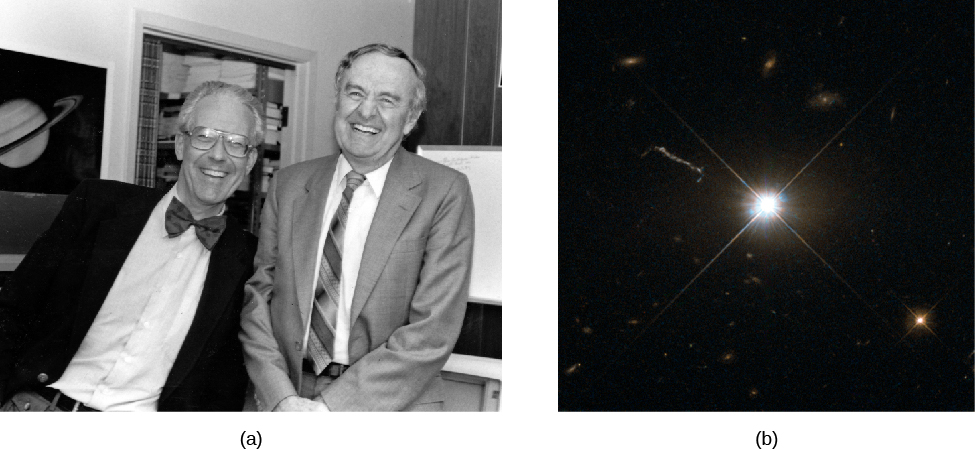
In 1963 at Caltech’s Palomar Observatory, Maarten Schmidt (Figure 27.3) was puzzling over the spectrum of one of the radio stars, which was named 3C 273 because it was the 273rd entry in the third Cambridge catalog of radio sources (part (b) of Figure 27.3). There were strong emission lines in the spectrum, and Schmidt recognized that they had the same spacing between them as the Balmer lines of hydrogen (see Radiation and Spectra). But the lines in 3C 273 were shifted far to the red of the wavelengths at which the Balmer lines are normally located. Indeed, these lines were at such long wavelengths that if the redshifts were attributed to the Doppler effect, 3C 273 was receding from us at a speed of 45,000 kilometers per second, or about 15% the speed of light! Since stars don’t show Doppler shifts this large, no one had thought of considering high redshifts to be the cause of the strange spectra.
英語のヒント
1963年、カリフォルニア工科大学のパロマー天文台で、マーテン・シュミット(図27.3)は、ある電波を出す星のスペクトルを前に考え込んでいた。それは、ケンブリッジの第3電波源カタログで273番目の項目だったことから、3C 273と名づけられていた(図27.3のb)。スペクトルには強い輝線があり、シュミットは、その線どうしの間隔が、水素のバルマー系列の線と同じであることに気づいた(「放射とスペクトル」参照)。しかし、3C 273の線は、バルマー線の通常の波長より、はるかに赤い側へずれていた。その波長は実に長く、赤方偏移をドップラー効果によるものと解釈すれば、3C 273は秒速4万5000キロメートル、光速の約15%で私たちから遠ざかっていることになる。恒星はこれほど大きいドップラー偏移を示さないため、奇妙なスペクトルの原因として、大きな赤方偏移を考えた人はいなかったのである。
Quasar Pioneers and Quasar 3C 273.クエーサー研究の先駆者たちと3C 273
credit a: modification of work by Andrew Fraknoi; credit b: modification of work by ESA/Hubble/NASA · CC BY 4.0
Figure 27.3 (a) Maarten Schmidt (left), who solved the puzzle of the quasar spectra in 1963, shares a joke in this 1987 photo with Allan Sandage, who took the first spectrum of a quasar. Sandage was also instrumental in measuring the value of Hubble’s constant. (b) This is the first quasar for which a redshift was measured. The redshift showed that the light from it took about 2.5 billion years to reach us. Despite this great distance, it is still one of the quasars closest to the Milky Way Galaxy. Note also the faint streak going toward the upper left from the quasar. Some quasars, like 3C 273, eject super-fast jets of material. The jet from 3C 273 is about 200,000 light-years long. (credit a: modification of work by Andrew Fraknoi; credit b: modification of work by ESA/Hubble/NASA)
図27.3 (a)1963年にクエーサーのスペクトルの謎を解いたマーテン・シュミット(左)が、1987年のこの写真で、クエーサーの最初のスペクトルを撮ったアラン・サンデージと冗談を交わしている。サンデージは、ハッブル定数の測定でも重要な役割を果たした。(b)赤方偏移が初めて測定されたクエーサー。その赤方偏移から、光が私たちへ届くのに約25億年かかったことがわかった。それほど遠くても、天の川銀河に最も近いクエーサーの一つである。クエーサーから左上へ延びる淡い筋にも注目しよう。3C 273のような一部のクエーサーは、超高速の物質のジェットを放出する。3C 273のジェットの長さは約20万光年である。(a:アンドリュー・フラクノイの作品を改変。b:ESA/Hubble/NASAの作品を改変。)
The puzzling emission lines in other star-like radio sources were then reexamined to see if they, too, might be well-known lines with large redshifts. This proved to be the case, but the other objects were found to be receding from us at even greater speeds. Their astounding speeds showed that the radio “stars” could not possibly be stars in our own Galaxy. Any true star moving at more than a few hundred kilometers per second would be able to overcome the gravitational pull of the Galaxy and completely escape from it. (As we shall see later in this chapter, astronomers eventually discovered that there was also more to these “stars” than just a point of light.)
英語のヒント
ほかの星状の電波源に見られた謎の輝線も、大きな赤方偏移を受けた既知の線ではないかと調べ直された。そのとおりであるとわかったが、ほかの天体は、さらに大きな速さで私たちから遠ざかっていた。この驚くべき速さは、電波を出す「星」が、私たちの銀河の中の恒星であるはずがないことを示した。秒速数百キロメートルを超えて動く本物の恒星なら、銀河の重力を振り切り、完全に外へ脱出できるからである。この章で後に見るように、天文学者はやがて、この「星」が単なる光の点以上のものであることも発見する。
It turns out that these high-velocity objects only look like stars because they are compact and very far away. Later, astronomers discovered objects with large redshifts that appear star-like but have no radio emission. Observations also showed that quasars were bright in the infrared and X-ray bands too, and not all these X-ray or infrared-bright quasars could be seen in either the radio or the visible-light bands of the spectrum. Today, all these objects are referred to as quasi-stellar objects (QSOs), or, as they are more popularly known, quasars. (The name was also soon appropriated by a manufacturer of home electronics.)
英語のヒント
これらの高速の天体が恒星のように見えるのは、小さくまとまっていて、非常に遠くにあるからにすぎない。その後、天文学者は、大きな赤方偏移を持ち、恒星のように見えるのに、電波を出さない天体も発見した。クエーサーは赤外線やX線の波長帯でも明るいとわかったが、そのようなクエーサーが、電波や可視光の波長帯でも必ず見えるわけではなかった。今日では、これらをすべて準恒星状天体(QSO)と呼び、より一般的にはクエーサーとして知られている。この名前は、まもなく家庭用電子機器のメーカーにも採用された。
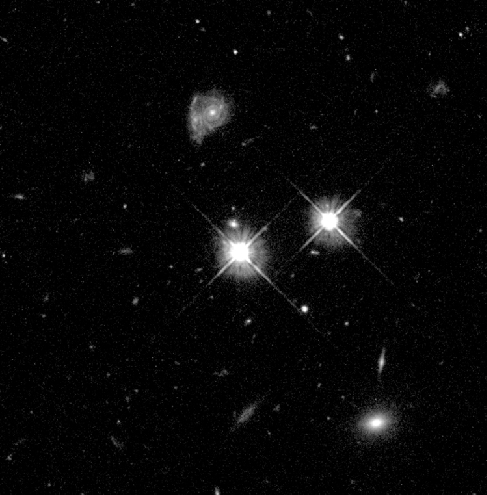
Over a million quasars have now been discovered, and spectra are available for over a hundred thousand. All these spectra show redshifts, none show blueshifts, and their redshifts can be very large. Yet in a photo they look just like stars (Figure 27.4).
英語のヒント
今では100万個を超えるクエーサーが発見され、10万個以上についてスペクトルが得られている。すべてのスペクトルは赤方偏移を示し、青方偏移を示すものはない。その赤方偏移は非常に大きいこともある。それでも、写真では恒星とそっくりに見える(図27.4)。
Typical Quasar Imaged by the Hubble Space Telescope.ハッブル宇宙望遠鏡が撮った典型的なクエーサー
credit: Charles Steidel (CIT)/NASA/ESA · NASA media use guidelines
Figure 27.4 One of these two bright “stars” in the middle is in our Galaxy, while the other is a quasar 9 billion light-years away. From this picture alone, there’s no way to say which is which. (The quasar is the one in the center of the picture.) (credit: Charles Steidel (CIT)/NASA/ESA)
図27.4 中央付近の明るい二つの「星」のうち、一つは私たちの銀河にあり、もう一つは90億光年離れたクエーサーである。この画像だけでは、どちらがどちらかを判断する方法はない。クエーサーは画像の中央にあるほうである。(提供:Charles Steidel[CIT]/NASA/ESA)
In the record-holding quasars, the first Lyman series line of hydrogen, with a laboratory wavelength of 121.5 nanometers in the ultraviolet portion of the spectrum, is shifted all the way through the visible region to the infrared. At such high redshifts, the simple formula for converting a Doppler shift to speed (Radiation and Spectra) must be modified to take into account the effects of the theory of relativity. If we apply the relativistic form of the Doppler shift formula, we find that these redshifts correspond to velocities of about 96% of the speed of light.
英語のヒント
記録的に大きな赤方偏移を持つクエーサーでは、水素のライマン系列の最初の線が、可視光領域をすべて通り越し、赤外線までずれている。この線の実験室での波長は121.5ナノメートルで、本来は紫外線にある。このように大きい赤方偏移では、「放射とスペクトル」で扱った、ドップラー偏移を速さへ変換する単純な式を、相対性理論の効果を考慮するよう修正しなければならない。相対論的なドップラー偏移の式を適用すると、これらの赤方偏移は、光速の約96%という速度に対応することがわかる。
Recession Speed of a Quasarクエーサーの後退速度
The formula for the Doppler shift, which astronomers denote by the letters z, is
天文学者がzで表すドップラー偏移の式は、次のとおりである。
where λ is the wavelength emitted by a source of radiation that is not moving, Δλ is the difference between that wavelength and the wavelength we measure, v is the speed with which the source moves away, and c (as usual) is the speed of light.
ここで、λは動いていない放射源が出す波長、Δλはその波長と測定した波長の差、vは放射源が遠ざかる速さ、cはいつものように光速である。
A line in the spectrum of a galaxy is at a wavelength of 393 nanometers (nm, or 10–9 m) when the source is at rest. Let’s say the line is measured to be longer than this value (redshifted) by 7.86 nm. Then its redshift , so its speed away from us is 2% of the speed of light
ある銀河のスペクトルの線は、光源が静止しているとき、393ナノメートルの波長を持つ。ナノメートルはnmと書き、10–9 mである。この線の波長が、測定ではその値より7.86 nm長く、すなわち赤方偏移していたとしよう。すると赤方偏移はであり、私たちから遠ざかる速さは光速の2%となる
This formula is fine for galaxies that are relatively nearby and are moving away from us slowly in the expansion of the universe. But the quasars and distant galaxies we discuss in this chapter are moving away at speeds close to the speed of light. In that case, converting a Doppler shift (redshift) to a distance must include the effects of the special theory of relativity, which explains how measurements of space and time change when we see things moving at high speeds. The details of how this is done are way beyond the level of this text, but we can share with you the relativistic formula for the Doppler shift:
この式は、比較的近くにあり、宇宙膨張によってゆっくり遠ざかる銀河には十分使える。しかし、この章で扱うクエーサーや遠方の銀河は、光速に近い速度で遠ざかっている。この場合、ドップラー偏移、すなわち赤方偏移を距離へ変換するには、特殊相対性理論の効果を含めなければならない。この理論は、高速で動くものを見るとき、空間と時間の測定がどのように変わるかを説明する。計算方法の詳しい説明は本書の水準を大きく超えるが、相対論的なドップラー偏移の式は示せる。
Let’s do an example. Suppose a distant quasar has a redshift of 3. At what fraction of the speed of light is the quasar moving away?
例を考えよう。ある遠方のクエーサーの赤方偏移が3だとする。このクエーサーは、光速の何倍の速さで遠ざかっているか。
Solution解き方
We calculate the following:
次のように計算する。
The quasar is thus receding from us at about 88% the speed of light.
したがって、このクエーサーは光速の約88%で、私たちから遠ざかっている。
Check Your Learning理解を確かめよう
Several lines of hydrogen absorption in the visible spectrum have rest wavelengths of 410 nm, 434 nm, 486 nm, and 656 nm. In a spectrum of a distant galaxy, these same lines are observed to have wavelengths of 492 nm, 521 nm, 583 nm, and 787 nm respectively. What is the redshift of this galaxy? What is the recession speed of this galaxy?
可視光スペクトルにある水素の吸収線のうち、いくつかの静止波長は410 nm、434 nm、486 nm、656 nmである。遠くの銀河のスペクトルでは、同じ線がそれぞれ492 nm、521 nm、583 nm、787 nmに観測される。この銀河の赤方偏移はいくらか。後退速度はいくらか。