第27章活動銀河・クエーサー・超大質量ブラックホールActive Galaxies, Quasars, and Supermassive Black Holes
Quasars Obey the Hubble Lawクエーサーはハッブルの法則に従う
The first question astronomers asked was whether quasars obeyed the Hubble law and were really at the large distances implied by their redshifts. If they did not obey the rule that large redshift means large distance, then they could be much closer, and their luminosity could be a lot less. One straightforward way to show that quasars had to obey the Hubble law was to demonstrate that they were actually part of galaxies, and that their redshift was the same as the galaxy that hosted them. Since ordinary galaxies do obey the Hubble law, anything within them would be subject to the same rules.
英語のヒント
天文学者が最初に問うたのは、クエーサーはハッブルの法則に従い、その赤方偏移が示す大きな距離に本当にあるのか、ということだった。大きい赤方偏移は大きい距離を意味する、という規則に従わないなら、クエーサーはずっと近くにあり、その光度もはるかに小さいかもしれない。クエーサーがハッブルの法則に従うことを示す率直な方法の一つは、それが実際に銀河の一部であり、母銀河と同じ赤方偏移を持つと示すことである。普通の銀河はハッブルの法則に従うのだから、その内部のものも同じ規則に従うはずである。
Observations with the Hubble Space Telescope provided the strongest evidence showing that quasars are located at the centers of galaxies. Hints that this is true had been obtained with ground-based telescopes, but space observations were required to make a convincing case. The reason is that quasars can outshine their entire galaxies by factors of 10 to 100 or even more. When this light passes through Earth’s atmosphere, it is blurred by turbulence and drowns out the faint light from the surrounding galaxy—much as the bright headlights from an oncoming car at night make it difficult to see anything close by.
英語のヒント
ハッブル宇宙望遠鏡の観測は、クエーサーが銀河の中心に位置することを示す、最も強い証拠を与えた。地上の望遠鏡でもその手がかりは得られていたが、説得力のある裏づけには宇宙からの観測が必要だった。クエーサーは母銀河全体よりも、10〜100倍、あるいはそれ以上も明るく光ることがあるからである。その光が地球の大気を通ると、乱流によってぼやけ、周囲の銀河の淡い光を覆い隠してしまう。夜、向かってくる車の明るいヘッドライトの近くにあるものが、見えにくくなるのとよく似ている。
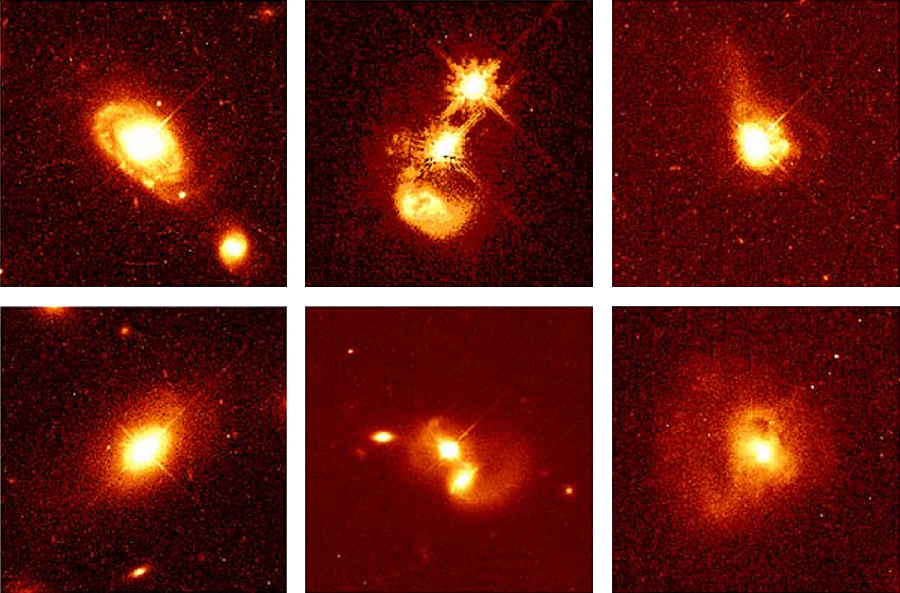
The Hubble Space Telescope, however, is not affected by atmospheric turbulence and can detect the faint glow from some of the galaxies that host quasars (Figure 27.5). Quasars have been found in the cores of both spiral and elliptical galaxies, and each quasar has the same redshift as its host galaxy. A wide range of studies with the Hubble Space Telescope now clearly demonstrate that quasars are indeed far away. If so, they must be producing a truly impressive amount of energy to be detectable as points of light that are much brighter than their galaxy. Interestingly, many quasar host galaxies are found to be involved in a collision with a second galaxy, providing, as we shall see, an important clue to the source of their prodigious energy output.
英語のヒント
しかしハッブル宇宙望遠鏡は、大気の乱流の影響を受けないため、クエーサーを宿す銀河の一部から、淡い光を検出できる(図27.5)。クエーサーは渦巻銀河と楕円銀河の両方の中心核に見つかり、いずれも母銀河と同じ赤方偏移を持つ。ハッブル宇宙望遠鏡による幅広い研究は今や、クエーサーが確かに遠方にあることを明瞭に示している。そうであれば、母銀河よりはるかに明るい光の点として検出されるためには、本当に途方もない量のエネルギーを生み出していなければならない。興味深いことに、多くのクエーサーの母銀河が、別の銀河との衝突に関わっているとわかっている。後で見るように、これは、その膨大なエネルギー出力の源を探る重要な手がかりになる。
Quasar Host Galaxies.クエーサーの母銀河
credit: modification of work by John Bahcall, Mike Disney, NASA · NASA media use guidelines
Figure 27.5 The Hubble Space Telescope reveals the much fainter “host” galaxies around quasars. The top left image shows a quasar that lies at the heart of a spiral galaxy 1.4 billion light-years from Earth. The bottom left image shows a quasar that lies at the center of an elliptical galaxy some 1.5 billion light-years from us. The middle images show remote pairs of interacting galaxies, one of which harbors a quasar. Each of the right images shows long tails of gas and dust streaming away from a galaxy that contains a quasar. Such tails are produced when one galaxy collides with another. (credit: modification of work by John Bahcall, Mike Disney, NASA)
図27.5 ハッブル宇宙望遠鏡は、クエーサーの周囲にある、はるかに暗い母銀河を明らかにする。左上の画像は、地球から14億光年離れた渦巻銀河の中心にあるクエーサーを示す。左下は、約15億光年離れた楕円銀河の中心にあるクエーサーである。中央は相互作用する遠方の銀河の対で、一方がクエーサーを宿している。右の各画像には、クエーサーを含む銀河から遠ざかる方向へ流れる、ガスと塵の長い尾が見える。このような尾は、銀河どうしの衝突で生じる。(John Bahcall、Mike Disney、NASAの作品を改変。)
The Size of the Energy Sourceエネルギー源の大きさ
Given their large distances, quasars have to be extremely luminous to be visible to us at all—far brighter than any normal galaxy. In visible light alone, most are far more energetic than the brightest elliptical galaxies. But, as we saw, quasars also emit energy at X-ray and ultraviolet wavelengths, and some are radio sources as well. When all their radiation is added together, some QSOs have total luminosities as large as a hundred trillion Suns (1014 LSun), which is 10 to 100 times the brightness of luminous elliptical galaxies.
英語のヒント
クエーサーは非常に遠いため、そもそも私たちに見えるには、普通のどの銀河よりも、はるかに大きな光度を持っていなければならない。可視光だけを見ても、大半は、最も明るい楕円銀河よりずっと多くのエネルギーを放っている。しかし、すでに見たように、クエーサーはX線や紫外線でもエネルギーを出し、一部は電波源でもある。すべての放射を合計すると、総光度が太陽の100兆倍(1014 LSun)にも達するQSOがある。これは、明るい楕円銀河の光度の10〜100倍である。
Finding a mechanism to produce the large amount of energy emitted by a quasar would be difficult under any circumstances. But there is an additional problem. When astronomers began monitoring quasars carefully, they found that some vary in luminosity on time scales of months, weeks, or even, in some cases, days. This variation is irregular and can change the brightness of a quasar by a few tens of percent in both its visible light and radio output.
英語のヒント
クエーサーが放つ大量のエネルギーを生む仕組みを見つけるのは、どんな状況でも難しいだろう。しかし、さらに問題がある。天文学者がクエーサーを注意深く監視し始めると、数か月、数週間、ときには数日という時間尺度で、光度が変わるものがあるとわかった。その変動は不規則で、可視光と電波の両方の出力で、明るさが数十%変わることもある。
Think about what such a change in luminosity means. A quasar at its dimmest is still more brilliant than any normal galaxy. Now imagine that the brightness increases by 30% in a few weeks. Whatever mechanism is responsible must be able to release new energy at rates that stagger our imaginations. The most dramatic changes in quasar brightness are equivalent to the energy released by 100,000 billion Suns. To produce this much energy we would have to convert the total mass of about ten Earths into energy every minute.
英語のヒント
このような光度変化が何を意味するのか考えよう。クエーサーは最も暗いときでさえ、普通のどの銀河よりも明るい。その明るさが、数週間で30%増すと想像してほしい。どのような仕組みが原因であれ、想像を絶する割合で、新しいエネルギーを放出できなければならない。クエーサーの明るさの最も劇的な変化は、太陽100兆個が放つエネルギーに相当する。この量のエネルギーを生み出すには、約10個の地球の全質量を、毎分エネルギーへ変換しなければならない。
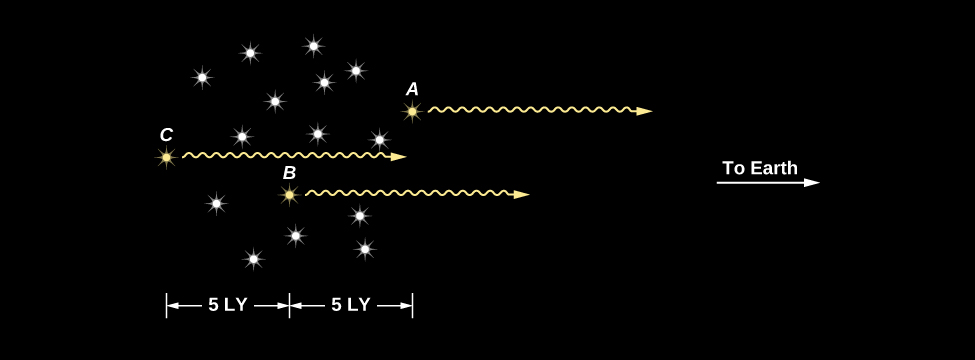
Moreover, because the fluctuations occur in such short times, the part of a quasar that is varying must be smaller than the distance light travels in the time it takes the variation to occur—typically a few months. To see why this must be so, let’s consider a cluster of stars 10 light-years in diameter at a very large distance from Earth (see Figure 27.6, in which Earth is off to the right). Suppose every star in this cluster somehow brightens simultaneously and remains bright. When the light from this event arrives at Earth, we would first see the brighter light from stars on the near side; 5 years later we would see increased light from stars at the center. Ten years would pass before we detected more light from stars on the far side.
英語のヒント
さらに、変動がそれほど短い時間で起きるのだから、変化しているクエーサーの部分は、光がその変動時間、典型的には数か月の間に進む距離よりも小さくなければならない。そうなる理由を理解するため、地球から非常に遠いところにある、直径10光年の星団を考えよう(図27.6。地球は図の右の外側にある)。星団のすべての星が、何らかの方法で同時に明るくなり、その明るさを保つとする。この出来事の光が地球に届くと、最初に見えるのは手前側の星からの明るくなった光である。5年後には、中心の星から増した光が届く。向こう側の星の光の増加を検出するまでには、10年が過ぎることになる。
How the Size of a Source Affects the Timescale of Its Variability.光源の大きさが変動の時間尺度へ及ぼす影響
OpenStax / Rice University · CC BY 4.0
Figure 27.6 This diagram shows why light variations from a large region in space appear to last for an extended period of time as viewed from Earth. Suppose all the stars in this cluster, which is 10 light-years across, brighten simultaneously and instantaneously. From Earth, star A will appear to brighten 5 years before star B, which in turn will appear to brighten 5 years earlier than star C. It will take 10 years for an Earth observer to get the full effect of the brightening.
図27.6 空間の広い領域で起きた光の変化が、地球からは長い時間をかけて起きるように見える理由を示した図。直径10光年のこの星団のすべての星が、同時に、一瞬で明るくなったとしよう。地球から見ると、AはBより5年早く明るくなり、BはCより5年早く明るくなる。地球の観測者が増光の全効果を受け取るまでには、10年かかる。
Even though all stars in the cluster brightened at the same time, the fact that the cluster is 10 light-years wide means that 10 years must elapse before the increased light from every part of the cluster reaches us. From Earth we would see the cluster get brighter and brighter, as light from more and more stars began to reach us. Not until 10 years after the brightening began would we see the cluster reach maximum brightness. In other words, if an extended object suddenly flares up, it will seem to brighten over a period of time equal to the time it takes light to travel across the object from its far side.
英語のヒント
星団のすべての星が同時に明るくなったとしても、直径が10光年あるため、すべての部分で増した光が私たちに届くまでには、10年が経過しなければならない。地球からは、次々に多くの星の光が届き始めるにつれて、星団がますます明るくなるように見える。明るくなり始めてから10年後になって初めて、最大の明るさに達した姿を見る。言い換えれば、広がりのある天体が突然明るくなっても、地球からは、その向こう側から光が天体全体を横切るのに必要な時間をかけて、明るくなったように見える。
We can apply this idea to brightness changes in quasars to estimate their diameters. Because quasars typically vary (get brighter and dimmer) over periods of a few months, the region where the energy is generated can be no larger than a few light-months across. If it were larger, it would take longer than a few months for the light from the far side to reach us.
英語のヒント
この考えをクエーサーの明るさの変化へ適用すれば、その直径を推定できる。クエーサーは通常、数か月の期間で明るくなったり暗くなったりする。そのため、エネルギーを生み出す領域の直径は、数光月を超えることはできない。それより大きければ、向こう側からの光が私たちへ届くまでに、数か月より長い時間がかかってしまう。
How large is a region of a few light-months? Pluto, usually the outermost (dwarf) planet in our solar system, is about 5.5 light-hours from us, while the nearest star is 4 light-years away. Clearly a region a few light months across is tiny relative to the size of the entire Galaxy. And some quasars vary even more rapidly, which means their energy is generated in an even smaller region. Whatever mechanism powers the quasars must be able to generate more energy than that produced by an entire galaxy in a volume of space that, in some cases, is not much larger than our solar system.
英語のヒント
数光月の領域とは、どれほどの大きさだろうか。太陽系で通常、最も外側の準惑星である冥王星は、私たちから約5.5光時にある。それに対し、最も近い恒星は4光年先にある。明らかに、直径数光月の領域は、銀河全体に比べればごく小さい。さらに速く変動するクエーサーもあり、その場合は、さらに小さな領域でエネルギーが生み出されていることになる。クエーサーを動かす仕組みは何であれ、場合によっては太陽系よりそれほど大きくない空間の中で、銀河全体が出す以上のエネルギーを生み出せなければならない。