第27章活動銀河・クエーサー・超大質量ブラックホールActive Galaxies, Quasars, and Supermassive Black Holes
27.2 Supermassive Black Holes: What Quasars Really Are27.2 超大質量ブラックホール――クエーサーの正体
Learning Objectives学習の目標
By the end of this section, you will be able to:
この節を終えると、次のことができるようになる。
Describe the characteristics common to all quasars
すべてのクエーサーに共通する特徴を説明する。
Justify the claim that supermassive black holes are the source of the energy emitted by quasars (and AGNs)
超大質量ブラックホールが、クエーサーやAGNの放つエネルギーの源だという主張の根拠を示す。
Explain how a quasar’s energy is produced
クエーサーのエネルギーが、どのように生み出されるかを説明する。
In order to find a common model for quasars (and their cousins, the AGNs), let’s first list the common characteristics we have been describing—and add some new ones:
英語のヒント
クエーサーと、その近縁であるAGNに共通するモデルを見つけるため、まず、ここまで述べてきた共通の特徴を挙げ、新しい特徴もいくつか付け加えよう。
Quasars are hugely powerful, emitting more power in radiated light than all the stars in our Galaxy combined.
クエーサーは途方もなく高い出力を持ち、私たちの銀河のすべての星を合わせたものより、大きな出力を光として放射する。
Quasars are tiny, about the size of our solar system (to astronomers, that is really small!).
クエーサーは小さく、その大きさは太陽系ほどである。天文学者にとっては、これは本当に小さい。
Some quasars are observed to be shooting out pairs of straight jets at close to the speed of light, in a tight beam, to distances far beyond the galaxies they live in. These jets are themselves powerful sources of radio and gamma-ray radiation.
一部のクエーサーは、光速に近い速度で、2本1組のまっすぐなジェットを、細く絞られたビームとして放出している。ジェットは母銀河をはるかに越える距離まで伸びる。このジェット自体も、強力な電波やガンマ線の放射源となる。
Because quasars put out so much power from such a small region, they can’t be powered by nuclear fusion the way stars are; they must use some process that is far more efficient.
クエーサーは、それほど小さな領域から非常に大きな出力を放つため、恒星のように核融合を動力源にすることはできない。はるかに効率のよい、何か別の過程を使わなければならない。
As we shall see later in this chapter, quasars were much more common when the universe was young than they are today. That means they must have been able to form in the first billion years or so after the universe began to expand.
この章で後に見るように、クエーサーは現在よりも、宇宙が若かったころのほうが、はるかに多かった。したがって、宇宙が膨張を始めてから最初のおよそ10億年以内に、形成できたはずである。
The readers of this text are in a much better position than the astronomers who discovered quasars in the 1960s to guess what powers the quasars. That’s because the key idea in solving the puzzle came from observations of the black holes we discussed in Black Holes and Curved Spacetime. The discovery of the first stellar mass black hole in the binary system Cygnus X-1 was announced in 1971, several years after the discovery of quasars. Proof that there is a black hole at the center of our own Galaxy came even later. Back when astronomers first began trying to figure out what powered quasars, black holes were simply one of the more exotic predictions of the general theory of relativity that still waited to be connected to the real world.
英語のヒント
本書の読者は、クエーサーを動かすものを推測するうえで、1960年代にそれを発見した天文学者たちより、ずっと有利な立場にいる。この謎を解く鍵となる考えは、「ブラックホールと曲がった時空」で扱った、ブラックホールの観測から生まれたからである。連星系はくちょう座X-1で最初の恒星質量ブラックホールが発見されたという発表は1971年で、クエーサーの発見より数年遅かった。私たちの銀河中心にブラックホールがある証拠が得られたのは、さらに後である。クエーサーの動力源を考え始めた当時、ブラックホールは、一般相対性理論のとりわけ風変わりな予測の一つにすぎず、まだ現実の世界とのつながりを待っていた。
It was only as proof of the existence of black holes accumulated over several decades that it became clearer that only supermassive black holes could account for all the observed properties of quasars and AGNs. As we saw in The Milky Way Galaxy, our own Galaxy has a black hole in its center, and the energy is emitted from a small central region. While our black hole doesn’t have the mass or energy of the quasar black holes, the mechanism that powers them is similar. The evidence now shows that most—and probably all—elliptical galaxies and all spirals with nuclear bulges have black holes at their centers. The amount of energy emitted by material near the black hole depends on two things: the mass of the black hole and the amount of matter that is falling into it.
英語のヒント
ブラックホールの存在の証拠が数十年にわたって積み重なって初めて、クエーサーとAGNの観測された性質をすべて説明できるのは、超大質量ブラックホールだけだと、いっそう明らかになった。「天の川銀河」で見たように、私たちの銀河も中心にブラックホールを持ち、小さな中心領域からエネルギーを放っている。私たちのブラックホールは、クエーサーのブラックホールほどの質量やエネルギーを持たないが、動力を生む仕組みは似ている。現在の証拠は、大半の、そしておそらくすべての楕円銀河と、中心のバルジを持つすべての渦巻銀河が、中心にブラックホールを持つことを示す。ブラックホール付近の物質が放つエネルギー量は、ブラックホールの質量と、そこへ落ち込む物質の量という、二つの要因で決まる。
If a black hole with a billion Suns’ worth of mass inside (109 MSun) accretes (gathers) even a relatively modest amount of additional material—say, about 10 MSun per year—then (as we shall see) it can, in the process, produce as much energy as a thousand normal galaxies. This is enough to account for the total energy of a quasar. If the mass of the black hole is smaller than a billion solar masses or the accretion rate is low, then the amount of energy emitted can be much smaller, as it is in the case of the Milky Way.
英語のヒント
内部に太陽10億個分の質量(109 MSun)を持つブラックホールが、比較的控えめな量、たとえば年に約10 MSunの物質を降着、つまり集めるだけでも、その過程で、普通の銀河1000個に相当するエネルギーを生み出せる。後でその仕組みを見る。これは、クエーサーの総エネルギーを説明するのに十分である。ブラックホールの質量が10億太陽質量より小さい場合や、降着率が低い場合には、天の川銀河のように、放出されるエネルギー量もはるかに小さくなりうる。
Observational Evidence for Black Holesブラックホールの観測的証拠
In order to prove that a black hole is present at the center of a galaxy, we must demonstrate that so much mass is crammed into so small a volume that no normal objects—massive stars or clusters of stars—could possibly account for it (just as we did for the black hole in the Milky Way). We already know from observations (discussed in Black Holes and Curved Spacetime) that an accreting black hole is surrounded by a hot accretion disk with gas and dust that swirl around the black hole before it falls in.
英語のヒント
銀河中心にブラックホールがあると証明するには、非常に大きな質量が非常に小さな体積へ詰め込まれており、大質量星や星団など、普通のどんな天体でも説明できないことを示さなければならない。天の川銀河のブラックホールについて行ったのと同じである。「ブラックホールと曲がった時空」で扱った観測から、物質を降着するブラックホールは、高温の降着円盤に囲まれていると、すでにわかっている。そのガスと塵は、落ち込む前にブラックホールの周りを渦巻く。
If we assume that the energy emitted by quasars is also produced by a hot accretion disk, then, as we saw in the previous section, the size of the disk must be given by the time the quasar energy takes to vary. For quasars, the emission in visible light varies on typical time scales of 5 to 2000 days, limiting the size of the disk to that many light-days.
英語のヒント
クエーサーの放つエネルギーも高温の降着円盤で生まれると仮定すれば、前の節で見たように、円盤の大きさは、クエーサーのエネルギーが変動するのにかかる時間によって定まるはずである。クエーサーの可視光放射は、典型的には5〜2000日の時間尺度で変動する。そのため、円盤の大きさも、それと同じ数の光日までに制限される。
In the X-ray band, quasars vary even more rapidly, so the light travel time argument tells us that this more energetic radiation is generated in an even smaller region. Therefore, the mass around which the accretion disk is swirling must be confined to a space that is even smaller. If the quasar mechanism involves a great deal of mass, then the only astronomical object that can confine a lot of mass into a very small space is a black hole. In a few cases, it turns out that the X-rays are emitted from a region just a few times the size of the black hole event horizon.
英語のヒント
X線の波長帯では、クエーサーはさらに速く変動する。したがって、光の伝わる時間に基づく議論から、このより高エネルギーの放射は、いっそう小さな領域で生じているとわかる。すると、降着円盤がその周りを渦巻いている中心の質量は、それよりもさらに小さな空間に収まっていなければならない。クエーサーの仕組みに大きな質量が関わるのであれば、非常に小さな空間へ多くの質量を収められる天体は、ブラックホールしかない。いくつかの例では、X線はブラックホールの事象の地平面の、わずか数倍の大きさの領域から出ているとわかっている。
The next challenge, then, is to “weigh” this central mass in a quasar. In the case of our own Galaxy, we used observations of the orbits of stars very close to the galactic center, along with Kepler’s third law, to estimate the mass of the central black hole (The Milky Way Galaxy). In the case of distant galaxies, we cannot measure the orbits of individual stars, but we can measure the orbital speed of the gas in the rotating accretion disk. The Hubble Space Telescope is especially well suited to this task because it is above the blurring of Earth’s atmosphere and can obtain spectra very close to the bright central regions of active galaxies. The Doppler effect is then used to measure radial velocities of the orbiting material and so derive the speed with which it moves around.
英語のヒント
次の課題は、クエーサーの中心の質量を「量る」ことである。私たちの銀河では、中心のすぐ近くにある星の軌道の観測と、ケプラーの第3法則を使って、中心ブラックホールの質量を推定した(「天の川銀河」参照)。遠方の銀河では、個々の星の軌道は測れないが、回転する降着円盤のガスの周回速度は測定できる。ハッブル宇宙望遠鏡はこの仕事にとくに適している。像をぼかす地球大気より上にあり、活動銀河の明るい中心領域のごく近くで、スペクトルを得られるからである。ドップラー効果を使って、周回する物質の視線速度を測り、そこから周回する速さを求める。
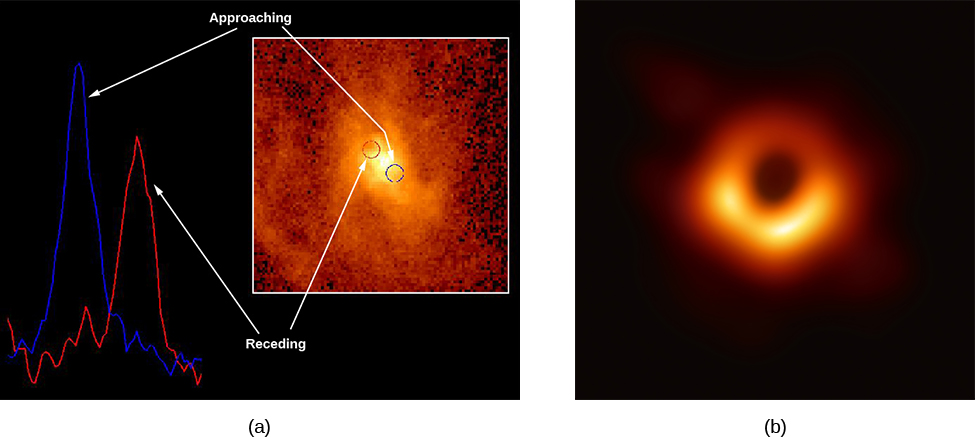
One of the first galaxies to be studied with the Hubble Space Telescope is our old favorite, the giant elliptical M87. Hubble Space Telescope images showed that there is a disk of hot (10,000 K) gas swirling around the center of M87 (Figure 27.8). It was surprising to find hot gas in an elliptical galaxy because this type of galaxy is usually devoid of gas and dust. But the discovery was extremely useful for pinning down the existence of the black hole. Astronomers measured the Doppler shift of spectral lines emitted by this gas, found its speed of rotation, and then used the speed to derive the amount of mass inside the disk—applying Kepler’s third law.
英語のヒント
ハッブル宇宙望遠鏡で初期に研究された銀河の一つは、おなじみの巨大楕円銀河M87である。画像には、M87の中心を渦巻く、1万Kの高温ガスの円盤が写っていた(図27.8)。楕円銀河には普通、ガスや塵がほとんどないので、高温ガスの発見は意外だった。しかし、その発見は、ブラックホールの存在を確かめるうえで非常に役立った。天文学者たちは、このガスが放つスペクトル線のドップラー偏移を測って回転速度を求め、その速度にケプラーの第3法則を適用して、円盤の内側の質量を導き出した。
Evidence for a Black Hole at the Center of M87.M87の中心にあるブラックホールの証拠
credit (a): modification of work by Holland Ford, STScI/JHU; Richard Harms, Linda Dressel, Ajay K. Kochhar, Applied Research Corp.; Zlatan Tsvetanov, Arthur Davidsen, Gerard Kriss, Johns Hopkins; Ralph Bohlin, George Hartig, STScI; Bruce Margon, University of Washington in Seattle; NASA; credit (b): modification of work by European Southern Observatory (ESO), Event Horizon Telescope Collaboration · CC BY 4.0
Figure 27.8 (a) The disk of whirling gas at right was discovered at the center of the giant elliptical galaxy M87 with the Hubble Space Telescope. Observations made on opposite sides of the disk show that one side is approaching us (the spectral lines are blueshifted by the Doppler effect) while the other is receding (lines redshifted), a clear indication that the disk is rotating. The rotation speed is about 550 kilometers per second or 1.2 million miles per hour. Such a high rotation speed is evidence that there is a very massive black hole at the center of M87. (b) In 2019, the Event Horizon Telescope, a collaborative venture among radio telescopes spanning our planet, was able to produce the first radio image of the shadow of the M87 black hole on the accretion disk surrounding it. This was taken with radio waves, so color is arbitrary. The shadow is about 2 ½ times as big as the event horizon of the supermassive black hole. (credit (a): modification of work by Holland Ford, STScI/JHU; Richard Harms, Linda Dressel, Ajay K. Kochhar, Applied Research Corp.; Zlatan Tsvetanov, Arthur Davidsen, Gerard Kriss, Johns Hopkins; Ralph Bohlin, George Hartig, STScI; Bruce Margon, University of Washington in Seattle; NASA; credit (b): modification of work by European Southern Observatory (ESO), Event Horizon Telescope Collaboration)
図27.8 (a)右の渦巻くガスの円盤は、巨大楕円銀河M87の中心で、ハッブル宇宙望遠鏡によって発見された。円盤の両側を観測すると、一方は近づき、ドップラー効果でスペクトル線が青方偏移し、もう一方は遠ざかり、線が赤方偏移している。これは、円盤が回転している明確な証拠である。回転速度は秒速約550キロメートル、時速約120万マイル。この高速回転は、M87の中心に非常に大質量のブラックホールがあることを示す。(b)2019年、地球全体に広がる電波望遠鏡の共同事業、イベント・ホライズン・テレスコープは、周囲の降着円盤に現れるM87のブラックホールの影を、初めて電波画像にすることに成功した。電波で撮影したので、色は任意につけている。影の大きさは、超大質量ブラックホールの事象の地平面の約2.5倍である。(a:Holland Ford[STScI/JHU]、Richard Harms、Linda Dressel、Ajay K. Kochhar[Applied Research Corp.]、Zlatan Tsvetanov、Arthur Davidsen、Gerard Kriss[ジョンズ・ホプキンズ大学]、Ralph Bohlin、George Hartig[STScI]、Bruce Margon[シアトルのワシントン大学]、NASAの作品を改変。b:欧州南天天文台[ESO]、Event Horizon Telescope Collaborationの作品を改変。)
Modern estimates show that there is a mass of at least 3.5 billion MSun concentrated in a tiny region at the very center of M87. So much mass in such a small volume of space must be a black hole. Let’s stop for a moment and take in this figure: a single black hole that has swallowed enough material to make 3.5 billion stars like the Sun. Few astronomical measurements have ever led to so mind-boggling a result. What a strange environment the neighborhood of such a supermassive black hole must be.
英語のヒント
近年の推定では、M87のまさに中心の小さな領域に、少なくとも35億 MSunの質量が集中している。これほど小さい空間に、それほどの質量があるなら、ブラックホールでなければならない。立ち止まって、この数字を受け止めよう。太陽のような恒星を35億個つくれるだけの物質を、一つのブラックホールが飲み込んだのである。天文学の測定が、これほど想像を絶する結果へ導いた例はほとんどない。このような超大質量ブラックホールの近くは、何と奇妙な環境だろう。
An international team of astronomers in 2019 made the first image of what the inner region of such a black hole, near the event horizon, looks like. They used the Event Horizon Telescope, an array of radio telescopes in different countries, spanning planet Earth, to observe M87. The signals from the many telescopes were sent to a central location and used to make a far more detailed radio-wave image than any single telescope can produce. Figure 27.8b shows you that picture with artificial colors to help the eye. What you see as a black region in the middle is the shadow that the central black hole of M87 makes on its event horizon.
英語のヒント
2019年、国際的な天文学者チームは、このようなブラックホールの内側の領域、事象の地平面付近がどのように見えるかを、初めて画像にした。地球上の各国に分散した電波望遠鏡の配列、イベント・ホライズン・テレスコープを使って、M87を観測したのである。多くの望遠鏡の信号を1か所へ集め、単独のどの望遠鏡でも得られない、はるかに細かい電波画像をつくった。図27.8bは、その画像に、目で見やすいよう人工的な色をつけたものである。中央の黒い領域として見えるのは、M87の中心ブラックホールが、その事象の地平面上につくる影である。
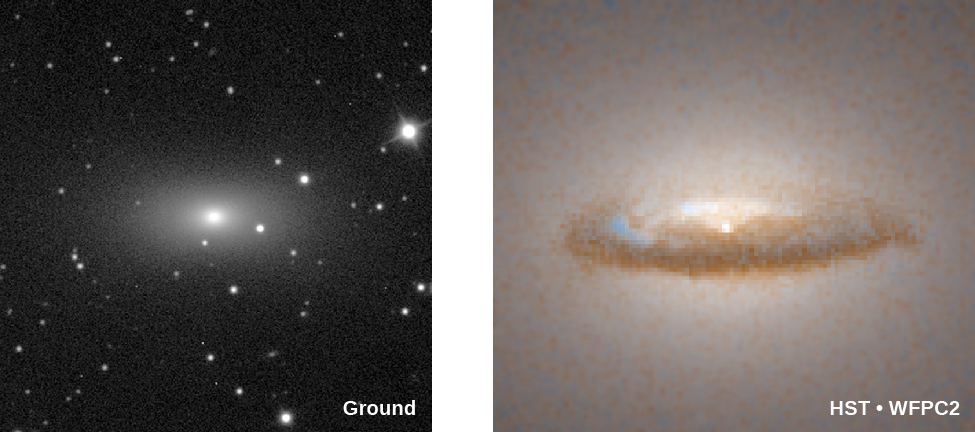
Another example is shown in Figure 27.9. Here, we see a disk of dust and gas that surrounds a 300-million-MSun black hole in the center of an elliptical galaxy. (The bright spot in the center is produced by the combined light of stars that have been pulled close together by the gravitational force of the black hole.) The mass of the black hole was again derived from measurements of the rotational speed of the disk. The gas in the disk is moving around at 155 kilometers per second at a distance of only 186 light-years from its center. Given the pull of the mass at the center, we expect that the whole dust disk should be swallowed by the black hole in several billion years.
英語のヒント
別の例を図27.9に示す。楕円銀河の中心で、3億 MSunのブラックホールを取り巻く、塵とガスの円盤が見える。中心の明るい点は、ブラックホールの重力に引かれて密集した恒星の光を合わせたものである。このブラックホールの質量も、円盤の回転速度の測定から求められた。円盤のガスは、中心からわずか186光年の距離を、秒速155キロメートルで回る。中心の質量による引きつけを考えると、この塵の円盤全体は、数十億年でブラックホールに飲み込まれるはずだと予想される。
Another Galaxy with a Black-Hole Disk.ブラックホールの円盤を持つ別の銀河
credit: modification of work by Roeland P. van der Marel (STScI), Frank C. van den Bosch (University of Washington), NASA · CC BY 4.0
Figure 27.9 The ground-based image shows an elliptical galaxy called NGC 7052 located in the constellation of Vulpecula, almost 200 million light-years from Earth. At the galaxy’s center (right) is a dust disk roughly 3700 light-years in diameter. The disk rotates like a giant merry-go-round: gas in the inner part (186 light-years from the center) whirls around at a speed of 155 kilometers per second (341,000 miles per hour). From these measurements and Kepler’s third law, it is possible to estimate that the disk is orbiting around a central black hole with a mass of 300 million Suns. (credit: modification of work by Roeland P. van der Marel (STScI), Frank C. van den Bosch (University of Washington), NASA)
図27.9 地上からの画像は、こぎつね座にあるNGC 7052という楕円銀河を示す。地球からの距離は約2億光年である。銀河の中心(右)には、直径約3700光年の塵の円盤がある。円盤は巨大なメリーゴーラウンドのように回転し、内側、中心から186光年のところのガスは、秒速155キロメートル、時速34万1000マイルで渦巻く。この測定とケプラーの第3法則から、円盤は3億太陽質量の中心ブラックホールを周回していると推定できる。(Roeland P. van der Marel[STScI]、Frank C. van den Bosch[ワシントン大学]、NASAの作品を改変。)
But do we have to accept black holes as the only explanation of what lies at the center of these galaxies? What else could we put in such a small space other than a giant black hole? The alternative is stars. But to explain the masses in the centers of galaxies without a black hole we need to put at least a million stars in a region the size of the solar system. To fit, they would have be only 2 star diameters apart. Collisions between stars would happen all the time. And these collisions would lead to mergers of stars, and very soon the one giant star that they form would collapse into a black hole. So there is really no escape: only a black hole can fit so much mass into so small a space.
英語のヒント
しかし、これらの銀河の中心にあるものを説明するには、ブラックホールだけを受け入れなければならないのだろうか。巨大ブラックホール以外に、これほど小さな空間へ入れられるものは何だろうか。代わりの候補は恒星である。けれども、ブラックホールなしで銀河中心の質量を説明するには、太陽系ほどの領域に、少なくとも100万個の星を詰めなければならない。収まるには、星どうしの間隔は、星の直径のわずか2倍となる。恒星の衝突が絶えず起き、衝突によって星は合体する。できた一つの巨大な星も、すぐに崩壊してブラックホールになるだろう。したがって、結局は逃げ道がない。これほど小さな空間に、これほどの質量を収められるのは、ブラックホールだけなのである。
As we saw earlier, observations now show that all the galaxies with a spherical concentration of stars—either elliptical galaxies or spiral galaxies with nuclear bulges (see the chapter on Galaxies)—harbor one of these giant black holes at their centers. Among them is our neighbor spiral galaxy, the Andromeda galaxy, M31. The masses of these central black holes range from a just under a million up to at least 30 billion times the mass of the Sun. Several black holes may be even more massive, but the mass estimates have large uncertainties and need verification. We call these black holes “supermassive” to distinguish them from the much smaller black holes that form when some stars die (see The Death of Stars). So far, the most massive black holes from stars—those detected through gravitational waves detected by LIGO—have masses of about 80 solar masses.
英語のヒント
すでに見たように、星が球状に集中した領域を持つ銀河、すなわち楕円銀河や、中心にバルジを持つ渦巻銀河は、すべて中心にこうした巨大ブラックホールを宿すことが、現在の観測で示されている(「銀河」の章参照)。近隣の渦巻銀河、アンドロメダ銀河M31も、その一つである。これらの中心ブラックホールの質量は、100万太陽質量を少し下回るものから、少なくとも300億太陽質量までに及ぶ。さらに大質量のものもあるかもしれないが、質量推定の不確かさが大きく、検証を要する。恒星の一部が死ぬときにできる、ずっと小さなブラックホールと区別するため、これらを「超大質量」と呼ぶ(「恒星の死」参照)。これまでのところ、恒星に由来する最も大質量のブラックホールは、LIGOが重力波で検出したもので、約80太陽質量を持つ。