第27章活動銀河・クエーサー・超大質量ブラックホールActive Galaxies, Quasars, and Supermassive Black Holes
Radio Jets電波ジェット
So far, our model seems to explain the central energy source in quasars and active galaxies. But, as we have seen, there is more to quasars and other active galaxies than the point-like energy source. They can also have long jets that glow with radio waves, light, and sometimes even X-rays, and that extend far beyond the limits of the parent galaxy. Can we find a way for our black hole and its accretion disk to produce these jets of energetic particles as well?
英語のヒント
ここまでのモデルは、クエーサーや活動銀河の中心のエネルギー源を説明できそうである。しかし、すでに見たように、それらには点状のエネルギー源以外にも特徴がある。電波、可視光、ときにはX線でさえ輝き、母銀河の端をはるかに越えて延びる、長いジェットを持つことがある。ブラックホールとその降着円盤が、高エネルギー粒子のジェットもつくる方法を、見つけられるだろうか。
Many different observations have now traced these jets to within 3 to 30 light-years of the parent quasar or galactic nucleus. While the black hole and accretion disk are typically smaller than 1 light-year, we nevertheless presume that if the jets come this close, they probably originate in the vicinity of the black hole. Another characteristic of the jets we need to explain is that they contain matter moving close to the speed of light.
英語のヒント
多くの異なる観測によって、ジェットは、その母体となるクエーサーや銀河核から、3〜30光年以内のところまでたどられている。ブラックホールと降着円盤は、通常1光年より小さい。それでも、ジェットがこれほど近くまで来ているなら、おそらくブラックホール付近に起源があるのだろうと考えられる。もう一つ説明すべきジェットの特徴は、光速近くで動く物質を含むことである。
Why are energetic electrons and other particles near a supermassive black hole ejected into jets, and often into two oppositely directed jets, rather than in all directions? Again, we must use theoretical models and supercomputer simulations of what happens when a lot of material whirls inward in a crowded black hole accretion disk. Although there is no agreement on exactly how jets form, it has become clear that any material escaping from the neighborhood of the black hole has an easier time doing so perpendicular to the disk.
英語のヒント
超大質量ブラックホールの近くの、高エネルギーの電子などの粒子は、なぜあらゆる方向へではなく、ジェットとして、しかもしばしば互いに反対向きの2本として放出されるのだろうか。ここでも、多くの物質が混み合う降着円盤を内向きに渦巻くとき、何が起きるかについて、理論モデルとスーパーコンピューターのシミュレーションが必要になる。ジェットがどう形成されるかについて、正確な一致した見解はない。しかし、ブラックホール付近から逃げる物質は、円盤に垂直な方向なら逃げやすいことが明らかになっている。
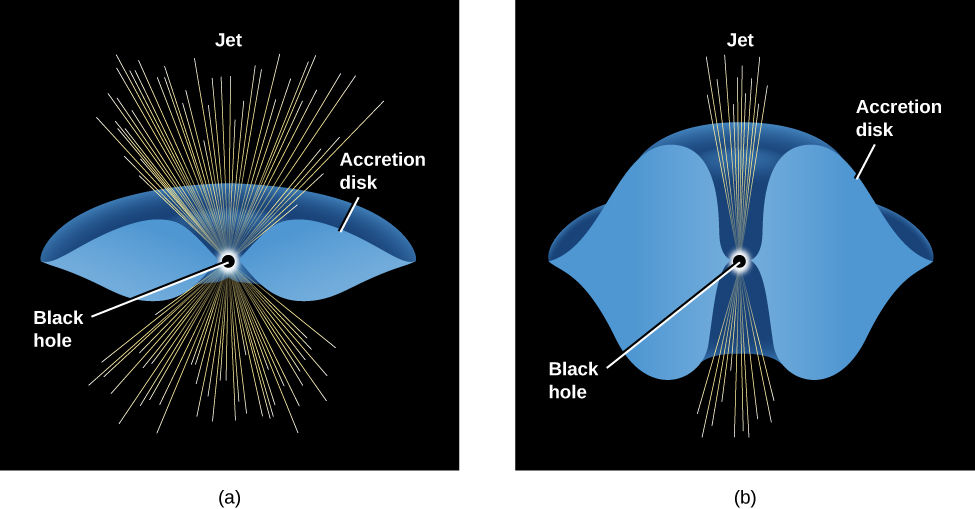
In some ways, the inner regions of black hole accretion disks resemble a baby that is just learning to eat by herself. As much food as goes into the baby’s mouth can sometimes wind up being spit out in various directions. In the same way, some of the material whirling inward toward a black hole finds itself under tremendous pressure and orbiting with tremendous speed. Under such conditions, simulations show that a significant amount of material can be flung outward—not back along the disk, where more material is crowding in, but above and below the disk. If the disk is thick (as it tends to be when a lot of material falls in quickly), it can channel the outrushing material into narrow beams perpendicular to the disk (Figure 27.12).
英語のヒント
ある意味で、ブラックホールの降着円盤の内側は、ひとりで食べることを覚え始めた赤ん坊に似ている。口へ入るのと同じほどの量の食べ物が、さまざまな方向へ吐き出されることもある。これと同様に、ブラックホールへ内向きに渦巻く物質の一部は、途方もない圧力を受け、途方もない速度で周回している。シミュレーションによれば、このような条件では、かなりの量の物質が外へ投げ出される。さらに物質が押し寄せる円盤に沿って戻るのではなく、円盤の上下へ向かう。大量の物質が急速に落ち込むときによくあるように、円盤が厚ければ、流れ出る物質を、円盤に垂直な細いビームへ導ける(図27.12)。
Models of Accretion Disks.降着円盤のモデル
OpenStax / Rice University · CC BY 4.0
Figure 27.12 These schematic drawings show what accretion disks might look like around large black holes for (a) a thin accretion disk and (b) a “fat” disk—the type needed to account for channeling the outflow of hot material into narrow jets oriented perpendicular to the disk.
図27.12 大きなブラックホールの周りの降着円盤が、どのように見えるかを示す模式図。(a)は薄い円盤、(b)は「太った」円盤である。後者は、高温物質の流出を、円盤に垂直な細いジェットへ導くことを説明するために必要な形である。
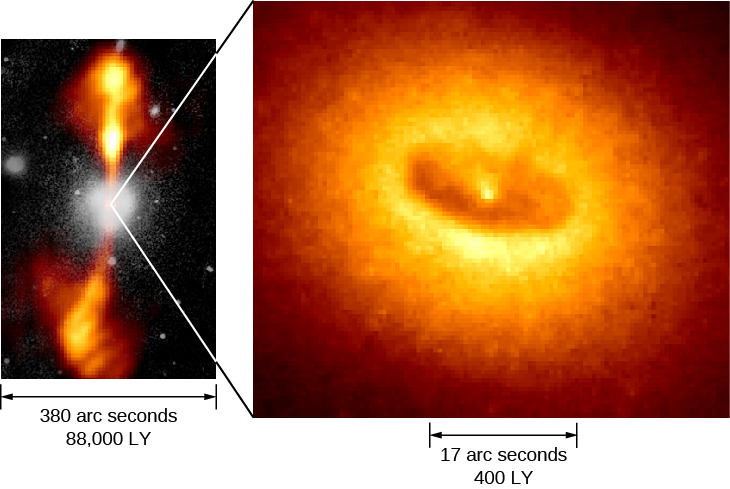
Figure 27.13 shows observations of an elliptical galaxy that behaves in exactly this way. At the center of this active galaxy, there is a ring of dust and gas about 800 light-years in diameter, surrounding a 1.2-billion-MSun black hole. Radio observations show that two jets emerge in a direction perpendicular to the ring, just as the model predicts.
英語のヒント
図27.13は、まさにこのように振る舞う楕円銀河の観測を示す。この活動銀河の中心には、12億 MSunのブラックホールを取り囲む、直径約800光年の塵とガスの輪がある。電波観測では、モデルが予測するとおり、輪に垂直な方向へ2本のジェットが出ている。
Jets and Disk in an Active Galaxy.活動銀河のジェットと円盤
credit: modification of work by ESA/HST · ESA educational/informational image permission
Figure 27.13 The picture on the left shows the active elliptical galaxy NGC 4261, which is located in the Virgo Cluster at a distance of about 100 million light-years. The galaxy itself—the white circular region in the center—is shown the way it looks in visible light, while the jets are seen at radio wavelengths. A Hubble Space Telescope image of the central portion of the galaxy is shown on the right. It contains a ring of dust and gas about 800 light-years in diameter, surrounding a supermassive black hole. Note that the jets emerge from the galaxy in a direction perpendicular to the plane of the ring. (credit: modification of work by ESA/HST)
図27.13 左は、おとめ座銀河団にあり、約1億光年離れた活動楕円銀河NGC 4261を示す。中央の白い円形領域である銀河自体は、可視光での姿であり、ジェットは電波で見たものである。右は、ハッブル宇宙望遠鏡による銀河中心部の画像。超大質量ブラックホールを取り巻く、直径約800光年の塵とガスの輪がある。ジェットが輪の面に垂直な方向へ銀河から出ることに注目しよう。(ESA/HSTの作品を改変。)
With this black hole model, we have come a long way toward understanding the quasars and active galaxies that seemed very mysterious only a few decades ago. As often happens in astronomy, a combination of better instruments (making better observations) and improved theoretical models enabled us to make significant progress on a puzzling aspect of the cosmos.
英語のヒント
ブラックホールのモデルによって、わずか数十年前には非常に不可思議に思えたクエーサーや活動銀河の理解は、大きく進んだ。天文学でよくあるように、より優れた観測を可能にする装置と、改良された理論モデルの組み合わせが、宇宙の謎めいた側面について、大きな進歩をもたらしたのである。