第27章活動銀河・クエーサー・超大質量ブラックホールActive Galaxies, Quasars, and Supermassive Black Holes
Codependence of Black Holes and Galaxiesブラックホールと銀河の相互依存
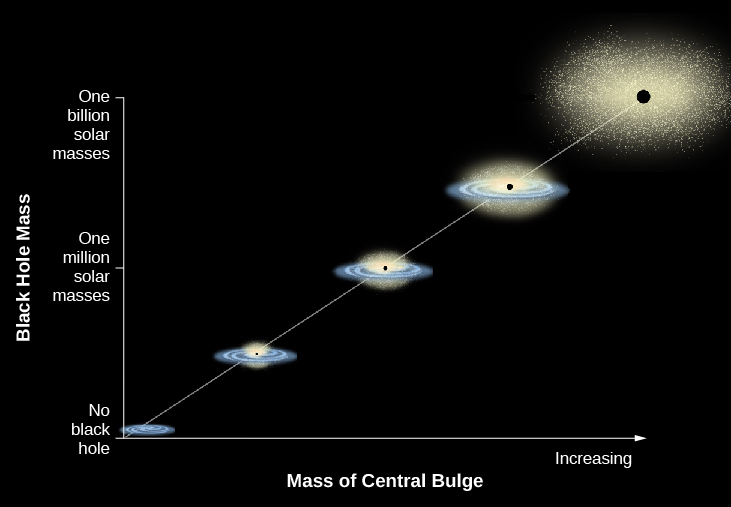
Once black hole masses began to be measured reliably in the late 1990s, they posed an enigma. It looked as though the mass of the central black hole depended on the mass of the galaxy. The black holes in galaxies always seem to be just 1/200 the mass of the galaxy they live in. This result is shown schematically in Figure 27.15, and some of the observations are plotted in Figure 27.16.
英語のヒント
1990年代後半、ブラックホールの質量を確かに測れるようになると、一つの謎が浮かび上がった。中心ブラックホールの質量は、銀河の質量に依存するように見えたのである。ブラックホールはつねに、自分が属する銀河の質量の、ちょうど200分の1ほどであるように見える。この結果を図27.15に模式的に示し、観測の一部を図27.16に描く。
Relationship between Black Hole Mass and the Mass of the Host Galaxy.ブラックホールの質量と母銀河の質量の関係
credit: modification of work by K. Cordes, S. Brown (STScI) · CC BY 4.0
Figure 27.15 Observations show that there is a close correlation between the mass of the black hole at the center of a galaxy and the mass of the spherical distribution of stars that surrounds the black hole. That spherical distribution may be in the form of either an elliptical galaxy or the central bulge of a spiral galaxy. (credit: modification of work by K. Cordes, S. Brown (STScI))
図27.15 観測は、銀河中心のブラックホールの質量と、その周囲に球状に分布する恒星の質量との間に、密接な相関があることを示す。球状の星の分布は、楕円銀河全体であることも、渦巻銀河の中心バルジであることもある。(K. Cordes、S. Brown[STScI]の作品を改変。)
Correlation between the Mass of the Central Black Hole and the Mass Contained within the Bulge of Stars Surrounding the Black Hole, Using Data from Real Galaxies.実際の銀河のデータによる、中心ブラックホールの質量と周囲の恒星バルジの質量の相関
Figure 27.16 The black hole always turns out to be about 1/200 the mass of the stars surrounding it. The horizontal and vertical bars surrounding each point show the uncertainty of the measurement. (credit: modification of work by Nicholas J. McConnell, Chung-Pei Ma, “Revisiting the Scaling Relations of Black Hole Masses and Host Galaxy Properties,” The Astrophysical Journal, 764:184 (14 pp.), February 20, 2013.)
図27.16 ブラックホールの質量は、つねに周囲の恒星の質量の約200分の1となる。各点の上下・左右の棒は、測定の不確かさを示す。(Nicholas J. McConnell、Chung-Pei Ma, “Revisiting the Scaling Relations of Black Hole Masses and Host Galaxy Properties,” The Astrophysical Journal, 764:184[14ページ], 2013年2月20日の作品を改変。)
Somehow black hole mass and the mass of the surrounding bulge of stars are connected. But why does this correlation exist? Unfortunately, astronomers do not yet know the answer to this question. We do know, however, that the black hole can influence the rate of star formation in the galaxy, and that the properties of the surrounding galaxy can influence how fast the black hole grows. Let’s see how these processes work.
英語のヒント
何らかの形で、ブラックホールの質量と、その周囲にある恒星のバルジの質量は結び付いている。しかし、なぜこの相関が存在するのだろうか。残念ながら、天文学者はまだ答えを知らない。それでも、ブラックホールが銀河の星形成率に影響し、周囲の銀河の性質がブラックホールの成長速度に影響しうることはわかっている。これらの過程がどのように働くのかを見ていこう。
How a Galaxy Can Influence a Black Hole in Its Center銀河は中心のブラックホールにどのような影響を及ぼすか
Let’s look first at how the surrounding galaxy might influence the growth and size of the black hole. Without large quantities of fresh “food,” the surroundings of black holes glow only weakly as bits of local material spiral inward toward the black hole. So somehow large amounts of gas have to find their way to the black hole from the galaxy in order to feed the quasar and make it grow and give off the energy to be noticed. Where does this “food” for the black hole come from originally and how might it be replenished? The jury is still out, but the options are pretty clear.
英語のヒント
まず、周囲の銀河がブラックホールの成長や大きさにどのような影響を及ぼすかを考えよう。新たな「餌」が大量に入ってこなければ、近くの物質が少しずつらせんを描いて内側へ落ち込むだけなので、ブラックホールの周囲は弱くしか光らない。したがって、クエーサーに餌を与えて成長させ、検出できるほどのエネルギーを放出させるには、大量のガスが何らかの経路で銀河からブラックホールへたどり着く必要がある。この「餌」は、もともとどこから来て、どうすれば補給されるのだろうか。まだ結論は出ていないが、候補はかなりはっきりしている。
One obvious source of fuel for the black hole is matter from the host galaxy itself. Galaxies start out with large amounts of interstellar gas and dust, and at least some of this interstellar matter is gradually converted into stars as the galaxy evolves. On the other hand, as stars go through their lives and die, they lose mass all the time into the space between them, thereby returning some of the gas and dust to the interstellar medium. We expect to find more gas and dust in the central regions early in a galaxy’s life than later on, when much of it has been converted into stars. Any of the interstellar matter that ventures too close to the black hole may be accreted by it. This means that we would expect that the number and luminosity of quasars powered in this way would decline with time. And as we have seen, that is just what we find.
英語のヒント
ブラックホールの燃料として、まず考えられるのは母銀河そのものの物質である。銀河は大量の星間ガスと塵を持って出発し、進化するにつれて、その少なくとも一部が徐々に恒星へと変わる。その反面、恒星は一生を送り、やがて死ぬまでの間、絶えず質量を星間空間へ放出し、ガスや塵の一部を星間物質へ戻している。銀河の中心部には、ガスや塵の多くが恒星になった後期よりも、初期のほうが多くのガスや塵があると予想される。ブラックホールへ近づきすぎた星間物質は、そこへ降着しうる。したがって、この方法でエネルギーを得るクエーサーの数と光度は、時間とともに減少すると予想される。すでに見たように、実際に観測されるのは、まさにその傾向である。
Today both elliptical galaxies and the nuclear bulges of spiral galaxies have very little raw material left to serve as a source of fuel for the black hole. And most of the giant black holes in nearby galaxies, including the one in our own Milky Way, are now dark and relatively quiet—mere shadows of their former selves. So that fits with our observations.
英語のヒント
現在では、楕円銀河にも渦巻銀河の中心バルジにも、ブラックホールの燃料になる原料がほとんど残っていない。天の川銀河のものも含め、近くの銀河にある巨大ブラックホールの大半は、今では暗く、比較的静かで、かつての姿の面影をとどめるにすぎない。これも観測と一致している。
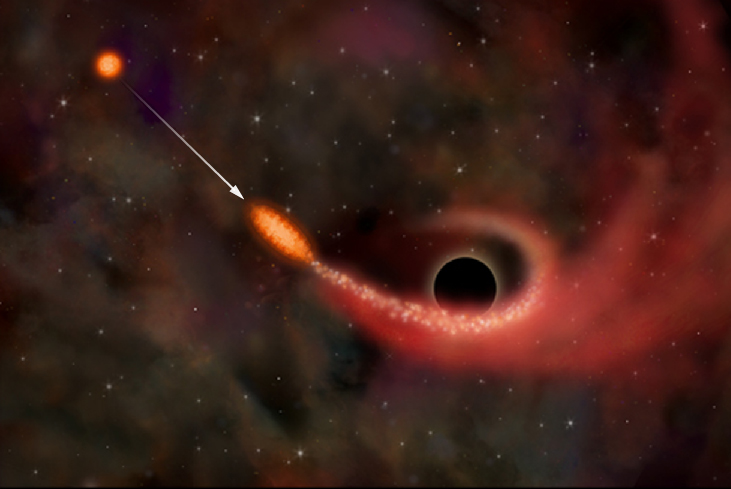
We should note that even if you have a quiescent supermassive black hole, a star in the area could occasionally get close to it. Then the powerful tidal forces of the black hole can pull the whole star apart into a stream of gas. This stream quickly forms an accretion disk that gives off energy in the normal way and makes the black hole region into a temporary quasar. However, the material will fall into the black hole after only a few weeks or months. The black hole then goes back into its lurking, quiescent state, until another victim wanders by.
英語のヒント
活動していない超大質量ブラックホールでも、近くの恒星が、ときおりすぐそばを通ることがある。その場合、ブラックホールの強い潮汐力が恒星全体を引き裂いて、ガスの流れに変えてしまう。このガスはすばやく降着円盤を作り、通常の仕組みでエネルギーを放出するため、ブラックホールの周囲は一時的にクエーサーになる。しかし、物質はわずか数週間から数か月でブラックホールへ落ち込む。その後は、次の犠牲者が迷い込んでくるまで、ブラックホールは再びひっそりと潜む静かな状態に戻る。
This sort of “cannibal” event happens only once every 100,000 years or so in a typical galaxy. But we can monitor millions of galaxies in the sky, so a few of these “tidal disruption events” are found each year (Figure 27.17). However, these individual events, dramatic as they are, are too rare to account for the huge masses of the central black holes.
英語のヒント
このように星を「食べる」出来事は、典型的な銀河では約10万年に一度しか起こらない。しかし、空の何百万もの銀河を監視できるので、この「潮汐破壊現象」は毎年いくつか見つかる(図27.17)。とはいえ、個々の現象がいかに劇的でも、発生頻度が低すぎて、銀河中心のブラックホールの巨大な質量を説明することはできない。
A Black Hole Snacks on a Star.恒星を食べるブラックホール
credit: modification of work by NASA/CXC/M. Weiss · NASA/SAO media use
Figure 27.17 This artist’s impression shows three stages of a star (red) swinging too close to a giant black hole (black circle). The star starts off (top left) in its normal spherical shape, then begins to be pulled into a long football shape by tides raised by the black hole (center). When the star gets closer still, the tides become stronger than the gravity holding the star together, and it breaks up into a streamer (right). Much of the star’s matter forms a temporary accretion disk that lights up as a quasar for a few weeks or months. (credit: modification of work by NASA/CXC/M. Weiss)
図27.17 この想像図は、巨大ブラックホール(黒い円)へ近づきすぎた恒星(赤)の三段階を示す。恒星は初め、通常の球形をしている(左上)が、ブラックホールが生む潮汐力によって、細長いラグビーボール状に引き伸ばされ始める(中央)。さらに近づくと、潮汐力が恒星を一つに保つ自己重力を上回り、星は崩れて細長い流れになる(右)。恒星の物質の多くは一時的な降着円盤を形成し、数週間から数か月の間、クエーサーとして輝く。(クレジット:NASA/CXC/M. Weissによる作品を改変)
Another source of fuel for the black hole is the collision of its host galaxy with another galaxy. Some of the brightest galaxies turn out, when a detailed picture is taken, to be pairs of colliding galaxies. And most of them have quasars inside them, not easily visible to us because they are buried by enormous amounts of dust and gas.
英語のヒント
ブラックホールの別の燃料源は、母銀河と他の銀河との衝突である。非常に明るい銀河の中には、詳しく撮影すると、衝突中の二つの銀河だとわかるものがある。その大半は内部にクエーサーを含むが、大量の塵とガスに埋もれているため、簡単には見えない。
A collision between two cars creates quite a mess, pushing parts out of their regular place. In the same way, if two galaxies collide and merge, then gas and dust (though not so much the stars) can get pushed out of their regular orbits. Some may veer close enough to the black hole in one galaxy or the other to be devoured by it and so provide the necessary fuel to power a quasar. As we saw, galaxy collisions and mergers happened most frequently when the universe was young and probably help account for the fact that quasars were most common when the universe was only about 20% of its current age.
英語のヒント
自動車同士の衝突は、部品を本来の位置から押し出し、大きな混乱を起こす。同じように、二つの銀河が衝突して合体すると、ガスや塵は、それまでの軌道から押し出されうる。恒星については、それほどではない。その物質の一部は進路を変え、どちらかの銀河のブラックホールに食べられるほど近くまで行くかもしれない。こうして、クエーサーのエネルギー源となる燃料が供給される。すでに見たように、銀河の衝突と合体は若い宇宙で最も頻繁に起きた。このことは、宇宙の年齢が現在の約20%のころにクエーサーが最も多かった理由の説明にも、おそらく役立つ。
Collisions in today’s universe are less frequent, but they do happen. Once a galaxy reaches the size of the Milky Way, most of the galaxies it merges with will be much smaller galaxies—dwarf galaxies (see the chapter on Galaxies). These don’t disrupt the big galaxy much, but they can supply some additional gas to its black hole.
英語のヒント
現在の宇宙では衝突の頻度は低くなっているが、起こらなくなったわけではない。銀河が天の川銀河ほどの大きさに達すると、合体する相手の大半は、ずっと小さい矮小銀河になる(「銀河」の章を参照)。こうした銀河は、大きい銀河をさほど乱さないが、そのブラックホールへガスをいくらか追加供給できる。
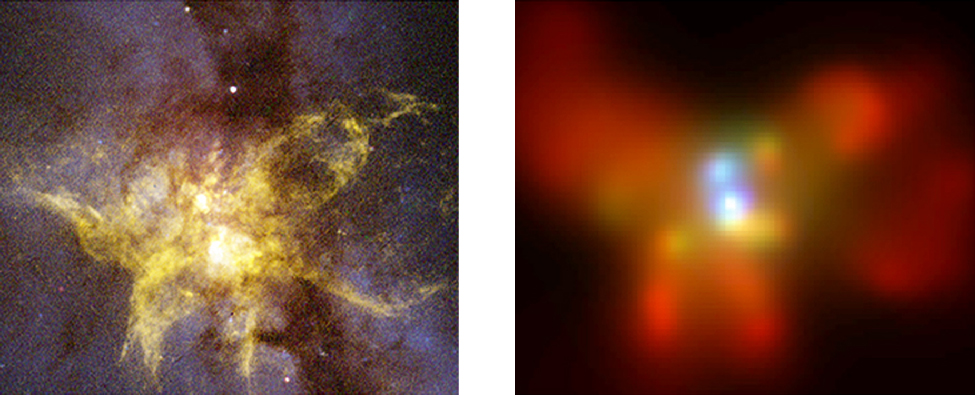
By the way, if two galaxies, each of which contains a black hole, collide, then the two black holes may merge and form an even larger black hole (Figure 27.18). In this process they will emit a burst of gravitational waves. One of the main goals of the European Space Agency’s planned LISA (Laser Interferometer Space Antenna) mission is to detect the gravitational wave signals from the merging of supermassive black holes.
英語のヒント
なお、ブラックホールを一つずつ含む二つの銀河が衝突すると、二つのブラックホールも合体して、さらに大きなブラックホールになる可能性がある(図27.18)。この過程では、重力波が一気に放出される。欧州宇宙機関が計画しているLISA(レーザー干渉計宇宙アンテナ)の主要な目標の一つは、超大質量ブラックホールの合体が生む重力波信号を検出することである。
Colliding Galaxies with Two Black Holes.二つのブラックホールを含む、衝突中の銀河
credit left: modification of work by NASA/STScI/R. P. van der Marel, J. Gerssen; credit right: modification of work by NASA/CXC/MPE/S. Komossa et al · CC BY 4.0
Figure 27.18 We compare Hubble Space Telescope visible-light (left) and Chandra X-ray (right) images of the central regions of NGC 6240, a galaxy about 400 million light-years away. It is a prime example of a galaxy in which stars are forming, evolving, and exploding at an exceptionally rapid rate due to a relatively recent merger (30 million years ago). The Chandra image shows two bright X-ray sources, each produced by hot gas surrounding a black hole. Over the course of the next few hundred million years, the two supermassive black holes, which are about 3000 light-years apart, will drift toward each other and merge to form an even larger black hole. This detection of a binary black hole supports the idea that black holes can grow to enormous masses in the centers of galaxies by merging with nearby galaxies. (credit left: modification of work by NASA/STScI/R. P. van der Marel, J. Gerssen; credit right: modification of work by NASA/CXC/MPE/S.Komossa et al)
図27.18 約4億光年先の銀河NGC 6240の中心部を、ハッブル宇宙望遠鏡の可視光画像(左)とチャンドラX線望遠鏡の画像(右)で比べている。比較的最近、3000万年前に起きた合体により、恒星の形成、進化、爆発が非常に速いペースで進む銀河の代表例である。チャンドラの画像には二つの明るいX線源があり、それぞれブラックホールを取り囲む高温のガスが放射している。約3000光年離れた二つの超大質量ブラックホールは、今後数億年の間に互いに近づき、合体して、さらに大きなブラックホールになると考えられる。この連ブラックホールの検出は、銀河が近くの銀河と合体することで、中心のブラックホールが巨大な質量へ成長できるという考えを支持する。(左のクレジット:NASA/STScI/R. P. van der Marel, J. Gerssenによる作品を改変。右のクレジット:NASA/CXC/MPE/S. Komossaほかによる作品を改変)