第27章活動銀河・クエーサー・超大質量ブラックホールActive Galaxies, Quasars, and Supermassive Black Holes
Energy Production around a Black Holeブラックホールの周りでのエネルギー生成
By now, you may be willing to entertain the idea that huge black holes lurk at the centers of active galaxies. But we still need to answer the question of how such a black hole can account for one of the most powerful sources of energy in the universe. As we saw in Black Holes and Curved Spacetime, a black hole itself can radiate no energy. Any energy we detect from it must come from material very close to the black hole, but not inside its event horizon.
英語のヒント
ここまで来ると、活動銀河の中心には巨大ブラックホールが潜むという考えを、受け入れてもよいと感じているかもしれない。しかし、それがどうして、宇宙で最も強力なエネルギー源の一つを説明できるのか、まだ答える必要がある。「ブラックホールと曲がった時空」で見たように、ブラックホールそのものはエネルギーを放射できない。そこから検出されるエネルギーは、どれもブラックホールのごく近くにあり、事象の地平面の内側にはない物質から来なければならない。
In a galaxy, a central black hole (with its strong gravity) attracts matter—stars, dust, and gas—orbiting in the dense nuclear regions. This matter spirals in toward the spinning black hole and forms an accretion disk of material around it. As the material spirals ever closer to the black hole, it accelerates and becomes compressed, heating up to temperatures of millions of degrees. Such hot matter can radiate prodigious amounts of energy as it falls in toward the black hole.
英語のヒント
銀河中心のブラックホールは、その強い重力によって、密集した核の領域を周回する恒星、塵、ガスなどの物質を引きつける。物質は回転するブラックホールへ向けて、らせん状に落ち込み、周囲に降着円盤をつくる。さらに近づくにつれて加速し、圧縮され、数百万度まで加熱される。このような高温物質は、ブラックホールへ落ち込みながら、膨大なエネルギーを放射できる。
To convince yourself that falling into a region with strong gravity can release a great deal of energy, imagine dropping a printed version of your astronomy textbook out the window of the ground floor of the library. It will land with a thud, and maybe give a surprised pigeon a nasty bump, but the energy released by its fall will not be very great. Now take the same book up to the fifteenth floor of a tall building and drop it from there. For anyone below, astronomy could suddenly become a deadly subject; when the book hits, it does so with a great deal of energy.
英語のヒント
強い重力の領域へ落ちることで大量のエネルギーが放出される、と納得するために、紙の天文学の教科書を、図書館の1階の窓から落とすと想像しよう。本はどすんと着地し、驚いたハトにひどいこぶをつくるかもしれないが、その落下で放出されるエネルギーは大したものではない。今度は同じ本を、高い建物の15階まで持っていき、そこから落とす。下にいる人にとって、天文学は突然、命に関わる科目になりうる。本が衝突するとき、今度は大量のエネルギーを伴うからである。
Dropping things from far away into the much stronger gravity of a black hole is much more effective in turning the energy released by infall into other forms of energy. Just as the falling book can heat up the air, shake the ground, or produce sound energy that can be heard some distance away, so the energy of material falling toward a black hole can be converted to significant amounts of electromagnetic radiation.
英語のヒント
はるかに強い重力を持つブラックホールへ、遠くから物を落とすと、落下で解放されるエネルギーを、ずっと効率よく別の形へ変えられる。落ちる本が空気を温め、地面を揺らし、少し離れていても聞こえる音のエネルギーを生むのと同じように、ブラックホールへ落ちる物質のエネルギーは、大量の電磁放射へ変換できる。
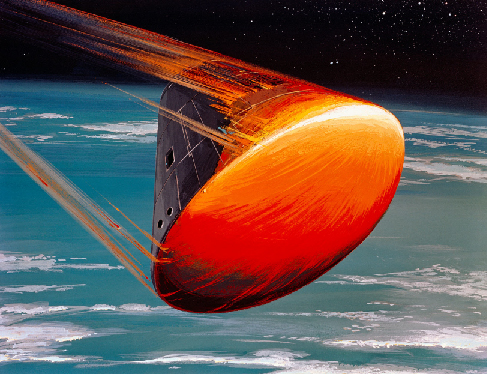
What a black hole has to work with is not textbooks but streams of infalling gas. If a dense blob of gas moves through a thin gas at high speed, it heats up as it slows by friction. As it slows down, kinetic (motion) energy is turned into heat energy. Just like a spaceship reentering the atmosphere (Figure 27.10), gas approaching a black hole heats up and glows where it meets other gas. But this gas, as it approaches the event horizon, reaches speeds of 10% the speed of light and more. It therefore gets far, far hotter than a spaceship, which reaches no more than about 1500 K. Indeed, gas near a supermassive black hole reaches a temperature of about 150,000 K, about 100 times hotter than a spaceship returning to Earth. It can even get so hot—millions of degrees—that it radiates X-rays.
英語のヒント
ブラックホールが相手にするのは教科書ではなく、落下するガスの流れである。密度の高いガスの塊が、薄いガスの中を高速で進むと、摩擦によって減速しながら加熱される。減速するとき、運動エネルギーは熱エネルギーへ変わる。大気へ再突入する宇宙船(図27.10)と同じように、ブラックホールへ近づくガスも、ほかのガスに出会うところで熱くなり、光る。しかし、このガスは事象の地平面へ近づくと、光速の10%以上に達する。そのため、約1500 Kまでしか上がらない宇宙船より、はるかに高温になる。実際、超大質量ブラックホール付近のガスは約15万Kとなり、地球へ帰還する宇宙船の約100倍も熱い。数百万度に達し、X線を放射するほどになることさえある。
Friction in Earth’s Atmosphere.地球大気との摩擦
credit: modification of work by NASA · NASA media use guidelines
Figure 27.10 In this artist’s impression, the rapid motion of a spacecraft (the Apollo mission reentry capsule) through the atmosphere compresses and heats the air ahead of it, which heats the spacecraft in turn until it glows red hot. Pushing on the air slows down the spacecraft, turning the kinetic energy of the spacecraft into heat. Fast-moving gas falling into a quasar heats up in a similar way. (credit: modification of work by NASA)
図27.10 この想像図では、宇宙船であるアポロ帰還カプセルが大気中を高速で進み、前方の空気を圧縮して加熱している。その空気が今度は宇宙船を熱し、赤く光るまでにする。空気を押すことで宇宙船は減速し、その運動エネルギーは熱へ変わる。クエーサーへ落ちる高速のガスも、同じように加熱される。(NASAの作品を改変。)
The amount of energy that can be liberated this way is enormous. Einstein showed that mass and energy are interchangeable with his famous formula E = mc2 (see The Sun: A Nuclear Powerhouse). A hydrogen bomb releases just 1% of that energy, as does a star. Quasars are much more efficient than that. The energy released falling to the event horizon of a black hole can easily reach 10% or, in the extreme theoretical limit, 32%, of that energy. (Unlike the hydrogen atoms in a bomb or a star, the gas falling into the black hole is not actually losing mass from its atoms to free up the energy; the energy is produced just because the gas is falling closer and closer to the black hole.) This huge energy release explains how a tiny volume like the region around a black hole can release as much power as a whole galaxy. But to radiate all that energy, instead of just falling inside the event horizon with barely a peep, the hot gas must take the time to swirl around the black hole in the accretion disk and emit some of its energy.
英語のヒント
この方法で解放できるエネルギーは膨大である。アインシュタインは有名な式E = mc2で、質量とエネルギーが互いに変換できることを示した(「太陽――核エネルギーの源」参照)。水素爆弾が放出するのは、そのエネルギーのわずか1%であり、恒星も同じである。クエーサーは、それよりはるかに効率がよい。ブラックホールの事象の地平面へ落ちるときに解放されるエネルギーは、容易に10%へ達し、理論上の極限では32%にもなる。爆弾や恒星の中の水素原子と違い、ブラックホールへ落ちるガスは、エネルギーを解放するために原子の質量そのものを失っているわけではない。ガスがブラックホールへ次第に近づいて落ちることによって、エネルギーが生じるのである。この膨大なエネルギーの解放によって、ブラックホール周囲のように小さい体積の領域が、銀河全体と同じほどの出力を放てることを説明できる。しかし、それをすべて放射するには、熱いガスは、ほとんど何も発さずに事象の地平面へ落ち込むのではなく、降着円盤の中でブラックホールの周りを回る時間を取り、エネルギーの一部を放出しなければならない。
You might be wondering how much mass from its accretion disk a quasar black hole can consume at any given time. In 2024, astronomers were able to make measurements of a very distant quasar with catalog number J0529-4351, whose central black hole already contains some 17 billion times the mass of our Sun. They found that the black hole was eating approximately the mass of our Sun each day! That’s an astounding rate of consumption. They concluded that the energy produced from the accretion disk makes this quasar the most luminous object we have seen so far anywhere in the universe. (But it’s so far away that to us, the quasar just looks like an ordinary star.)
英語のヒント
クエーサーのブラックホールは、ある時点で、降着円盤からどれほどの質量を取り込めるのだろうか。2024年、天文学者は、カタログ番号J0529-4351という非常に遠いクエーサーを測定できた。その中心ブラックホールは、すでに太陽の約170億倍の質量を含む。ブラックホールは、毎日ほぼ太陽1個分の質量を食べている、とわかったのである。驚くべき消費の速さである。降着円盤が生むエネルギーによって、このクエーサーは、これまで宇宙のどこにも観測したことがないほど光度の高い天体になる、と研究者たちは結論した。しかし、あまりに遠いため、私たちには普通の星のように見えるだけである。
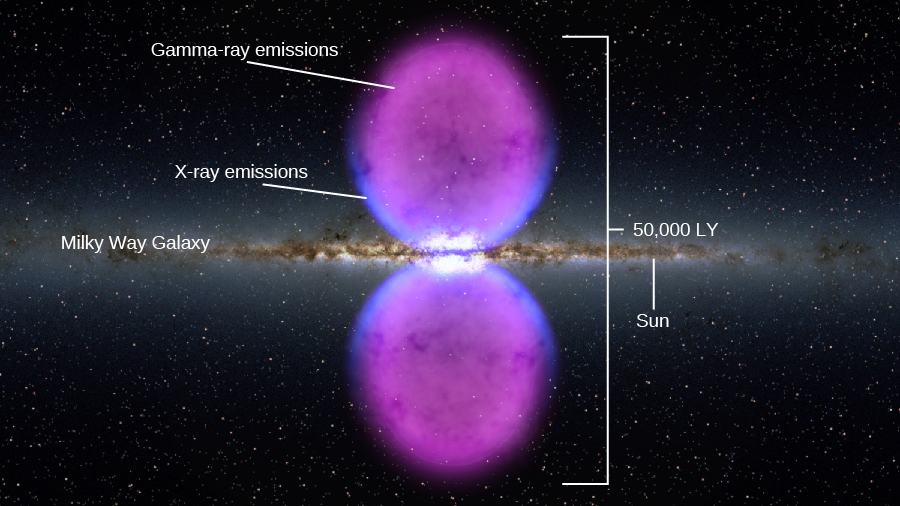
Most black holes don’t show any signs of quasar emission. We call them “quiescent.” But, like sleeping dragons, they can be woken up by being roused with a fresh supply of gas. Our own Milky Way black hole is currently quiescent, but it may have been a quasar just a few million years ago (Figure 27.11). Two giant bubbles that extend 25,000 light-years above and below the galactic center are emitting gamma rays. Were these produced a few million years ago when a significant amount of matter fell into the black hole at the center of the galaxy? Astronomers are still working to understand what remarkable event might have formed these enormous bubbles.
英語のヒント
大半のブラックホールは、クエーサーの放射の兆候を何も示さない。このようなものを「静穏」と呼ぶ。しかし、眠るドラゴンのように、新しいガスを供給して刺激すれば、目を覚ますことがある。天の川銀河のブラックホールはいま静穏だが、わずか数百万年前にはクエーサーだったかもしれない(図27.11)。銀河中心の上と下へ、それぞれ2万5000光年延びる二つの巨大な泡状構造が、ガンマ線を出している。数百万年前、大量の物質が銀河中心のブラックホールへ落ちたときに生じたのだろうか。どのような驚くべき出来事が、この巨大な泡をつくったのか、天文学者は今も解明に取り組んでいる。
Fermi Bubbles in the Galaxy.天の川銀河のフェルミバブル
credit: modification of work by NASA’s Goddard Space Flight Center · NASA media use guidelines
Figure 27.11 Giant bubbles shining in gamma-ray light lie above and below the center of the Milky Way Galaxy, as seen by the Fermi satellite. (The gamma-ray and X-ray image is superimposed on a visible-light image of the inner parts of our Galaxy.) The bubbles may be evidence that the supermassive black hole at the center of our Galaxy was a quasar a few million years ago. (credit: modification of work by NASA’s Goddard Space Flight Center)
図27.11 フェルミ衛星が見た、天の川銀河中心の上下に広がり、ガンマ線で輝く巨大な泡。ガンマ線とX線の画像を、銀河の内側の部分の可視光画像に重ねている。泡は、銀河中心の超大質量ブラックホールが、数百万年前にはクエーサーだった証拠かもしれない。(NASAゴダード宇宙飛行センターの作品を改変。)
The physics required to account for the exact way in which the energy of infalling material is converted to radiation near a black hole is far more complicated than our simple discussion suggests. To understand what happens in the “rough and tumble” region around a massive black hole, astronomers and physicists must resort to computer simulations (and they require supercomputers, fast machines capable of awesome numbers of calculations per second). The details of these models are beyond the scope of our book, but they support the basic description presented here.
英語のヒント
ブラックホールの近くで、落下物質のエネルギーが放射へ変換される正確な仕組みを説明する物理学は、ここまでの単純な説明から受ける印象より、はるかに複雑である。大質量ブラックホールの周りの、激しく入り乱れた領域で何が起きるかを理解するには、天文学者や物理学者はコンピューター・シミュレーションを使わなければならない。しかも、1秒に驚異的な回数の計算ができる高速装置、スーパーコンピューターが必要である。モデルの詳細は本書の範囲を超えるが、ここで述べた基本的な説明を支持している。