第27章活動銀河・クエーサー・超大質量ブラックホールActive Galaxies, Quasars, and Supermassive Black Holes
27.3 Quasars as Probes of Evolution in the Universe27.3 宇宙の進化を探るクエーサー
Learning Objectives学習の目標
By the end of this section, you will be able to:
この節を終えると、次のことができるようになる。
Trace the rise and fall of quasars over cosmic time
宇宙の時間の流れに沿って、クエーサーの増減をたどる。
Describe some of the ways in which galaxies and black holes influence each other’s growth
銀河とブラックホールが、互いの成長に影響する方法をいくつか説明する。
Describe some ways the first black holes may have formed
最初のブラックホールが、どのように形成された可能性があるかを説明する。
Explain why some black holes are not producing quasar emission but rather are quiescent
一部のブラックホールがクエーサーの放射を出さず、静穏な状態にある理由を説明する。
The quasars’ brilliance and large distance make them ideal probes of the far reaches of the universe and its remote past. Recall that when first introducing quasars, we mentioned that they generally tend to be far away. When we see extremely distant objects, we are seeing them as they were long ago. Radiation from a quasar 8 billion light-years away is telling us what that quasar and its environment were like 8 billion years ago, much closer to the time that the galaxy that surrounds it first formed. Astronomers have now detected light emitted from quasars that were already formed only a few hundred million years after the universe began its expansion 13.8 billion years ago. Thus, they give us a remarkable opportunity to learn about the time when large structures were first assembling in the cosmos.
英語のヒント
クエーサーは、明るく、遠くにあるため、宇宙のはるか遠方と遠い過去を探るのに理想的な手段になる。最初に紹介したとき、クエーサーは一般に遠くにある傾向を述べたことを思い出そう。非常に遠い天体を見るとき、私たちは昔の姿を見ている。80億光年離れたクエーサーからの放射は、そのクエーサーと周囲が80億年前にどのようだったかを伝える。それは、周囲の銀河が最初にできた時期に、ずっと近い。天文学者は今や、138億年前に宇宙が膨張を始めてから、わずか数億年後にはすでに形成されていたクエーサーの光も検出している。したがって、クエーサーは、宇宙で大きな構造が初めて集まり始めた時期を学ぶ、すばらしい機会を与える。
The Evolution of Quasarsクエーサーの進化
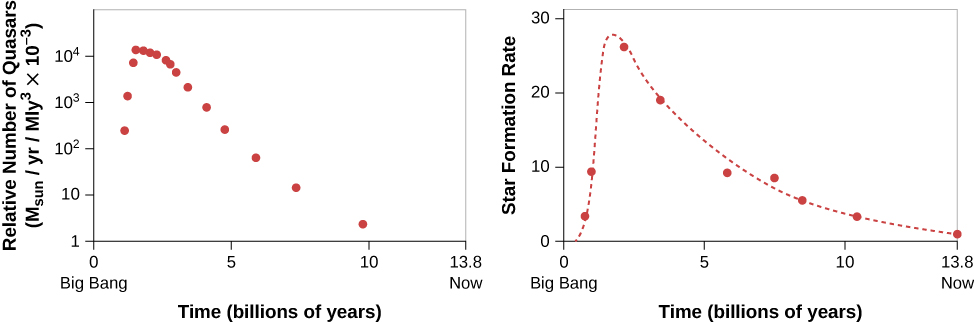
Quasars provide compelling evidence that we live in an evolving universe—one that changes with time. They tell us that astronomers living billions of years ago would have seen a universe that is very different from the universe of today. Counts of the number of quasars at different redshifts (and thus at different times in the evolution of the universe) show us how dramatic these changes are (Figure 27.14). We now know that the number of quasars was greatest at the time when the universe was only 20% of its present age.
英語のヒント
クエーサーは、私たちが、時間とともに変わる、進化する宇宙にいるという有力な証拠を与える。数十億年前に天文学者がいたなら、現在とは非常に違う宇宙を見ただろう、と教えてくれるのである。異なる赤方偏移、したがって宇宙の進化における異なる時代で、クエーサーの数を数えると、その変化の劇的な大きさがわかる(図27.14)。いまでは、宇宙の年齢が現在のわずか20%だった時期に、クエーサーの数が最も多かったとわかっている。
Relative Number of Quasars and Rate at Which Stars Formed as a Function of the Age of the Universe.宇宙の年齢に応じたクエーサーの相対数と星形成率
OpenStax / Rice University · CC BY 4.0
Figure 27.14 An age of 0 on the plots corresponds to the beginning of the universe; an age of 13.8 corresponds to the present time. Both the number of quasars and the rate of star formation were at a peak when the universe was about 20% as old as it is now.
図27.14 グラフの年齢0は宇宙の始まり、13.8は現在に対応する。クエーサーの数も星形成率も、宇宙が現在の約20%の年齢だったころに最大だった。
As you can see, the drop-off in the numbers of quasars as time gets nearer to the present day is quite abrupt. Observations also show that the emission from the accretion disks around the most massive black holes peaks early and then fades. The most powerful quasars are seen only at early times. In order to explain this result, we make use of our model of the energy source of the quasars—namely that quasars are black holes with enough fuel to make a brilliant accretion disk right around them.
英語のヒント
図のように、時間が現在へ近づくにつれて、クエーサーの数は急激に減る。最も大質量のブラックホールを囲む降着円盤の放射も、早い時期に最大となり、その後衰えることが、観測からわかる。最も強力なクエーサーは、初期の時代にしか見られない。この結果を説明するため、クエーサーのエネルギー源のモデルを使おう。すなわち、クエーサーは、すぐ周りに明るい降着円盤をつくるだけの燃料を持つブラックホールだ、というモデルである。
The fact that there were more quasars long ago (far away) than there are today (nearby) could be explained if there was more material available to be accreted by black holes early in the history of the universe. You might say that the quasars were more active when their black holes had fuel for their “energy-producing engines.” If that fuel was mostly consumed in the first few billion years after the universe began its expansion, then later in its life, a “hungry” black hole would have very little left with which to light up the galaxy’s central regions.
英語のヒント
昔、すなわち遠方のクエーサーが、現在、すなわち近傍より多かったことは、宇宙史の初期には、ブラックホールへ降着できる物質が多かったとすれば説明できる。ブラックホールが「エネルギーを生むエンジン」の燃料を持っていた時期には、クエーサーも活発だった、といってもよい。宇宙が膨張を始めた後、最初の数十億年で燃料の大部分が使われたなら、その後の「空腹」のブラックホールには、銀河中心部を輝かせる材料が、ほとんど残っていないだろう。
In other words, if matter in the accretion disk is continually being depleted by falling into the black hole or being blown out from the galaxy in the form of jets, then a quasar can continue to radiate only as long as new gas is available to replenish the accretion disk.
英語のヒント
言い換えれば、降着円盤の物質が、ブラックホールへ落ちたり、ジェットとして銀河の外へ吹き出されたりして、絶えず減っているなら、クエーサーが放射し続けられるのは、円盤を補給する新しいガスが得られる間だけである。
In fact, there was more gas around to be accreted early in the history of the universe. Back then, most gas had not yet collapsed to form stars, so there was more fuel available for both the feeding of black holes and the forming of new stars. Much of that fuel was subsequently consumed in the formation of stars during the first few billion years after the universe began its expansion. Later in its life, a galaxy would have little left to feed a hungry black hole or to form more new stars. As we see from Figure 27.14, both star formation and black hole growth peaked together when the universe was about 2 billion years old. Ever since, both have been in sharp decline. We are late to the party of the galaxies and have missed some of the early excitement.
英語のヒント
実際、宇宙史の初期には、降着に使えるガスがもっと多かった。当時、大半のガスはまだ崩壊して恒星になっていなかったため、ブラックホールへの供給にも、新しい星の形成にも使える燃料が豊富だった。その多くは、その後、宇宙が膨張を始めてから最初の数十億年の星形成で消費された。後の時代の銀河には、空腹のブラックホールへ与えたり、さらに新しい星をつくったりする材料が、ほとんど残っていないだろう。図27.14に見るように、星形成とブラックホールの成長は、ともに宇宙の年齢が約20億年のときに最大となった。それ以来、どちらも急激に減少している。私たちは銀河のパーティーに遅れて来て、初期の盛り上がりを一部見逃したのである。
Observations of nearer galaxies (seen later in time) indicate that there is another source of fuel for the central black holes—the collision of galaxies. If two galaxies of similar mass collide and merge, or if a smaller galaxy is pulled into a larger one, then gas and dust from one may come close enough to the black hole in the other to be devoured by it and so provide the necessary fuel. Astronomers have found that collisions were also much more common early in the history of the universe than they are today. There were more small galaxies in those early times because over time, as we shall see (in The Evolution and Distribution of Galaxies), small galaxies tend to combine into larger ones. Again, this means that we would expect to see more quasars long ago (far away) than we do today (nearby)—as we in fact do.
英語のヒント
近くの、したがって後の時代の姿が見える銀河の観測は、中心ブラックホールの燃料に別の供給源があることを示す。銀河の衝突である。同程度の質量の二つの銀河が衝突・合体したり、小さい銀河が大きい銀河へ引き込まれたりすれば、一方のガスや塵が、もう一方のブラックホールに飲み込まれるほど近づき、必要な燃料を供給できる。天文学者は、衝突も、現在より宇宙史の初期にはるかに多かったと見いだした。その時代には小さい銀河が多かった。「銀河の進化と分布」で見るように、小さい銀河は時間とともに合体して、大きくなる傾向があるからである。したがって、この点からも、昔、すなわち遠方には、現在の近傍より多くのクエーサーを期待する。そして実際に、そのとおり観測している。