第23章恒星の死The Death of Stars
White Dwarfs白色矮星
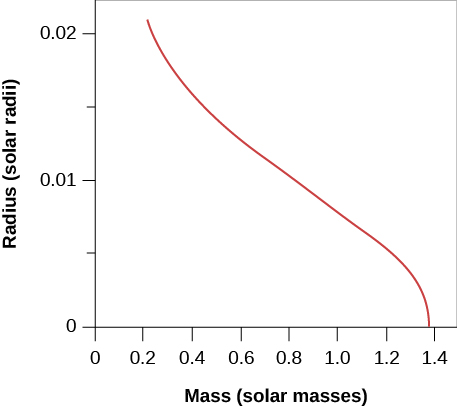
White dwarfs, then, are stable, compact objects with electron-degenerate cores that cannot contract any further. Calculations showing that white dwarfs are the likely end state of low-mass stars were first carried out by the Indian-American astrophysicist Subrahmanyan Chandrasekhar. He was able to show how much a star will shrink before the degenerate electrons halt its further contraction and hence what its final diameter will be (Figure 23.2).
英語のヒント
したがって白色矮星は、電子が縮退した、これ以上収縮できない中心核を持つ、安定した小さく密な天体である。白色矮星が低質量星の最終的な姿になると考えられることを、初めて計算で示したのは、インド出身のアメリカの天体物理学者、スブラマニアン・チャンドラセカールだった。彼は、縮退した電子がそれ以上の収縮を止めるまでに星がどれほど小さくなるか、したがって最終的な直径がどれほどになるかを示した(図23.2)。
When Chandrasekhar made his calculation about white dwarfs, he found something very surprising: the radius of a white dwarf shrinks as the mass in the star increases (the larger the mass, the more tightly packed the electrons can become, resulting in a smaller radius). According to the best theoretical models, a white dwarf with a mass of about 1.4 MSun or larger would have a radius of zero. What the calculations are telling us is that even the force of degenerate electrons cannot stop the collapse of a star with more mass than this. The maximum mass that a star can end its life with and still become a white dwarf—1.4 MSun—is called the Chandrasekhar limit. Stars with end-of-life masses that exceed this limit have a different kind of end in store—one that we will explore in the next section.
英語のヒント
白色矮星を計算したチャンドラセカールは、非常に意外なことに気づいた。星の質量が増すほど、白色矮星の半径は小さくなるのである。質量が大きいほど電子はより密に詰め込まれ、その結果、半径が小さくなる。最も優れた理論モデルによると、質量が約1.4 MSun以上の白色矮星の半径は、ゼロになってしまう。計算が示しているのは、この値を超える質量を持つ星では、縮退した電子の力でも崩壊を止められない、ということである。星が一生を終えるときに、なお白色矮星になれる最大の質量、1.4 MSunを、チャンドラセカール限界という。最期の質量がこの限界を超える星には、別の結末が待っている。次の節では、その結末を見ていこう。
Relating Masses and Radii of White Dwarfs.白色矮星の質量と半径の関係。
OpenStax / Rice University · CC BY 4.0
Figure 23.2 Models of white-dwarf structure predict that as the mass of the star increases (toward the right), its radius gets smaller and smaller.
図23.2 白色矮星の構造モデルによると、星の質量が大きくなるほど〈右へ進むほど〉、半径は小さくなる。
The Ultimate Fate of White Dwarfs白色矮星の究極の運命
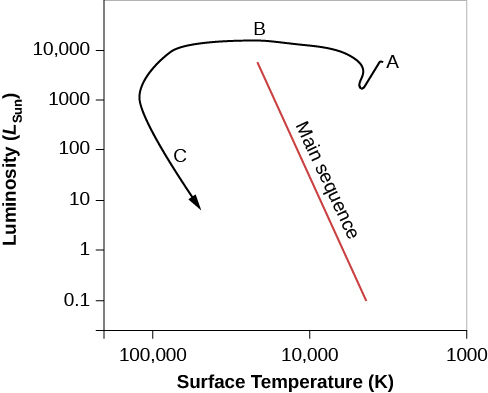
If the birth of a main-sequence star is defined by the onset of fusion reactions, then we must consider the end of all fusion reactions to be the time of a star’s death. As the core is stabilized by degeneracy pressure, a last shudder of fusion passes through the outside of the star, consuming the little hydrogen still remaining. Now the star is a true white dwarf: nuclear fusion in its interior has ceased. Figure 23.4 shows the path of a star like the Sun on the H–R diagram during its final stages.
英語のヒント
主系列星の誕生を核融合反応の始まりと定めるなら、すべての核融合反応が終わるときを、星の死と考える必要がある。縮退圧によって中心核が安定すると、最後の核融合の震えが星の外側を通り、わずかに残った水素を消費する。これで星は本当の白色矮星となり、内部の核融合は止まる。図23.4は、太陽のような星が一生の最後の段階でたどる、HR図上の経路を示している。
Evolutionary Track for a Star Like the Sun.太陽のような星の進化トラック。
OpenStax / Rice University · CC BY 4.0
Figure 23.4 This diagram shows the changes in luminosity and surface temperature for a star with a mass like the Sun’s as it nears the end of its life. After the star becomes a giant again (point A on the diagram), it will lose more and more mass as its core begins to collapse. The mass loss will expose the hot inner core, which will appear at the center of a planetary nebula. In this stage, the star moves across the diagram to the left as it becomes hotter and hotter during its collapse (point B). At first, the luminosity remains nearly constant, but as the star begins to cool off, it becomes less and less bright (point C). It is now a white dwarf and will continue to cool slowly for billions of years until all of its remaining store of energy is radiated away. (This assumes the Sun will lose between 46–50% of its mass during the giant stages, based upon various theoretical models).
図23.4 太陽ほどの質量を持つ星が、一生の終わりに近づいたときの光度と表面温度の変化を示す図。再び巨星になると〈図の点A〉、中心核が崩壊し始め、星はさらに多くの質量を失う。その結果、高温の内部の中心核が露出し、惑星状星雲の中心に姿を見せる。この段階では、崩壊とともに星はますます高温になり、図上を左へ移動する〈点B〉。初めは光度がほぼ一定のままだが、冷え始めると次第に暗くなる〈点C〉。星は今や白色矮星であり、残されたエネルギーの蓄えをすべて放射してしまうまで、数十億年にわたってゆっくり冷え続ける。(さまざまな理論モデルに基づき、太陽が巨星の段階で質量の46~50%を失うと仮定している。)
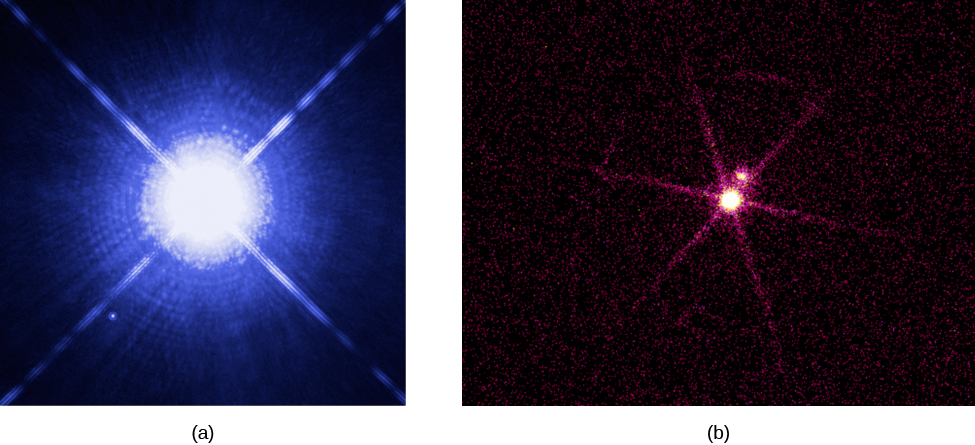
Since a stable white dwarf can no longer contract or produce energy through fusion, its only energy source is the heat represented by the motions of the atomic nuclei in its interior. The light it emits comes from this internal stored heat, which is substantial. Gradually, however, the white dwarf radiates away all its heat into space. After many billions of years, the nuclei will be moving much more slowly, and the white dwarf will no longer shine (Figure 23.5). It will then be a black dwarf—a cold stellar corpse with the mass of a star and the size of a planet. It will be composed mostly of carbon, oxygen, and neon, the products of the most advanced fusion reactions of which the star was capable.
英語のヒント
安定した白色矮星は、もはや収縮も核融合によるエネルギー生成もできない。そのため、唯一のエネルギー源は、内部の原子核の運動という形で蓄えられた熱である。白色矮星が放つ光は、この大量の内部の蓄熱から来ている。しかし白色矮星は、少しずつすべての熱を宇宙へ放射していく。何十億年もたつと、原子核の動きはずっと遅くなり、白色矮星は輝かなくなる(図23.5)。そのときには、恒星の質量と惑星の大きさを持つ冷たい星の残骸、黒色矮星となっている。その主成分は炭素、酸素、ネオンであり、その星に可能だった最も先の段階の核融合反応によってできたものである。
Visible Light and X-Ray Images of the Sirius Star System.シリウス連星系の可視光画像とX線画像。
credit a: modification of work by NASA, ESA, H. Bond, M. Barstow(University of Leicester); credit b: modification of work by NASA/SAO/CXC · NASA/SAO media use
Figure 23.5 (a) This image taken by the Hubble Space Telescope shows Sirius A (the large bright star), and its companion star, the white dwarf known as Sirius B (the tiny, faint star at the lower left). Sirius A and B are 8.6 light-years from Earth and are our fifth-closest star system. Note that the image has intentionally been overexposed to allow us to see Sirius B. (b) The same system is shown in X-ray taken with the Chandra Space Telescope. Note that Sirius A is fainter in X-rays than the hot white dwarf that is Sirius B. (credit a: modification of work by NASA, ESA, H. Bond, M. Barstow(University of Leicester); credit b: modification of work by NASA/SAO/CXC)
図23.5 〈a〉ハッブル宇宙望遠鏡の画像。大きく明るい星がシリウスAで、左下の小さく暗い星が、その伴星である白色矮星シリウスB。地球から8.6光年離れており、私たちから5番目に近い恒星系である。シリウスBが見えるように、意図的に露出オーバーにしてある。〈b〉チャンドラ宇宙望遠鏡が撮影した、同じ恒星系のX線画像。X線では、シリウスAは高温の白色矮星シリウスBより暗い。(出典a:NASA、ESA、H. Bond、M. Barstow〈レスター大学〉の作品を改変。出典b:NASA/SAO/CXCの作品を改変)
We have one final surprise as we leave our low-mass star in the stellar graveyard. Calculations show that as a degenerate star cools, the atoms inside it in essence “solidify” into a giant, highly compact lattice (organized rows of atoms, just like in a crystal). When carbon is compressed and crystallized in this way, it becomes a giant diamond-like star. A white dwarf star might make the most impressive engagement present you could ever see, although any attempt to mine the diamond-like material inside would crush an ardent lover instantly!
英語のヒント
低質量星を星の墓場に残して去る前に、最後の驚きを紹介しよう。計算によると、縮退した星が冷えるにつれ、内部の原子は、巨大で非常に密な格子へと、いわば『固まる』。格子とは、結晶と同じように原子が規則正しく並んだものである。炭素がこのように圧縮されて結晶化すると、巨大なダイヤモンドのような星になる。白色矮星は、考え得る限り最も印象的な婚約の贈り物になるかもしれない。もっとも、内部のダイヤモンドのような物質を掘り出そうとすれば、熱烈な恋人も一瞬で押しつぶされてしまうだろう。